




About this worksheet
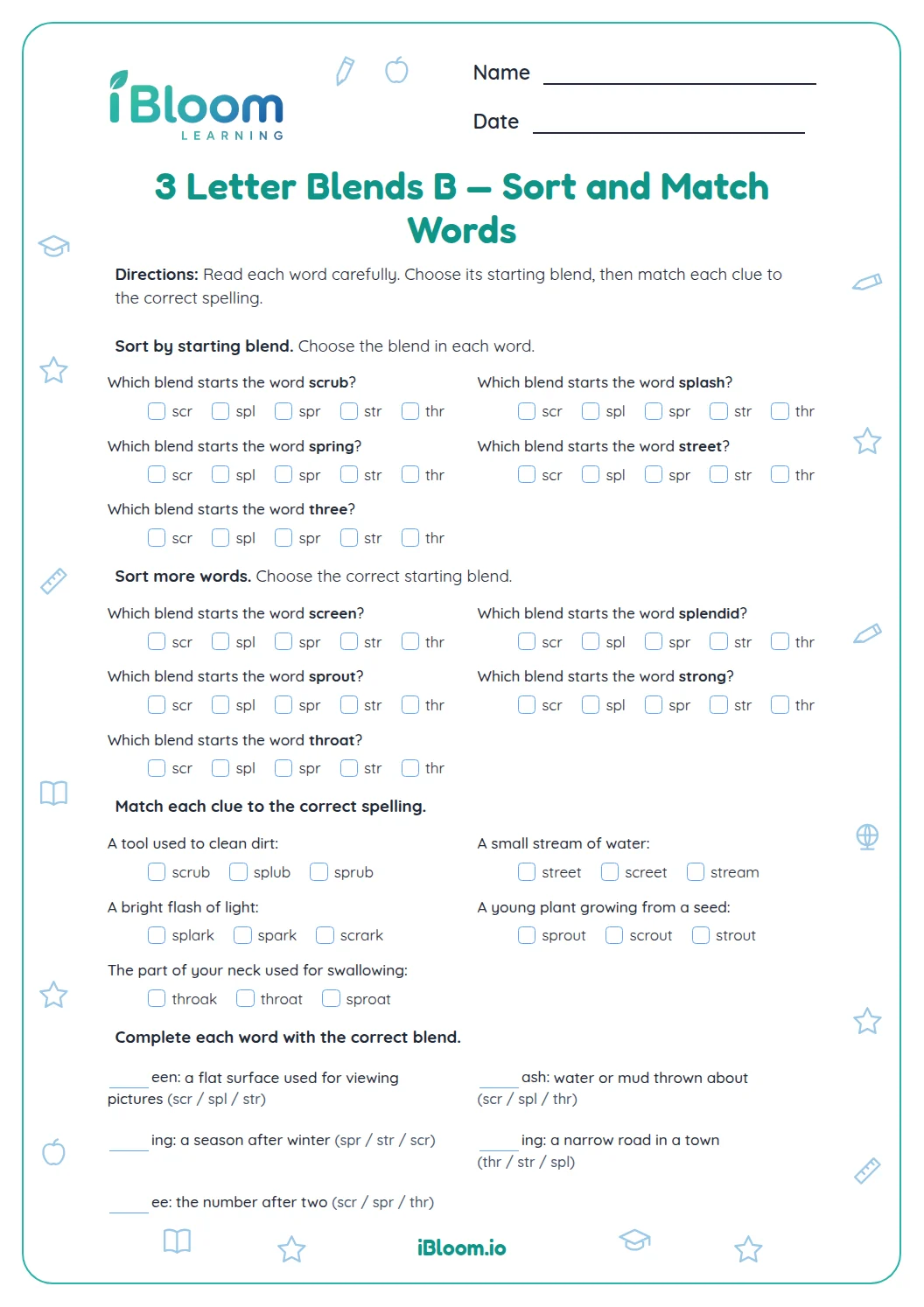
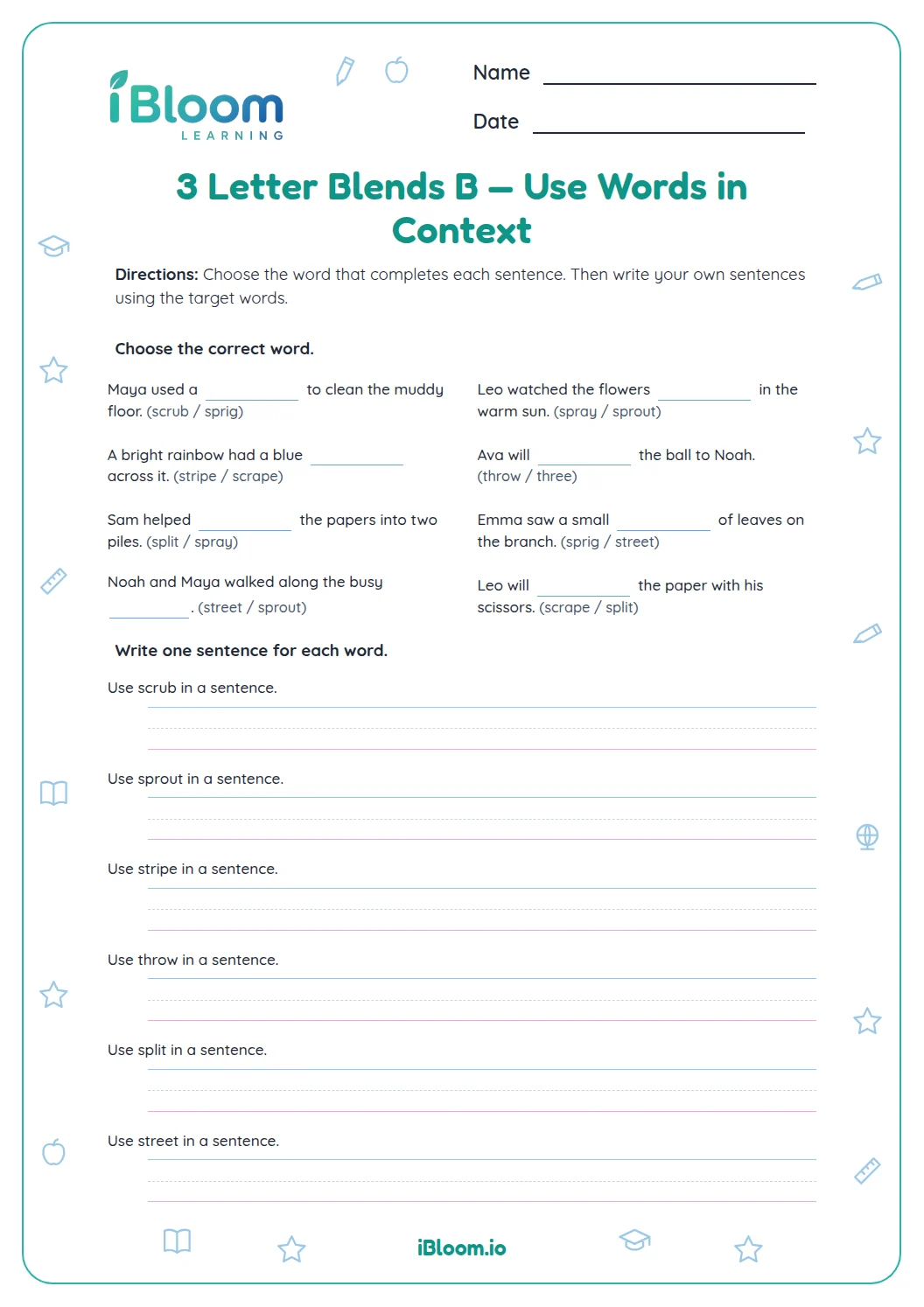
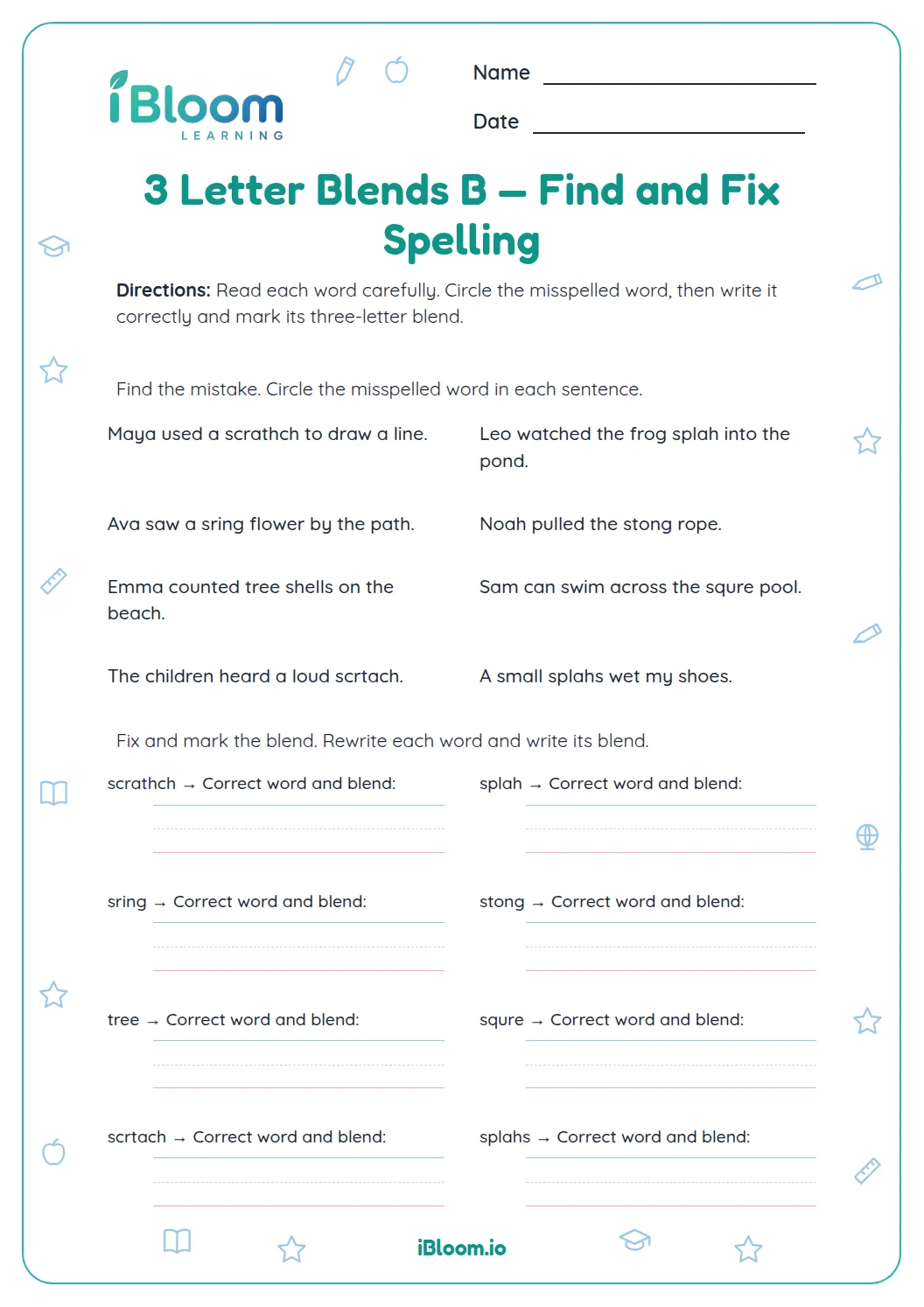
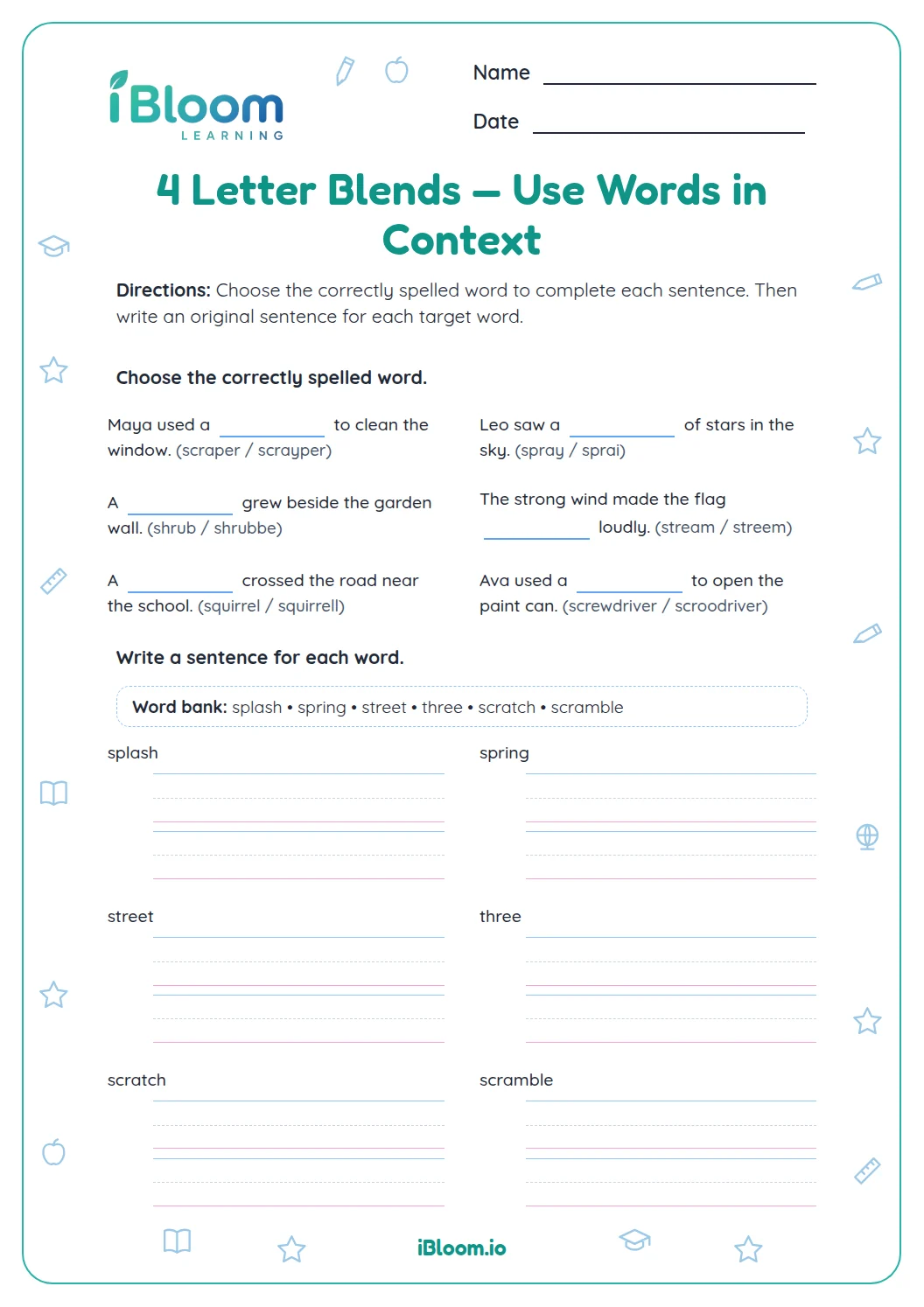
This Grade 3 spelling worksheet practices three-letter consonant blends in word beginnings. Part A asks children to complete eight words from meaning clues, including strip, splash, spring, scratch, strong, thrill, shrimp, and scream. Part B asks them to recognize each blend in a whole word. The page practices Common Core L.3.2f: using spelling patterns and generalizations when writing words. The answer key gives the missing blends and selected words.
Aligned to L.3.2f
How can children complete a three-letter blend?
A consonant blend keeps each consonant sound audible. In a word such as strip, /s/, /t/, and /r/ can each be heard at the beginning. The first eight questions ask for the letters that complete a word clue.
The word clue narrows the spelling: “a narrow strip” points to strip, so the missing beginning is str.
How can students check a blend in a whole word?
Read the whole choice aloud and listen to its first three sounds. Splash begins with spl; spring begins with spr. Similar-looking choices make it useful to check all three consonants.
- 1Which word begins with spl?
- 2Compare splash, stripe, and shrimp.
- 3Splash starts with s, p, l.
- 4Answer: splash
What does this page practice?
Part A completes eight words with str, spl, spr, scr, thr, or shr. Part B identifies a word that begins with each named blend. The two parts move from supplying the spelling to checking it in a complete word.
How to use this worksheet at home or in class
- 1Say the target word aloud and stretch its first sounds.
- 2Read the meaning clue before filling in letters.
- 3Write only the missing beginning blend in Part A.
- 4For Part B, say the first three sounds of each choice.
- 5Check each spelling against the answer key and correct the blend.
Common mistakes and quick fixes
The mistake
Leaving out the middle consonant in a blend, such as writing “sip” for strip.
The fix
Stretch the word slowly and listen for /s/, /t/, and /r/ before writing.
The mistake
Choosing a word because it shares the first letter, such as stripe for spl.
The fix
Check the second and third consonants too: spl must be s-p-l.
The mistake
Writing the whole word when the blank asks for the blend.
The fix
Use the printed ending as a guide and add only the three missing letters.
Common Core alignment
This printable gives students focused practice with the listed English language arts skill.
Use spelling patterns and generalizations when writing words.
On this sheet: Students supply and recognize the three-letter beginning blends str, spl, spr, scr, thr, and shr in complete words.
Show the official wordingHide the official wording
Use spelling patterns and generalizations (e.g., word families, position-based spellings, syllable patterns, ending rules, meaningful word parts) in writing words.
What to practice next
Make more practice
Questions parents and teachers ask
What is a three-letter blend?
It is a group of three consonants at the beginning of a word where each sound can still be heard. This sheet practices str, spl, spr, scr, thr, and shr, and asks children to listen for each sound before writing the letters.
How many questions are on the worksheet?
There are 14 questions: eight missing-blend completions and six word choices. Children first supply the blend from a meaning clue, then recognize the blend in a complete word. The answer key lists each expected response. Ask the student to point to the exact word or event that supports the response, then explain the connection in their own words.
How should my child use the answer key?
Have your child read each word aloud and compare all three beginning consonants. If one sound is missing, rewrite the blend and say the word again. The key is useful for checking the exact three-letter spelling. Ask the student to point to the exact word or event that supports the response, then explain the connection in their own words.
Why are there several similar words in Part B?
The choices share some beginning sounds, so students need to listen through all three consonants. Reading every option aloud helps distinguish str from spr or spl before choosing the word. Ask the student to point to the exact word or event that supports the response, then explain the connection in their own words.