









About this worksheet
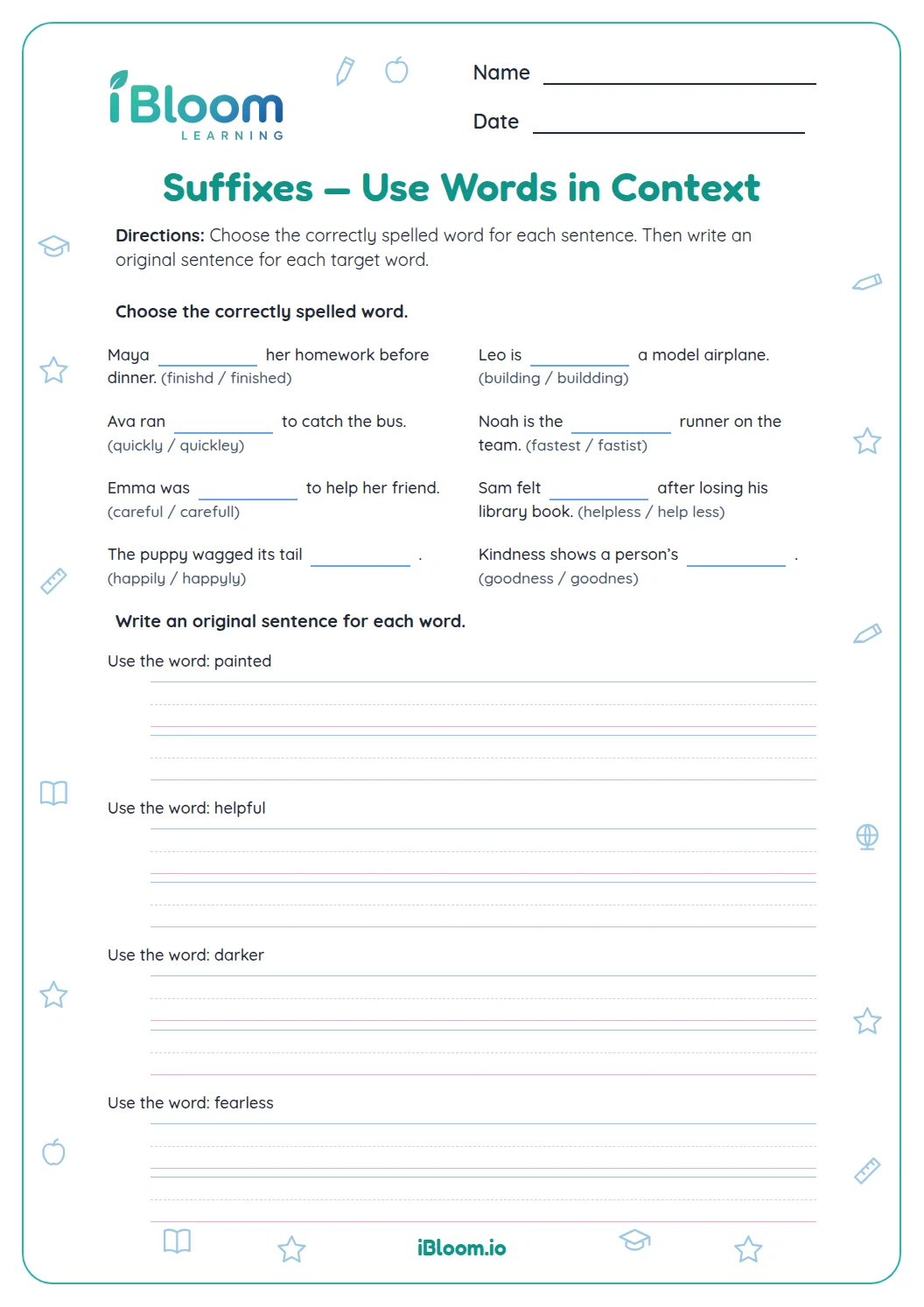
This Grade 4 spelling worksheet reviews common suffixes and the spelling changes that happen when they are added. Children build words such as hopeful and happiness, correct two suffix errors, and use suffix words in context. Sixteen questions are grouped into four parts, followed by a separate answer key. It aligns with CCSS 4.L.2.d: spelling grade-appropriate words correctly.
Aligned to L.4.2.d
How do suffixes make new words?
A suffix adds meaning at the end of a base word. Hopeful means full of hope; careless means without care. Say the new word and check how it is spelled.
- 1hope + -ful
- 2hopeful
When does the spelling change?
Some base words change before the suffix is added. With a consonant plus y, change y to i before -ness: happy becomes happiness. Keep the y before -ly in easy + -ly: easily.
How does context help with suffix words?
A sentence gives a new word a clear meaning. “The joyful music made us dance” shows that joyful describes a happy feeling. Part C asks children to use words this way.
What is in the review?
Part A builds eight words, Part B checks one spelling choice, Part C checks a spelling choice and two sentence uses, and Part D applies four more suffix patterns.
How to use this worksheet
- 1Read the base word and suffix aloud.
- 2Write the new word, watching for a spelling change.
- 3For choice items, compare the whole word letter by letter.
- 4In Part C, choose the correct spelling and sentence; then use the answer key to check.
- 5Use the answer key to check spelling and discuss any correction.
Mistakes to watch for
The mistake
Leaving the y in happy + -ness.
The fix
Change consonant + y to i before -ness: happiness.
The mistake
Adding an extra l in care + -ful.
The fix
The base care already ends in e; add -ful once to make careful.
The mistake
Changing the final e incorrectly in hope + -ful.
The fix
Keep the e before -ful: hopeful. Some suffixes cause changes, but this one does not.
Common Core alignment
This worksheet practices the following Common Core skills.
Spell each suffix word correctly, including common spelling changes.
On this sheet: Children spell grade-level words formed with familiar suffixes.
Show the official wordingHide the official wording
Spell grade-appropriate words correctly, consulting references as needed.
What to practice next
Make more practice
Further reading
Questions parents and teachers ask
What is a suffix?
A suffix is a group of letters added to the end of a base word to make a related word. In this worksheet, -ful changes hope to hopeful and -less changes care to careless. Children practice spelling the new words as well as recognizing their meanings.
Why does happy become happiness?
When a base word ends in a consonant plus y, change y to i before adding -ness. So happy + -ness becomes happiness. The worksheet includes this pattern as a spelling choice, then asks children to apply other suffix rules.
How can I check a suffix spelling?
Read the base word, name the suffix, and look for a spelling change before writing the whole word. The answer key lists the correct spelling for each fixed-answer item. For sentence choices, check that the target word fits the meaning and grammar of the sentence.
How many suffix patterns are practiced?
The 16 questions cover -ful, -less, -ness, -ly, -ment, -able, -er, and -ing. Some questions ask children to form words, while others focus on a spelling choice, a correction, or sentence meaning. This gives the learner a chance to explain the spelling pattern in their own words.
Does the sheet include an answer key?
Yes. The separate key page gives the correct spelling for each fixed-answer question and sample responses for the sentence prompts. Children can compare their sentence with the sample and check whether the suffix word is used meaningfully. This gives the learner a chance to explain the spelling pattern in their own words.