





About this worksheet
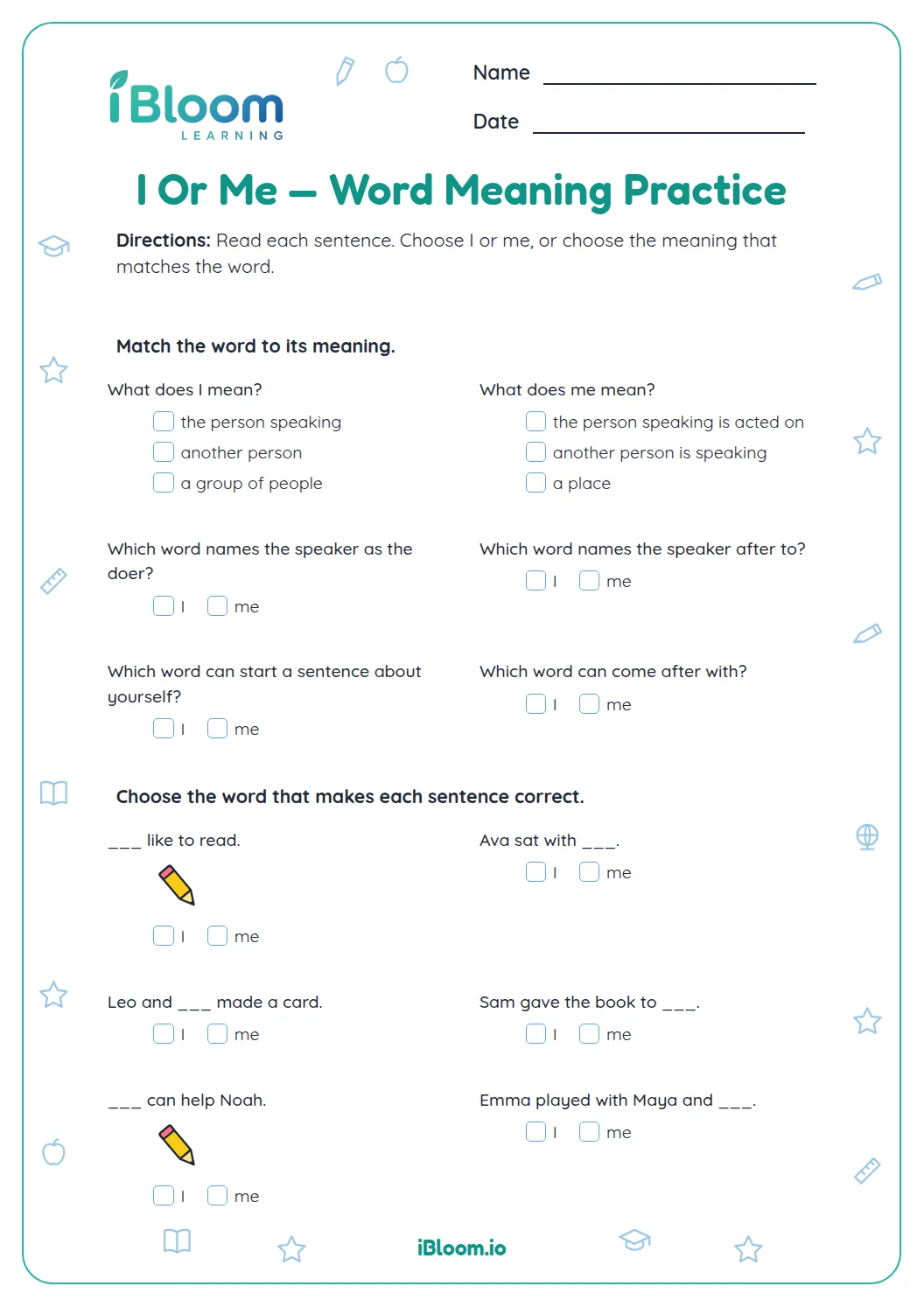
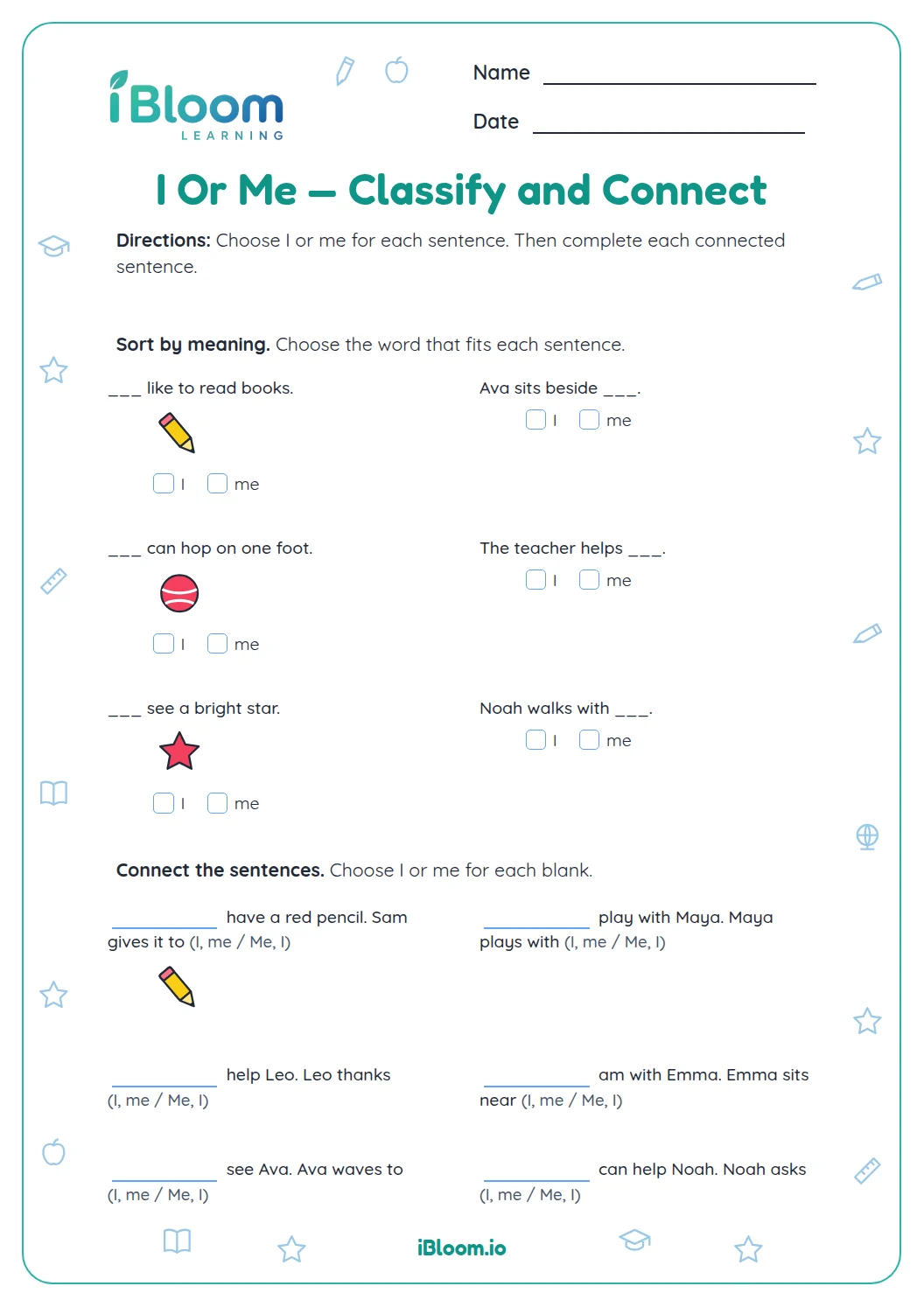
This free Grade 1 worksheet gives students 16 chances to choose I or me in a sentence. Students use I when the pronoun is doing the action, as in “I see a red kite,” and me after a verb or preposition, as in “The teacher sat beside me.” Three short parts move from choosing in context to reading full sentences. The answer key lists each choice. The practice aligns with CCSS L.1.1.d.
Aligned to L.1.1.d
How can students tell when to use I?
Use I when the pronoun is the one doing the action. In “Dad and I made a card,” both Dad and I are makers. Read the whole sentence to hear who is doing what.
Why does “Please save a seat for me” use me?
The word for is a preposition, and me follows it. Me also follows many action verbs when the person receives the action, as in “The teacher sat beside me.”
- 1Please save a seat for ___. → me
- 2The pronoun follows the preposition for.
What changes in the final part?
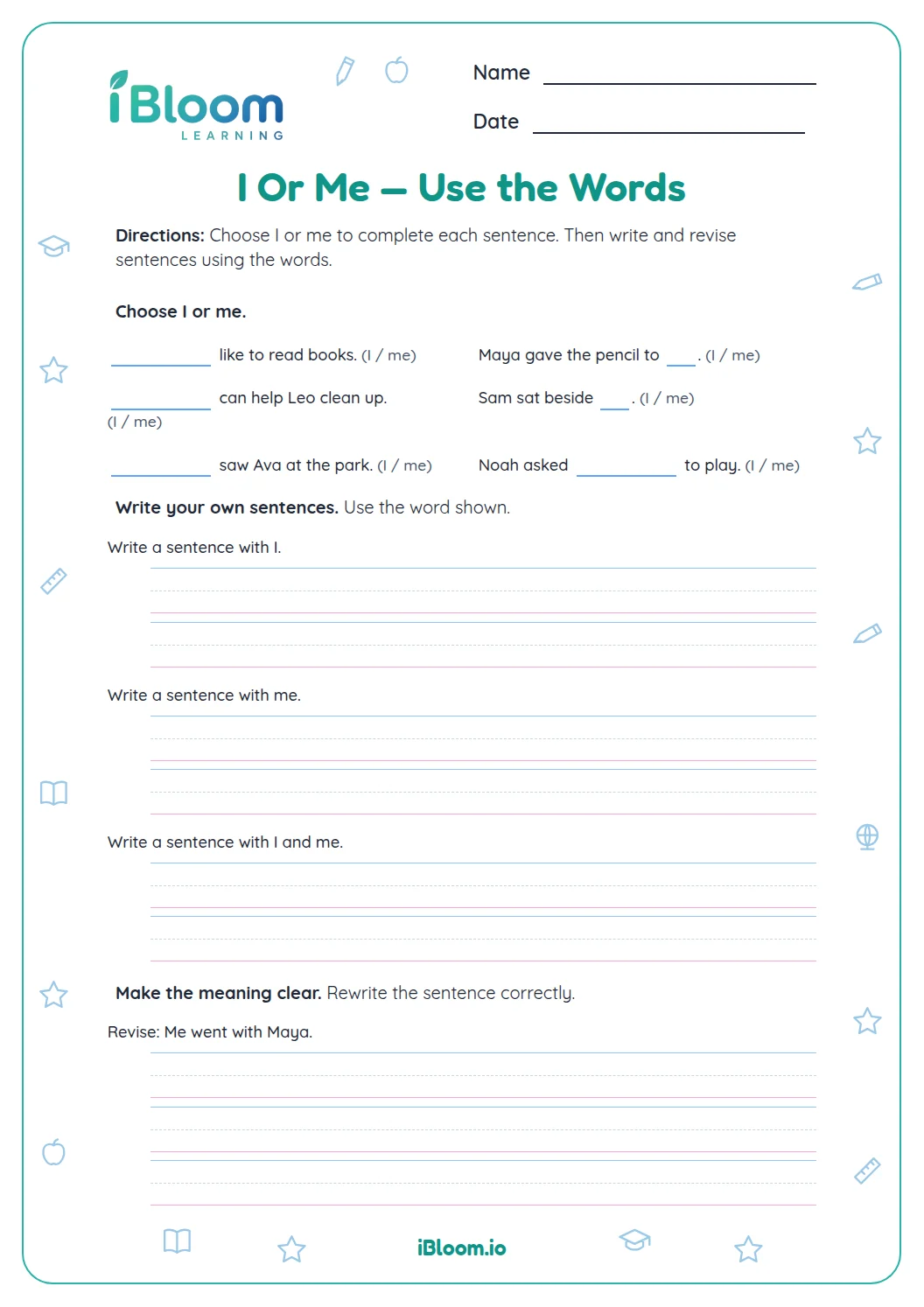
The last part asks students to read each whole sentence and choose I or me. They will see both subject examples, such as “I and Ben planted seeds,” and object examples, such as “The nurse spoke to me.”
How to use this worksheet
- 1Read the full sentence, including the words before and after the blank.
- 2Ask who is doing the action; use I for that person.
- 3Use me after a preposition or when someone receives the action.
- 4Say the completed sentence aloud to check that it sounds right.
- 5Check each choice with the answer key.
Common mistakes and quick fixes
The mistake
Choosing me as the subject of an action.
The fix
Ask who is doing the action; use I for the doer.
The mistake
Using I after to, for, with or beside.
The fix
Use me after these prepositions: “with me,” “for me.”
The mistake
Choosing from the nearest noun without reading the sentence.
The fix
Read the whole sentence to see the pronoun’s job.
Common Core alignment
This activity practices a skill named in the Common Core standards.
Use personal, possessive and indefinite pronouns.
On this sheet: Students choose I or me based on each pronoun’s job in a sentence.
Show the official wordingHide the official wording
Use personal, possessive, and indefinite pronouns (e.g., I, me, my; they, them, their, anyone, everything).
What to practice next
Make more practice
Further reading
Questions parents and teachers ask
What is the difference between I and me?
I names the person doing an action, as in “I can carry the bag.” Me names the person receiving an action or following a preposition, as in “The teacher sat beside me.” The examples include pronouns at the start and end of a sentence.
How many practice items are on the page?
The worksheet includes 16 multiple-choice sentences in three parts. Students choose I or me, using the sentence to decide whether the pronoun is a subject or an object. The second part also includes pronouns after verbs and prepositions. Read each sentence carefully and use its meaning as the clue.
Why is the answer “me” in “Please save a seat for me”?
Me follows the preposition for in this sentence. A useful check is to notice the word before the blank: after a preposition such as for, to, with or beside, choose me. The phrase for me shows how a preposition can cue the object form.
What does the answer key include?
The key gives the correct I or me choice for every sentence. Students can read the completed sentence aloud and check whether the pronoun matches the person doing or receiving the action. The sentence itself gives enough context to choose between the two options.
How long does this worksheet take?
Plan for about 10 minutes. The sentences are short, so students can focus on the pronoun’s role, read each completed sentence aloud and check their choices with the key. Every item offers just I and me as the possible choices.
Which standard is practiced?
This page aligns with CCSS L.1.1.d, which names personal pronouns including I and me. Students choose between the two forms based on how each pronoun functions in a sentence. The sentence examples use the two personal pronouns named in the page title.