
About this worksheet
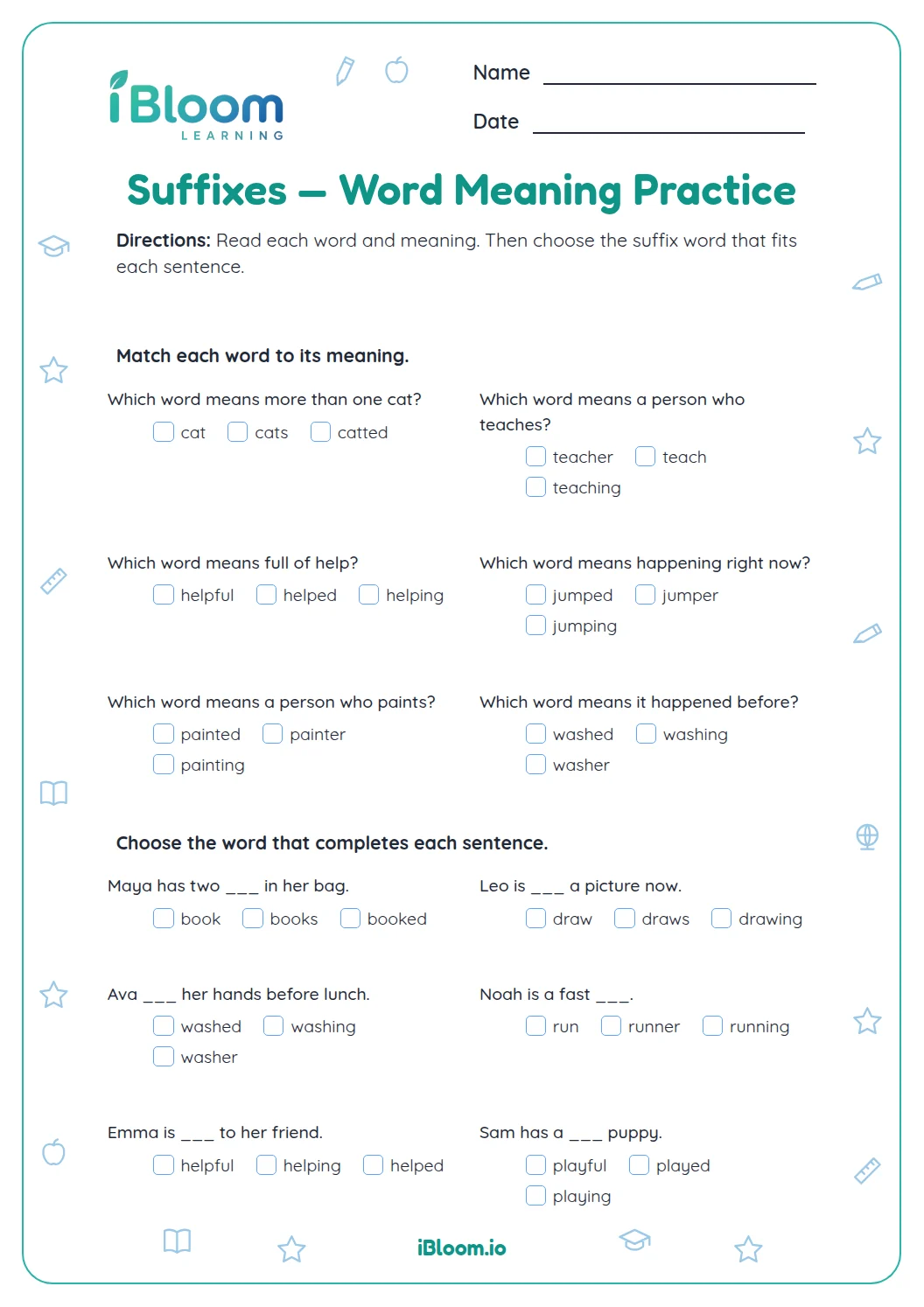
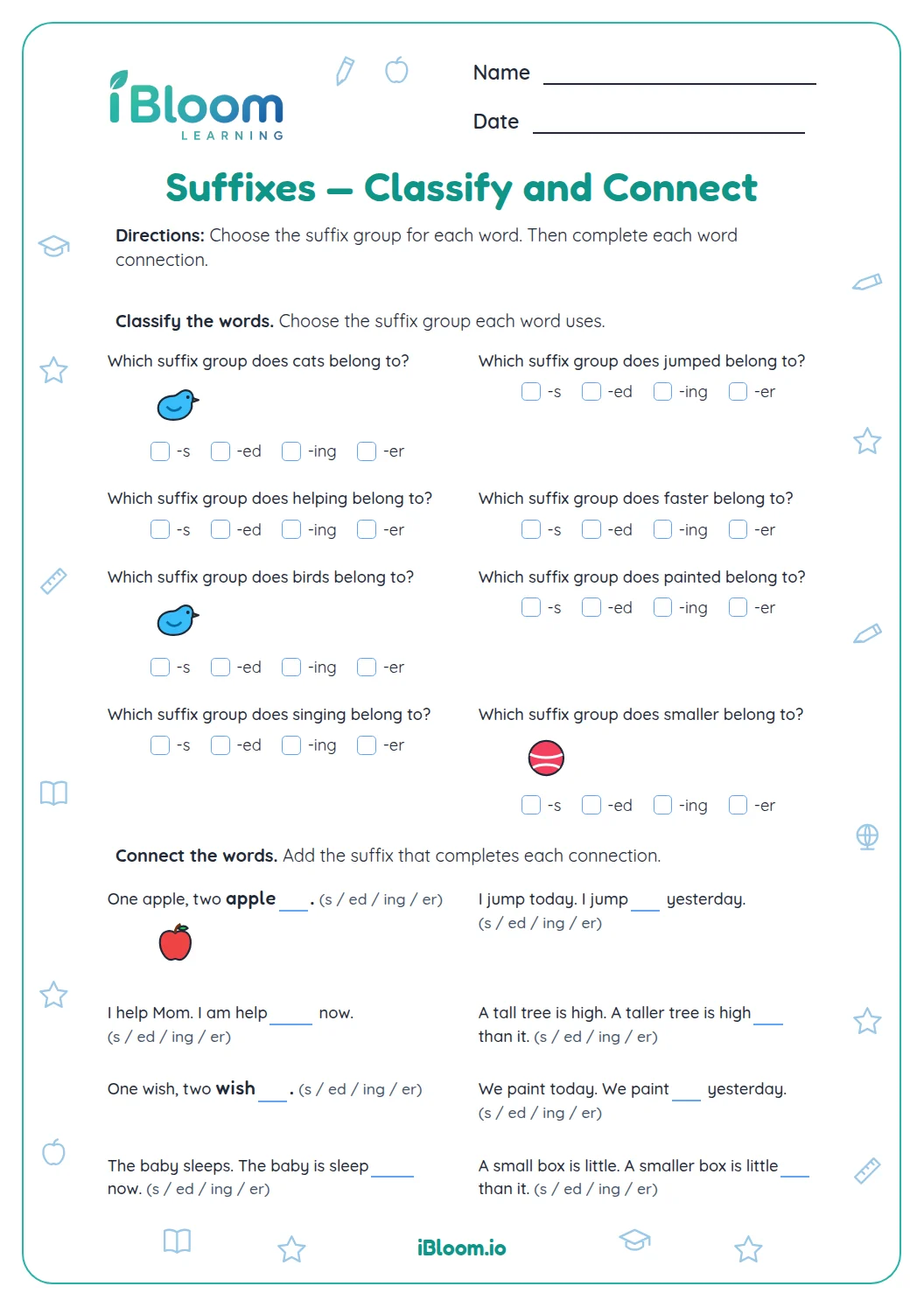
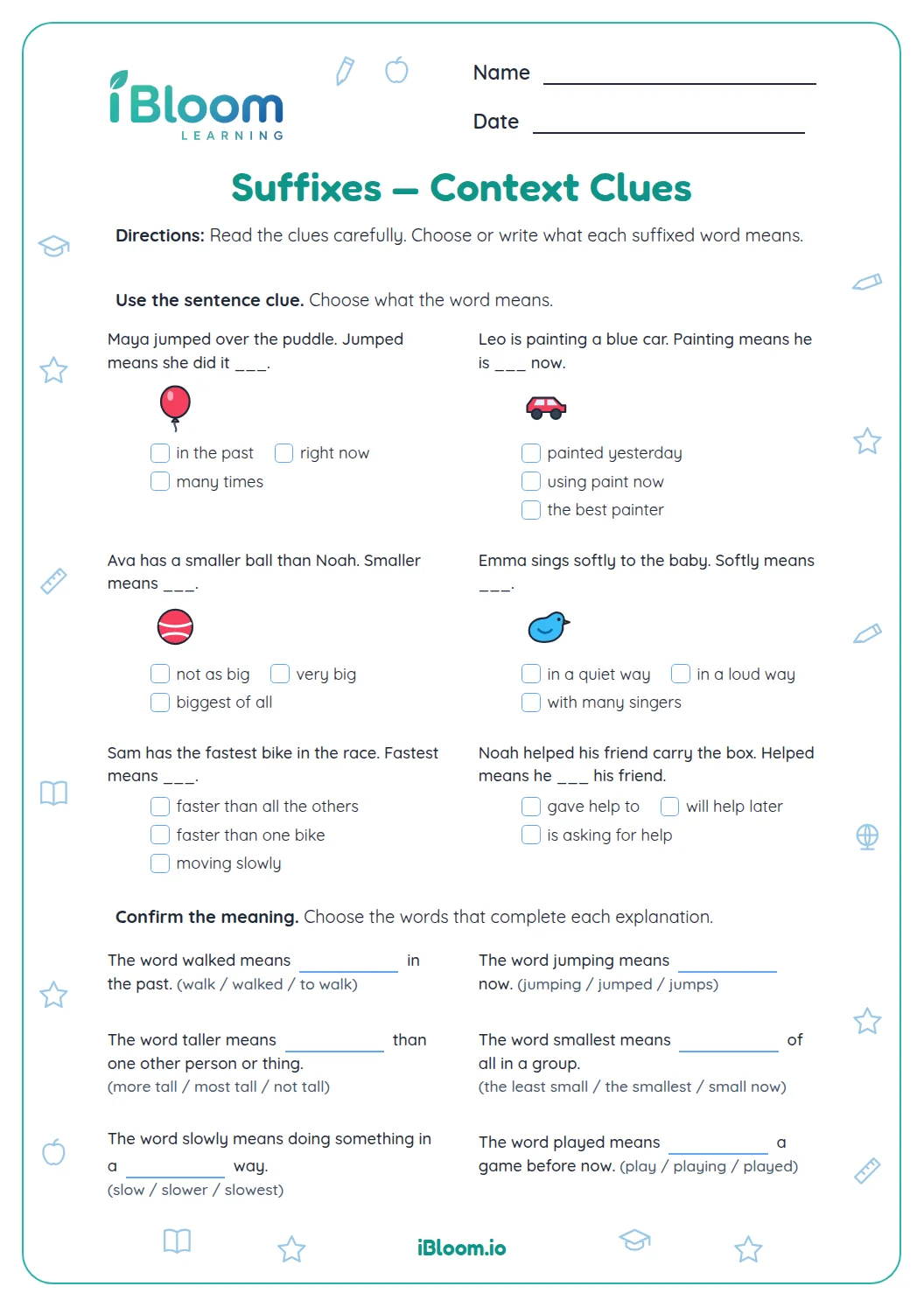
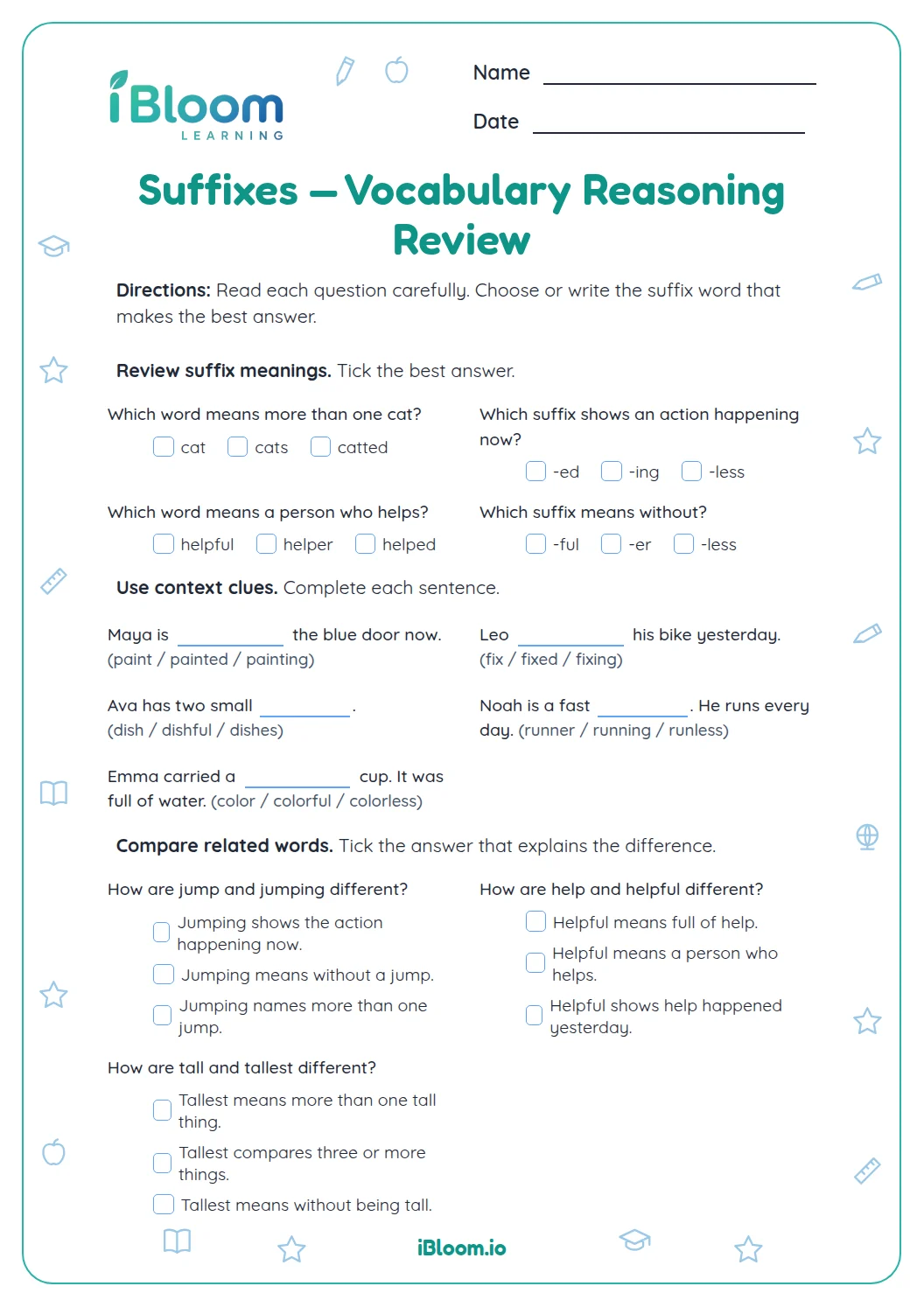
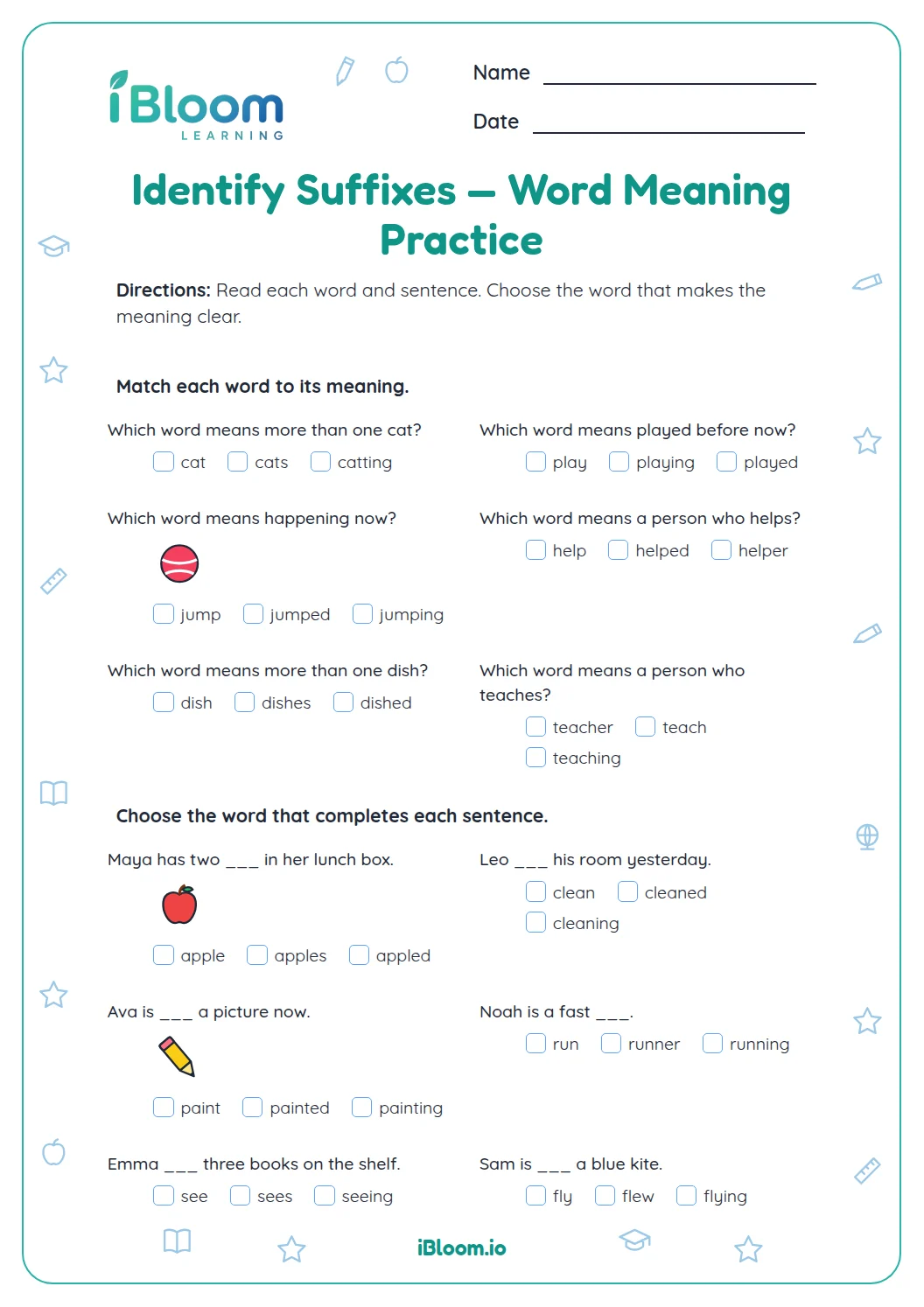
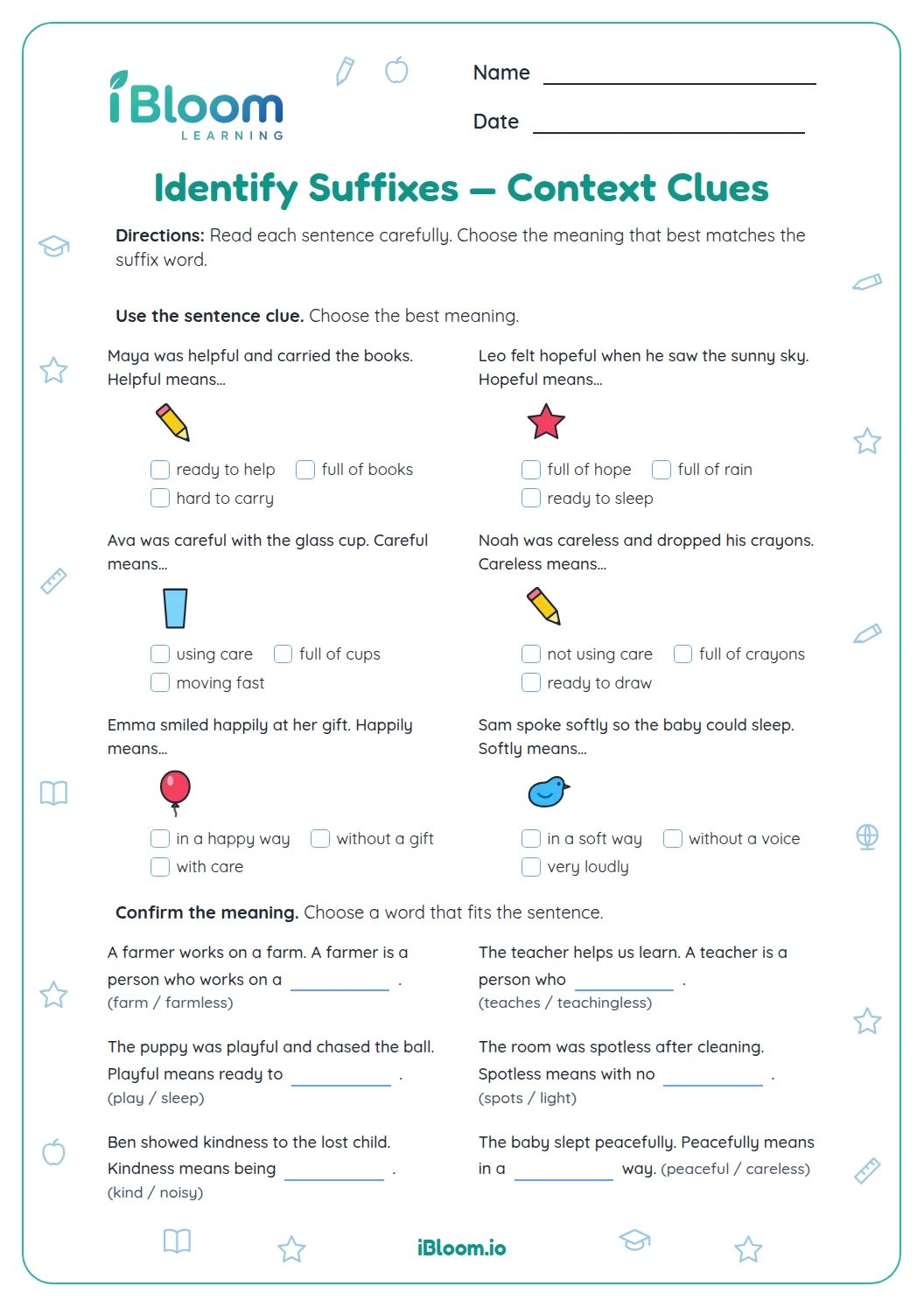
This Grade 1 worksheet helps children read common suffixes in context and build familiar words. Students choose words by meaning, complete sentences, make words with -ful, -less, and -ly, and write two original sentences.
Aligned to L.1.4.b
How does a suffix change a word?
A suffix is a word part added to the end of a base word. The suffix -ful often means “full of,” -less means “without,” and -ly can tell how an action happens.
Add -ful to help to make helpful. Add -less to fear to make fearless. Add -ly to slow to make slowly. Read the whole sentence to check whether the new word makes sense.
What will children practice?
The 14 questions move from word meanings to building words and choosing a suffix word in context. The last two prompts invite children to use a suffix word in a sentence of their own.
- Part A: choose between words by meaning
- Part B: complete sentences and build suffix words
- Part C: choose suffixes and words that fit their meaning
- Part D: write two original sentences
- The answer key includes sample sentences
How can a suffix help with meaning?
Question 6 adds -less to hope to make hopeless. The suffix -less means “without,” so hopeless describes having no hope.
How to use this worksheet
- 1Read the base word.
- 2Notice the suffix at its end.
- 3Use the suffix meaning as a clue.
- 4Read the whole sentence to see whether the word fits.
- 5For a writing prompt, use the suffix word in a sentence that shows its meaning.
Common mistakes and quick fixes
The mistake
Mixing up -ful and -less.
The fix
Remember that -ful often means full of, while -less means without.
The mistake
Using an adjective ending in -ful to describe how an action happens.
The fix
Use -ly for many words that tell how an action happens, such as slowly.
The mistake
Choosing a word that does not fit the sentence.
The fix
Read the full sentence with the new word before deciding.
Common Core alignment
This worksheet practices the listed Common Core skill at the stated grade.
Use common affixes as clues to the meaning of a word.
On this sheet: Students use -ful, -less, and -ly to form and interpret familiar words.
Show the official wordingHide the official wording
Use frequently occurring affixes as a clue to the meaning of a word.
What to practice next
Make more practice
Further reading
Questions parents and teachers ask
What does the suffix -less mean?
The suffix -less often means “without.” Adding -less to hope makes hopeless, meaning without hope. Children can look at the base word and suffix together to work out the meaning. The worksheet also uses familiar words such as fearless and careless.
What does -ly tell a reader in slowly?
In slowly, the suffix -ly helps tell how someone or something moves. A turtle that moves in a slow way moves slowly. The worksheet uses this familiar adverb in a sentence completion and a multiple-choice question. This ending helps describe the way an action happens.
What does helpful mean?
Helpful means giving help or making something easier for someone. The worksheet uses the word in a sentence about Mia sharing crayons and helping a friend. Children can use those actions as clues to the word’s meaning. Her actions provide a clear example rather than only a definition.
Are there sample answers for the writing questions?
Yes. The separate key gives one sample sentence for each writing prompt. Children may write different sentences, as long as each sentence uses the requested suffix word correctly and makes its meaning clear. The prompts appear at the end of the second worksheet page.
How can a child tell which suffix fits?
Think about the meaning the sentence needs. Use -ful for a quality such as helpful, -less for without something such as hopeless, and -ly for how an action happens, as in quickly. Then read the completed sentence aloud to check that it makes sense.