



About this worksheet
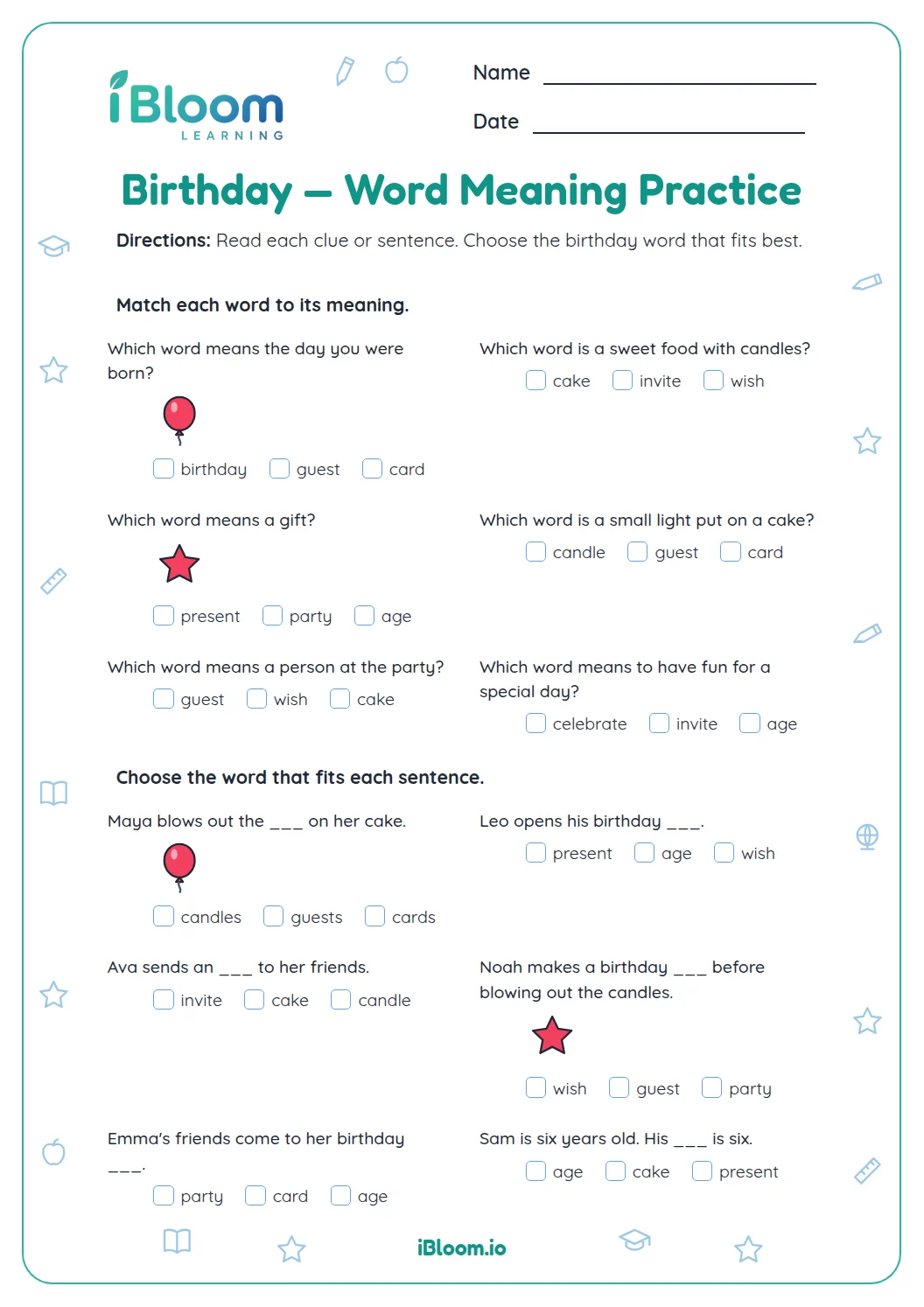
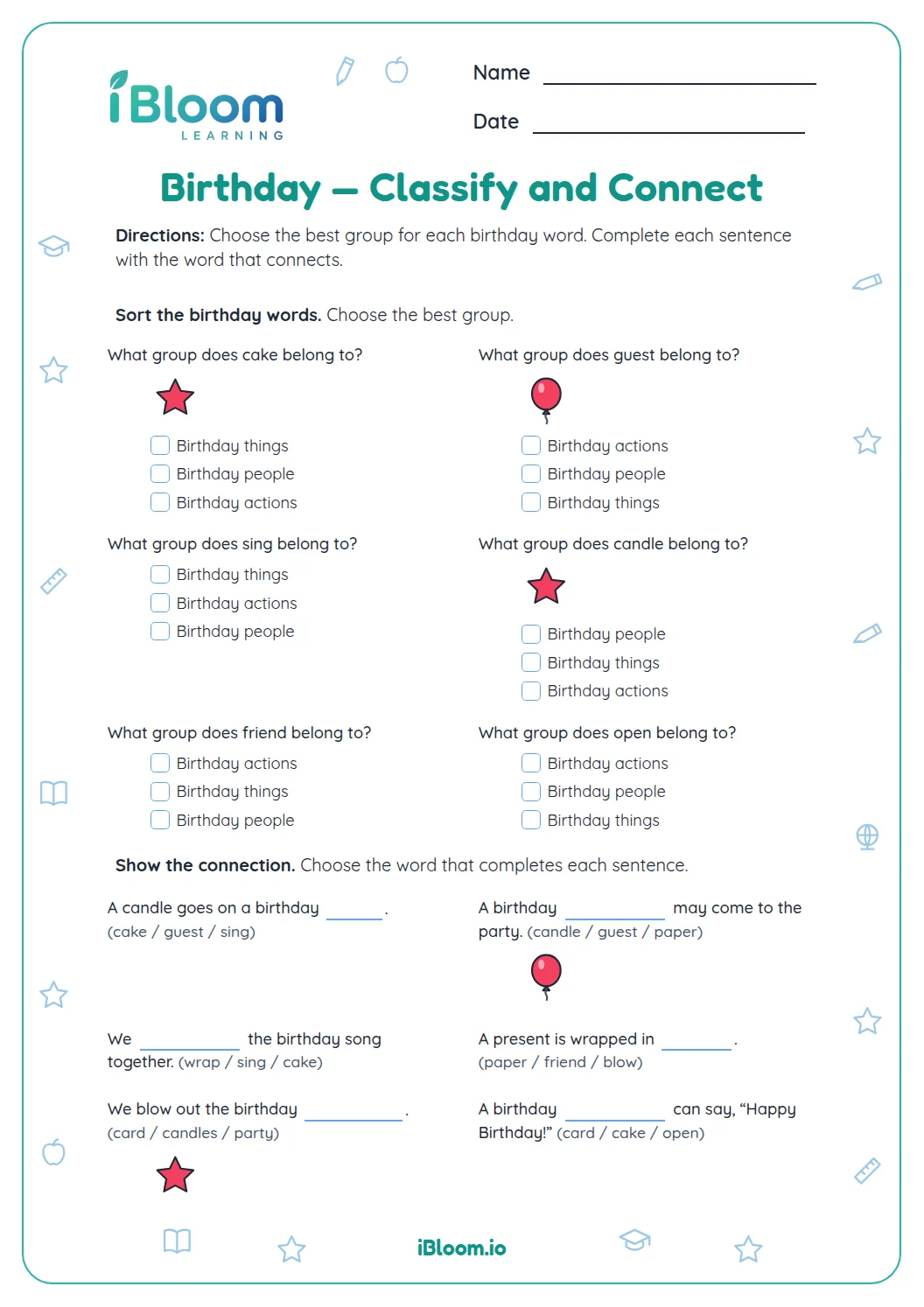
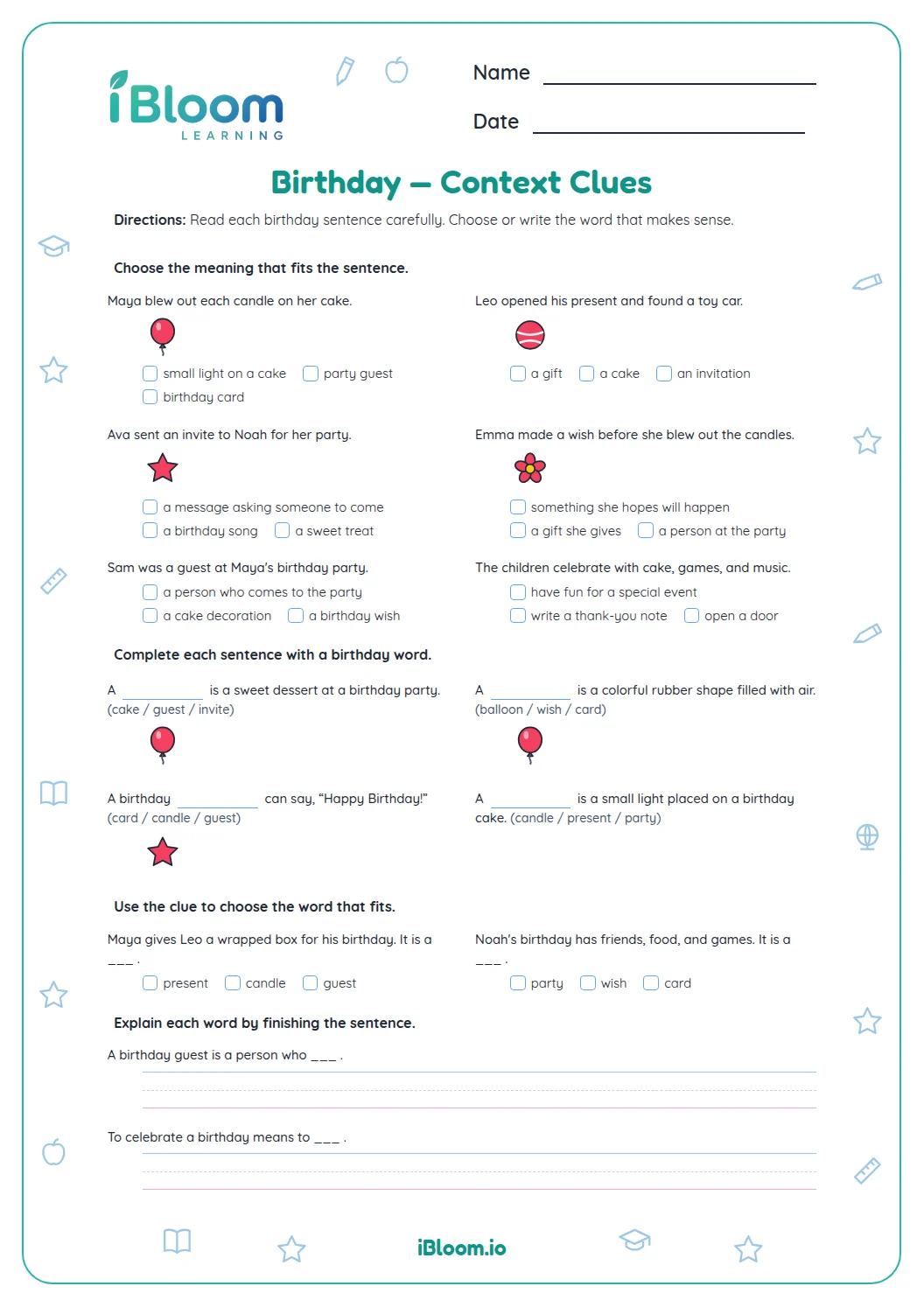
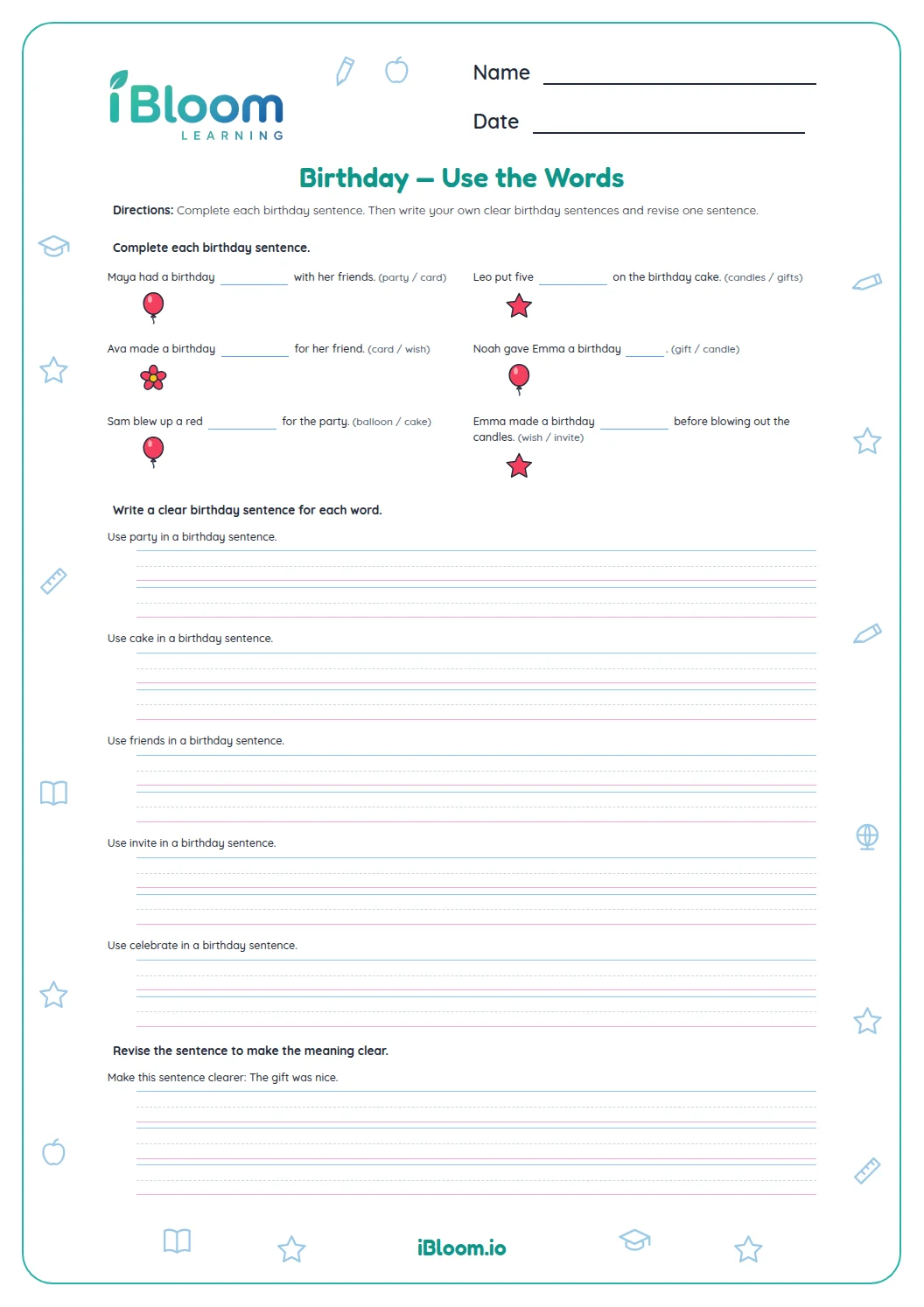
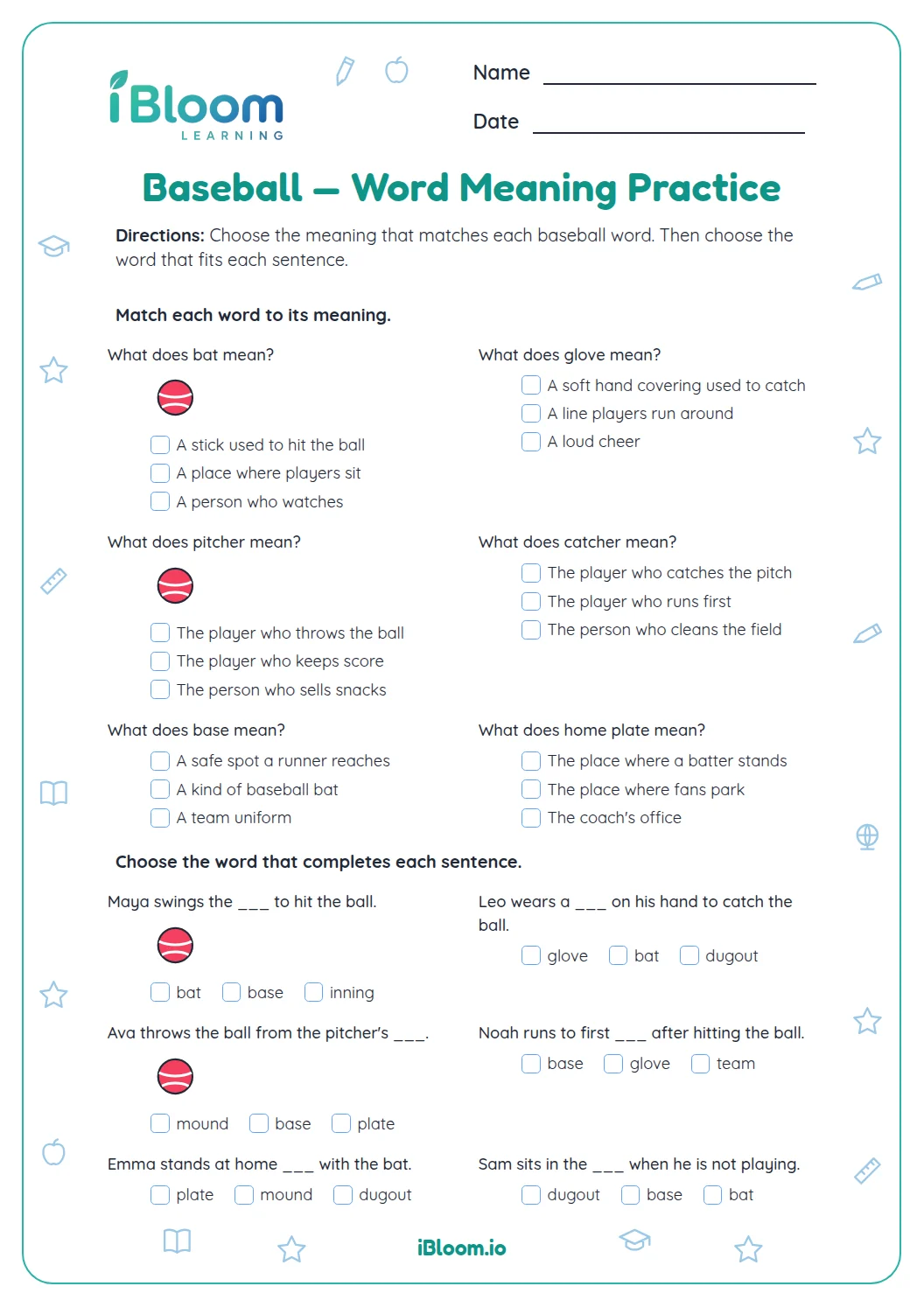
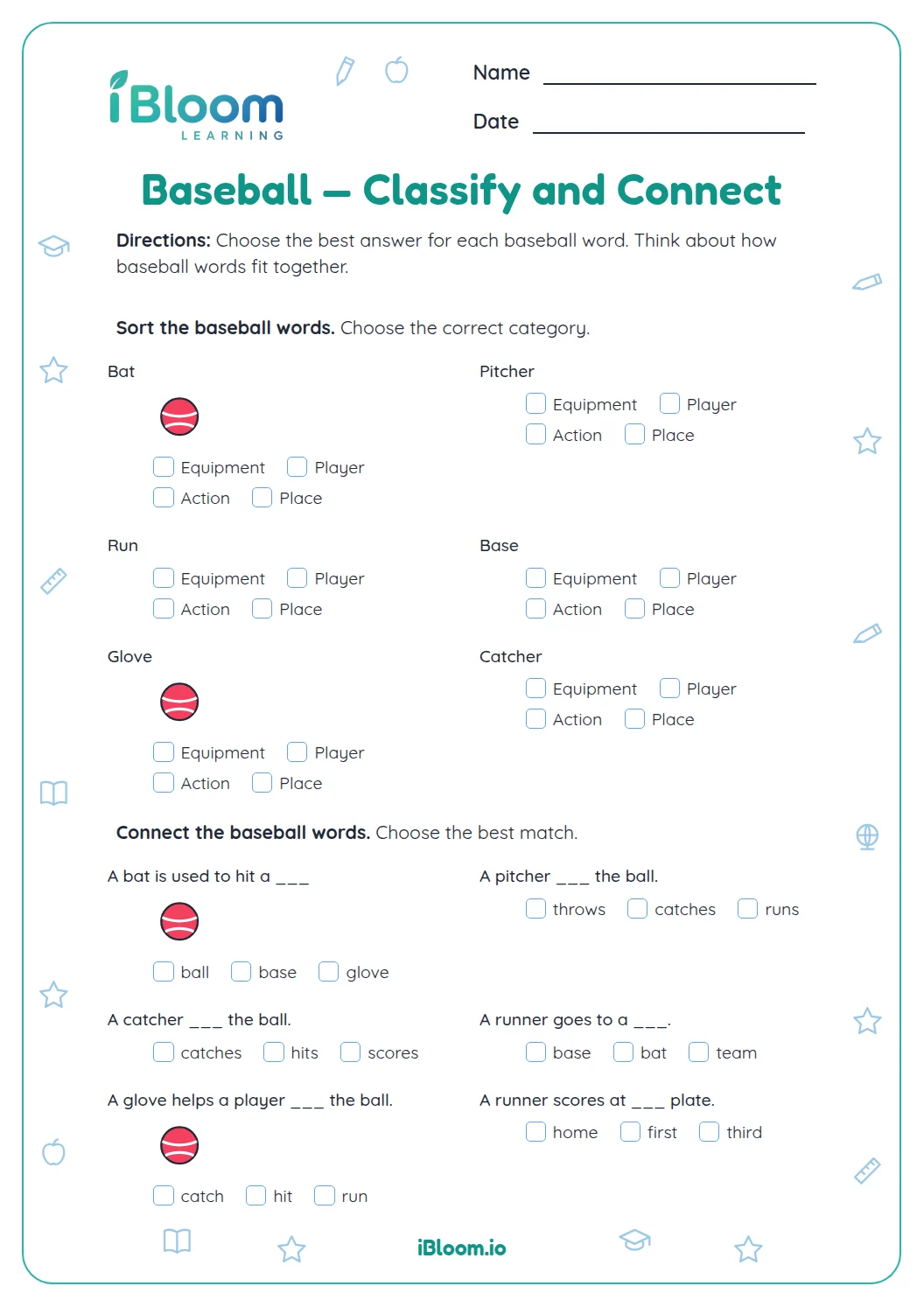
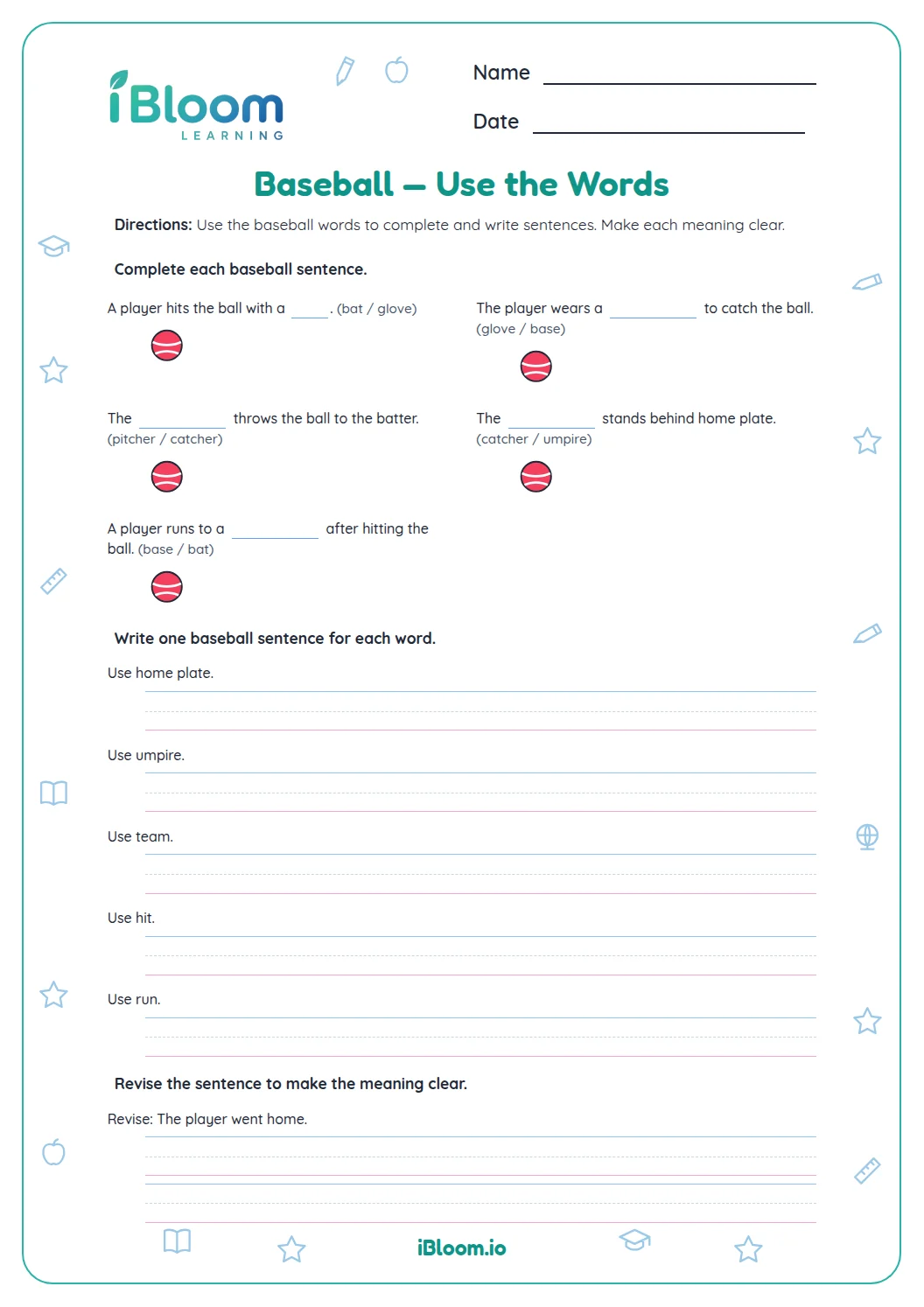
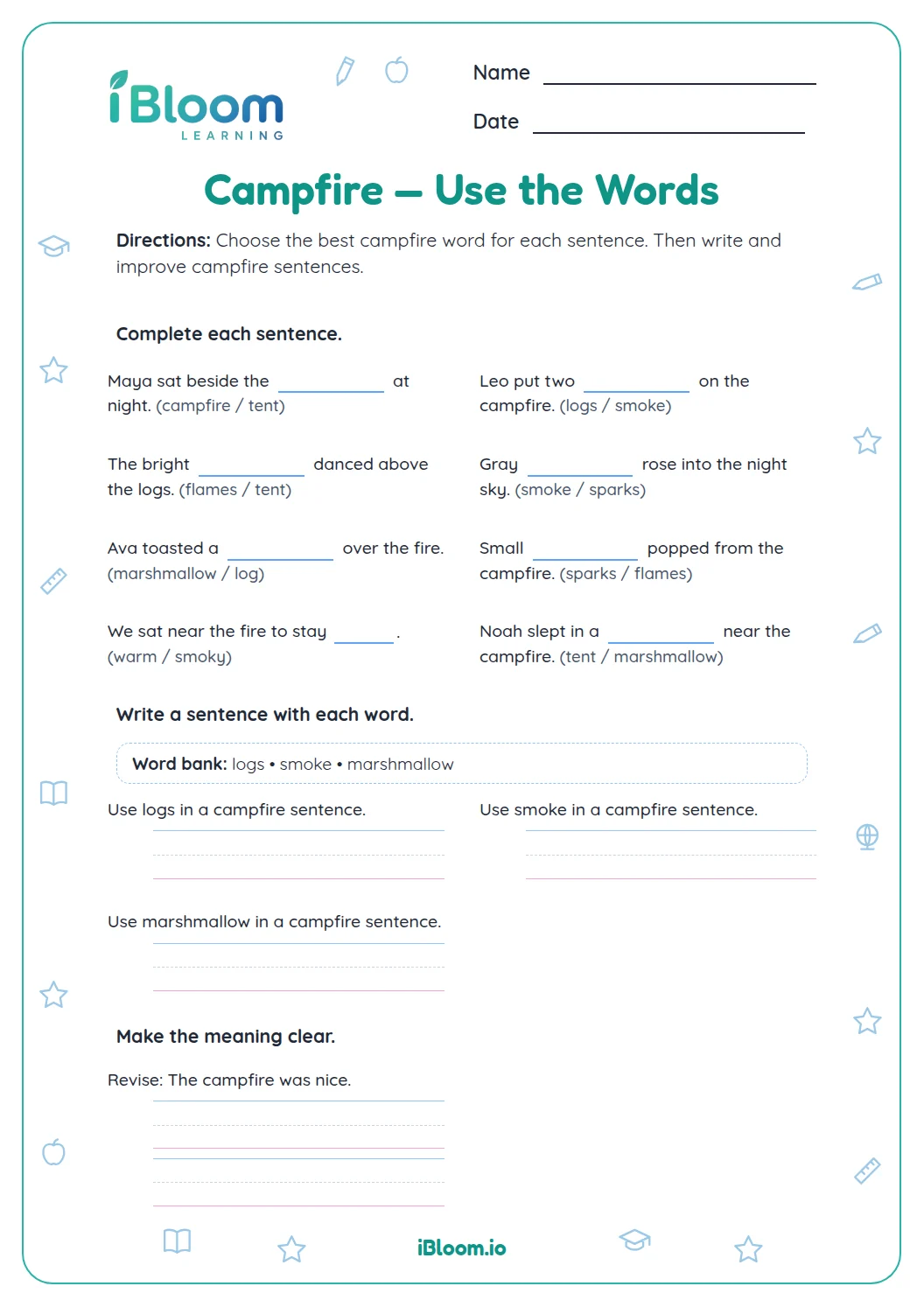
This Grade 1 birthday vocabulary worksheet begins with a word search containing eight familiar words, including cake, gift, and balloon. Children then answer 14 short questions that ask them to connect words with meanings, categories, beginning sounds, and a rhyme. The birthday theme gives the vocabulary a shared context, while each clue has one clear answer. The practice supports CCSS L.1.4.a, using sentence context as a clue to a word’s meaning. The answer key includes the word-search list and answers for the reasoning questions.
Aligned to L.1.5.a and L.1.4.a
Which birthday words will children find?
The grid contains cake, gift, candy, balloon, party, candle, card, and happy. The words run across the grid from left to right, making the search manageable for beginning readers.
How does the worksheet build word meaning?
After searching, children use each word in a clue. Some clues ask what an item is used for; others ask which words belong together or share a sound.
- 1Which two words name things you can eat?
- 2Answer: cake, candy
How can an adult support a new reader?
Read a clue aloud and invite the child to say what each choice means before selecting. Encourage them to find the word in the grid after answering.
How to use this worksheet
- 1Review the word list and say each birthday word aloud.
- 2Find and circle each word in the grid.
- 3Read each meaning clue and consider both answer choices.
- 4For sound questions, say the words aloud and listen to their first sound or ending rhyme.
- 5Check answers with the key and invite the child to explain one word connection.
Common vocabulary slips
The mistake
Picking a word because it is in the birthday theme, even when it does not fit the clue.
The fix
Ask what the word names and compare that meaning with the clue.
The mistake
Confusing a candle with a treat.
The fix
A candle is used on a cake; candy is a sweet food.
The mistake
Choosing a word that begins with the same letter but not the same sound.
The fix
Say both words slowly and listen to their first sound.
Common Core alignment
These questions group birthday words by meaning and use sentence context to choose a word.
Sort related words into categories and notice what those groups mean.
On this sheet: Children group birthday words by food and decoration, building categories from familiar vocabulary.
Show the official wordingHide the official wording
Sort words into categories (e.g., colors, clothing) to gain a sense of the concepts the categories represent.
Use sentence context to choose a word that completes an idea.
On this sheet: Children select birthday words that complete short sentences and fit their meaning.
Show the official wordingHide the official wording
Use sentence-level context as a clue to the meaning of a word or phrase.
What to practice next
Make more practice
Further reading
Questions parents and teachers ask
How many words are hidden in the birthday grid?
The eight listed words are cake, gift, candy, balloon, party, candle, card, and happy. In this grid, each runs left to right across a row, so children can scan one row at a time. The key repeats the list for checking.
What does the reasoning section ask children to do?
They connect familiar birthday words to meanings, uses, word groups, beginning sounds, and rhyme. For instance, children identify cake and candy as foods, then notice that balloon begins with the /b/ sound. Children can explain how a clue matches a word before choosing.
Is the word search appropriate for Grade 1?
Yes. The list uses short, familiar birthday words, and the grid places them horizontally from left to right. An adult can read the list aloud while the child scans each row and circles a word when it is found.
What is the difference between a candle and candy?
A candle is placed on a cake and can be blown out after a wish. Candy is a sweet food. The worksheet asks children to connect each word with what it names, then use other words in simple birthday contexts.
How long should the activity take?
Plan for about 15 minutes, depending on how quickly the child finds the words and reads the clues. The grid and short vocabulary questions can be completed in one sitting or split into two sessions. Adults can read the clues aloud, then let children complete one part at a time.