





About this worksheet
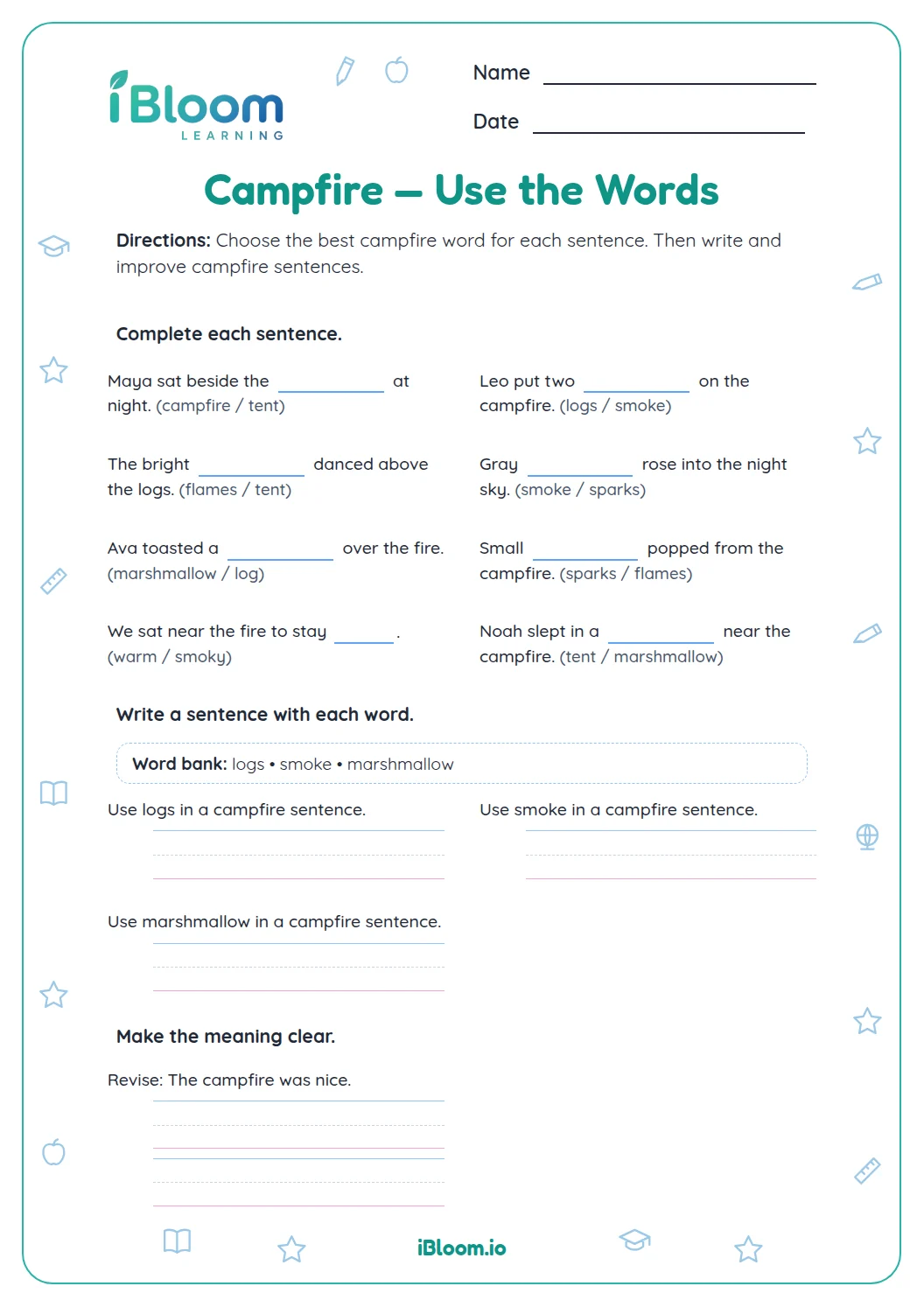
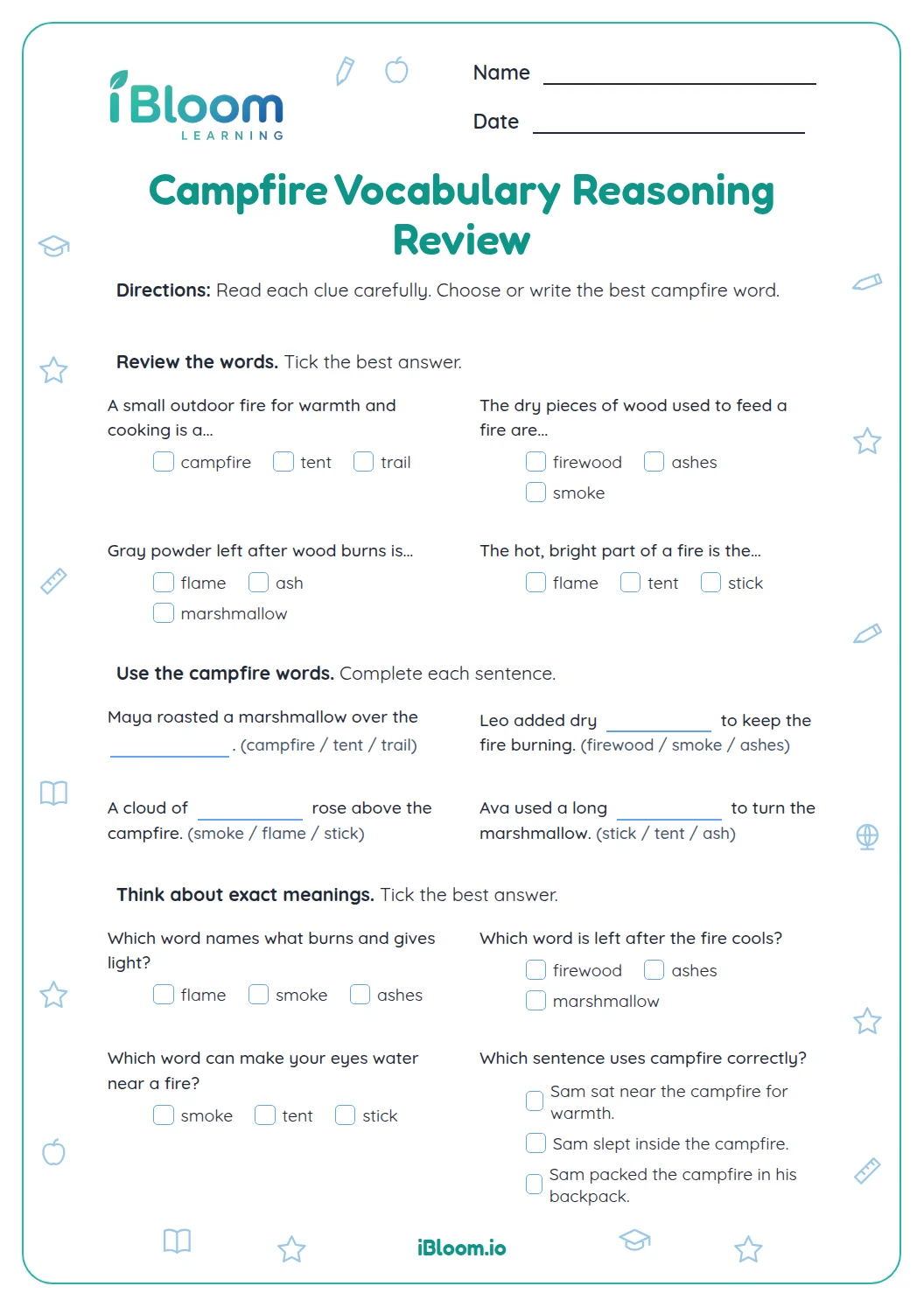
This free printable campfire vocabulary worksheet gives Grade 1 children 12 sentence-clue questions about a camping trip. In Part A, they choose the meaning of a capitalized word, such as CAMPFIRE, WOOD or FLAME. In Part B, they choose a word that matches the meaning described in a sentence. The questions practice Common Core L.1.4a: using sentence clues to understand words. Children can read independently or listen as an adult reads each item aloud. A separate answer key marks the correct choice for every question.
Aligned to L.1.4a
How do sentence clues help with campfire words?
Read the sentence before looking at the choices. Words such as burning, wood and above help a child connect FLAME to a fire. Ask the child to explain which detail helped, even when the correct choice seems obvious.
- 1A FLAME danced above the burning wood.
- 2The words burning wood give a clue.
- 3A flame is a bright part of a fire.
What changes from Part A to Part B?
Part A names the word and offers two meanings. Children meet campfire, wood, flame, smoke, spark, ash, warm and marshmallow in short camping sentences. Part B reverses the task: a sentence describes an action or thing, and children choose glow, roast, trail or blanket.
The four Part B items have three choices each. Read every choice and check it against the whole clue; a word can belong to a camping trip without fitting that particular sentence.
How can an adult help without giving away the answer?
Read the sentence and choices with the same emphasis. Ask the child to point to a clue, then say the selected meaning in their own words. For WARM, rubbing cold hands near a fire helps explain a comfortable amount of heat.
After checking, invite the child to use two of the words in a new spoken sentence. A sentence about a glowing lamp or a warm blanket shows how the word can be used beyond the camping setting.
How to use this worksheet
- 1Read the Part A direction and explain that capital letters mark the word to think about.
- 2Have the child read or listen to question 1, then choose a meaning.
- 3Continue through Part A, asking for one helpful clue after an uncertain answer.
- 4Read all three choices in each Part B item before choosing.
- 5Check the marked choices on the key and say a new sentence with two of the words.
Mistakes to notice and fix
The mistake
Choosing any word connected with camping.
The fix
In question 11, test each choice against “narrow path”; only trail names a path.
The mistake
Mixing up smoke, spark and ash.
The fix
Use their sentence clues: smoke rises like a gray cloud, a spark is a tiny glowing bit, and ash is powder left after burning.
The mistake
Calling warm the same as very hot.
The fix
Return to the cold hands in question 7 and choose “slightly hot”; describe comfortably warm hands.
Common Core alignment
Use clues in camping sentences to work out word meanings.
On this sheet: All 12 questions connect a word or meaning to clues in a sentence.
Show the official wordingHide the official wording
Use sentence-level context as a clue to the meaning of a word or phrase.
What to practice next
Make more practice
Further reading
Questions parents and teachers ask
Which campfire words are on the worksheet?
The sheet uses campfire, wood, flame, smoke, spark, ash, warm, marshmallow, glow, roast, trail and blanket. Each word has a sentence clue. The first eight questions ask for a meaning; the last four ask children to select the word that fits a description.
Can I read the questions aloud to my first grader?
Yes, you can read each sentence and all its choices aloud. Keep your voice neutral so the child still chooses the answer. Ask which words helped them decide, such as “from a fallen tree” for wood, and let them explain the meaning before checking the key.
How do I explain the difference between smoke and ash?
Use the different clues in questions 4 and 6. Smoke rises like a gray cloud while a fire burns; ash is the powder left after wood burns. Have your child say which one moves through the air in the sentence and which one is left behind.
What should children do in Part B?
Children choose the word that matches the sentence description in each of four questions. For example, “a narrow path through the woods” describes a trail. Read the entire clue, try each of the three choices, and select the one that names the described thing or action.
What does the answer key show?
The answer key marks the correct choice for all 12 questions. Use it after the child has tried both parts. For an incorrect response, reread that sentence together and point out its clue, then have the child explain why the correct meaning or word fits.