



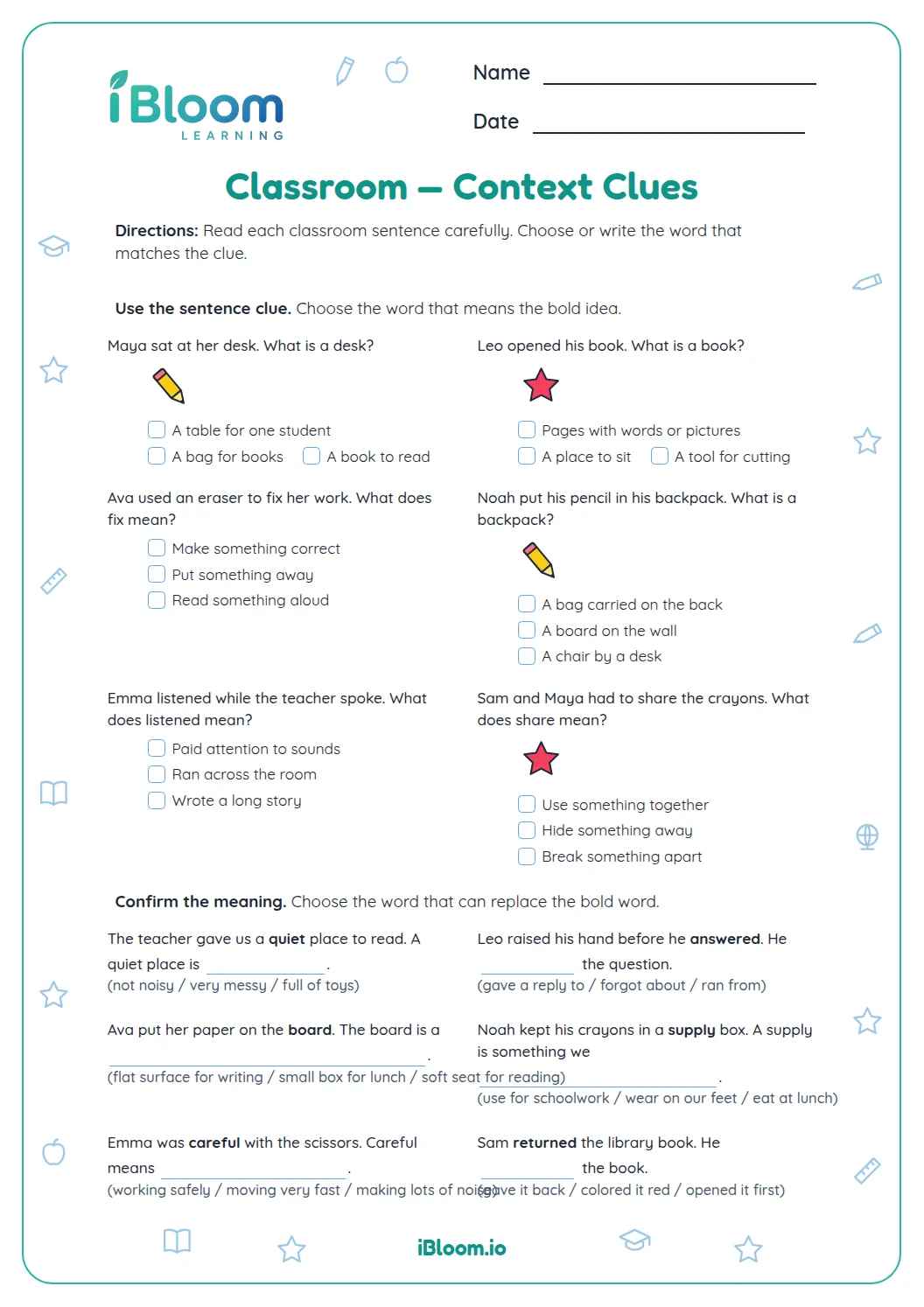


About this worksheet
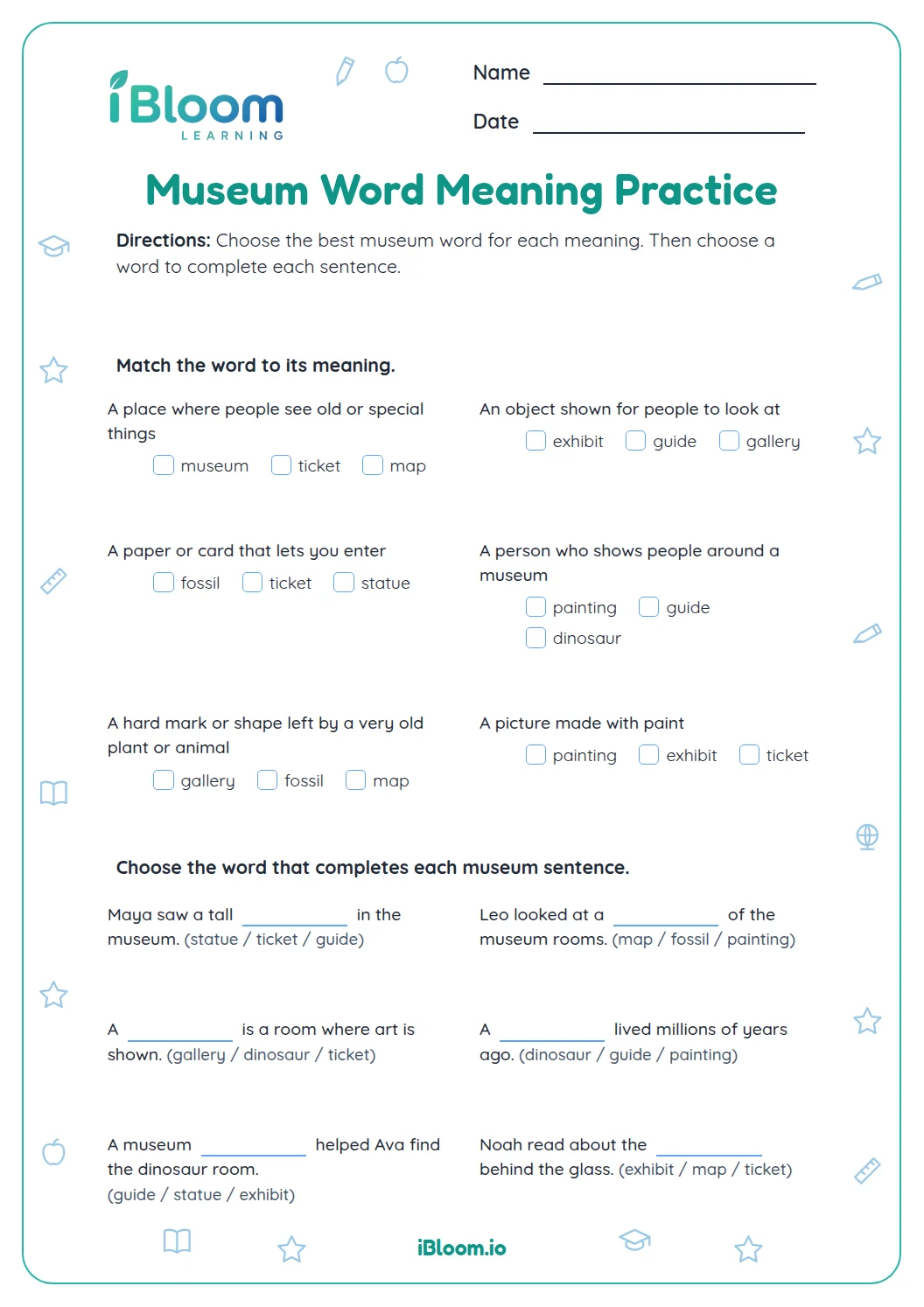
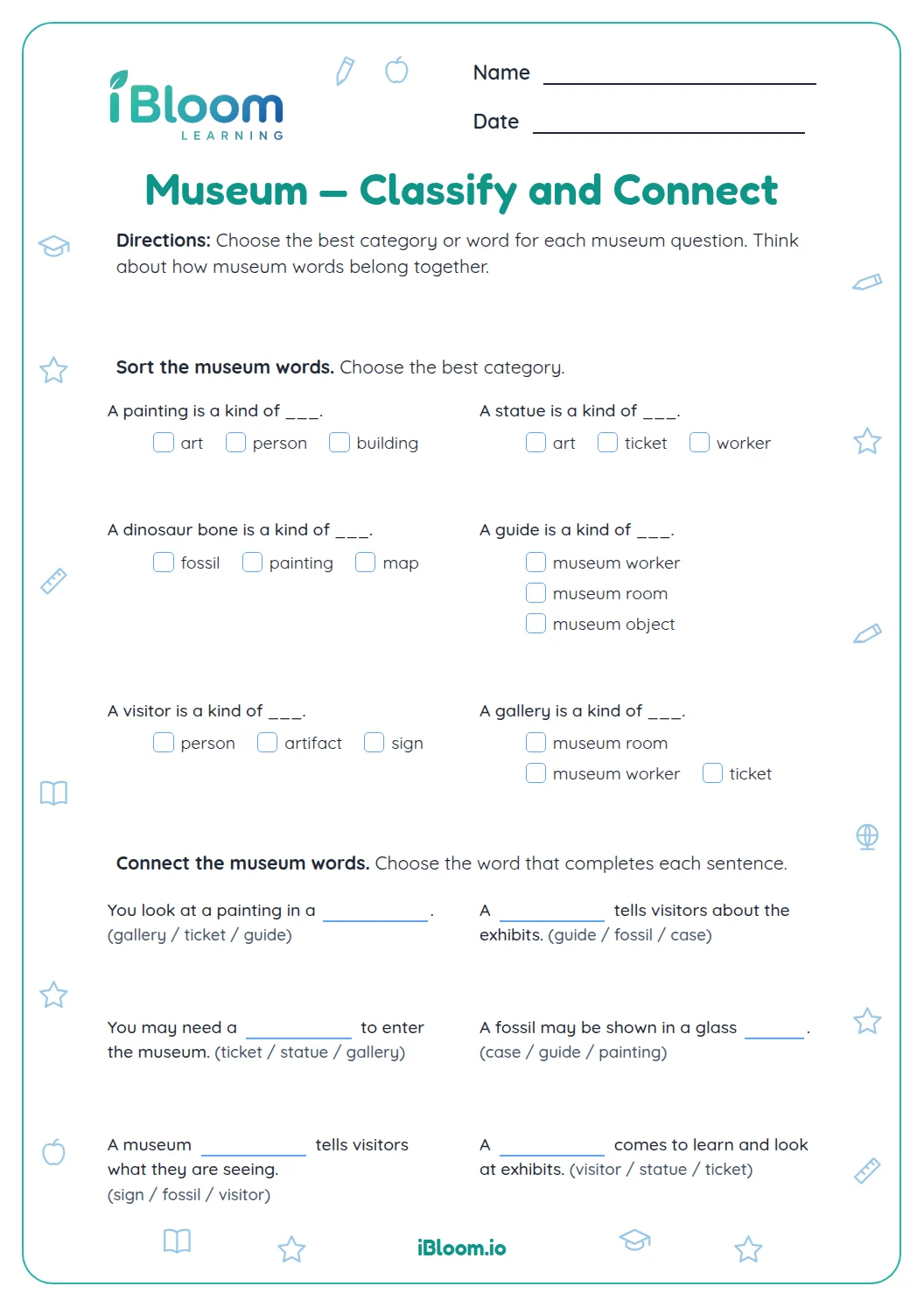
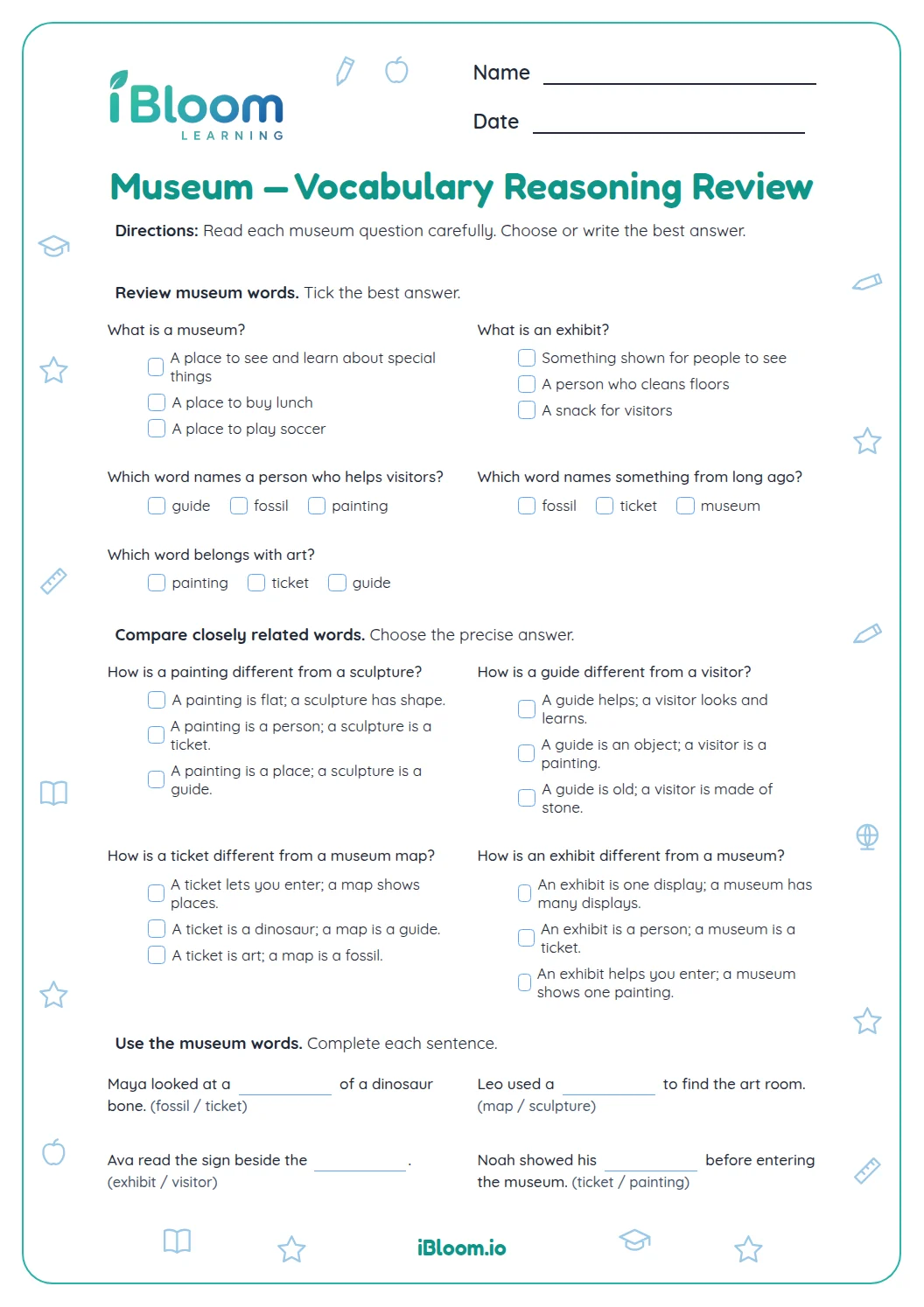
This free Grade 1 worksheet practices museum vocabulary through short, readable context clues. Children use sentence details to work out word meanings, then reinforce the words in a letter-grid search. The 15 questions are grouped into four parts: choices, short responses, two word completions, and a search. It practices Common Core L.1.4a: using sentence-level context as a clue to meaning. A separate answer key is included.
Aligned to L.1.4a
How do sentence clues reveal a word’s meaning?
A context clue is a nearby word or detail that helps a reader understand an unfamiliar word. In “The vase was FRAGILE, so we did not touch it,” the warning not to touch suggests it could break easily.
Children read the whole sentence before choosing a meaning, then check that the meaning makes sense in place of the target word.
- 1The vase was FRAGILE, so we did not touch it.
- 2Clue: we did not touch it
- 3“Easy to break” fits the warning.
- 4Answer: easy to break
What does each part ask children to do?
Part A has eight multiple-choice sentences. Part B has four short responses about museum words. Part C has two sentence-completion items, and Part D is a word search with eight words used on the sheet. The grid supports spelling recognition after children have used context to learn the meanings.
How can I make the practice useful?
Ask the child to point to the clue before looking at the choices. After answering, reread the sentence with the selected meaning in place of the target word. This keeps attention on meaning rather than guessing from one familiar word.
How to use this worksheet
- 1Read every sentence aloud or silently before answering.
- 2In Part A, name the clue that points to the bold museum word.
- 3In Part B, write the word that matches the sentence meaning.
- 4In Part C, scan across and down, then circle each museum word.
- 5Use the key to revisit any answer that did not fit the sentence.
Common mistakes and quick fixes
The mistake
Choosing a familiar meaning without checking the sentence.
The fix
Point to the clue words, then try the meaning in the sentence.
The mistake
Treating fragile as a synonym for old.
The fix
Ask whether the clue describes age or how easily something breaks.
The mistake
Searching the grid before knowing the word list.
The fix
Read each word first, then look for its first letter across or down.
Common Core alignment
This vocabulary practice connects sentence reading with word meaning.
Use nearby sentence details to work out museum words.
On this sheet: Parts A and B use sentence details to identify word meanings.
Show the official wordingHide the official wording
Use sentence-level context as a clue to the meaning of a word or phrase.
What to practice next
Make more practice
Further reading
Questions parents and teachers ask
What is a context clue?
A context clue is a nearby word or detail that helps explain an unfamiliar word. In “The vase was fragile, so we did not touch it,” the warning suggests that fragile means easy to break. Read the whole sentence before deciding what a word means, and point to the clue.
What does the museum worksheet include?
The worksheet has eight multiple-choice context questions, four short-answer questions, two sentence-completion questions, and one word search with eight museum terms. Children use sentence details to identify meanings, then find familiar words in the grid. A separate answer key gives the expected responses.
How can I help if my child is stuck?
Read the sentence aloud and ask which details help explain the target word. You might ask, “What does the sentence tell us about the vase?” Avoid giving the definition right away; a clue such as “we did not touch it” can help the child reason it out.
Does the word search teach the meanings by itself?
The word search mainly helps children notice and spell museum words. The sentence questions do the meaning work: children use details such as the warning about a fragile vase or an old coin. Pairing the activities gives practice with meaning and word recognition.
What is the answer key for?
The separate answer key lists the expected response for each multiple-choice, short-answer, and sentence-completion question, plus the eight words in the grid. For a different reasonable wording, ask whether it matches the clue and target word. This works especially well for short answers.