




About this worksheet
This printable pairs a word search with sentence-level vocabulary practice. Students first find ten words connected to music, decorations, food, and celebration, then choose words that fit each context. The examples describe a community celebration respectfully without suggesting that every family celebrates in the same way.
Aligned to L.2.4.a
How does context help a reader choose a word?
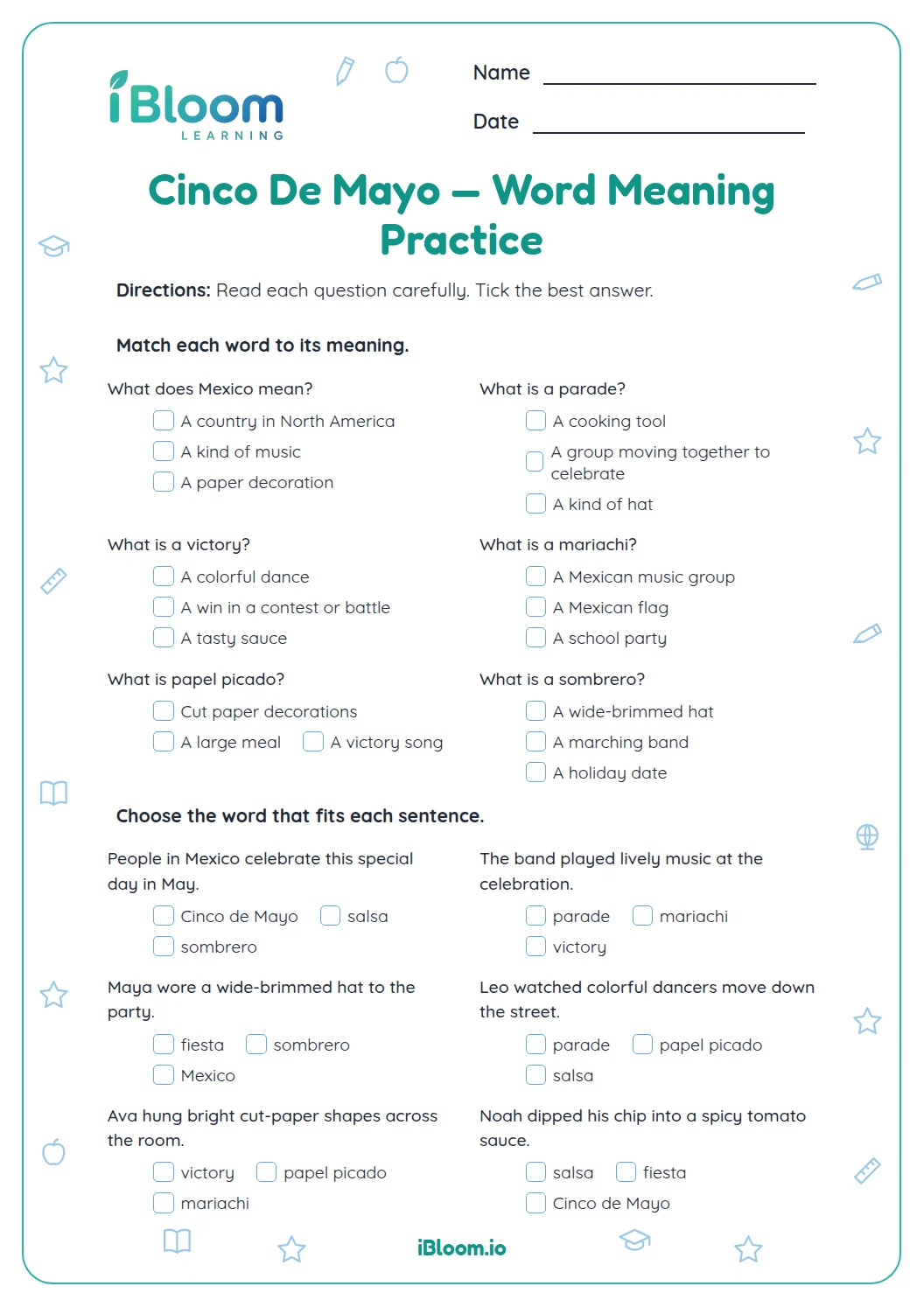
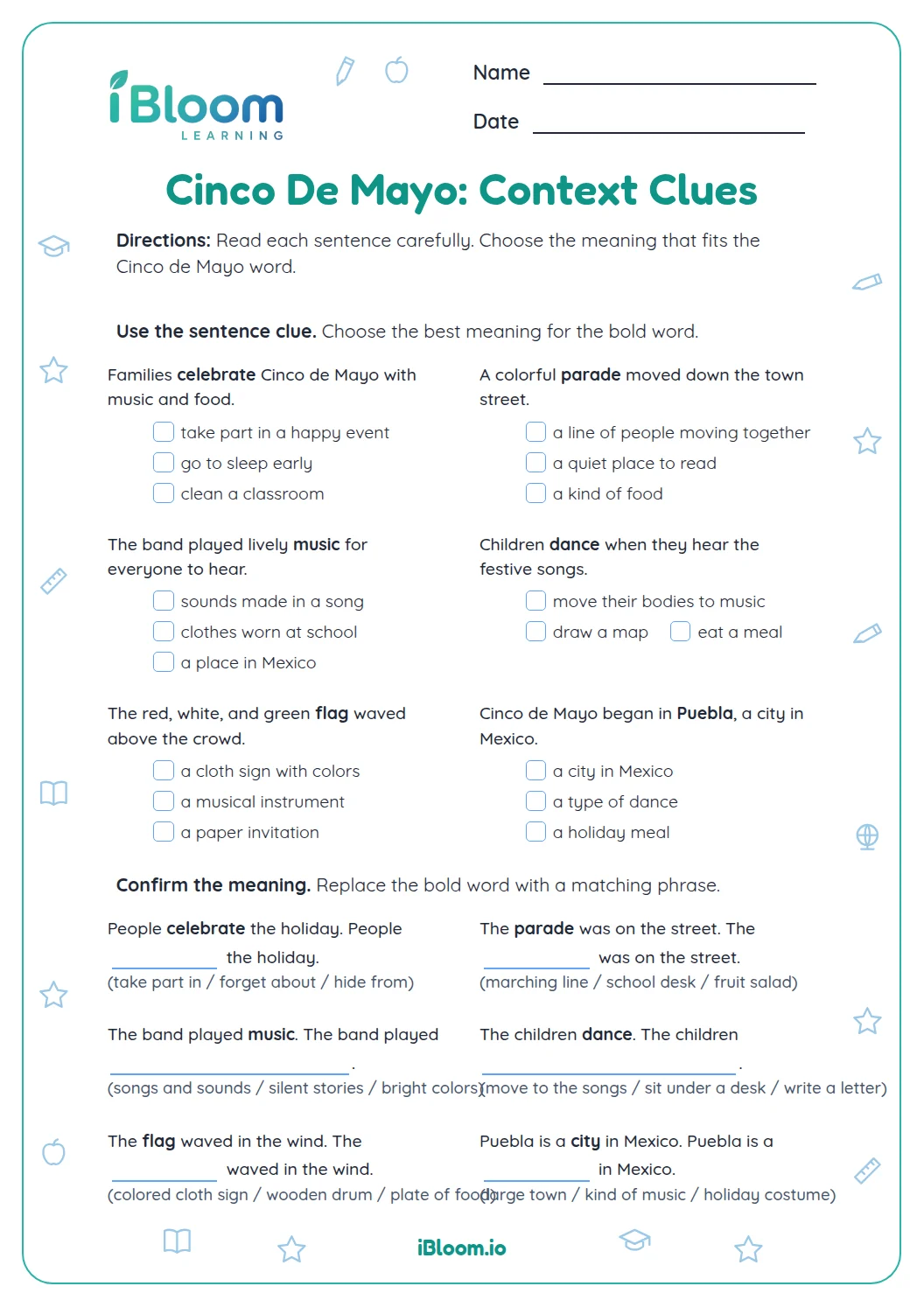
A sentence gives clues about what a word should mean. A band that sings and plays instruments makes music; a crowd watching people march may be watching a parade. Students can reread the whole sentence and check that the chosen word fits.
How does the worksheet approach Cinco de Mayo?
The activities use a small group of vocabulary words connected to a celebration, including music, food, decorations, and family. People mark the day in different ways, so students should avoid assuming one description fits everyone.
How to use the worksheet
- 1Circle each listed word in the grid.
- 2Read the whole sentence before choosing a vocabulary word.
- 3Reread the sentence with the word inserted.
- 4For the written response, give one word from the search that fits the clue.
Vocabulary checks
The mistake
Choosing a word because it is familiar, even though it does not fit the sentence.
The fix
Look for a clue in the sentence and read the completed sentence again.
The mistake
Mixing up the word for a celebration with a food or decoration.
The fix
Sort the words by what they name: an event, a sound, an object, or a food.
Common Core alignment
The worksheet practices using context and word meaning in Grade 2 reading.
Use sentence-level context as a clue to the meaning of a word or phrase.
On this sheet: Students choose words by using clues in each sentence.
Show the official wordingHide the official wording
Use sentence-level context as a clue to the meaning of a word or phrase.
What to practice next
Make more practice
Further reading
Questions parents and teachers ask
What words appear in the letter search?
The grid contains fiesta, parade, mariachi, music, dance, family, flag, taco, paper, and flower. After locating them, students use sentence clues to connect selected words with celebrations, people, music, food, and decorations. Ask the student to name the clue or operation that supports the choice, then check the completed sentence or equation against the key. This quick check connects.
How does context help a reader choose a word?
A sentence gives clues about which word makes sense. A crowd watching people march may be watching a parade, while a band that sings and plays instruments makes music. Reread the sentence with the word inserted to check it. This also distinguishes a music tradition from a food, object, or event word in the search.
What does mariachi mean in this worksheet?
Mariachi refers to a style of Mexican music and the musicians who perform it. In this worksheet, the sentence mentions a band and lively songs, giving a clue that points to music rather than food or decorations. This context makes the vocabulary choice more precise for young readers.
Do all families celebrate Cinco de Mayo in the same way?
No. Families and communities may mark Cinco de Mayo in different ways, and some do not celebrate it. The worksheet uses a few celebration words for vocabulary practice without suggesting that one set of activities describes every family. Ask the student to name the clue or operation that supports the choice, then check the completed sentence or equation against.
How many prompts follow the word search?
Thirteen sentence and clue prompts follow the grid. They use the ten listed words in context, with a few words appearing more than once so students can check meaning across different clues. Ask the student to name the clue or operation that supports the choice, then check the completed sentence or equation against the key. This quick check connects.