






About this worksheet
This Grade 2 printable pairs a word search with vocabulary reasoning. Students find ten words connected to Cinco de Mayo and then use short sentence clues to complete vocabulary ideas. The examples name Mexico and Puebla respectfully and place the holiday in its historical context. A separate key lists the search words and answers. Its context clues support CCSS L.2.4.
Aligned to L.2.4
Which words are hidden in the search?
Part A includes ten words connected to the worksheet topic: Mexico, Puebla, history, parade, music, dance, family, flag, honor, and community. Students find and circle each word across the rows.
- 1Look at the first row for MEXICO.
- 2Read the letters in order, then circle the word.
How can a sentence help explain a word?
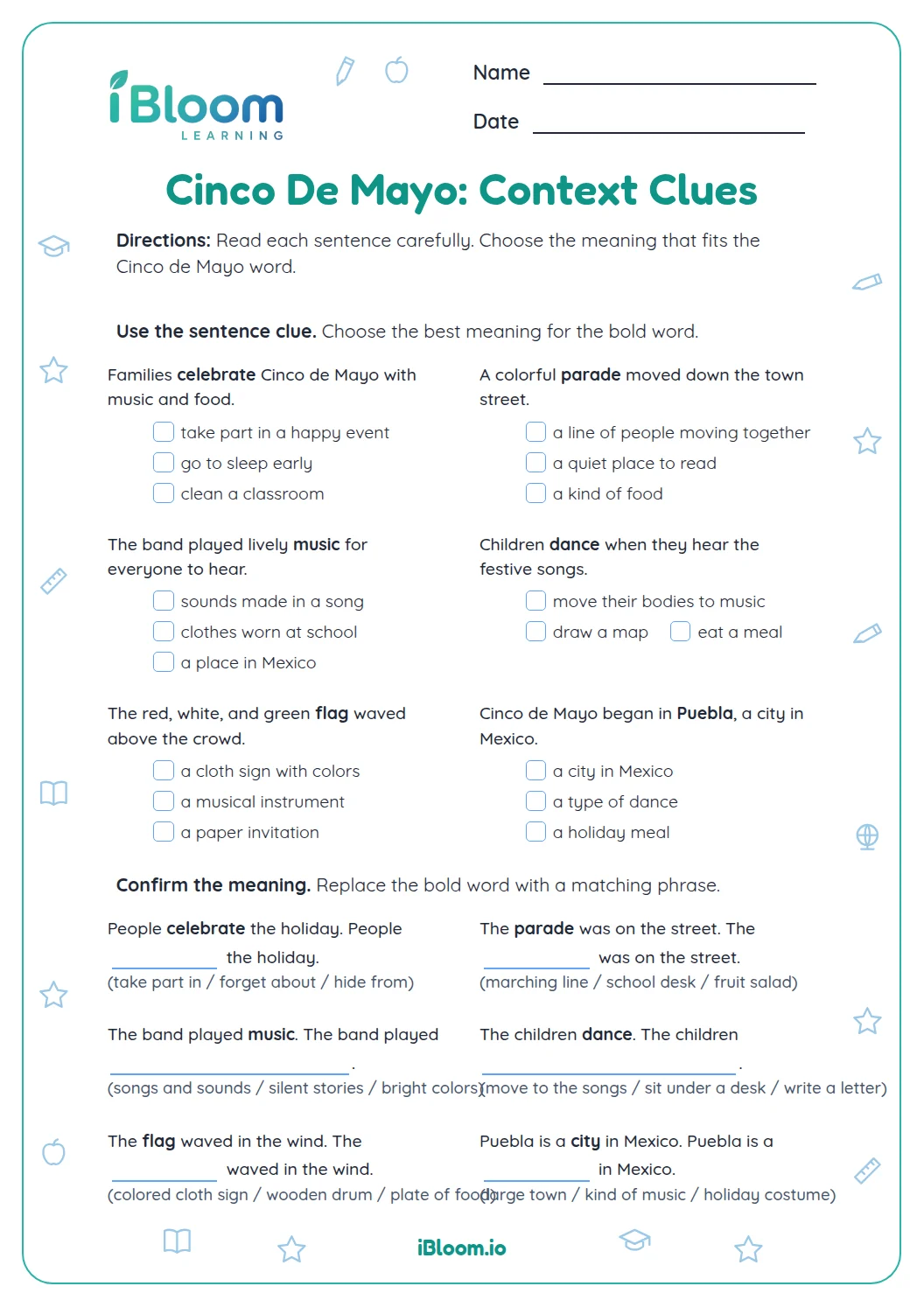
Read the whole sentence and look for an action or detail that points to the meaning. In “To show respect for someone is to ___ that person,” the clue points to honor. Part B uses short sentences so students can focus on the target word.
How do the words connect to the holiday?
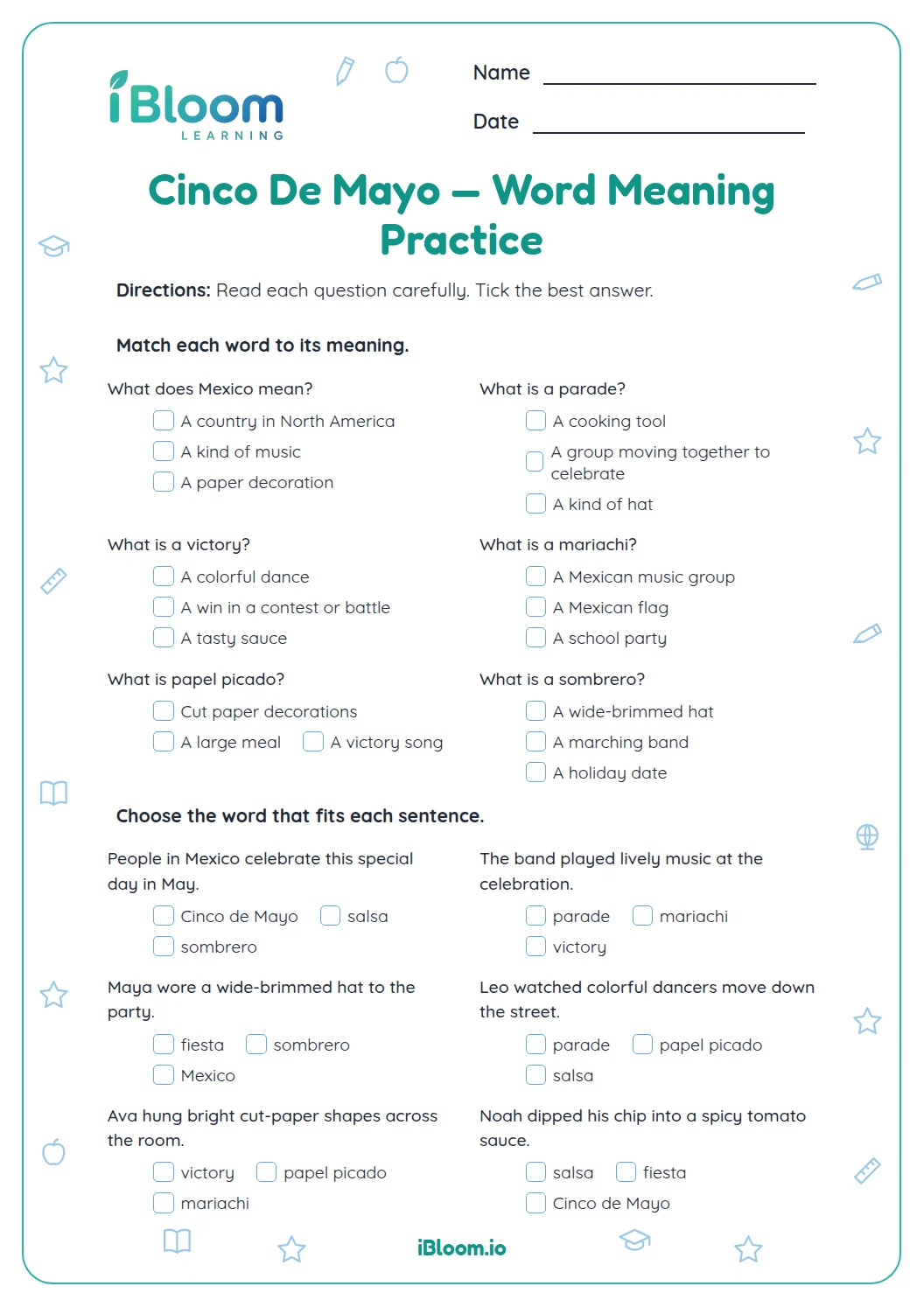
Cinco de Mayo remembers the Mexican victory at the Battle of Puebla. It is not Mexico’s Independence Day. The vocabulary questions connect place and history words with ways a community may learn or gather, while keeping the historical reference clear.
How to use this worksheet
- 1Find the ten listed words in Part A and circle each one.
- 2For each Part B clue, read the sentence before filling its blank.
- 3Use the clue phrase to choose a word that fits.
- 4Complete all thirteen vocabulary blanks in Part B.
- 5Check the word list and answers with the key.
Common mistakes and quick fixes
The mistake
Choosing a word only because it shares a topic with the sentence.
The fix
Use the action or detail in the sentence to test whether the meaning fits.
The mistake
Treating Puebla as a type of celebration.
The fix
Remember that Puebla is a place; the sentence clues help identify the role of each word.
The mistake
Calling Cinco de Mayo Mexican Independence Day.
The fix
Use the historical detail on this page: it remembers the Battle of Puebla.
Common Core alignment
This page gives students focused practice with the skills named in these Common Core standards.
Use strategies such as sentence clues to clarify word meanings.
On this sheet: Part B uses short context clues and familiar word relationships to select meanings.
Show the official wordingHide the official wording
Determine or clarify the meaning of unknown and multiple-meaning words and phrases based on grade 2 reading and content, choosing flexibly from an array of strategies.
What to practice next
Make more practice
Further reading
Questions parents and teachers ask
What is Cinco de Mayo?
Cinco de Mayo remembers the Mexican victory at the Battle of Puebla. It is not Mexico’s Independence Day. This worksheet includes Puebla and history in its word search and asks students to use those words in short vocabulary fill-ins. The clues keep the historical place name clear.
What words are in the word search?
The ten words are Mexico, Puebla, history, parade, music, dance, family, flag, honor, and community. Students find and circle them in Part A, then use vocabulary clues in Part B. The key repeats the full list for checking. The key is easy to check.
How does the worksheet practice vocabulary?
Students use sentence details to complete word meanings and identify place and history words. For example, “A group walking along a route while people watch” points to parade. Other clues connect music, dance, family, and community to familiar actions or settings.
How many questions are included?
There are fourteen tasks: one word search and thirteen vocabulary fill-ins. The printable includes the search list and each missing word in its answer key, so students can check the full set. The clues use words about place, history, celebration, and community.
How can I help with a tricky context clue?
Have the student read the entire sentence, then point to the action or detail that hints at the meaning. Ask which word makes the sentence sensible. The answer key lists the matching word for each clue and the ten terms hidden in the grid.