






About this worksheet
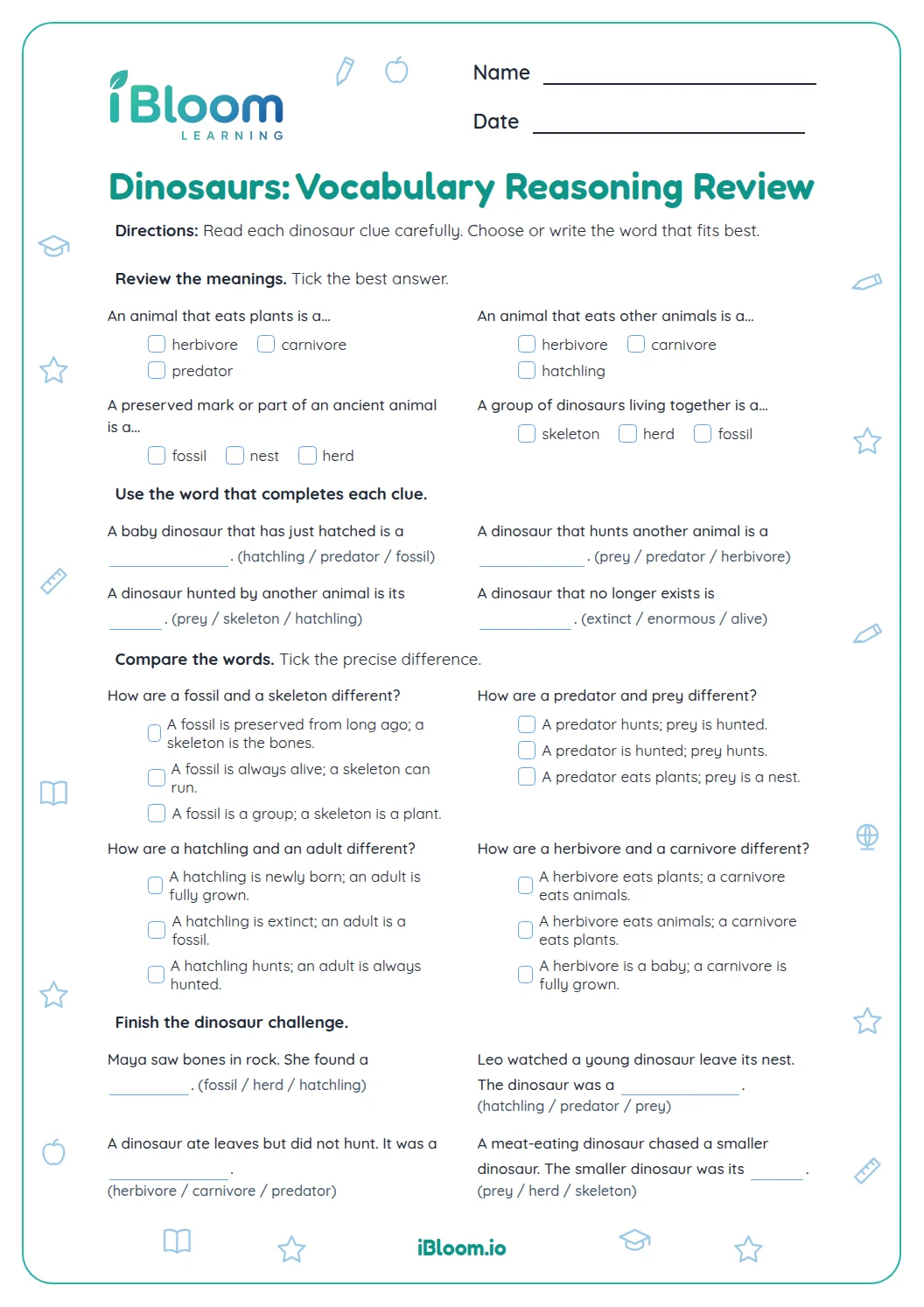
This free printable Grade 2 worksheet builds dinosaur vocabulary through classification and word connections. Part A gives food clues for six named dinosaurs, then asks children to choose plant-eater or meat-eater. Part B connects dinosaur facts with horns, plates, neck, teeth, claws and herbivore. All twelve questions have two choices. The activity practices real-life connections between words and their use under Common Core L.2.5a. An adult can read the dinosaur names aloud while children use the clues to choose. A separate answer key marks every correct choice.
Aligned to L.2.5a
What does classifying by diet mean?
Diet means the kinds of food an animal eats. Part A sorts Triceratops, Stegosaurus and Brachiosaurus as plant-eaters, and T. rex, Velociraptor and Spinosaurus as meat-eaters. Each question includes a food clue.
Fish are animals, so the fish in the Spinosaurus clue belong on the meat-eater side of this sorting task. Ask the child to explain the choice using the food word.
How do children connect dinosaur words?
Part B asks which word completes each fact. Children connect Triceratops with horns, Stegosaurus with plates, Brachiosaurus with neck, T. rex with teeth and Velociraptor with claws. The final question links plant-eater with herbivore.
- 1A Triceratops had three ___ on its face.
- 2Choices: horns or wings
- 3Horns are the pointed parts on its face.
- 4Choose horns.
How much reading help should an adult give?
Read the long dinosaur names aloud before children begin. The task is to understand the food and body-part words and their connections. Children can explain a choice aloud before marking it.
Return to the sentence if a choice is uncertain. In question 8, “bony” and “along its back” help connect Stegosaurus with plates. Here plates means bony structures, a different use from plates on a dinner table.
How to use this worksheet
- 1Read the six dinosaur names aloud together.
- 2Explain that diet means what an animal eats.
- 3Use each Part A food clue to choose plant-eater or meat-eater.
- 4Read each Part B sentence with both choices and select the word that fits.
- 5Check the key, then ask the child to explain one diet group and one body-part connection.
Mistakes to notice and fix
The mistake
Sorting a dinosaur by size instead of food.
The fix
Look for what it ate: plants point to plant-eater, and other animals point to meat-eater.
The mistake
Treating fish as a third group in question 6.
The fix
Fish are animals, so eating fish fits the meat-eater group in this activity.
The mistake
Confusing herbivore with carnivore.
The fix
Connect herbivore with plant-eater and carnivore with meat-eater, then reread question 12.
Common Core alignment
Connect dinosaur diet and body-part words with their meanings and uses.
On this sheet: Children use food clues to classify dinosaurs, then connect vocabulary with dinosaur facts.
Show the official wordingHide the official wording
Identify real-life connections between words and their use (e.g., describe foods that are spicy or juicy).
What to practice next
Make more practice
Further reading
Questions parents and teachers ask
Does my child need to read the dinosaur names alone?
No, an adult can read the dinosaur names aloud. The six names are Triceratops, T. rex, Stegosaurus, Velociraptor, Brachiosaurus and Spinosaurus. Part A supplies food clues, so children can focus on classifying by diet. Read the Part B choices together if any vocabulary is unfamiliar.
What are the two groups in Part A?
The groups are plant-eater and meat-eater. Triceratops, Stegosaurus and Brachiosaurus go in the plant-eater group. T. rex, Velociraptor and Spinosaurus go in the meat-eater group. Each question gives a food clue; ask children to use that clue when explaining why they chose a group.
Why is Spinosaurus in the meat-eater group?
The clue says Spinosaurus ate fish, and fish are animals. That puts it in the meat-eater group for this activity. Ask the child to compare fish with the plant foods in the other clues, then choose between the two groups printed on the sheet.
Which words complete the connections in Part B?
The answers are horns, plates, neck, teeth, claws and herbivore. The first five connect dinosaur names with body parts, while herbivore names an animal that eats plants. Read each completed fact aloud after checking, and ask the child to explain one connection in their own words.
Can I use this as an oral vocabulary activity?
Yes, read each question and both choices aloud, then let the child say an answer and explain the connection. Children can mark their choices afterward. The separate key checks all twelve responses, and you can revisit an uncertain word by using it in another spoken sentence.