




About this worksheet
This Grade 2 vocabulary worksheet pairs a transportation word search with sentence-level context clues. Part A asks students to find eight transportation words. In Part B, details about stations, water, wheels, rails and travel help students infer word meanings. The context-clue questions practice CCSS L.2.4.a.
Aligned to L.2.4
How should students use the word search?
Part A has eight transportation words, each placed across one row of the grid. Scan each row from left to right and circle each complete word.
- 1The first row spells B-U-S from left to right.
How can sentence details reveal meaning?
Part B sentences include clues about a vehicle’s route, action or purpose. Read the whole sentence, then choose the meaning supported by those details.
How do sentence clues point to a meaning?
For example, if a wagon is pulled along by a horse, the sentence shows that pulled means moved by a force from ahead.
How to use this worksheet
- 1Circle each target word as you find all its letters.
- 2Read each context sentence from beginning to end.
- 3Underline the detail that helps explain the target idea.
- 4Compare the answer choices with that detail.
- 5Check that your choice fits the full sentence.
Common mistakes and quick fixes
The mistake
Choosing a word because it is related to transportation.
The fix
Choose the meaning that matches the sentence detail.
The mistake
Stopping after finding only part of a grid word.
The fix
Check every letter and the word’s full length.
The mistake
Using one clue but ignoring the rest of the sentence.
The fix
Read the whole sentence and test the choice against all details.
Common Core alignment
This worksheet practices a specific skill described in the Common Core standards.
Use details in a sentence to infer the meaning of an unfamiliar word.
On this sheet: Part B uses sentence-level clues to determine meaning.
Show the official wordingHide the official wording
Determine or clarify the meaning of unknown and multiple-meaning words and phrases based on grade 2 reading and content, choosing flexibly from an array of strategies.
What to practice next
Make more practice
Further reading
Questions parents and teachers ask
What words are hidden in the grid?
The grid contains eight transportation words: bus, car, train, boat, taxi, bike, plane and truck. Each word runs from left to right in its own row. Students can circle a word after checking every letter in its spelling.
What are context clues?
Context clues are details in a sentence that help a reader infer a word’s meaning. This worksheet uses actions, places and vehicle features as clues. For example, a wagon pulled along by a horse is being moved by a force from ahead.
How can a student solve the ferry question?
Read the full sentence: “The ferry carried people across the river.” The words carried people and across the river point to a boat used to transport people. Students can compare that meaning with the other choices before answering.
How many questions and pages are included?
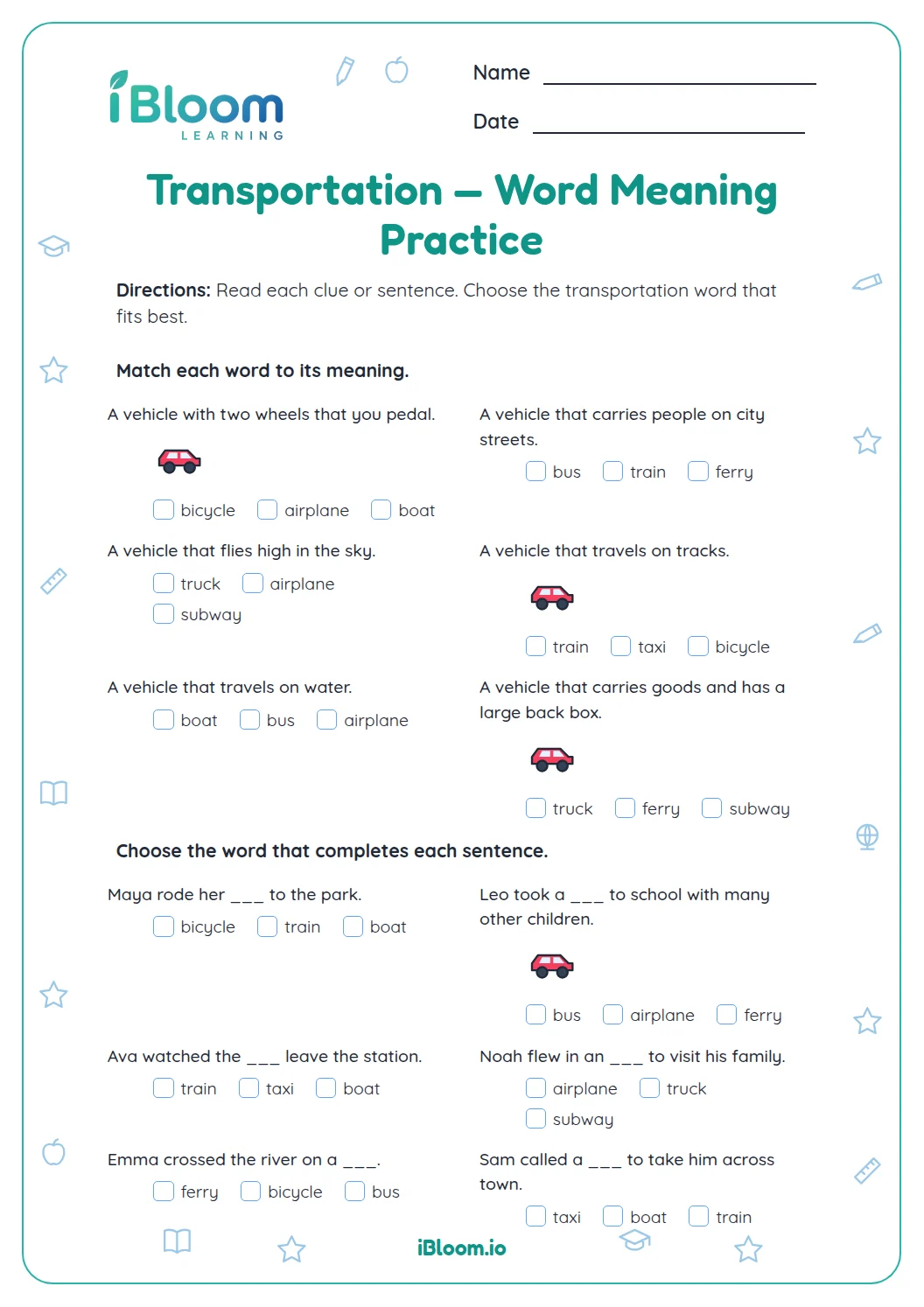
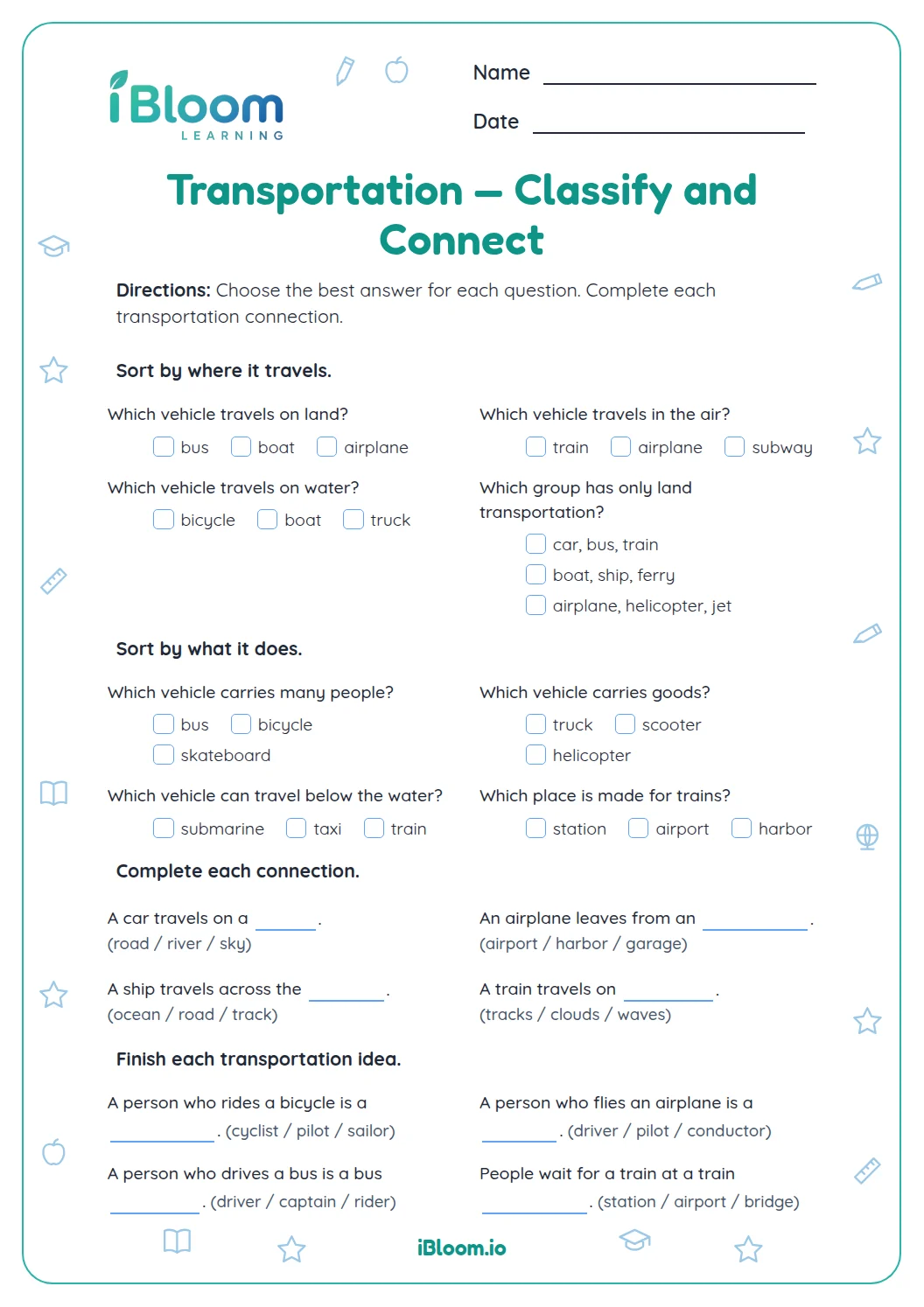
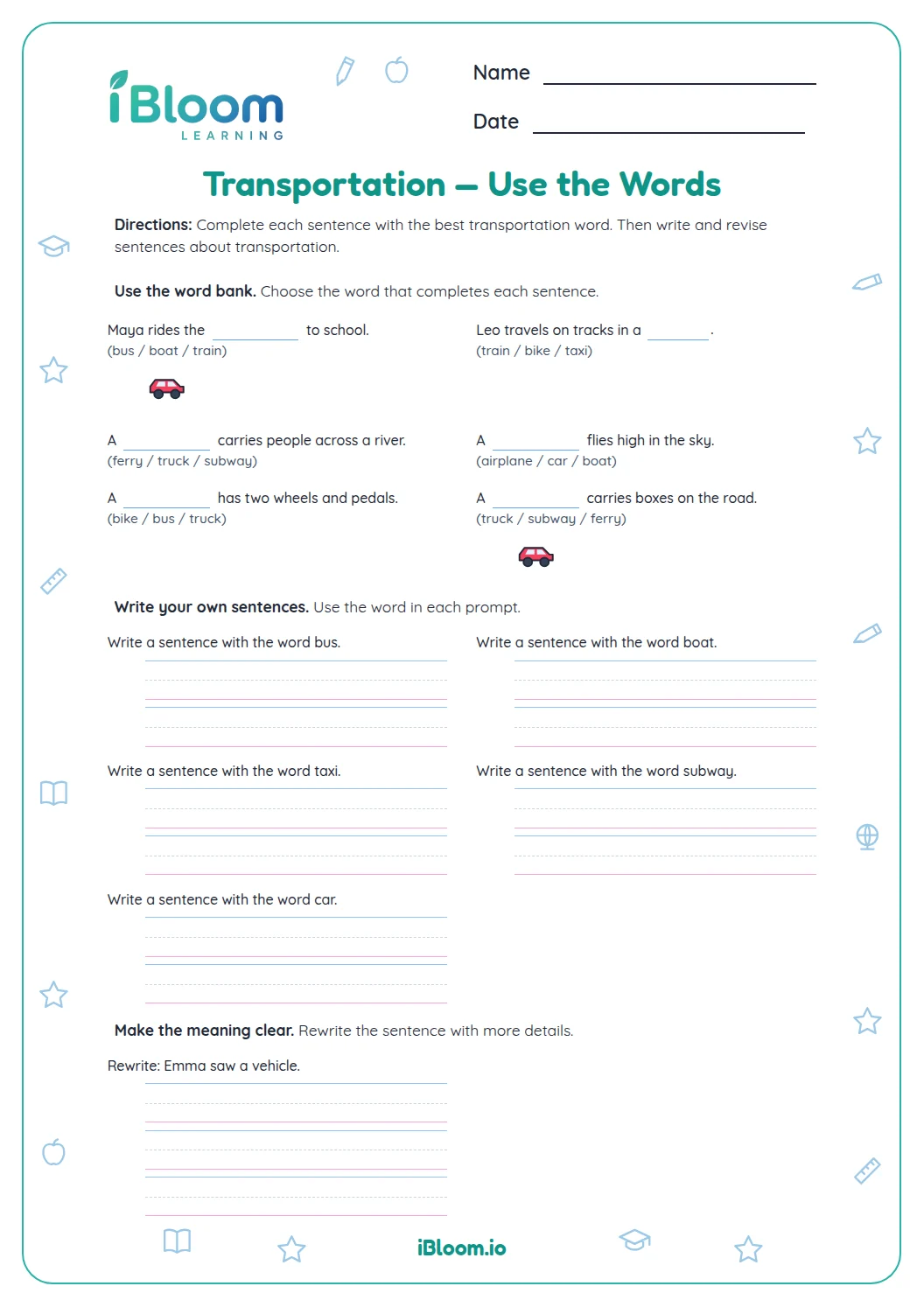
There are 14 questions across three worksheet pages, followed by three answer-key pages. One question is the word-search activity, and 13 are context-clue choices. The word search uses eight transportation words, each placed in a row from left to right.
Should students use a dictionary for the context questions?
Try the sentence clues first. Ask which details describe the word’s action, location or purpose, then compare the choices with those details. A dictionary can help confirm an unfamiliar meaning after the student has made an inference. The answer key supports checking afterward.