







About this worksheet
This free Grade 2 printable pairs an April Fools word search with meaning practice. Students use sentence clues and short definitions to fill in playful words, then find joke, prank, surprise, giggle, silly, trick, pretend and laugh in the grid. The activities keep the playful theme while asking children to think about what each word means in context. A separate answer key lists the choices and confirms the word-search targets.
Aligned to L.2.4.a
Which words will students find?
The word-search list includes eight short, familiar words related to jokes and playful surprises. Students may scan across, backward or down, then mark each target in the grid. Finding the word is only the first step; the next parts return to the same vocabulary and its meanings.
- joke · prank · surprise · giggle
- silly · trick · pretend · laugh
How do sentence clues help with word meaning?
A sentence often gives clues through an action or result. If friends hear a funny story and begin to do something, laugh is the word that fits. Rereading the whole sentence helps students use the situation instead of choosing a word by sound alone.
- 1“Maya told a funny story, and her friends began to ___.”
- 2The funny story is a clue that the friends began to laugh.
How are the final word choices different?
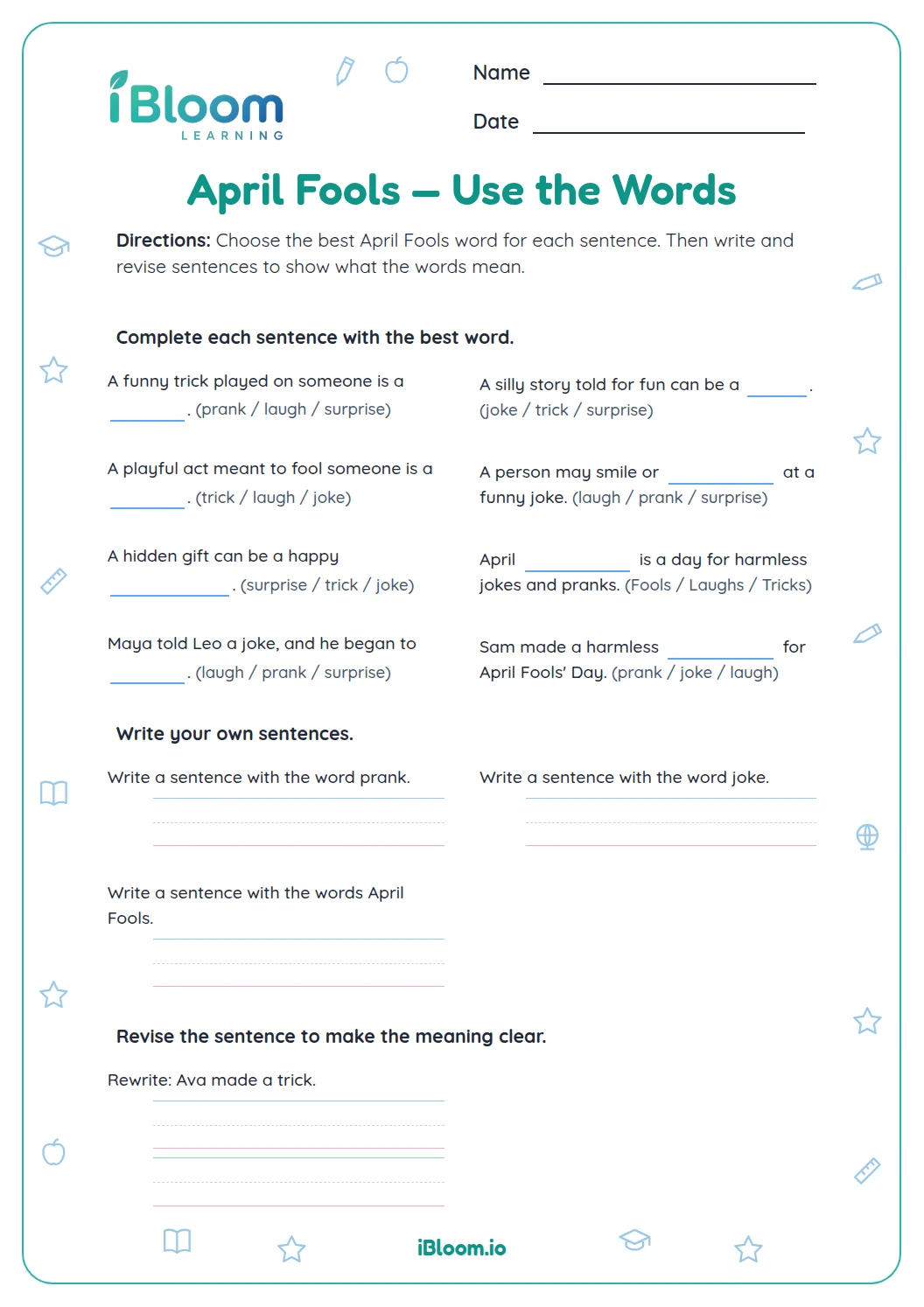
The last six questions give a short meaning and ask students to write the matching word. Some options are related, so look for the most exact fit: a giggle is a short happy sound, while laugh is the broader response. The key repeats the selected word for quick checking.
How to use the worksheet
- 1Read the word list and scan the grid in different directions.
- 2Mark a word only after matching all of its letters in order.
- 3Read each context sentence all the way through before choosing.
- 4For definition items, underline the key idea in the meaning.
- 5Check the answer key and revisit any word whose clue was unclear.
Common mistakes and quick fixes
The mistake
Choosing a word from the theme without checking the sentence.
The fix
Read the whole sentence and ask which word makes its action or result make sense.
The mistake
Mixing up related words such as giggle and laugh.
The fix
Notice whether the clue describes a short, quiet sound or a general response to something funny.
The mistake
Marking a near-match in the grid.
The fix
Check every letter in order and confirm the start and end of the target word.
Common Core alignment
This Grade 2 language standard connects directly to the sentence-clue questions in Part B.
Use a sentence clue to work out a word’s meaning.
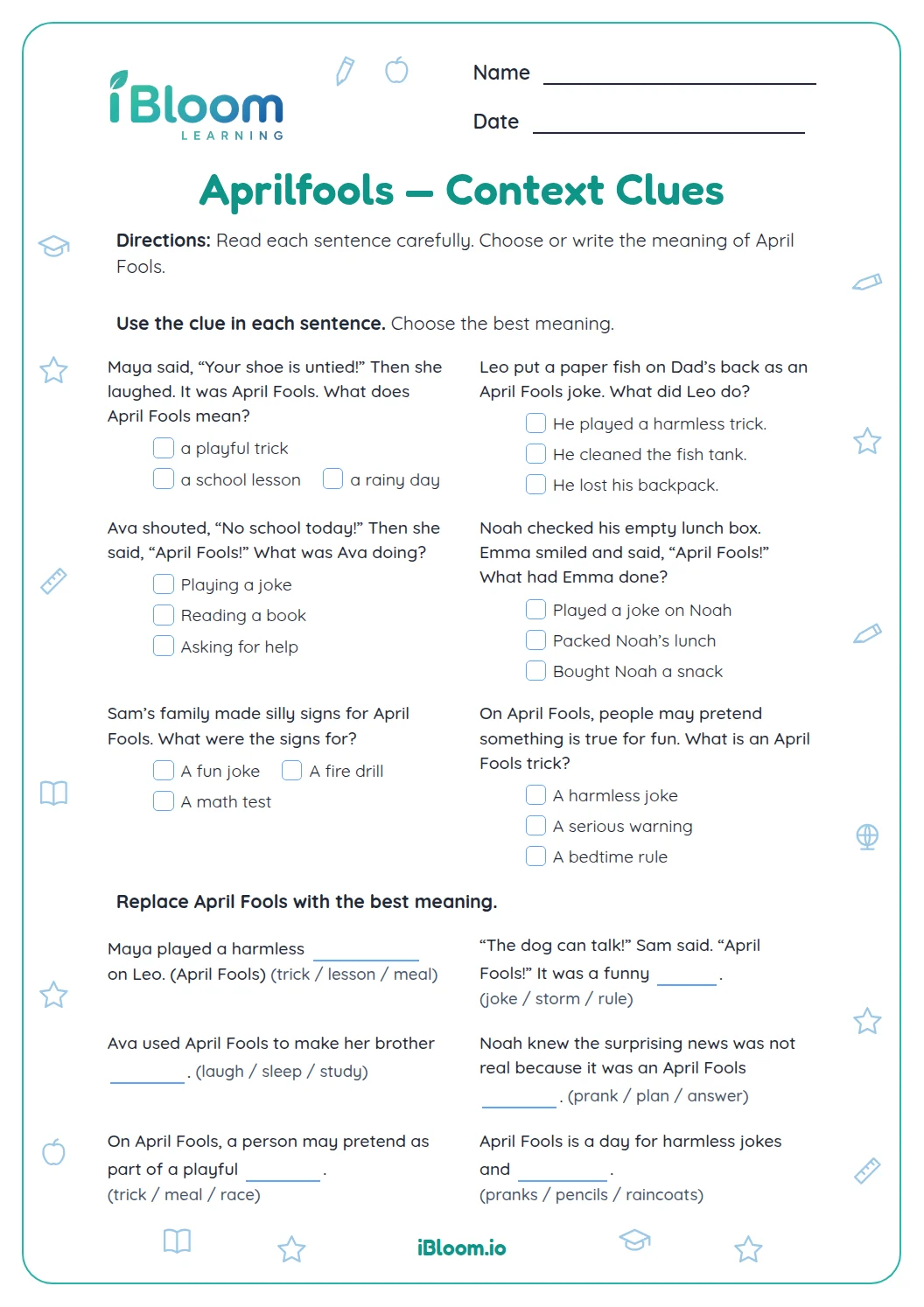
On this sheet: Part A uses sentence clues and definitions to identify playful vocabulary.
Show the official wordingHide the official wording
Use sentence-level context as a clue to the meaning of a word or phrase.
What to practice next
Make more practice
Further reading
Questions parents and teachers ask
Which eight words are hidden in the grid?
The word list is joke, prank, surprise, giggle, silly, trick, pretend and laugh. Students can look across, backward or down and mark each full word. The same words appear again in context and meaning questions so children work with the vocabulary beyond simply locating its letters.
Does the word search practice word meaning too?
The page pairs its word search with 13 context and meaning fill-ins. The repeated words help connect spelling with meaning. For example, a funny story gives a clue that friends may laugh. Students use the sentence or definition to write the matching word.
How can a child tell “giggle” from “laugh”?
A giggle is a short, often light or quiet sound made when amused. Laugh is a broader word for reacting to something funny. The sentence or definition gives a clue about which meaning is the better fit, so encourage your child to compare the whole clue with each option.
Are the word-search words hidden backward?
Yes. The directions allow words across, backward or down. Students should match each listed word letter by letter, then check that the whole sequence is present before marking it. The provided key notes that all eight listed words are the intended targets.
What should students do when two answer choices seem related?
Reread the full sentence or definition and look for its strongest clue. A joke and a prank are both playful, but one is something said to make people smile while the other is an action meant to fool someone briefly. Choose the word that matches the specific clue.