






About this worksheet
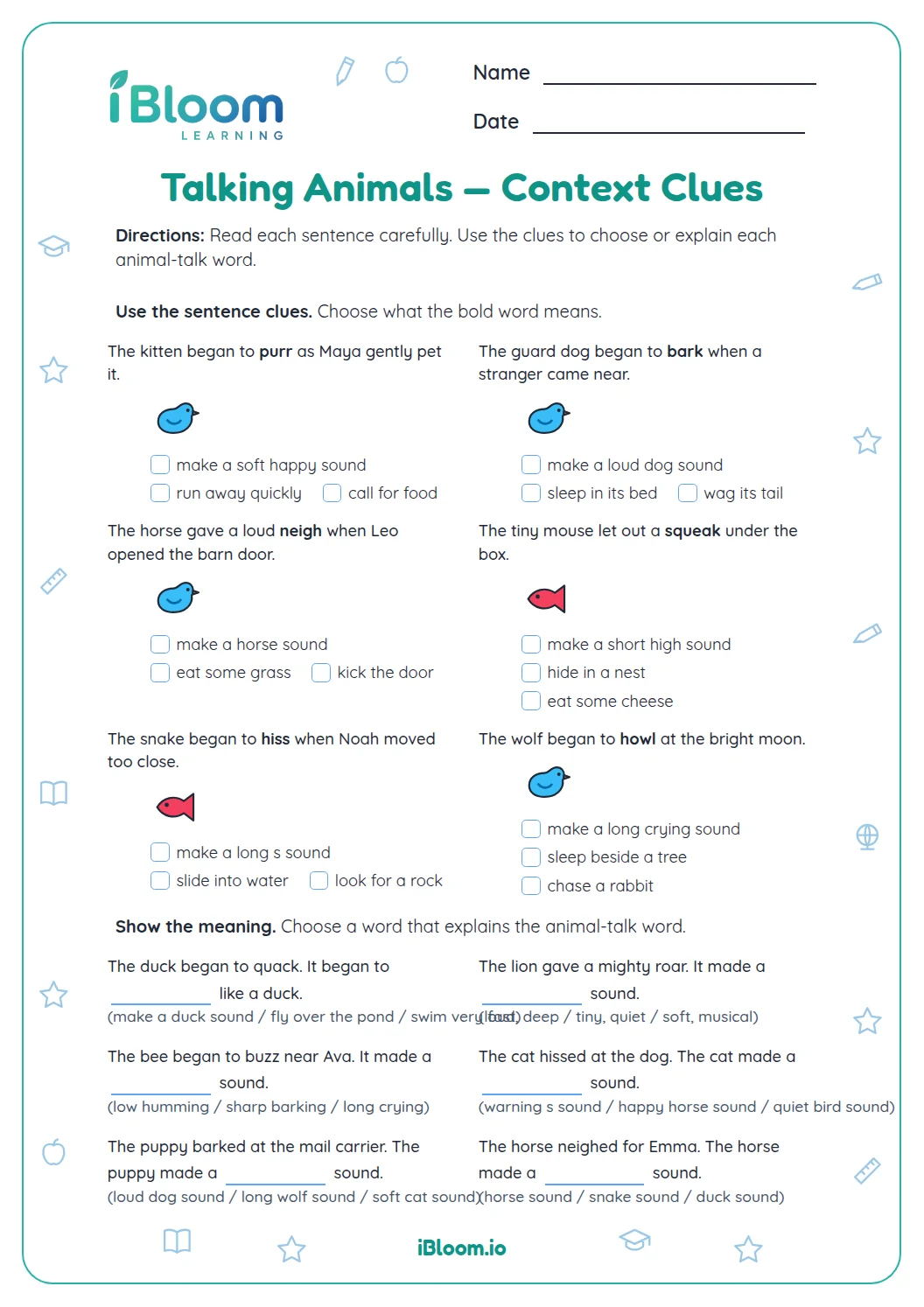
This free Grade 2 worksheet has 18 animal vocabulary questions in three parts. Children use clues to classify pets, farm animals, and wild animals, choose animals that make named sounds, and complete sentences with words such as bark, hiss, and bleat. The clues make each group choice clear: a duck raised by a farmer belongs in the farm group in that question. Matching sound words to animals practices CCSS L.2.5.a. A separate answer key gives every group, animal, and sound word.
Aligned to L.2.5.a
How do the clues make animal groups clear?
Pets, farm animals, and wild animals describe how animals live in these questions. Read the whole clue before choosing: a family keeps the dog as a pet, while a farmer raises the duck with chickens.
An animal can live in more than one setting. The duck clue specifies a farm so children can choose from the given groups without guessing where an unnamed duck lives.
Which sound words do children practice?
Part B connects moo, meow, quack, roar, and buzz to animals. Part C asks children to write bark, hiss, neigh, bleat, croak, hoot, and oink in animal sentences.
- 1A snake can ___. (bleat / hiss / oink)
- 2Bleat goes with a sheep; oink goes with a pig.
- 3A snake can hiss.
How do the three parts build the connections?
Part A sorts six animals using their living situations. Part B reverses the sound connection by giving a sound and asking for the animal. Part C names the animal and asks children to write its sound word.
Read an unfamiliar sound word aloud, then let your child choose and write it. After checking the key, cover the choices and ask for the same animal’s sound again.
How to use this worksheet
- 1Read the first animal clue together and choose its group.
- 2Complete Part A using the living situation in each clue.
- 3Say each sound in Part B and choose the matching animal.
- 4Read all three sound words before filling each blank in Part C.
- 5Check the key, then ask your child to name two animals and their sounds without choices.
Animal-word mix-ups to check
The mistake
Choosing wild animals for the duck raised by a farmer.
The fix
Use the clue about being raised with chickens; this duck belongs in the farm group.
The mistake
Writing neigh for a sheep.
The fix
Pair horse with neigh and sheep with bleat, then say each pair aloud.
The mistake
Choosing hiss for the owl.
The fix
Connect hiss with the snake and hoot with the owl before completing the sentence.
Common Core alignment
Connect animal names, living situations, and familiar sound words.
On this sheet: Children classify animals from clues and use sound words in animal sentences.
Show the official wordingHide the official wording
Identify real-life connections between words and their use (e.g., describe foods that are spicy or juicy).
What to practice next
Make more practice
Further reading
Questions parents and teachers ask
Why do the animal-group questions include clues?
The clues tell children which living situation to use when choosing a group. A duck might live in different settings, but this worksheet specifies a duck raised by a farmer with chickens. Use that detail to choose farm animals, just as the family-pet clue points to pets.
Which animals and sounds appear together?
The sheet connects twelve animals with familiar sound words: dog and bark, cow and moo, lion and roar, cat and meow, duck and quack, owl and hoot, bee and buzz, snake and hiss, horse and neigh, sheep and bleat, frog and croak, and pig and oink. Animal names recur in the group questions.
What should children write in the blanks?
Children write one sound word in each of the seven blanks in Part C. Three choices appear beside each sentence. For “A snake can ___,” the choices are bleat, hiss, and oink, so the child writes hiss. The answer key supplies the word for every blank.
Can I read the animal clues and sound words aloud?
Yes, read the clues and choices aloud while your child follows the print. You can also say an unfamiliar word such as neigh or bleat. Let the child decide which animal it matches, then reread the completed sentence together to connect the printed word with its meaning.
How is the answer key organized?
The key follows the same three parts as the worksheet and gives all 18 answers. It marks group and animal choices, then fills the seven sound-word blanks. When checking a group answer, return to the clue; when checking a sound answer, say the animal and sound together.