



About this worksheet
This free Grade 2 worksheet helps children use words for robots, their parts, and their actions. Six multiple-choice sentences practice battery, sensor, wheels, metal, code, and arms. Children then write five sentences using robot and slowly, move, screen, build, and machine. A final revision asks them to explain how a robot used its arm to help. These activities practice CCSS L.2.4a and L.2.6 through sentence clues and meaningful word use. The separate answer key supplies six fixed answers and six sample written responses.
Aligned to L.2.4a and L.2.6
Which robot words does the sheet teach?
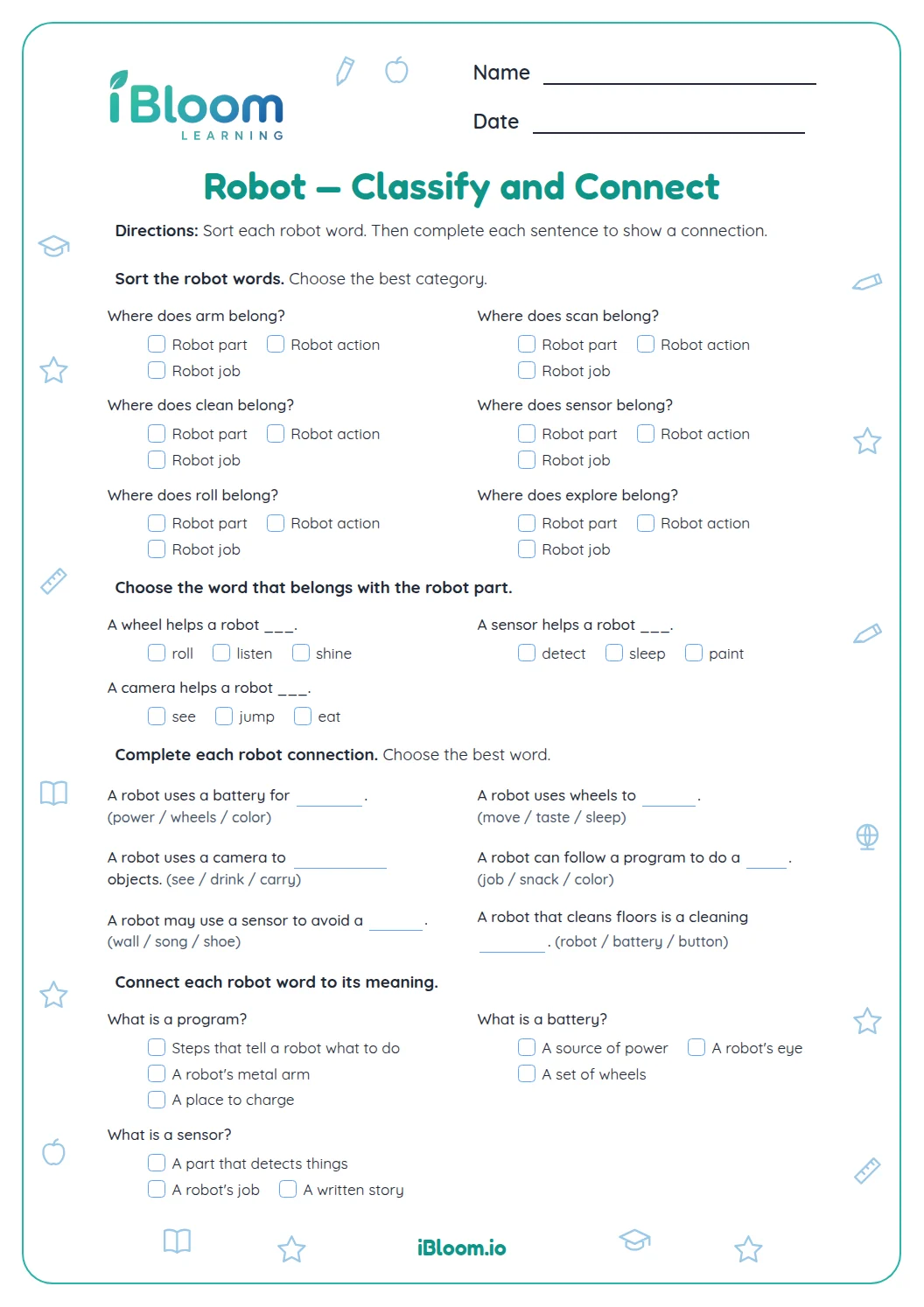
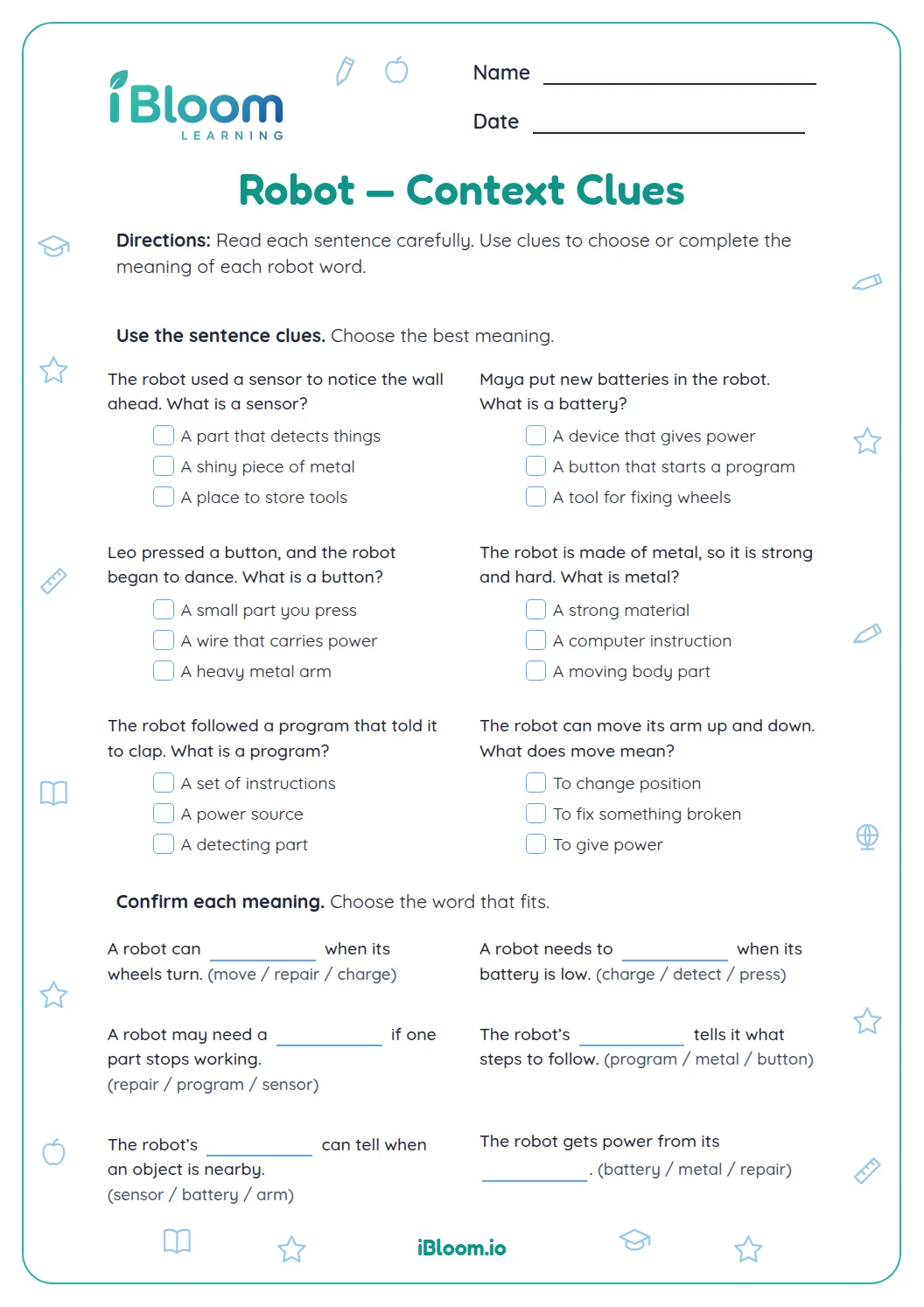
Part A connects six words to a job or property: battery supplies power, sensor detects something nearby, wheels roll, metal is a material, code gives instructions, and arms can lift. The sentences describe features of the robots in these examples.
Part B asks children to write sentences about robots using robot and slowly, move, screen, build, and machine. Part C asks them to add a helpful action to a sentence using arm. The writing shows whether children can use each word to tell a reader something clear.
How do sentence clues help children choose a word?
The words around a blank tell children what kind of meaning is needed. In question 1, “gives the robot power” points to a battery. A screen displays information, while an arm can lift or hold something.
Have children insert their choice and read the sentence aloud. If they can explain the connection in simple words, they are using the vocabulary rather than matching a familiar spelling.
- 1Its ___ gives the robot power.
- 2Choices: screen, battery, arm
- 3Clue: gives the robot power
- 4Answer: battery
- 5Complete sentence: Its battery gives the robot power.
What makes a robot sentence clear?
A clear sentence helps a reader understand an action or a part’s purpose. “The robot helped” gives little information. “The robot used its arm to lift a box” tells how it helped and makes arm meaningful.
For question 7, children use both robot and slowly. The adverb should describe an action, as in “The robot slowly rolls across the floor.” Questions 8–11 use move, screen, build, and machine. In question 12, children use arm to explain how the robot helped.
How to use this worksheet
- 1Say battery, sensor, code, and metal aloud and discuss a simple meaning for each.
- 2Read the first sentence and ask which word connects to power.
- 3Finish Part A by trying each chosen word in its sentence.
- 4Write the five Part B sentences; read each aloud to check that its meaning is clear.
- 5Revise the Part C sentence to explain how the robot helped. Check with the sample answers.
Mistakes to notice and how to help
The mistake
Choosing screen for the part that gives power.
The fix
Compare the jobs: a battery supplies power, while a screen shows a message.
The mistake
Writing “Build a robot” as a statement about who made a robot.
The fix
Name who builds it and add a detail: “We will build a robot with wheels.”
The mistake
Writing “I like robots” when the task asks for robot and slowly.
The fix
Keep both requested words and add an action that can happen slowly, such as rolling or lifting.
Common Core alignment
Use clues about robot parts and actions to choose words that fit sentences.
On this sheet: Part A uses sentence clues such as power, senses, and lift to connect robot words with their meanings.
Show the official wordingHide the official wording
Use sentence-level context as a clue to the meaning of a word or phrase.
Use robot vocabulary in clear sentences, including slowly to describe an action.
On this sheet: Part B asks children to write sentences with robot and slowly, move, screen, build, and machine; Part C asks them to clarify a sentence using arm.
Show the official wordingHide the official wording
Use words and phrases acquired through conversations, reading and being read to, and responding to texts, including using adjectives and adverbs to describe (e.g., When other kids are happy that makes me happy).
What to practice next
Make more practice
Further reading
Questions parents and teachers ask
Which words do children practice on this sheet?
Part A uses battery, sensor, wheels, metal, code, and arms in six sentence choices. Part B asks children to write with robot and slowly, move, screen, build, and machine. Part C returns to arm, asking children to explain how a robot used it to help.
How much independent writing does this sheet include?
Children write five original sentences and revise one short sentence. Each task names the word to use, and the first asks for both robot and slowly. Children can say an idea aloud before writing it, then check that the sentence uses the requested word and makes sense.
What does code mean on this worksheet?
Code means instructions that tell a robot what to do. In Part A, children complete a sentence about what directs the robot’s actions. You can connect the idea to an everyday list of steps, such as move forward, stop, and turn, while keeping the focus on the word’s meaning.
What should the sentence with slowly show?
It should use robot and slowly to describe an action. “The robot slowly rolls across the floor” is one example. Children may choose another sensible action, such as lifting a box or turning. Check that slowly describes how the action happens and that the whole sentence has a clear meaning.
How do I check the sentence-writing tasks?
Check that each Part B sentence uses its requested word and tells something sensible about a robot. For Part C, look for arm plus an action explaining how the robot helped. The key gives examples, but original sentences are welcome when they use the words accurately.