






About this worksheet
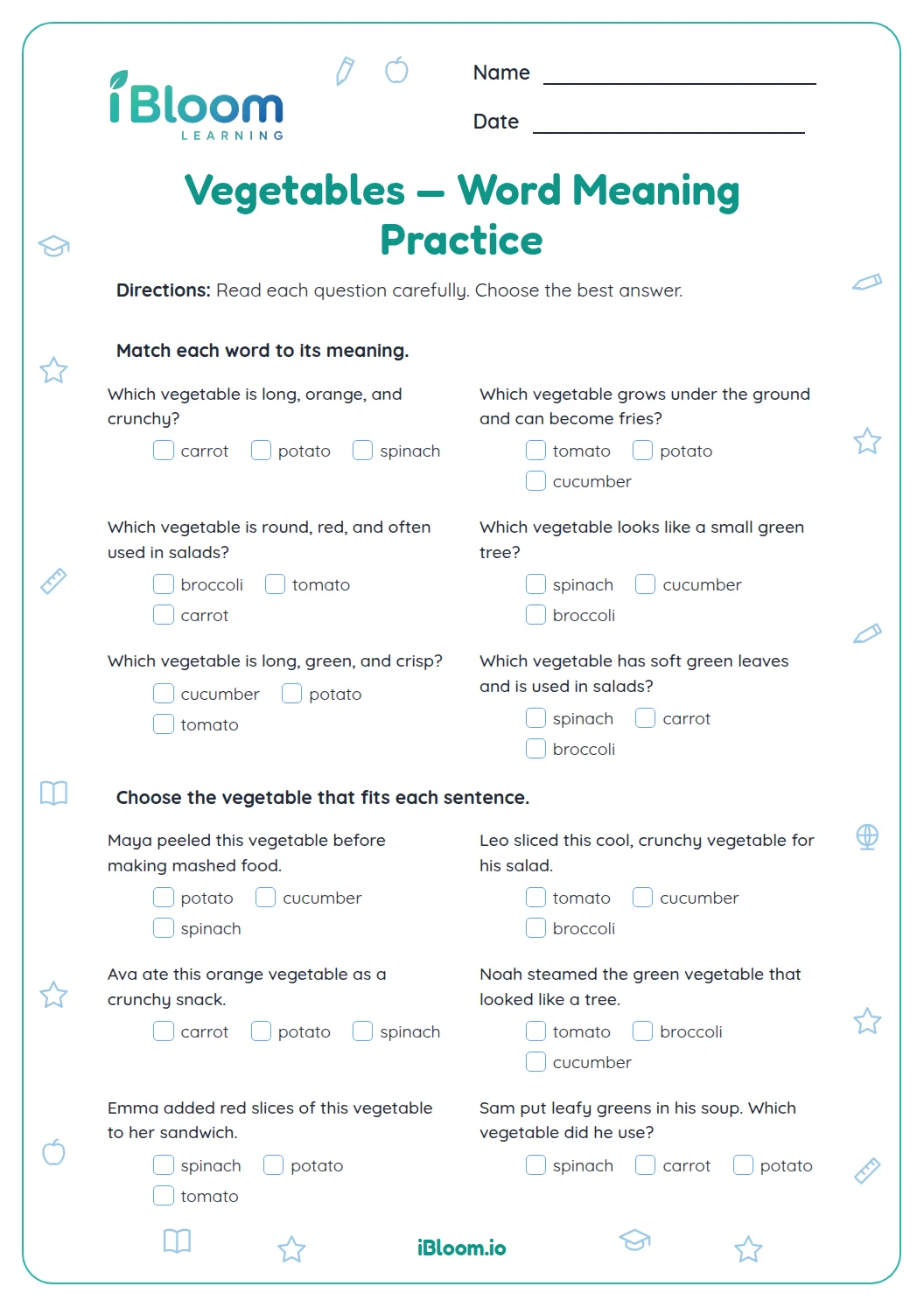
This Grade 2 vegetable vocabulary worksheet pairs an eleven-word search with reasoning about word meanings. Students find carrot, celery, spinach, pumpkin, broccoli, cucumber, tomato, pepper, lettuce, onion, and potato, then use sentence clues to identify vegetables and describe them. The 15 questions include a word-search activity, multiple-choice clues, sentence completions, and short writing. A separate answer key gives the search list and sample responses.
Aligned to L.2.4.a
How can students search for vegetable words?
Scan one row at a time and compare letter sequences with the word list. On this page, each target runs across a row. After finding a word, cross it off the list so attention can move to the remaining names.
How do sentence clues point to a vegetable?
Look for details about color, shape, texture, or how a food is prepared. “A crisp orange root that grows underground” gives several clues to carrot. More than one vegetable may be used in a real salad, so the specific descriptive details matter.
- 1“A crisp orange root that grows underground is a ___.” → carrot
- 2“Orange,” “root,” and “underground” all point to the same word.
How can a child explain a vegetable word?
Use an accurate detail that helps a reader picture or recognize it. “A cucumber is long and crisp” gives two clues. A comparison can also show how two vegetable words differ, such as a carrot’s orange color and lettuce’s leafy shape.
How to use this worksheet
- 1Read the eleven-word list before beginning the search.
- 2Search across one row at a time and circle each whole vegetable word.
- 3Read every clue carefully; notice details such as color, shape, texture, and preparation.
- 4Write one word for each completion, then reread the full sentence.
- 5Use a clear detail in each open response and compare with the sample key.
Common mistakes and quick fixes
The mistake
Choosing any salad vegetable for a clue about an orange underground root.
The fix
Use every clue in the sentence. Orange, root, and underground together identify carrot.
The mistake
Mixing up celery and cucumber because both are crisp and green.
The fix
Look at the shape clue: celery is a stalk, while cucumber is long and can be sliced into rounds.
The mistake
Writing a vegetable name without explaining it in the response.
The fix
Add one detail about color, shape, texture, or use so the reader can tell what the word means.
Common Core alignment
The sentence clues connect vegetable names with details that signal their meanings.
Use sentence-level context as a clue to the meaning of a word or phrase.
On this sheet: Students use context clues to select vegetable words that fit descriptions.
Show the official wordingHide the official wording
Use sentence-level context as a clue to the meaning of a word or phrase.
What to practice next
Make more practice
Further reading
Questions parents and teachers ask
Which words are hidden in the search?
The grid contains carrot, celery, spinach, pumpkin, broccoli, cucumber, tomato, pepper, lettuce, onion, and potato. Each word runs across a row. Students can check off a word as soon as they circle it so they do not search for the same word twice.
How do context clues help find the right vegetable?
Context clues are details around a word or blank that narrow its meaning. In “a crisp orange root that grows underground,” the color, texture, and growing place all point to carrot. Using several clues together is more reliable than guessing from one detail.
What evidence shows Liza keeps learning after the bee?
After the contest, Liza opens her study book and adds a note beside “describe”: “Picture an example before spelling.” That action shows she plans to use what she learned in future practice. The note is direct evidence for the inference that she wants to keep improving.
Why does Liza receive a ribbon even though she does not win?
The passage says Liza receives a ribbon for careful listening. She does not win the bee, but the ribbon recognizes a specific strength she showed while listening to the judge. The answer comes directly from the final paragraph, so it is a text detail rather than an inference.
Can students give different answers to the writing questions?
Yes. Questions 13–15 ask students to use or describe words, so different accurate sentences can work. The answer key gives examples: a salad idea, a shape or texture detail, and a comparison. Check that the vegetable word is used correctly and the sentence makes sense.
What can we practice after the vegetable search?
Try another Grade 2 themed word search, such as frozen foods, cheese, spring, or toppings. Students can also make a word list and write a short clue for each word, using color, shape, texture, or how the food is prepared.