





About this worksheet
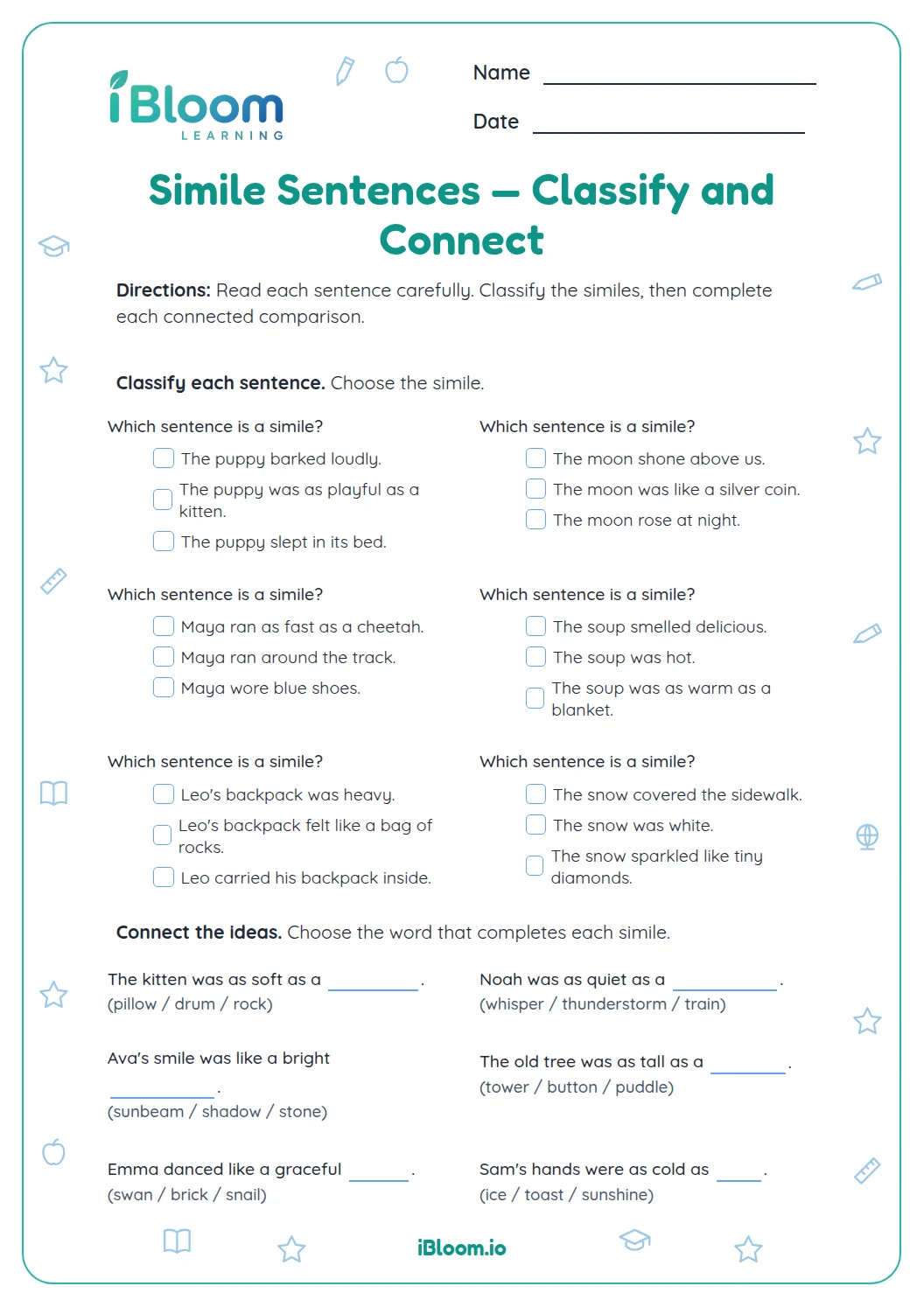
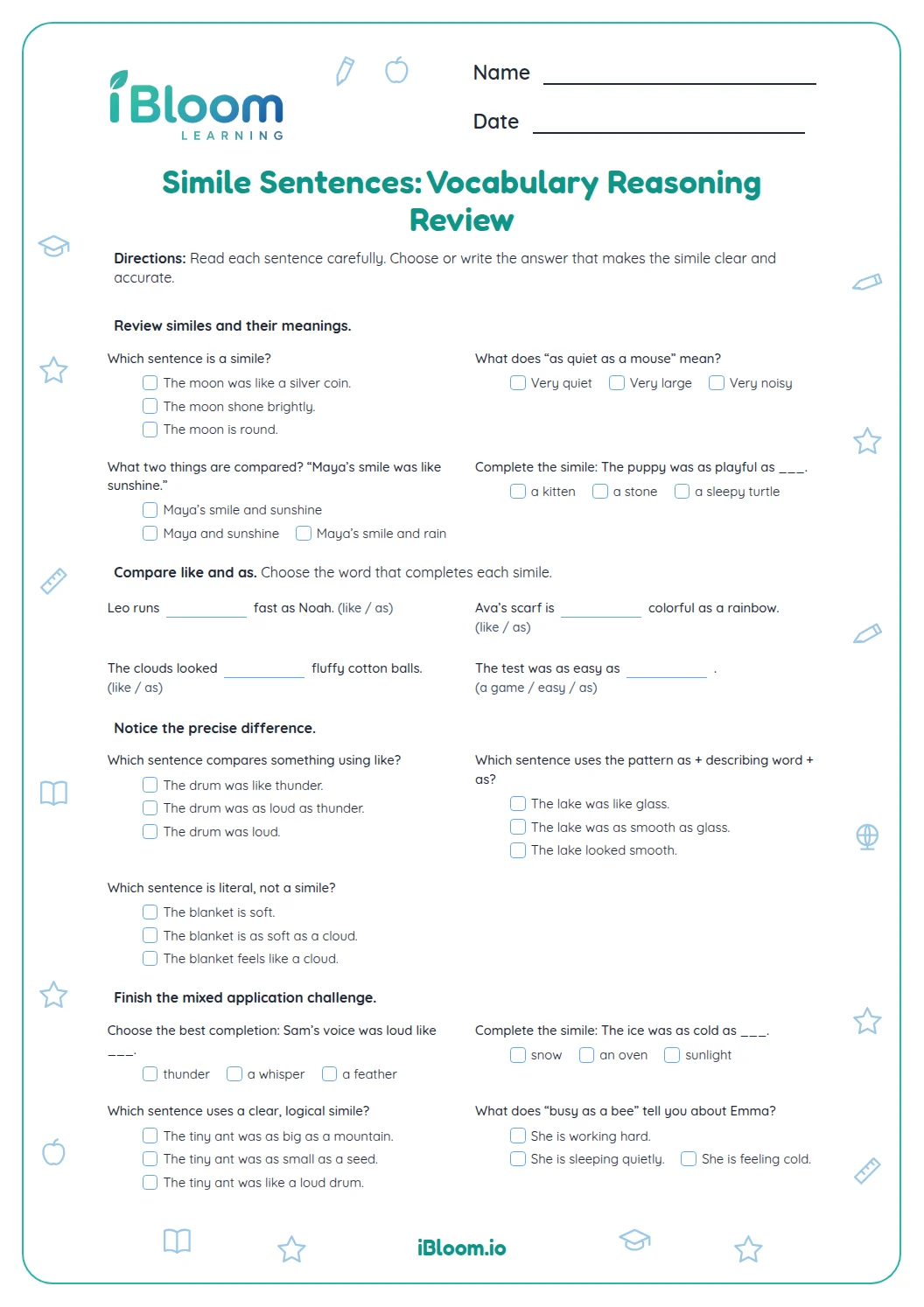
This Grade 3 worksheet keeps the original progression: choose a word or phrase that completes a simile, interpret what a comparison suggests, complete fresh sentences, and write two original similes. Four choice questions have one best answer; the answer key gives sample responses for the written prompts. The sentence work practices CCSS L.3.5.
Aligned to L.3.5
How do you choose a fitting comparison?
Read the quality in the sentence, then choose a comparison that makes it easy to imagine. In question 1, “hungry” fits a wolf better than a feather or a window. The comparison is not literal; it emphasizes the feeling.
- 1Lee was as hungry as a wolf.
- 2The comparison emphasizes how hungry Lee felt.
What does a simile suggest?
A simile uses like or as to connect two unlike things. Question 6 compares a voice to a clear bell; it suggests the voice is easy to hear, not that the speaker is a bell.
How can a student make an original simile?
Name a quality, choose a concrete comparison that helps a reader picture it, and connect the two ideas with like or as. Questions 9 and 10 ask for original comparisons; the final four prompts let learners complete a simile.
A quick way to read each simile
- 1Find the person, object, or sound being described.
- 2Name the quality, such as cold, bright, or loud.
- 3Read the comparison after like or as.
- 4Choose what that comparison suggests in the sentence.
- 5For an original simile, check that the comparison makes the quality clear.
Simile mistakes to check
The mistake
Taking the comparison literally.
The fix
Ask which quality is being compared; the voice is easy to hear, not a bell.
The mistake
Choosing a comparison that does not match the quality.
The fix
Read the whole sentence and connect the comparison to the described feeling or sound.
The mistake
Writing a comparison without like or as.
The fix
Use one of those words to make the relationship between the two unlike things clear.
Common Core alignment
The worksheet interprets figurative comparisons in context.
Understand figurative language and word relationships in context.
On this sheet: Learners interpret what each simile suggests and compose comparisons using like or as.
Show the official wordingHide the official wording
Demonstrate understanding of figurative language, word relationships and nuances in word meanings.
What to practice next
Make more practice
Further reading
Questions parents and teachers ask
What is a simile?
A simile compares unlike things using like or as. “The snow was as white as a sheet” compares the snow’s color with a familiar object to help the reader picture it. The comparison helps readers picture a quality rather than name a literal identity.
How does question 8 use a simile?
It says a voice is “as clear as a bell.” The comparison suggests the voice is easy to hear; it does not mean the speaker is actually a bell. The phrase describes how the voice sounds, which is the quality to notice.
Can a child write a different answer from the key?
Yes. The key gives one sample for each of the two open writing prompts. Another comparison is suitable when it uses like or as and clearly communicates the quality named in the prompt. The four final sentence completions also accept the fitting comparison shown in the key.
Why do the choices include silly comparisons?
The choices help learners compare how well each word matches the sentence. A feather or window does not fit the feeling of hunger, while a wolf makes the comparison clear. This makes the fitting choice clear without treating the comparison as a fact.
Does the worksheet include an answer key?
Yes. The separate key marks the best choice for each of the four selection questions, explains the meaning responses, supplies answers to the six sentence completions, and gives sample responses for both original writing prompts. Each sample uses the feature named in its prompt.