
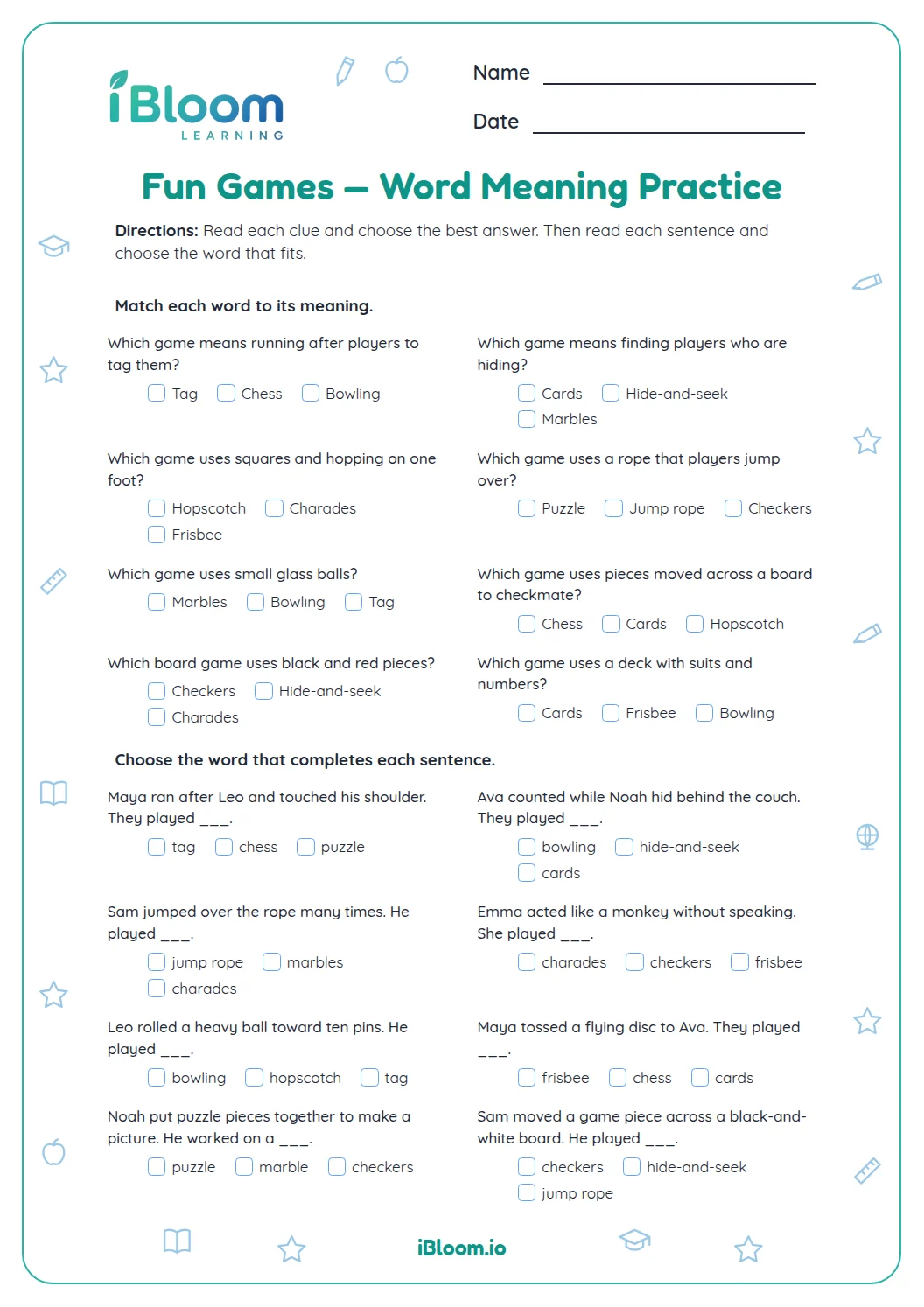
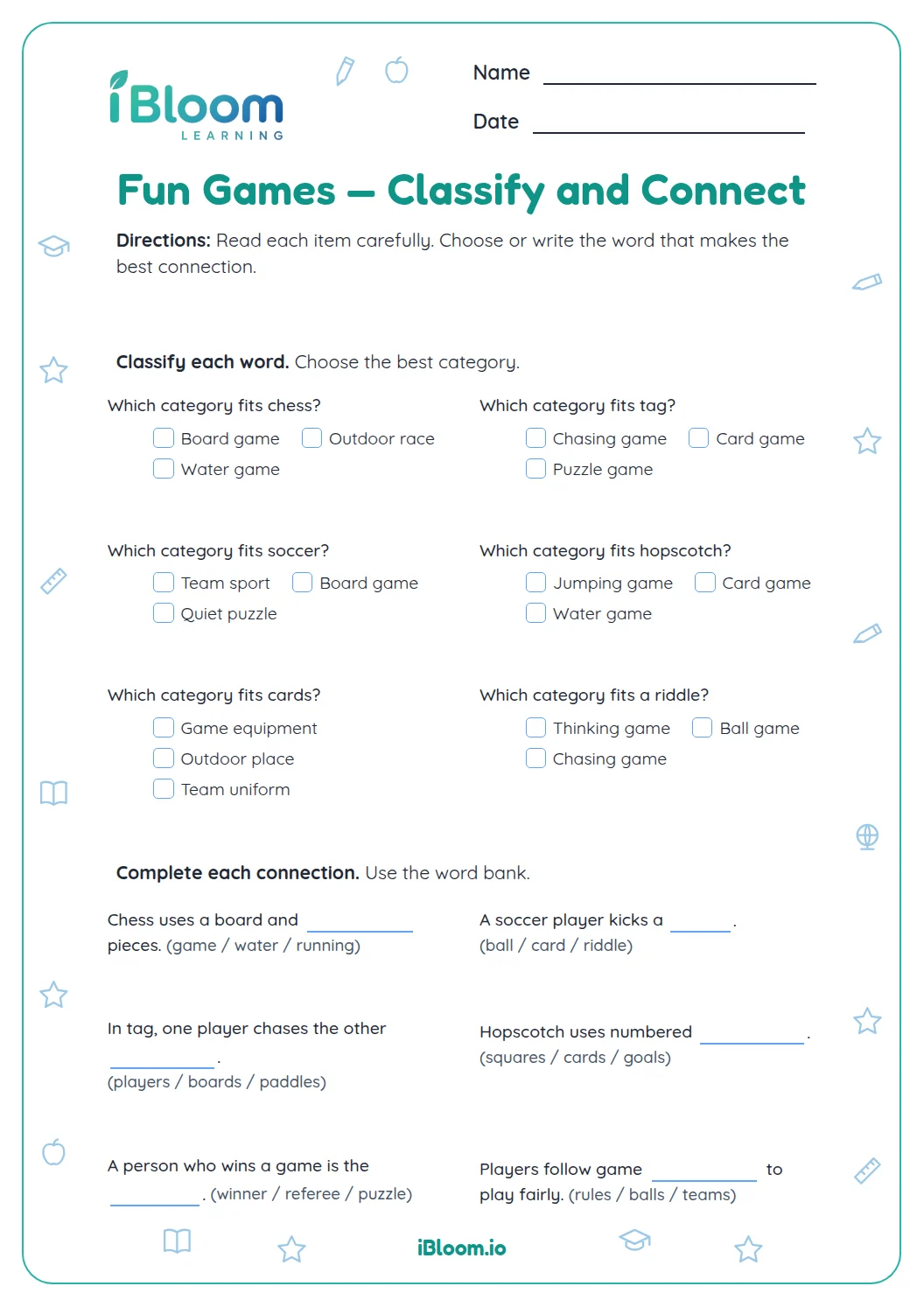
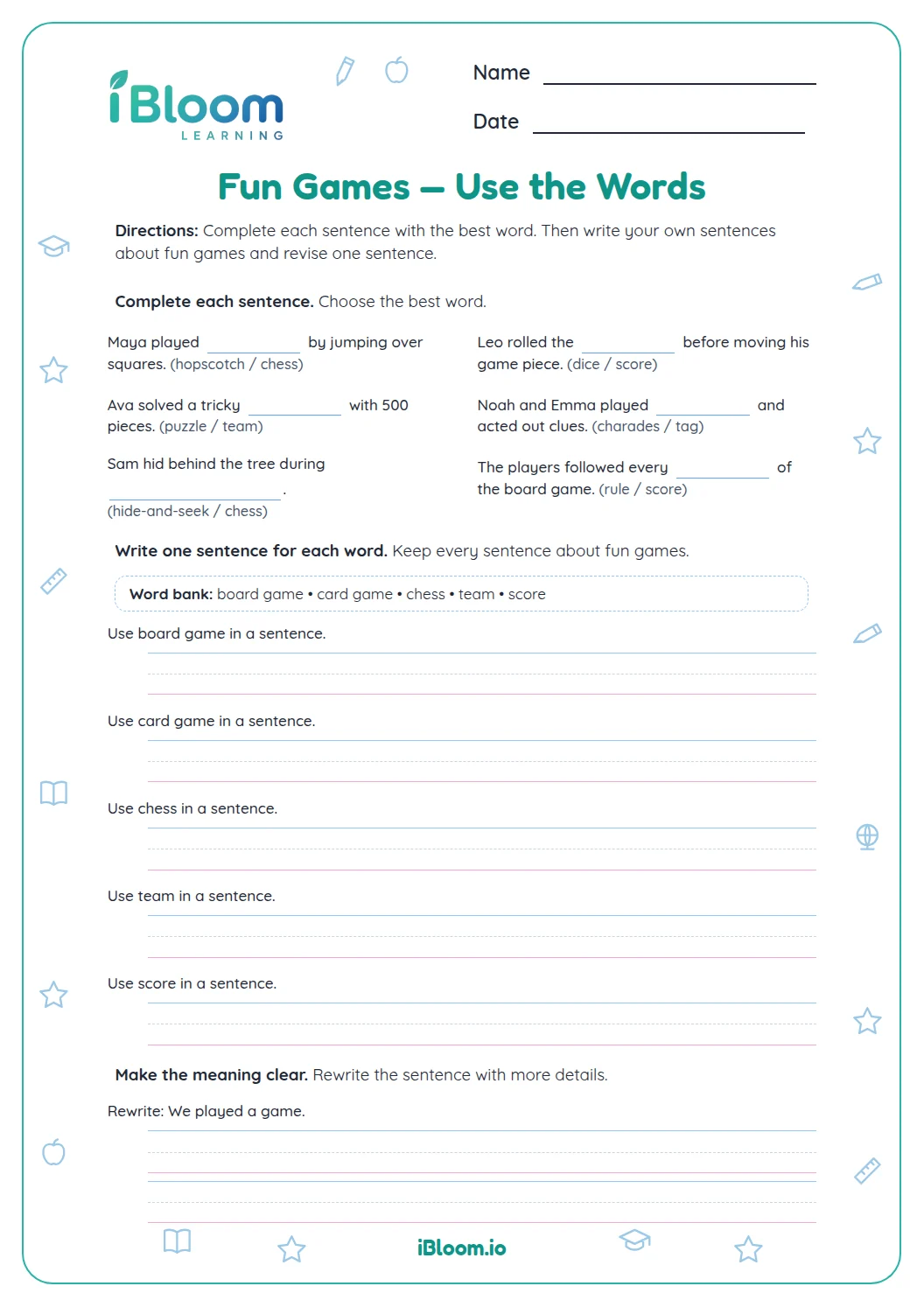
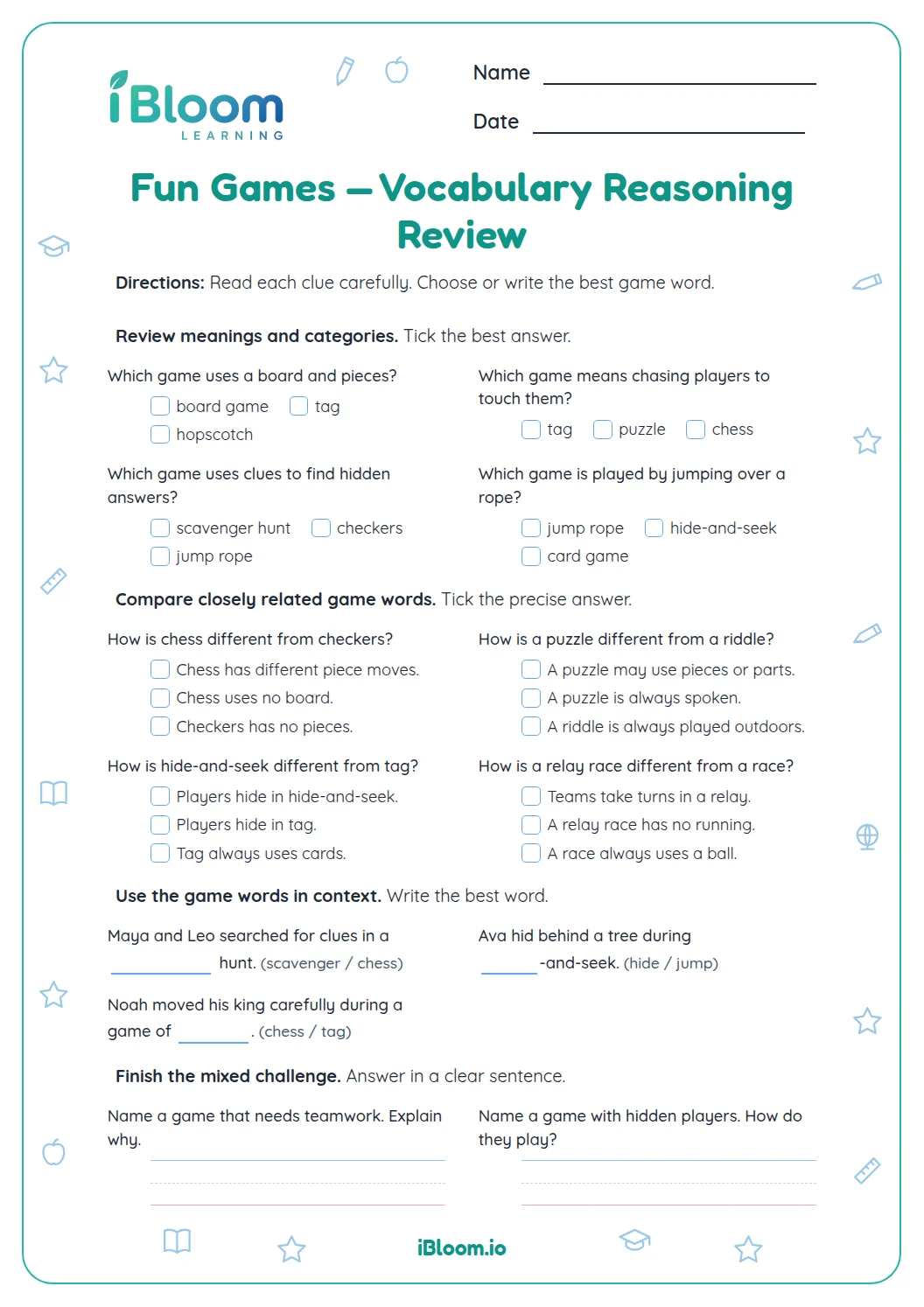



About this worksheet
This Grade 3 worksheet uses familiar games and play to practice context clues. In Part A, readers use sentence details to work out meanings such as eager, narrow, and timid. Part B asks them to match short game-related clues to words such as pause, referee, and teammate. The 14 multiple-choice questions align with CCSS L.3.4a, and a separate answer key is included.
Aligned to L.3.4a
Which details reveal a word’s meaning?
A context clue is information around a word that helps a reader understand it. In “Nora was eager to start the puzzle, so she opened the box right away,” opening the box right away signals that eager means excited to begin.
The first part of this sheet uses full sentences so children can connect the target word to a useful detail instead of guessing from the word alone.
How can a reader test a possible meaning?
Read the sentence again with the chosen meaning in place of the target word. If the sentence still makes sense, the meaning fits. For “The path was narrow, so only one child could walk on it at a time,” not wide fits the clue about one child at a time.
- 1The path was narrow, so only one child could walk on it at a time.
- 2Clue: only one child could walk at a time
- 3Try “very long”: it does not explain why only one child fits.
- 4Try “not wide”: it matches the clue.
- 5Answer: not wide
What kinds of game words appear here?
Part A has seven sentence questions, including eager, narrow, gather, simple, turns, timid, and clever. Part B has seven short clues for words connected to games, including pause, play, referee, and teammate.
- Part A: 7 sentence context questions
- Part B: 7 game-word meaning questions
- 14 multiple-choice items total
- Answer key on separate pages
How to work through the context clues
- 1Read the complete sentence before looking at the choices.
- 2Point to the detail that hints at the target word.
- 3Try each possible meaning in the sentence.
- 4For Part B, compare the clue with every word choice.
- 5Use the key to check and explain any answer that needs another look.
Common context-clue slips
The mistake
Choosing a familiar meaning without checking the sentence.
The fix
Use the clue about one child fitting on the path to see why narrow means not wide.
The mistake
Looking only at the target word and skipping the detail after it.
The fix
Read the whole sentence aloud, then name the clue before choosing.
The mistake
Picking a game word that matches only part of a clue.
The fix
Check every word in the clue; a referee judges a game, while a teammate is on your side.
Common Core alignment
This vocabulary practice uses sentence context to clarify word meaning.
Use sentence clues to work out what a word means.
On this sheet: Part A asks readers to use sentence details to identify word meanings.
Show the official wordingHide the official wording
Use sentence-level context as a clue to the meaning of a word or phrase.
What to practice next
Make more practice
Further reading
Questions parents and teachers ask
How does this worksheet teach context clues?
Readers use details around a target word to choose a meaning that fits the whole sentence. For example, a path that lets only one child walk at a time gives a clue that narrow means not wide. Part B applies the same careful matching to game words.
Which words do children practice?
Part A includes eager, narrow, gather, simple, turns, timid, and clever in short sentences. Part B asks readers to match clues with pause, play, referee, teammate, and other game words. The answer key supports a quick review of each choice and routine.
Is this a word search puzzle?
The page title comes from a fun-games vocabulary collection, but this particular sheet practices context clues using multiple-choice items. Children read a sentence or clue and select a meaning; they do not search a letter grid on this page today.
How should I help if my child misses an item?
Ask which words in the sentence give a hint, then reread it with each answer choice in place of the target. For a game-word clue, check whether the choice matches the complete description, not just one familiar word that sounds related.
How long does the sheet take?
Most learners can work through 14 questions in about 15 minutes. Reading the sentences aloud or talking through why a clue supports one meaning may take longer, and the two parts can be completed in separate short sessions for most third graders.