


About this worksheet
This Grade 3 vocabulary printable uses a dance word search as the starting point for meaning practice. Children find words such as rhythm, ballet, and tumble, then match meanings and complete short prompts with precise dance words. The answer key lists the hidden words and gives sample responses. Clue questions and sentences practice CCSS L.3.4.a by using context to understand word meaning.
Aligned to L.3.4.a
How do you work through the word search?
Find each listed word in the letter grid and circle it. Words may run in different directions; check the key if you need to confirm a location.
How do clues help with word meaning?
Part B describes a dance word instead of giving it. Use the clue’s details to write the term that fits.
- 1“A steady pattern of beats in music” describes rhythm.
- 2Write rhythm as the matching vocabulary word.
How can children use the vocabulary?
Part C gives short meaning prompts to complete. The final items ask children to supply a dance word that makes each clue or sentence clear.
How can I use this worksheet?
- 1Scan the grid for one listed word at a time.
- 2Circle a found word and cross it off the list.
- 3Read each meaning clue for details about movement, music, or performance.
- 4For sentence prompts, use the word so its meaning is clear.
- 5Check spelling and compare open responses with the sample key.
What mistakes should I watch for?
The mistake
Mixing up words with related but different meanings.
The fix
Explain the action in your own words before selecting a term.
The mistake
Writing a sentence that includes the target word but does not show its meaning.
The fix
Add a detail that makes the word’s meaning clear.
The mistake
Skipping a word in the search list.
The fix
Cross out each word only after finding and circling it.
Common Core alignment
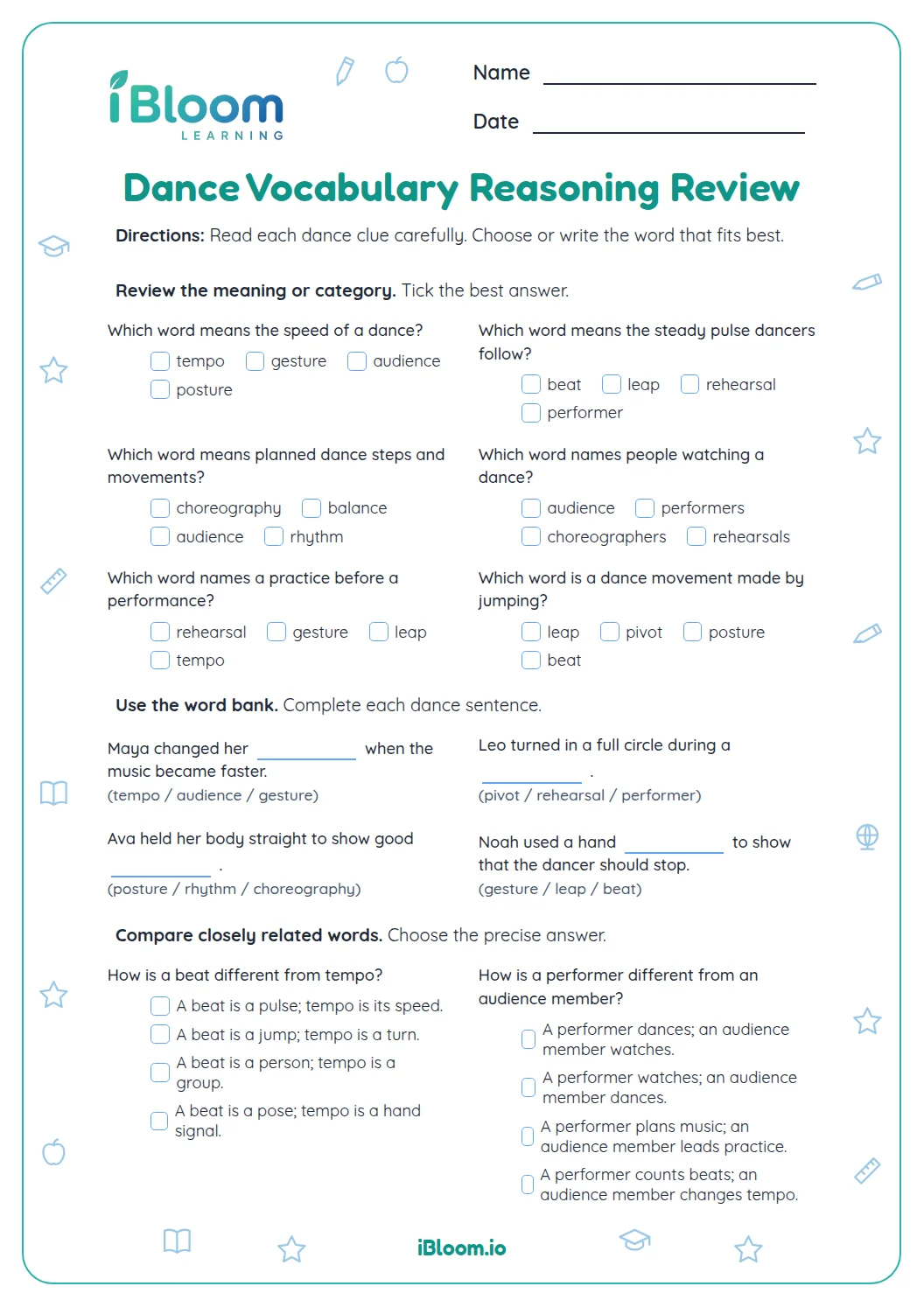
The clues and short responses ask students to use word meanings in context and connect related dance vocabulary.
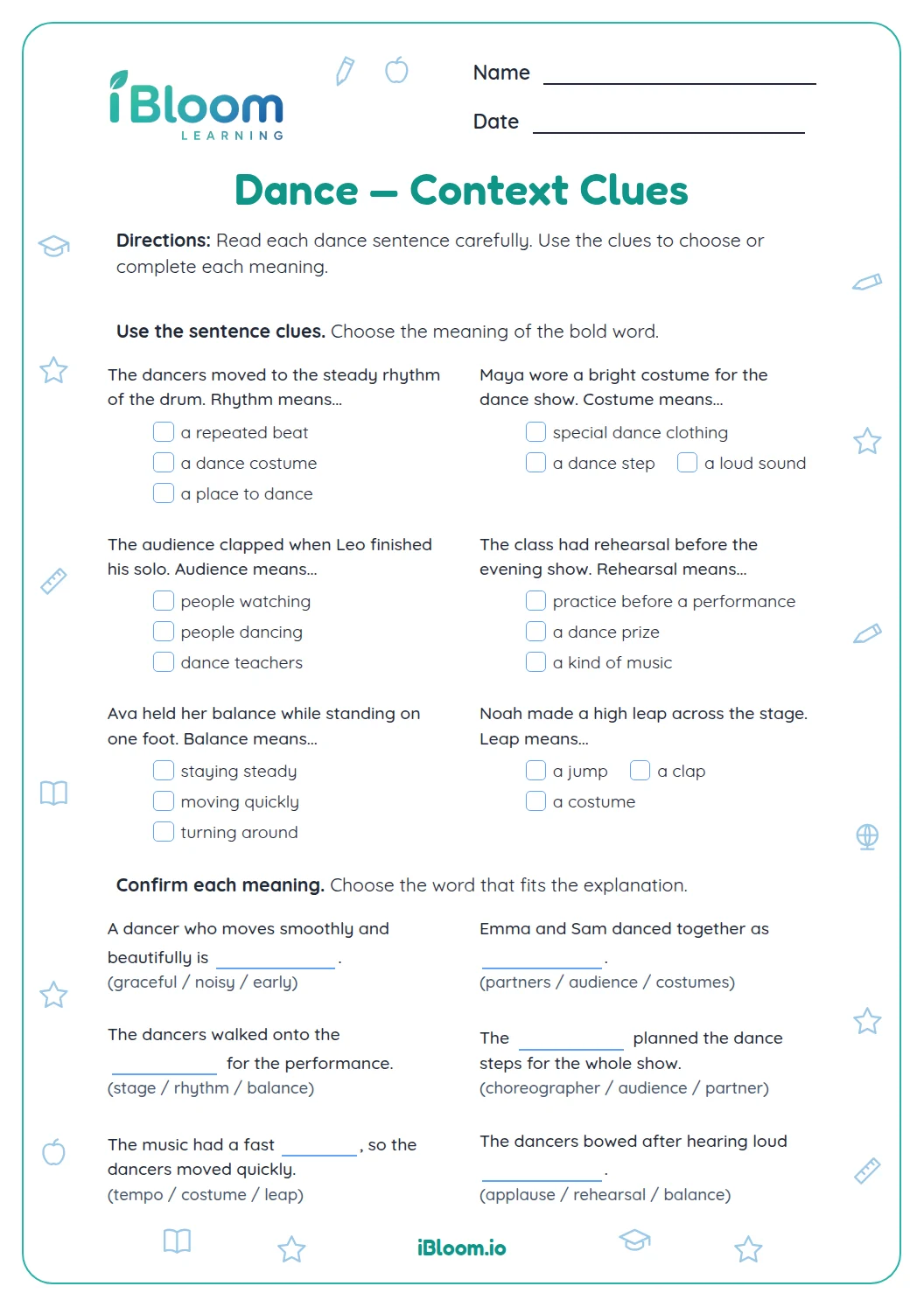
Use a sentence clue to identify what a dance word means.
On this sheet: Meaning clues and sentence responses practice using context to understand vocabulary.
Show the official wordingHide the official wording
Use sentence-level context as a clue to the meaning of a word or phrase.
What to practice next
Make more practice
Further reading
Questions parents and teachers ask
Which dance words are included?
The word search contains three targets: rhythm, ballet, and tumble. The follow-up clues and sentences practice more dance words, including stage, leap, costume, glide, twirl, beat, move, hop, and spin. Children meet each word in a short definition or sentence rather than searching for all of them in the grid.
How many questions are there?
There are 14 numbered questions in three parts: one word search, five meaning clues, and eight sentence completions. The word search has three target words, and the remaining prompts revisit dance vocabulary in context. The worksheet and answer key each have two pages.
How does this worksheet teach word meaning?
Children first find rhythm, ballet, and tumble in the grid. Next they match short definitions to words such as stage, leap, costume, and glide. The final prompts place dance words in sentences, giving children a chance to connect meaning with how a word is used.
What if a sentence answer differs from the key?
Use the key as a guide for the intended vocabulary word. Most sentence blanks point to one word from the worksheet, such as beat in “the steady ___ of music.” If a child offers another word, ask whether it fits the sentence and matches the dance meaning being practiced.
Is the word search the only activity?
No. The grid is only the first question. Five definition clues follow, then eight sentence completions use dance words in context. That gives children practice recognizing three words in the puzzle and applying a wider set of words about movement, music, and performance.
How long does it take?
Plan for about 15 minutes for all 14 questions. Finding three short words in the grid is a brief start; the meaning clues and sentence completions take most of the practice time. A child can finish one part at a time and check the separate two-page key afterward.