



About this worksheet
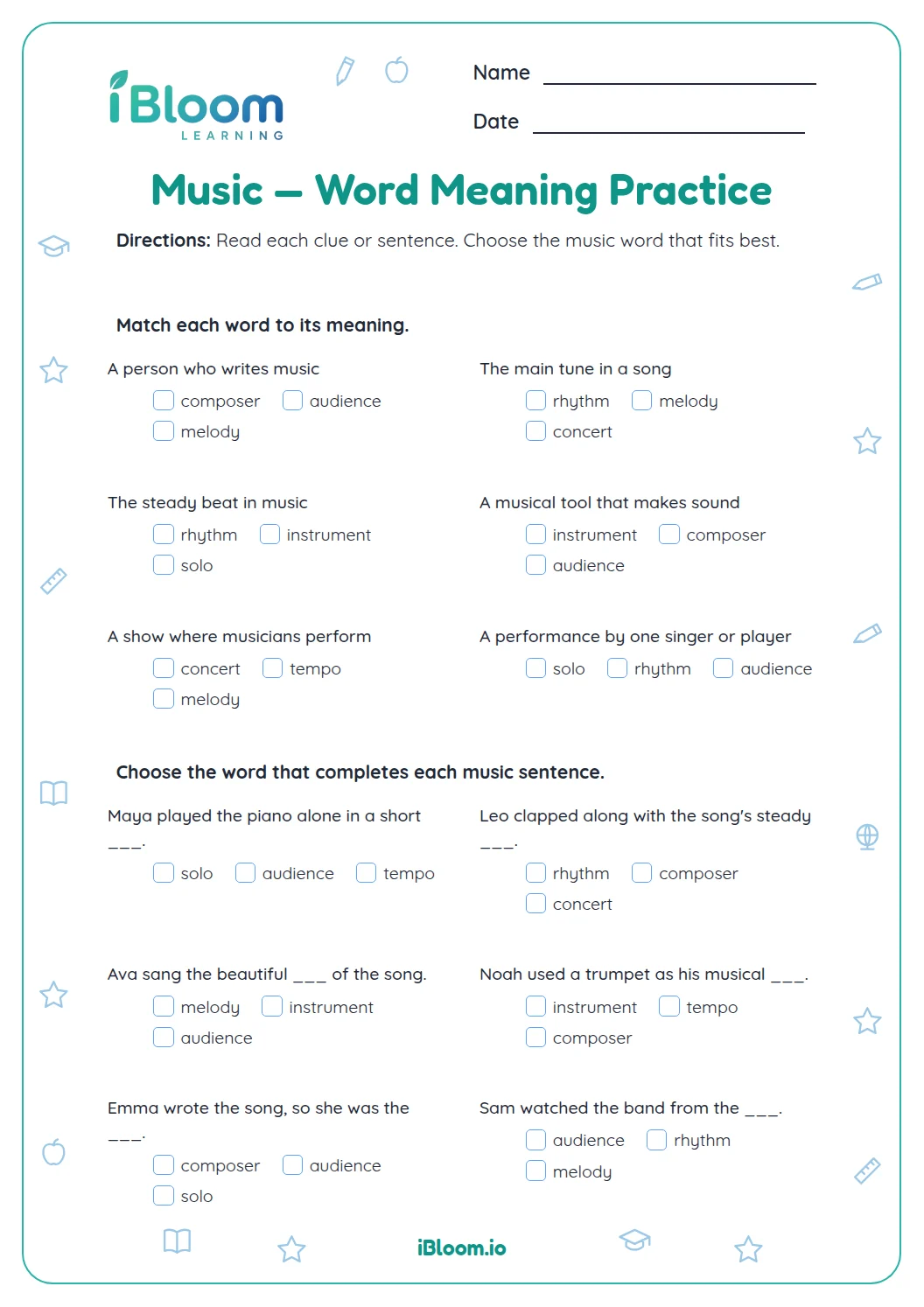
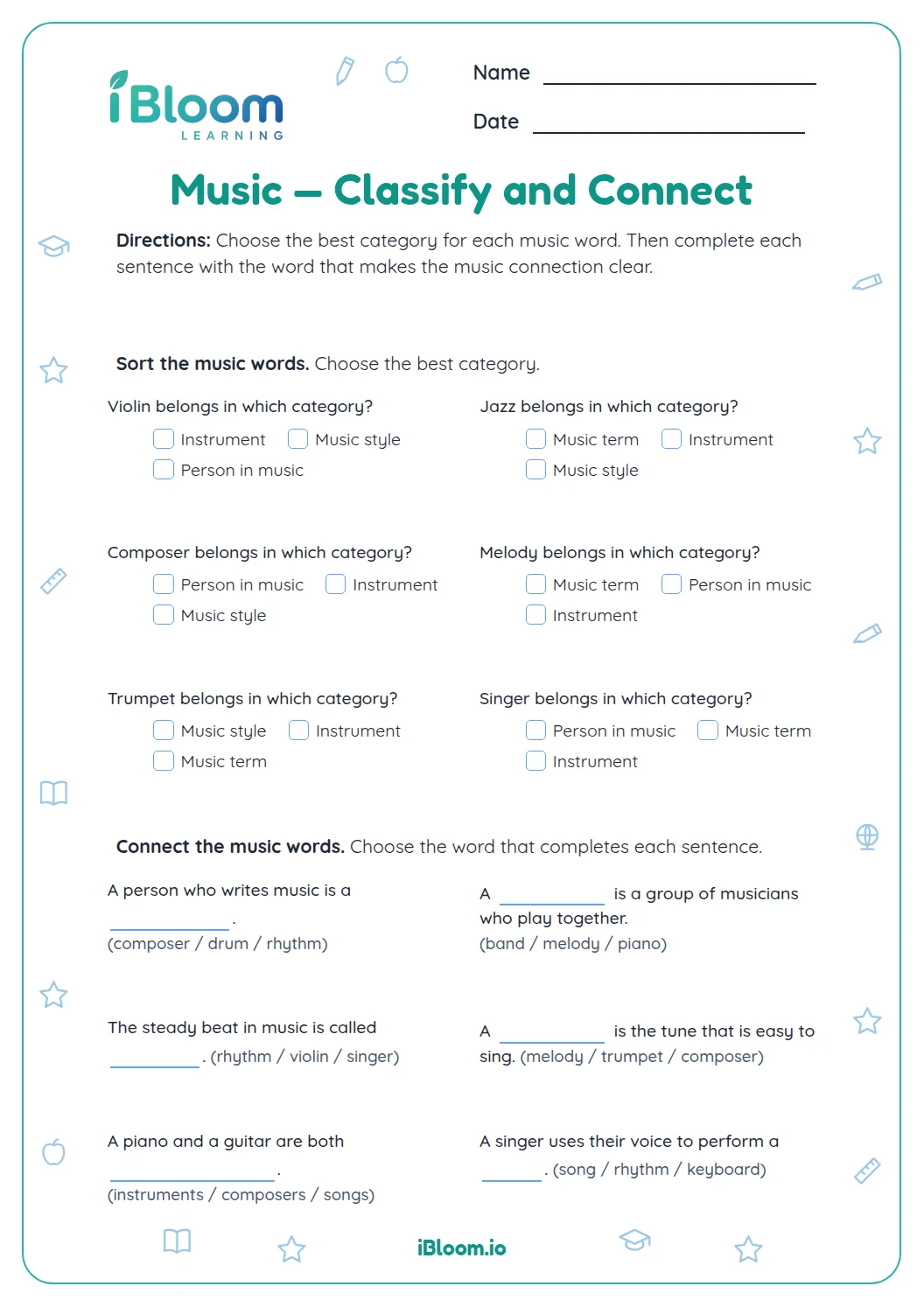
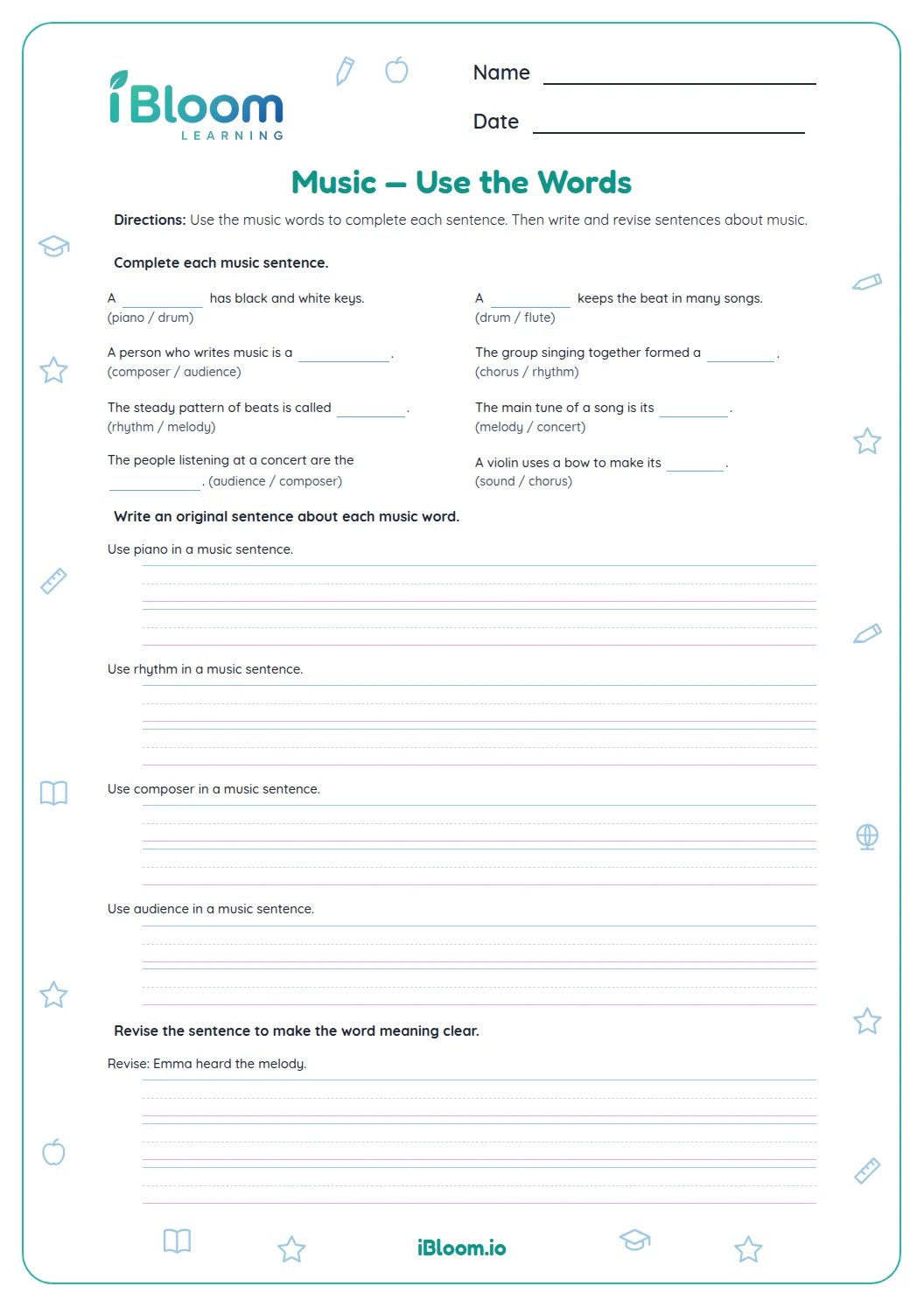
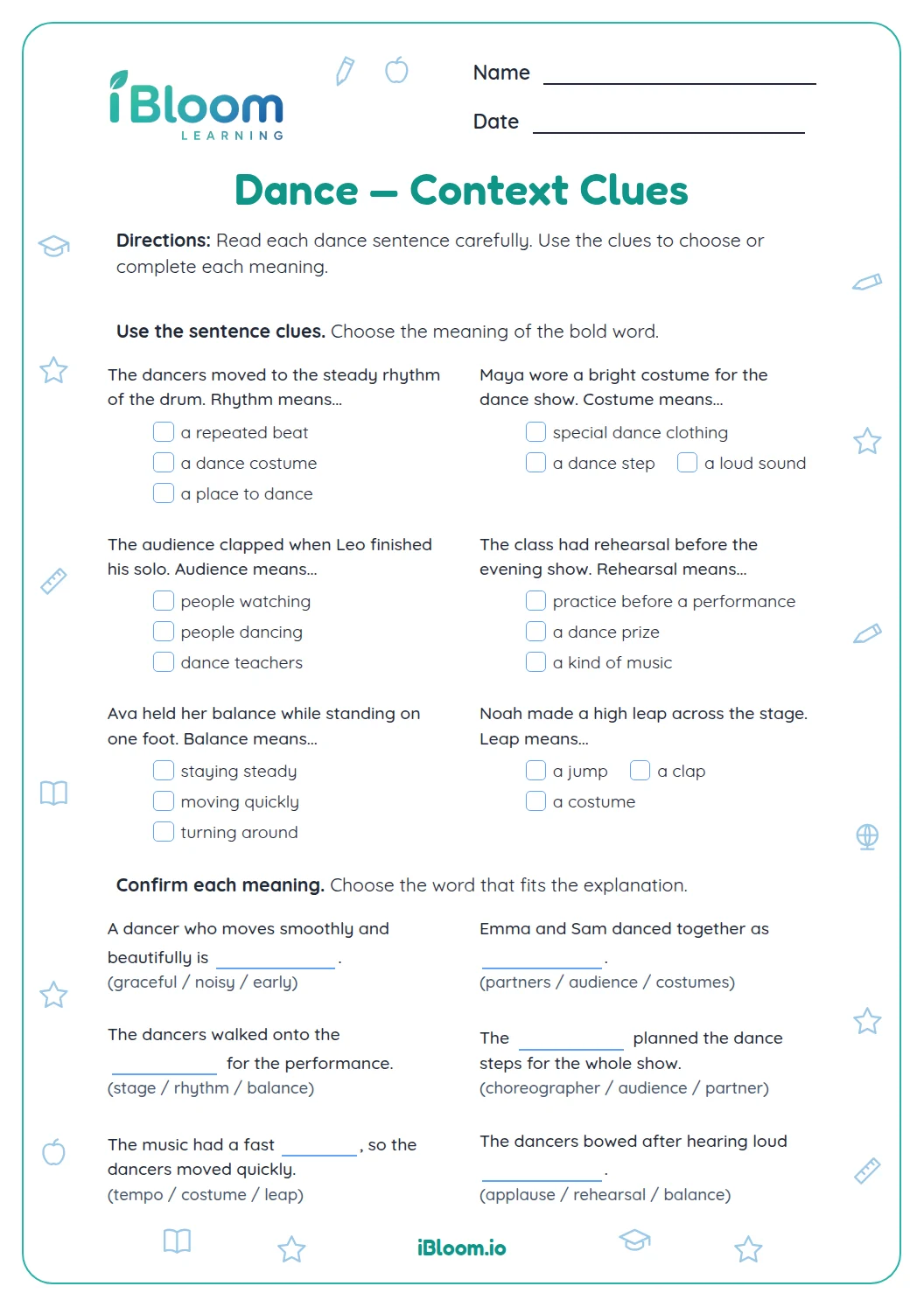
This printable Grade 3 vocabulary worksheet uses music sentences to practice context clues. Learners choose a word that fits details about a singer, band, instrument, rhythm, or performance. Part A focuses on familiar music terms; Part B adds more precise words such as pitch and ensemble. It includes 16 multiple-choice questions, a separate answer key, and practice with CCSS L.3.4a.
Aligned to L.3.4a
Where is the clue in a music sentence?
Look at the whole sentence, not only the blank. In “The drummer kept the ___ with an even pattern,” even pattern points to rhythm. The sentence helps explain the word without giving its definition directly.
How do you choose between rhythm and melody?
Rhythm is a pattern of beats; melody is the tune you can hum. An “even pattern” points to rhythm, while a tune you can hum points to melody. Try each option in the sentence and check that the meaning fits.
- 1The drummer kept the ___ with an even pattern.
- 2Clue: an even pattern of beats
- 3Answer: rhythm
Which music words does the sheet practice?
Part A uses words such as instrument, rhythm, melody, and lyrics. Part B adds terms including pitch, solo, chorus, ensemble, and expression. Each item has three choices and one answer that best fits its sentence clue.
How to use this worksheet
- 1Read the sentence from beginning to end.
- 2Underline or say the detail that acts as a clue.
- 3Try each choice in the blank.
- 4Choose the word that fits the sentence meaning.
- 5Check the key and explain which clue helped.
Common mistakes and quick fixes
The mistake
Choosing a familiar word without checking the sentence
The fix
Read the words around the blank and connect them to the meaning.
The mistake
Confusing rhythm and melody
The fix
Rhythm is a pattern of beats; melody is the tune a person can hum.
The mistake
Picking a related word that does not fit
The fix
A word can relate to music but still fail the sentence clue; test it in the blank.
Common Core alignment
Each item uses a sentence as a clue to word meaning.
Use the sentence clue to determine a music word’s meaning.
On this sheet: Each sentence gives context for selecting a music word.
Show the official wordingHide the official wording
Use sentence-level context as a clue to the meaning of a word or phrase.
What to practice next
Make more practice
Further reading
Questions parents and teachers ask
How do context clues help with music vocabulary?
A context clue is a detail in the sentence that helps explain which word belongs. In “The drummer kept the ___ with an even pattern,” the phrase even pattern points to rhythm. Learners use the sentence meaning rather than choosing a word just because it is music-related.
How many vocabulary questions are on this worksheet?
The sheet has 16 multiple-choice sentences across three worksheet pages, followed by a three-page answer key. Each sentence offers three options. Part A uses familiar terms such as instrument and melody; Part B includes more precise music words such as pitch and ensemble.
What is the difference between rhythm and melody?
Rhythm is the pattern of beats in music. Melody is the tune that can be sung or hummed. The worksheet uses both terms in separate sentences, with nearby details that help learners choose the word that matches the intended meaning.
What can I ask if a learner is unsure of an answer?
Ask the learner to reread the complete sentence and name its clue before looking at the choices. Then substitute each option into the blank and decide which one makes sense. This routine works especially well for words such as chorus, solo, and ensemble.
Does the sheet include an answer key?
Yes. A separate answer key gives the correct choice for all 16 questions. Have the learner finish a part before checking, then return to any missed item and point out the sentence detail that makes the correct music word fit.