


About this worksheet
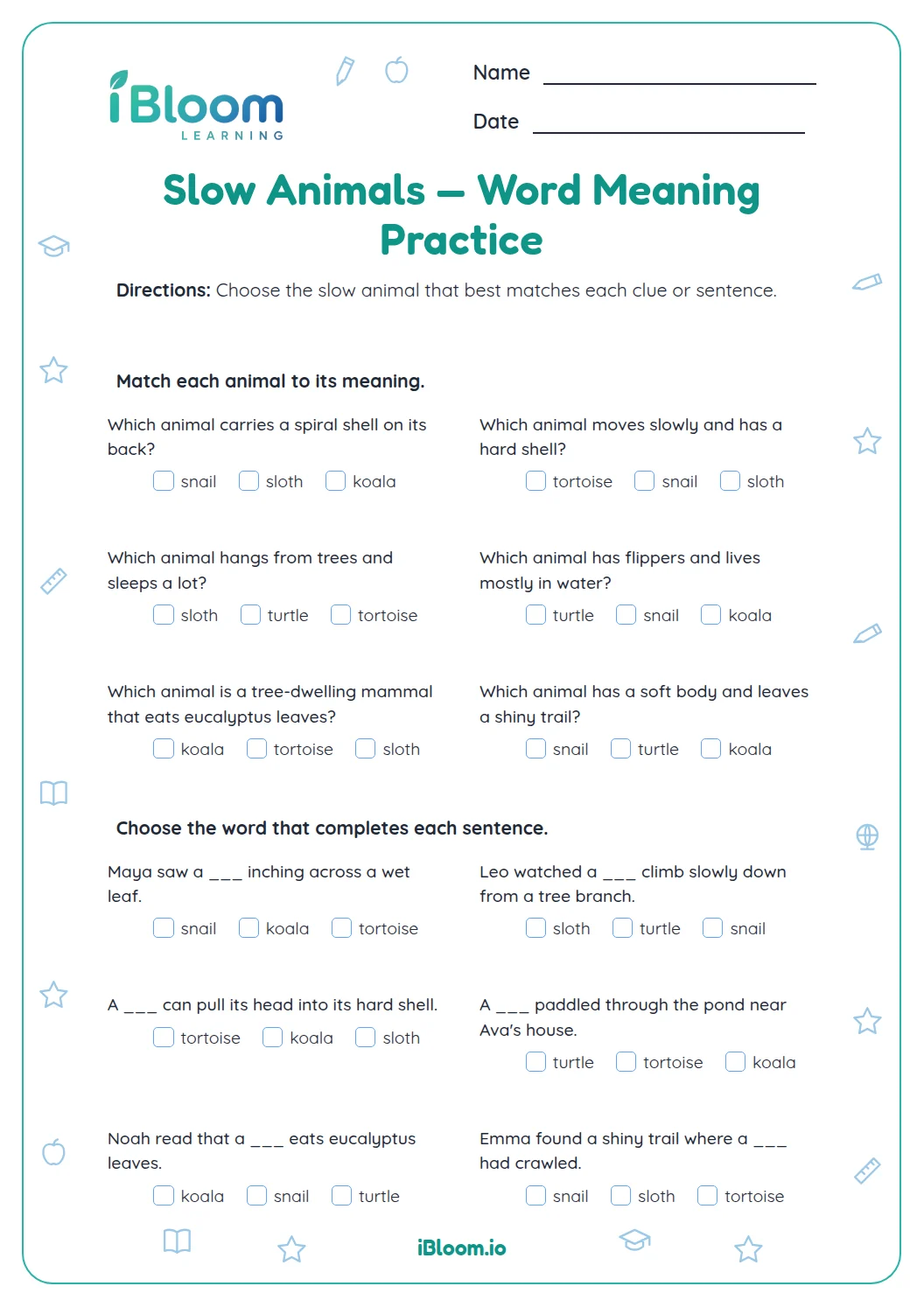
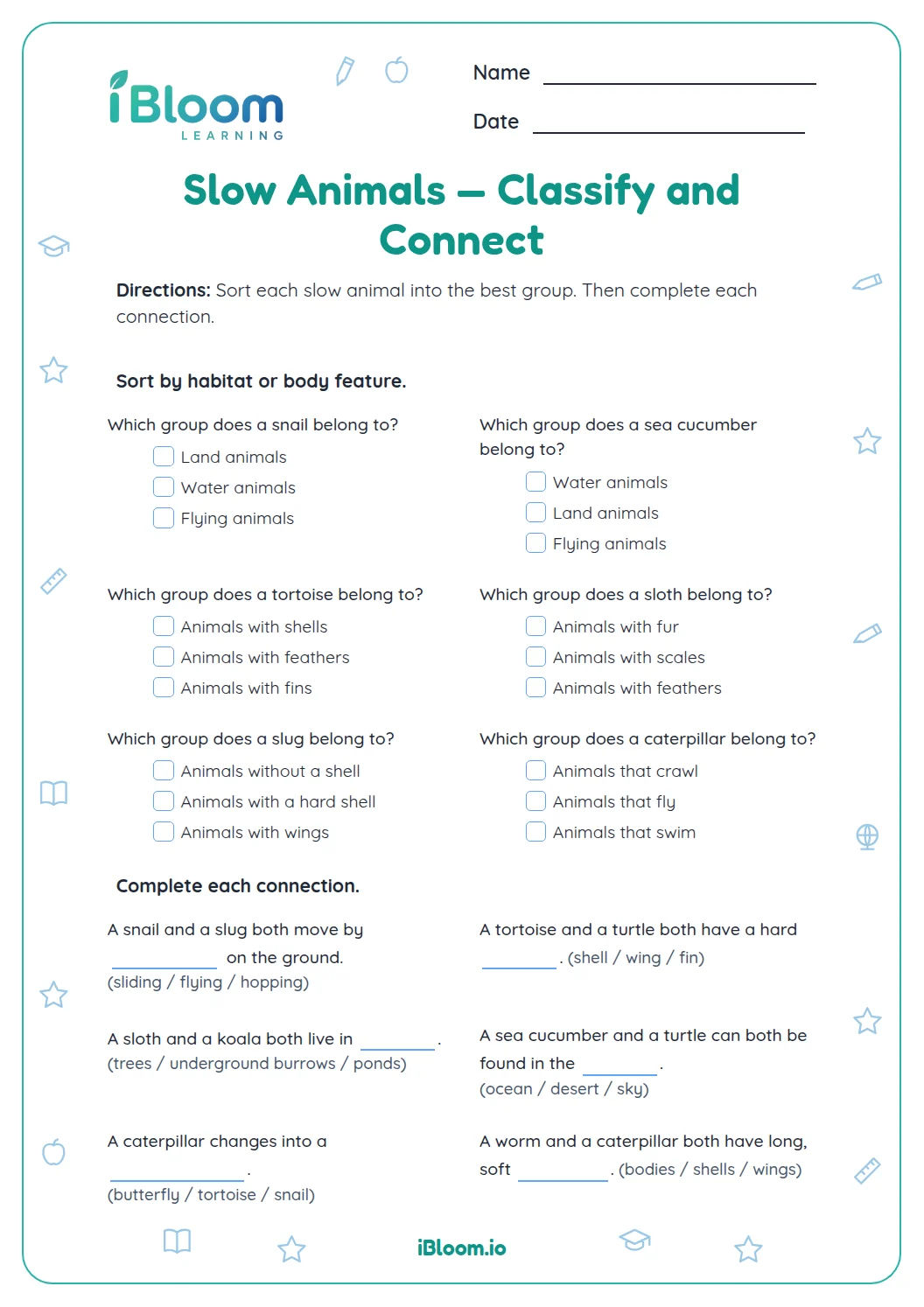
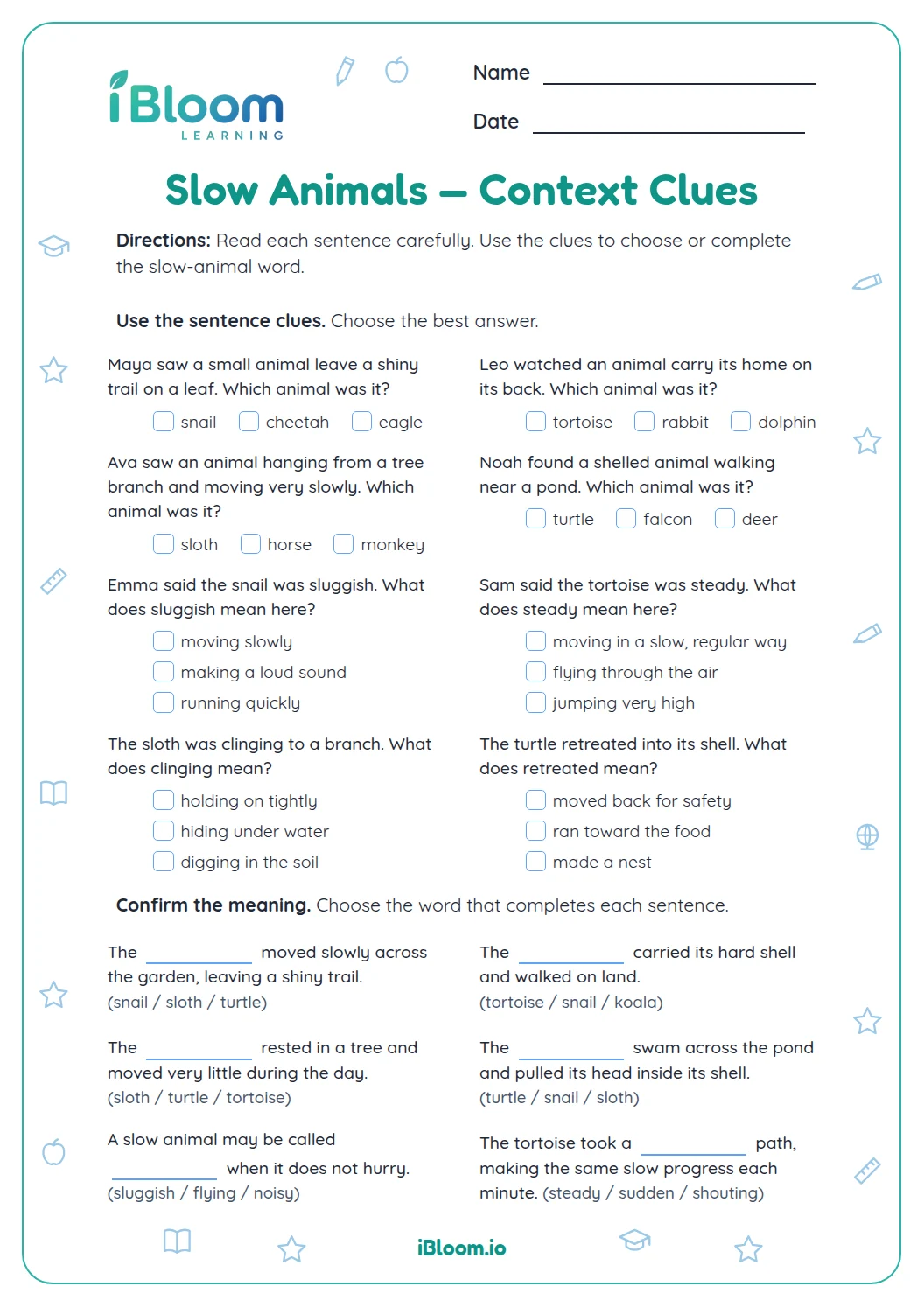
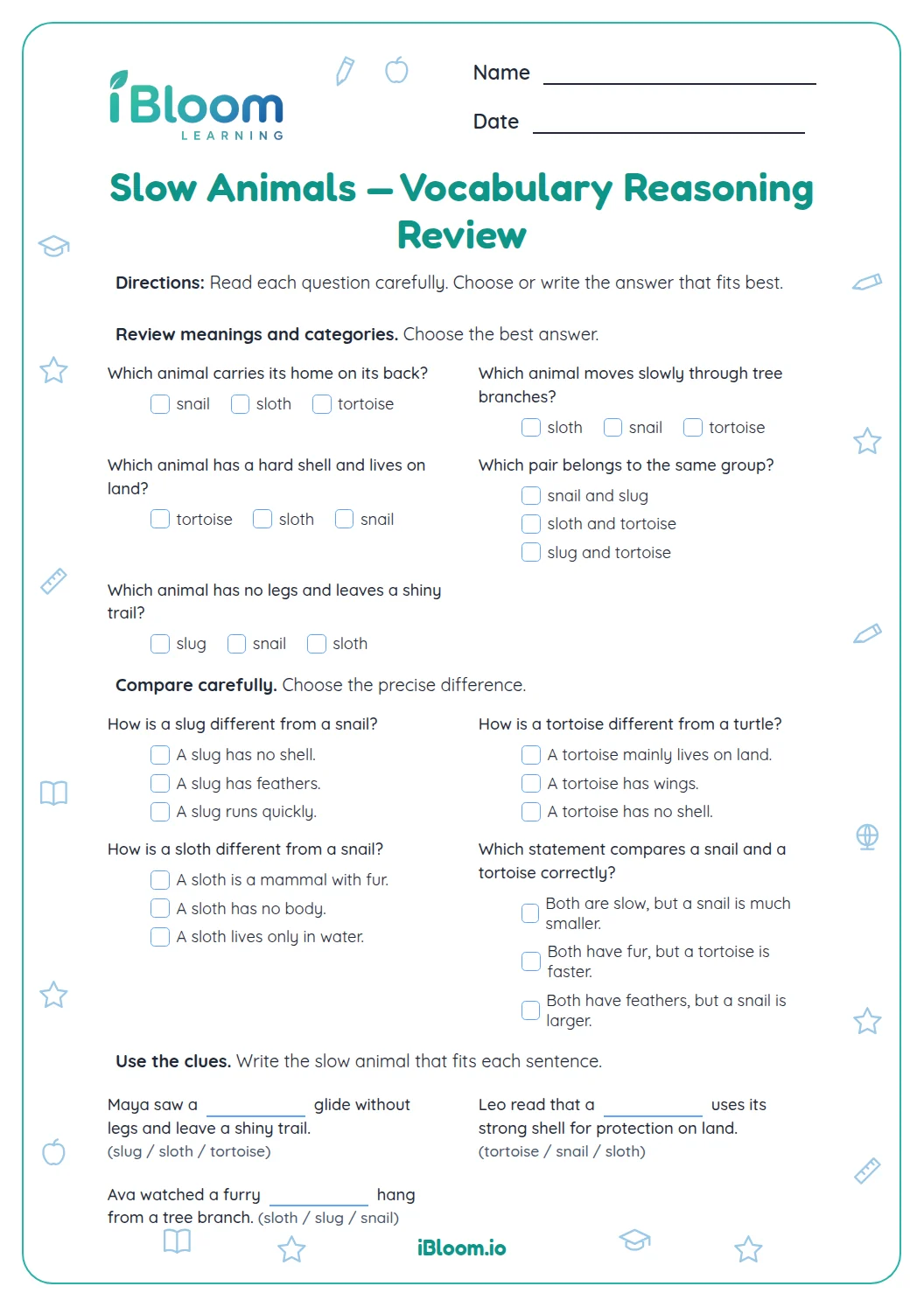
This free Grade 3 vocabulary worksheet helps children use snail, sloth, tortoise, turtle, slug, worm and caterpillar in context. Part A has eight sentences with two word choices. Part B asks for three original sentences, and Part C asks children to replace vague animal descriptions with more precise language. The thirteen questions support Common Core L.3.4a and L.3.6 by connecting sentence clues to word meanings and using vocabulary accurately. A separate answer key supplies the eight missing words and sample answers for all five writing tasks.
Aligned to L.3.4a and L.3.6
Which animal words will children practice?
The seven animal words are snail, sloth, tortoise, turtle, slug, worm and caterpillar. Each sentence in Part A provides two choices, so students use the described body part, place or action to decide which fits.
A word may appear more than once. Students should reread the context each time rather than crossing a word off after using it.
How do sentence clues lead to the right word?
Read the whole sentence and underline the clue that separates the two choices. In question 1, coiled shell distinguishes a snail from a slug. In question 3, a hard shell and legs point to a tortoise rather than a worm.
- 1A ___ has a coiled shell. (snail or slug)
- 2Clue: coiled shell
- 3Choose snail.
- 4Reread: A snail has a coiled shell.
What makes a vocabulary sentence useful?
A useful sentence shows the reader something about the animal or its action. “I saw a snail” uses the word correctly, but “The snail slid over a wet leaf” gives a more informative picture. The writing directions ask for a detail.
In Part C, children improve two vague sentences by naming an animal and adding an action or place. The model answers are examples; other accurate sentences can meet the directions.
How to use this worksheet
- 1Read the seven animal names aloud before starting.
- 2For each Part A sentence, find the clue that distinguishes the two choices.
- 3Mark the chosen word’s bubble and reread the sentence with that word in the blank.
- 4In Part B, include both the named animal and the requested detail.
- 5In Part C, replace the vague subject and add an accurate action or place, then check with the key.
Common mistakes and helpful fixes
The mistake
Choosing slug for a sentence that describes a coiled shell.
The fix
Underline coiled shell and compare the two offered words before filling the blank.
The mistake
Treating each animal name as a word that can be used only once.
The fix
The directions allow repeated choices. Use the clue in the current sentence.
The mistake
Writing “It moved” when the task asks for tortoise and a place.
The fix
Name the tortoise and add where it walked, such as along a garden path.
Common Core alignment
Use body-part, place and action clues to choose an animal word.
On this sheet: Eight sentence completions ask children to select the animal word that fits the context.
Show the official wordingHide the official wording
Use sentence-level context as a clue to the meaning of a word or phrase.
Use animal vocabulary accurately in original and revised sentences.
On this sheet: Students write and revise sentences with snail, sloth, turtle, tortoise and caterpillar.
Show the official wordingHide the official wording
Acquire and use accurately grade-appropriate conversational, general academic, and domain-specific words and phrases, including those that signal spatial and temporal relationships (e.g., After dinner that night we went looking for them).
What to practice next
Make more practice
Further reading
Questions parents and teachers ask
Which animal names are on this worksheet?
The worksheet uses snail, sloth, tortoise, turtle, slug, worm and caterpillar. Children choose between two names in each of eight sentences, then write or revise five more sentences. The clues concern shells, claws, soil, ponds and butterflies, helping children connect each name with a meaningful detail.
Can the same animal word be used more than once?
Yes, a word can be used again when it fits the new sentence. Turtle is the answer to both the pond-swimming clue and the clue about pulling a head into a shell. Ask your child to check each sentence’s clues instead of treating the choices as a one-use list.
What should a sentence about a snail include?
For question 9, it should use snail and tell where the snail moves. The model answer describes a snail sliding across a wet leaf. Other sensible places are welcome, such as a garden path. A sentence that only says “I saw a snail” needs the requested movement detail.
How do I check the five writing answers?
Check the required animal word and the requested detail first. Part B asks about a snail’s movement, a sloth’s use of a tree and a turtle’s swimming place. Part C asks for a tortoise’s walking place and a caterpillar’s food. Accept accurate alternatives to the samples, then help with capitals and ending punctuation.
How can we extend the vocabulary practice?
Ask your child to choose two animals from the sheet and describe a similarity or difference using a complete sentence. For example, a snail has a visible coiled shell, while a slug does not. Return to the worksheet clues for ideas, and encourage details that make the comparison clear.