







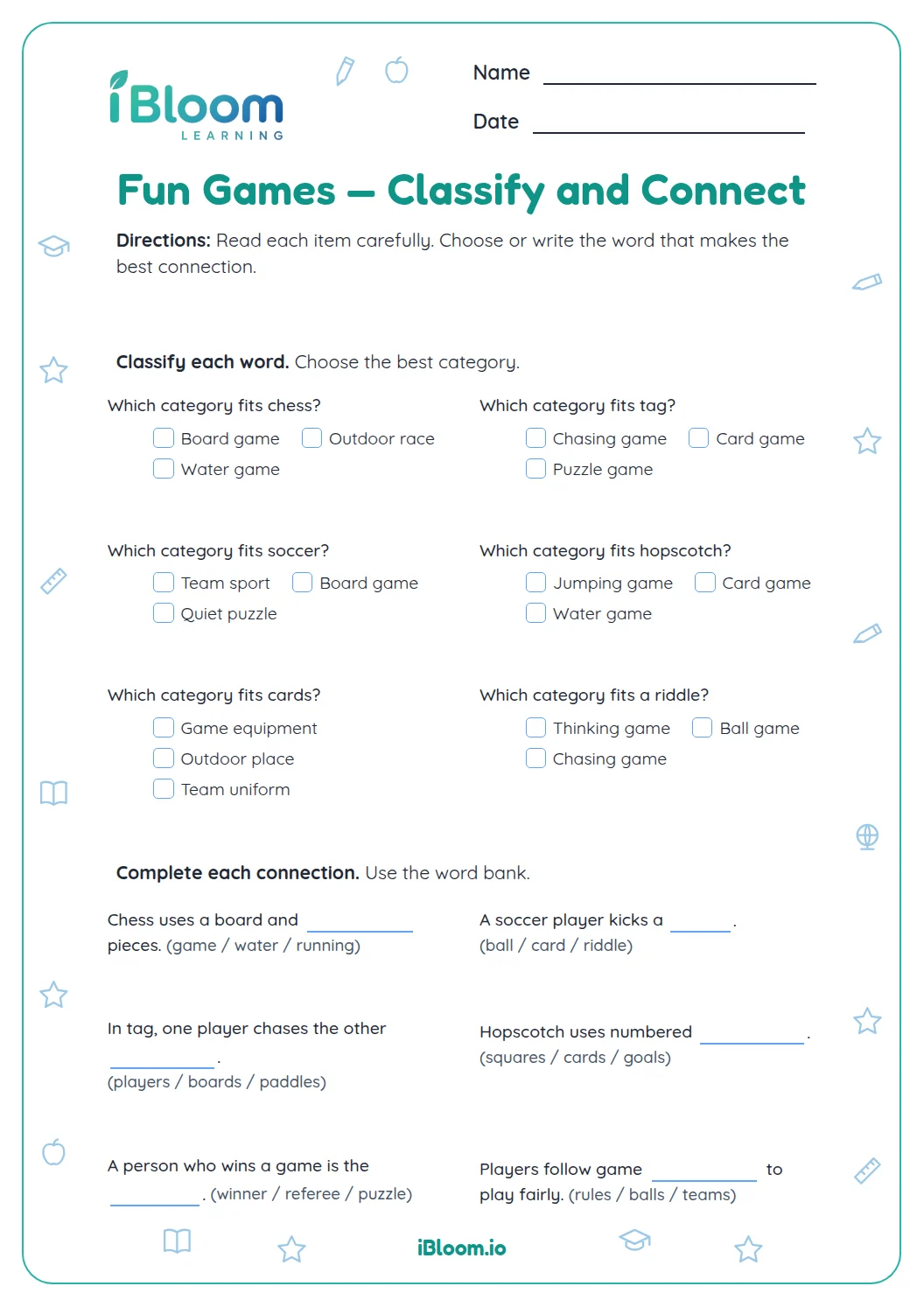
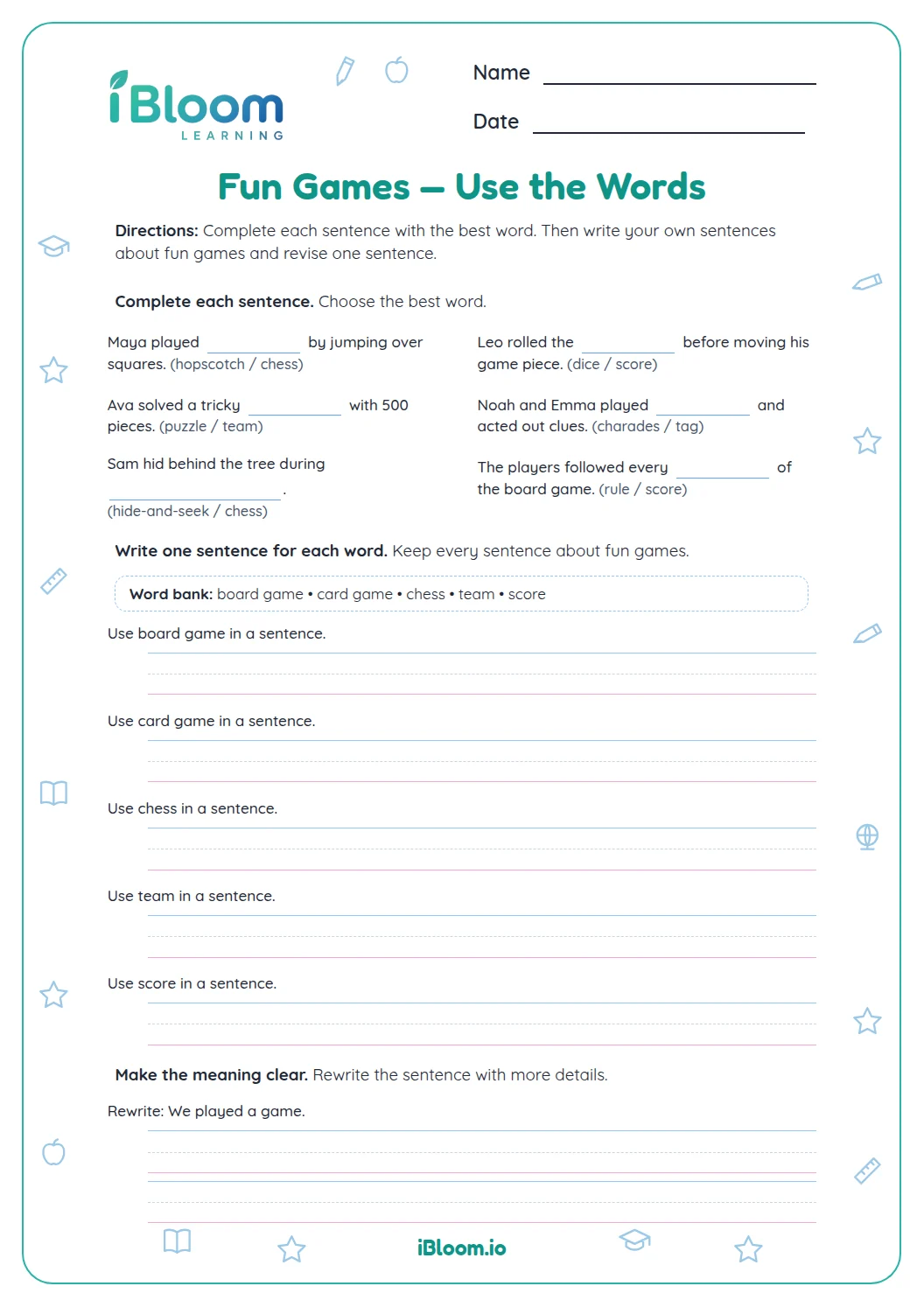
About this worksheet
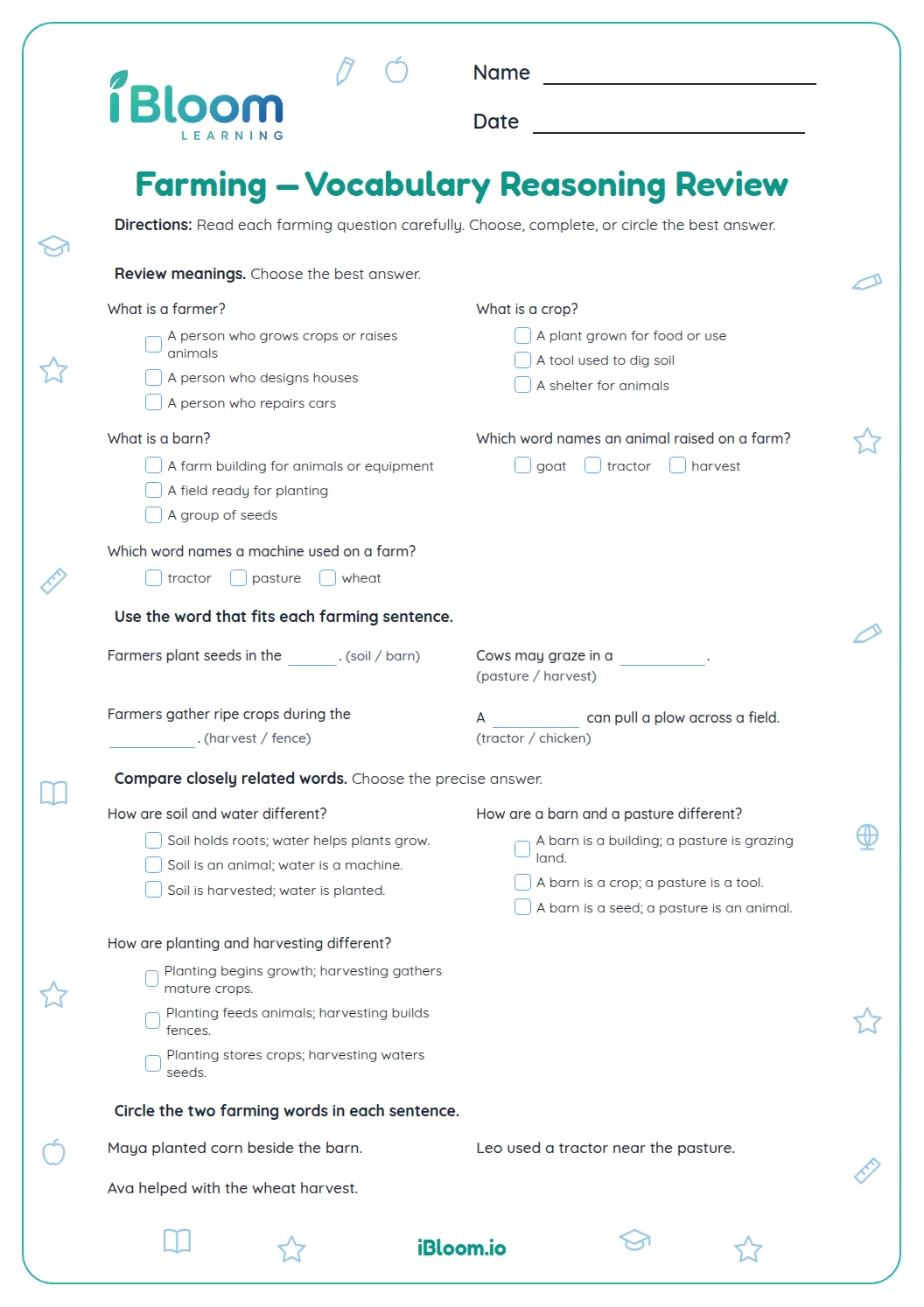
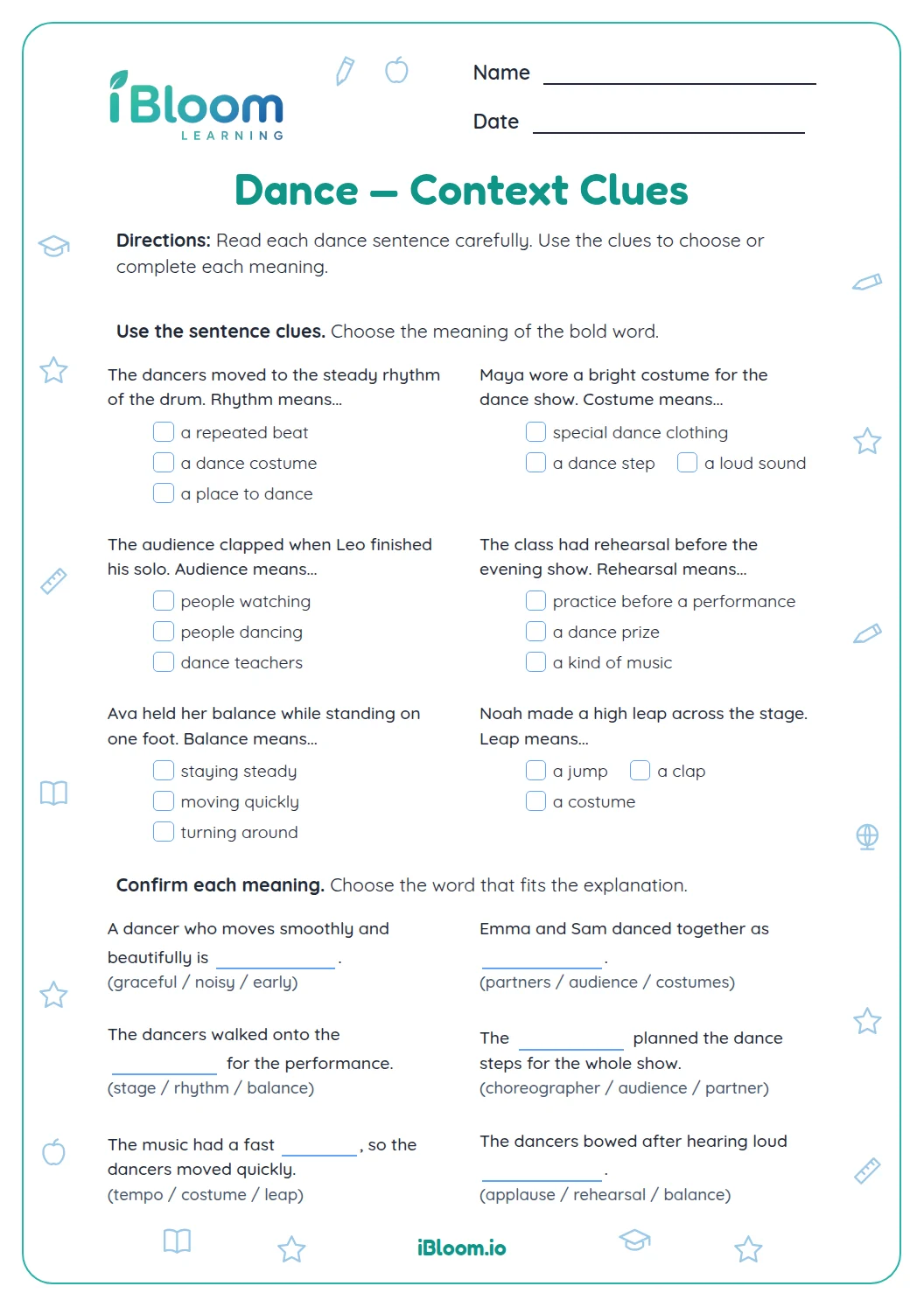
This Grade 3 printable starts with a farming word search, then practices farming vocabulary in sentence clues. Children find FARM, SEED, SOIL, CROP, HEN and BARN, infer meanings from nearby details, and complete farming terms. The separate answer key lists the context-clue answers and target words. The sentence work practices CCSS L.3.4.a.
Aligned to L.3.4.a
What is in the farming word search?
Part A hides FARM, SEED, SOIL, CROP, HEN and BARN across or down. Part B uses farming sentences to practice inferring what unfamiliar words mean.
How do children use farming context clues?
Children read each whole sentence, notice nearby details and choose or supply a word meaning that fits. The clues involve crops, tools, animals and farm places.
- 1“The farmer planted seeds in fertile soil, so crops grew well.” → fertile means able to grow plants well.
How can a child explain a context clue?
Point to the words that helped and say how they connect to the meaning. “Trees” and “apples” help show that gathered means collected in that sentence.
How to use this worksheet
- 1Read the whole sentence once.
- 2Reread the words before and after the unfamiliar word.
- 3Try each answer choice in the sentence.
- 4In the grid, scan one row or column at a time.
- 5For the last questions, use a short phrase or one clear clue.
Common mistakes and quick fixes
The mistake
Choosing a meaning based only on one familiar word.
The fix
Read the whole sentence and check whether the meaning fits all its details.
The mistake
Mixing up a seed and a seedling.
The fix
A seed can grow into a plant; a seedling is already a young plant.
The mistake
Finding letters in the grid but not the whole word.
The fix
Trace each letter in sequence and check that the complete listed word appears.
Common Core alignment
This vocabulary page practices using sentence clues to infer word meanings.
Use sentence-level context as a clue to a word’s meaning.
On this sheet: Children use surrounding sentence details to select the meaning of farming vocabulary.
Show the official wordingHide the official wording
Use sentence-level context as a clue to the meaning of a word or phrase.
What to practice next
Make more practice
Further reading
Questions parents and teachers ask
What are context clues?
Context clues are nearby words and details that help a reader work out an unfamiliar word. This worksheet uses farming sentences about crops, tools, animals and buildings to provide meaningful hints about vocabulary in context. Each sentence includes clues that make the target meaning reasonable, rather than asking children to memorize a definition.
What words are in the word search?
The first part hides FARM, SEED, SOIL, CROP, HEN and BARN, written across or down. Children scan the rows and columns, then cross off each word in the list. The remaining items use complete farming sentences to practice figuring out word meanings from nearby details.
How many questions are on this page?
There are 14 numbered items: five multiple-choice context clues, eight context-clue completions, and one word-search activity. The separate answer key gives the expected word or meaning for each item and names the six words hidden in the grid. The word search is the opening activity.
Should children guess before reading the choices?
It can help to cover the choices and first explain the unfamiliar word using the sentence. Then compare that idea with the options or blank and choose the meaning that fits all the sentence details. A reader can underline the nearby clue words before choosing an answer, then reread to confirm the fit.
What does the answer key include?
The key gives the correct meaning for each choice and the expected word for each blank. It accepts the farming term that completes the sentence and fits the clues printed around it, rather than a guess from memory. It also reinforces careful rereading.