
About this worksheet
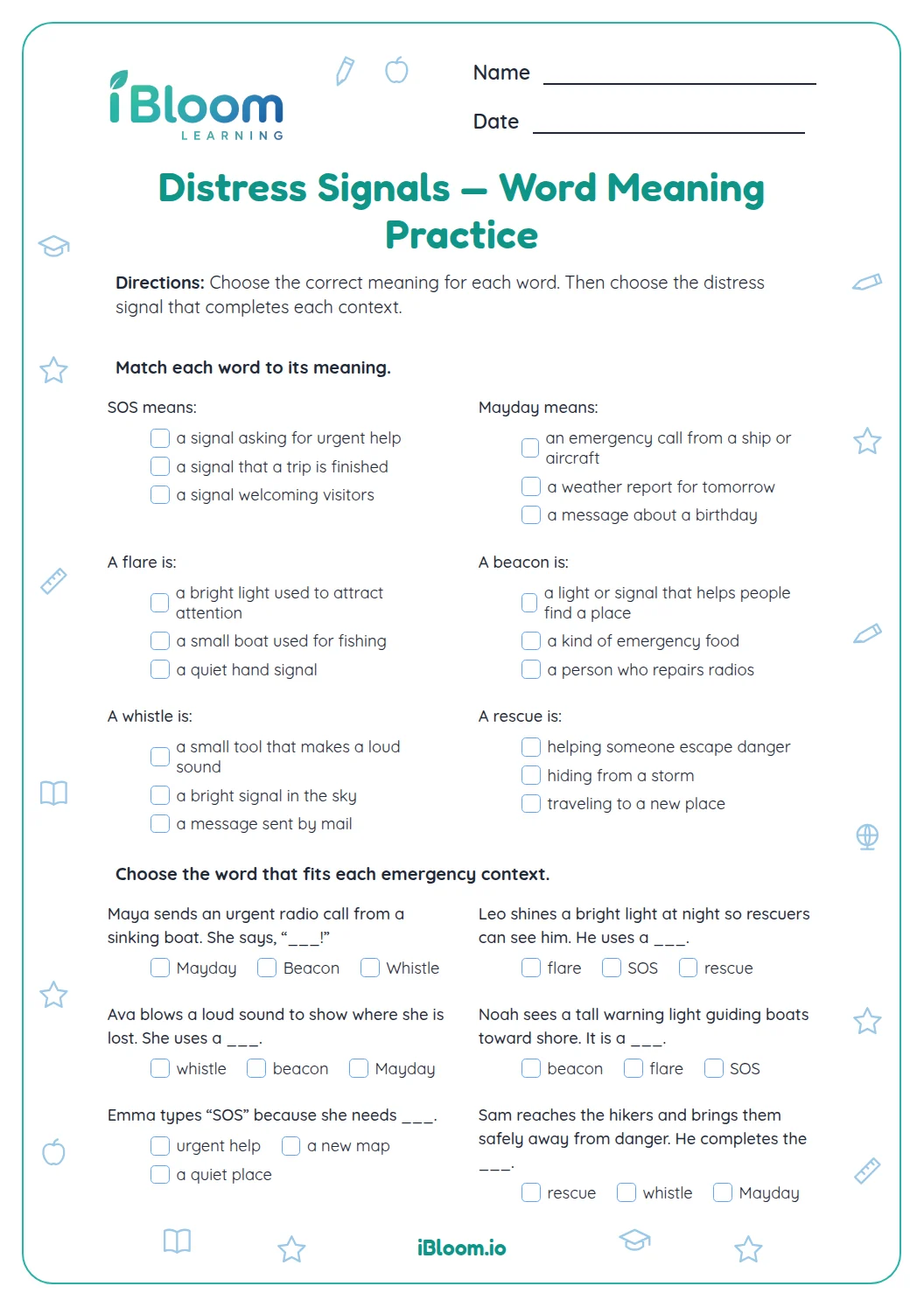
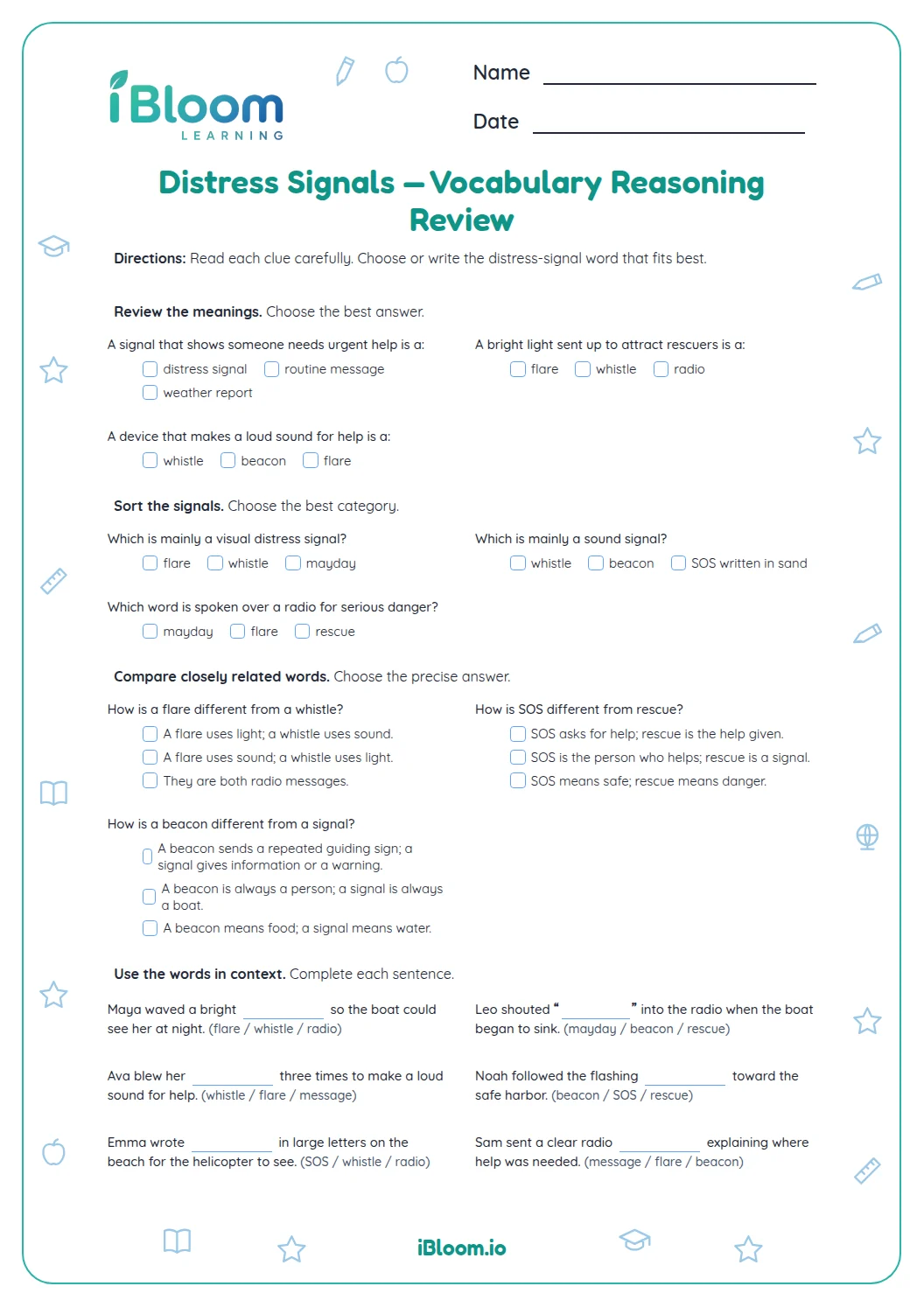
This Grade 4 vocabulary worksheet uses a six-word search and 13 short context clues about distress signals. Students distinguish spoken calls from visual signals, connect related terms, and use the words in context. The separate answer key lists the expected responses.
Aligned to CCSS.ELA-LITERACY.L.4.5
Which words are hidden in the grid?
The grid contains MAYDAY, SOS, FLARE, BEACON, RESCUE, and DISTRESS. Find each term before moving to the clues.
How can you classify signal words?
Notice how a signal is communicated. MAYDAY is a spoken emergency call, while a flare is a bright visual signal. Classifying the examples helps distinguish how people send a message.
How do context clues connect the words?
Read the whole sentence before filling a blank. For example, in “The ___ flashed so rescuers could see the boat,” flashed and see point to a beacon as the intended word.
How can students solve the word and clue activities?
- 1Scan the grid and circle each listed word.
- 2Read each clue all the way through before choosing a word.
- 3Notice whether the clue describes a spoken call, a visual signal, or an action.
- 4Use nearby words to check the meaning of a blank.
- 5Review the key and revisit any clue that does not fit its sentence.
What should students check?
The mistake
Treating every word as the same kind of signal.
The fix
Check whether the clue describes spoken words, a visual signal, or a rescue action.
The mistake
Filling a blank from one familiar word without reading the sentence.
The fix
Use the whole sentence to test whether the word fits its meaning and grammar.
The mistake
Skipping a word in the search because it runs in a different direction.
The fix
Scan both across and down, as the directions allow.
Curriculum alignment
This worksheet practices the grade-level skill named in its title.
Use context and word relationships to clarify the meaning of unfamiliar and multiple-meaning words.
On this sheet: The activities directly practice this skill.
Show the official wordingHide the official wording
Determine or clarify the meaning of unknown and multiple-meaning words and phrases based on grade 4 reading and content, choosing flexibly from a range of strategies.
What to practice next
Make more practice
Questions parents and teachers ask
Which words are in the word search?
The grid contains MAYDAY, SOS, FLARE, BEACON, RESCUE, and DISTRESS. Students circle each word, then move to clues that ask about how signal terms are classified and used. The answer key names all six search words. Students can point to the clue or place-value step they used so the check also reinforces the skill.
What is the difference between a spoken call and a visual signal?
A spoken call uses words that can be heard, while a visual signal is seen. The worksheet uses MAYDAY as a spoken emergency call and a flare as a bright visual signal. Students use sentence clues to connect each term with its role.
What does beacon mean in the worksheet?
A beacon is presented as a light or signal that can help people see a location from a distance. In the clue about a boat flashing so rescuers can see it, the surrounding words help identify beacon as the fitting vocabulary word.
Does this worksheet teach emergency procedures?
The activity practices vocabulary through a word search and context clues. It does not give instructions for handling an emergency. The student-facing clue says a child who notices an emergency should tell a trusted adult. Students can point to the clue or place-value step they used so the check also reinforces the skill.
Is an answer key included?
Yes. The separate answer key gives the words for the search and the expected answers to the vocabulary clues. Students can compare each response with the sentence and check that it fits both meaning and grammar. Students can point to the clue or place-value step they used so the check also reinforces the skill.