



About this worksheet
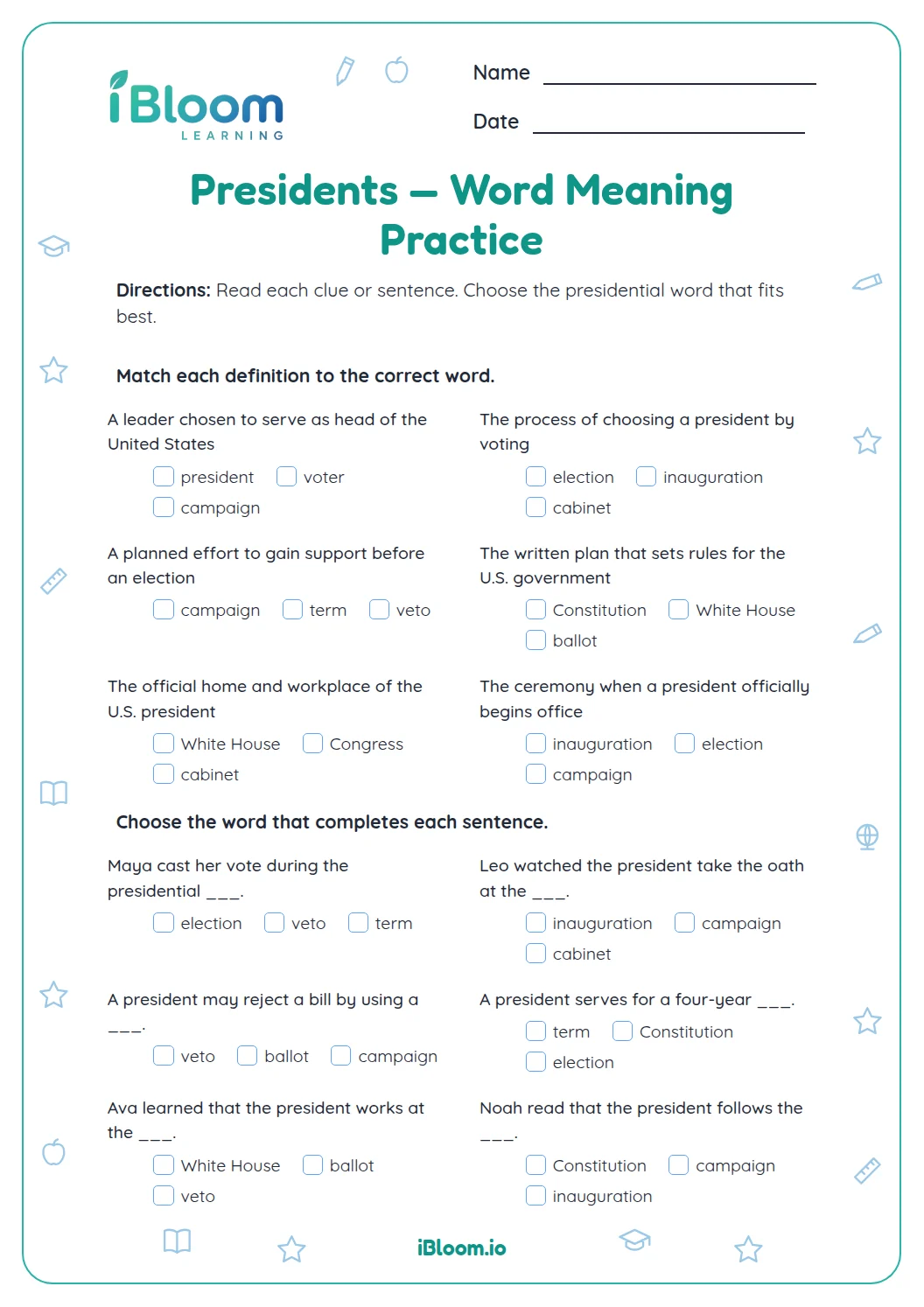
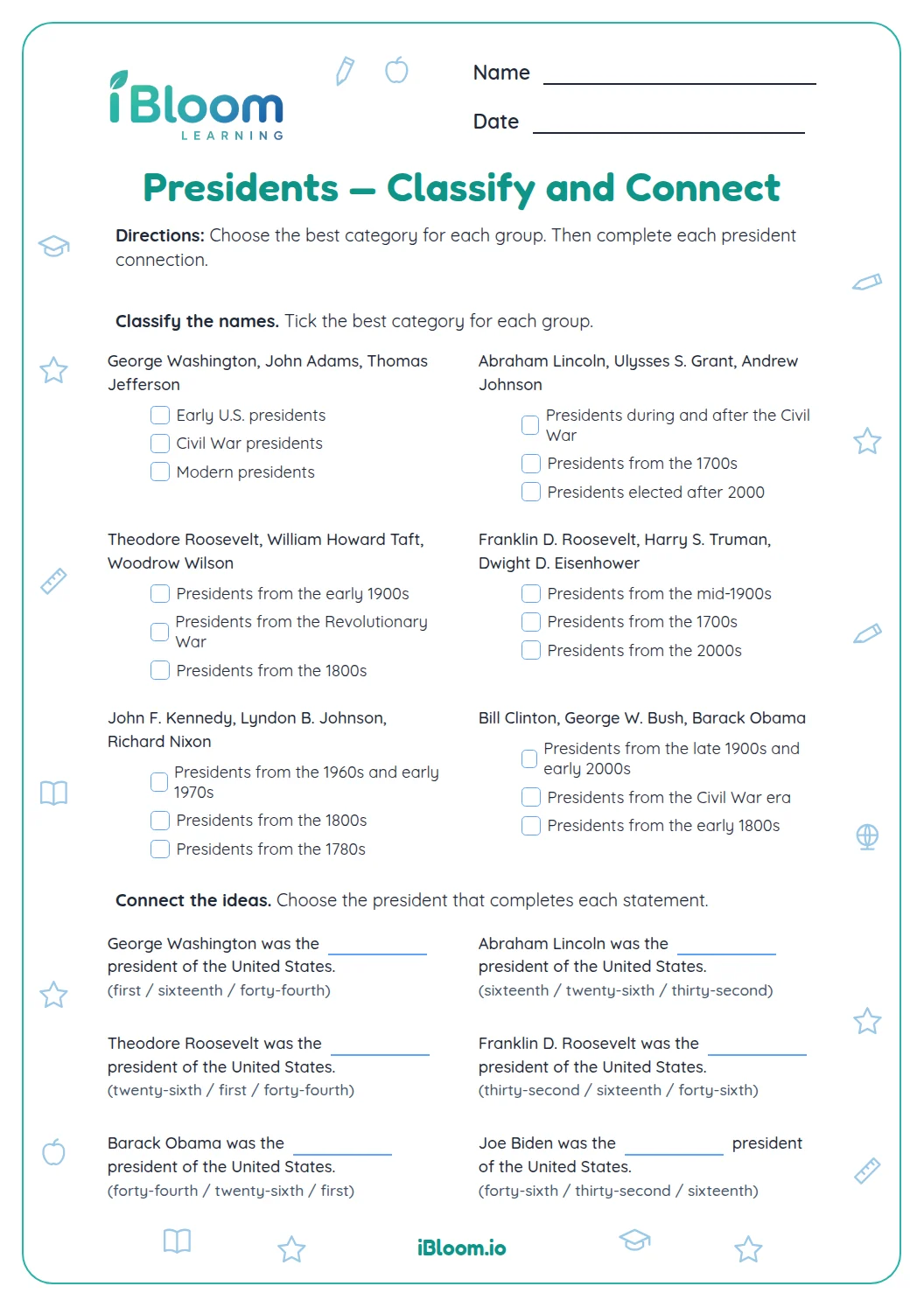
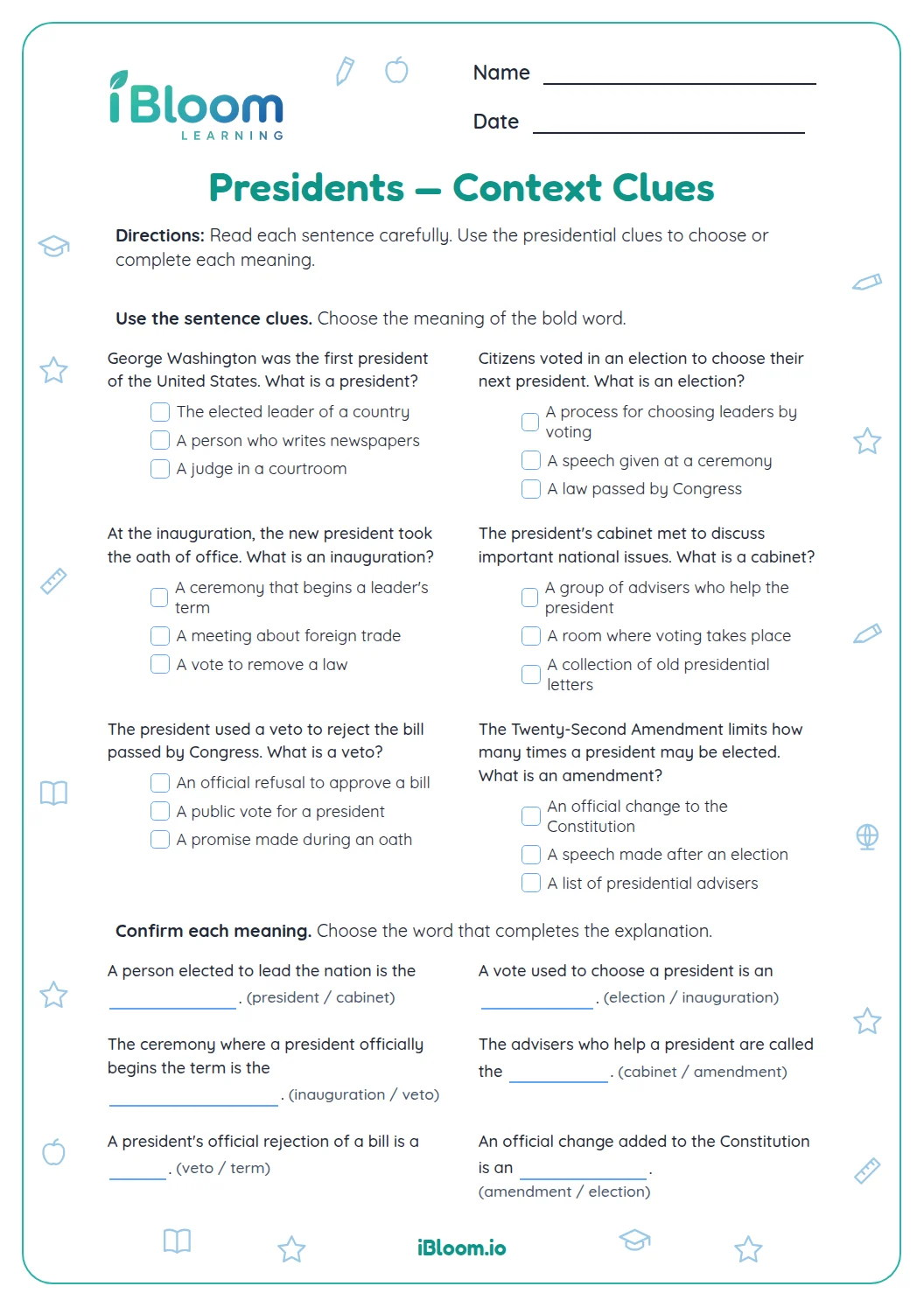
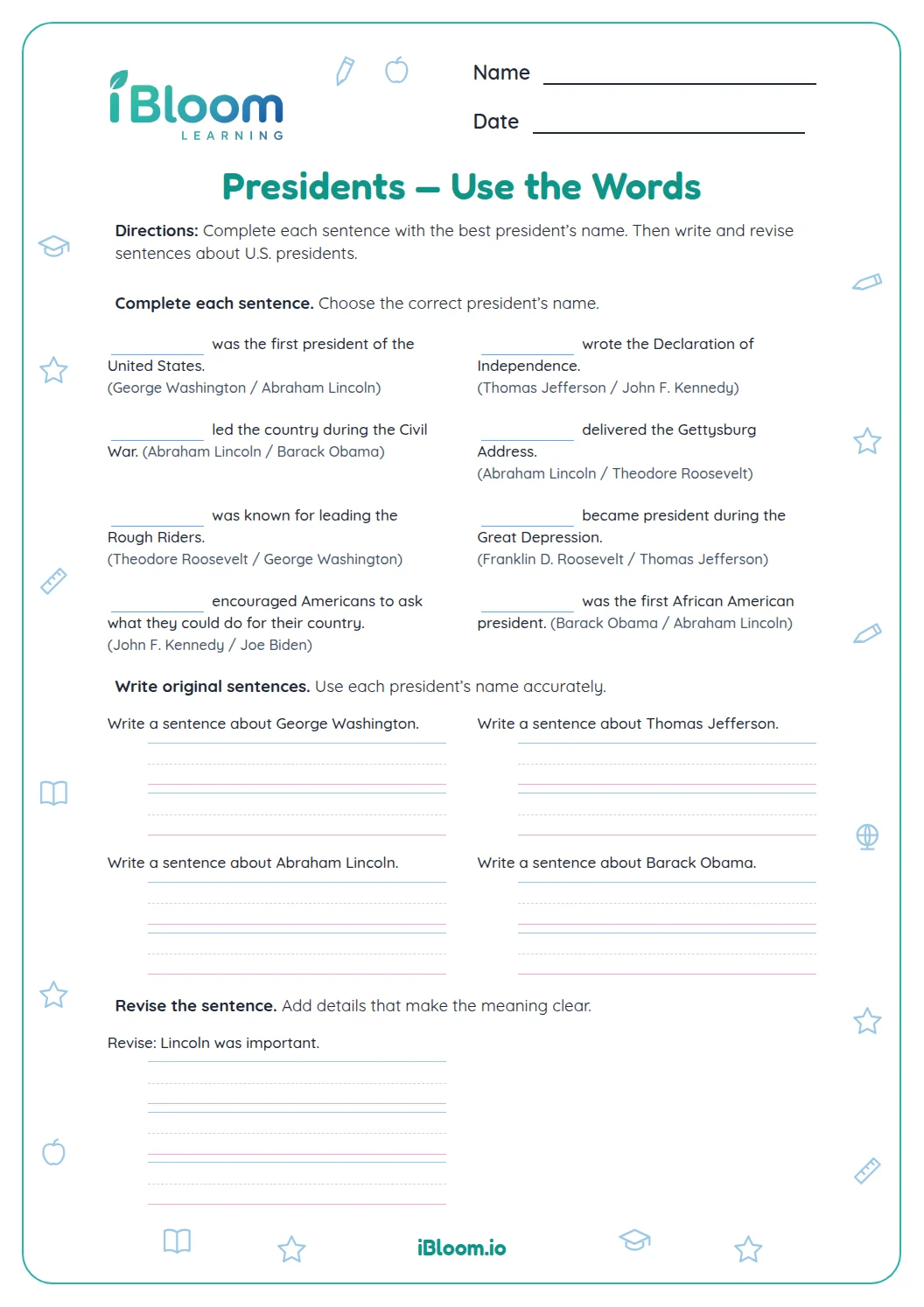
This free Grade 5 worksheet practices vocabulary connected with presidents and civic life. Children identify the meanings of president, citizen, election, inauguration, term, and campaign; complete sentences with candidate and other key terms; find ten words in a word search; and explain how related words differ. The clue and sentence tasks give practice using context to work out word meaning, with a separate answer key for review.
Aligned to L.5.4.a
How do clues reveal what a civic word means?
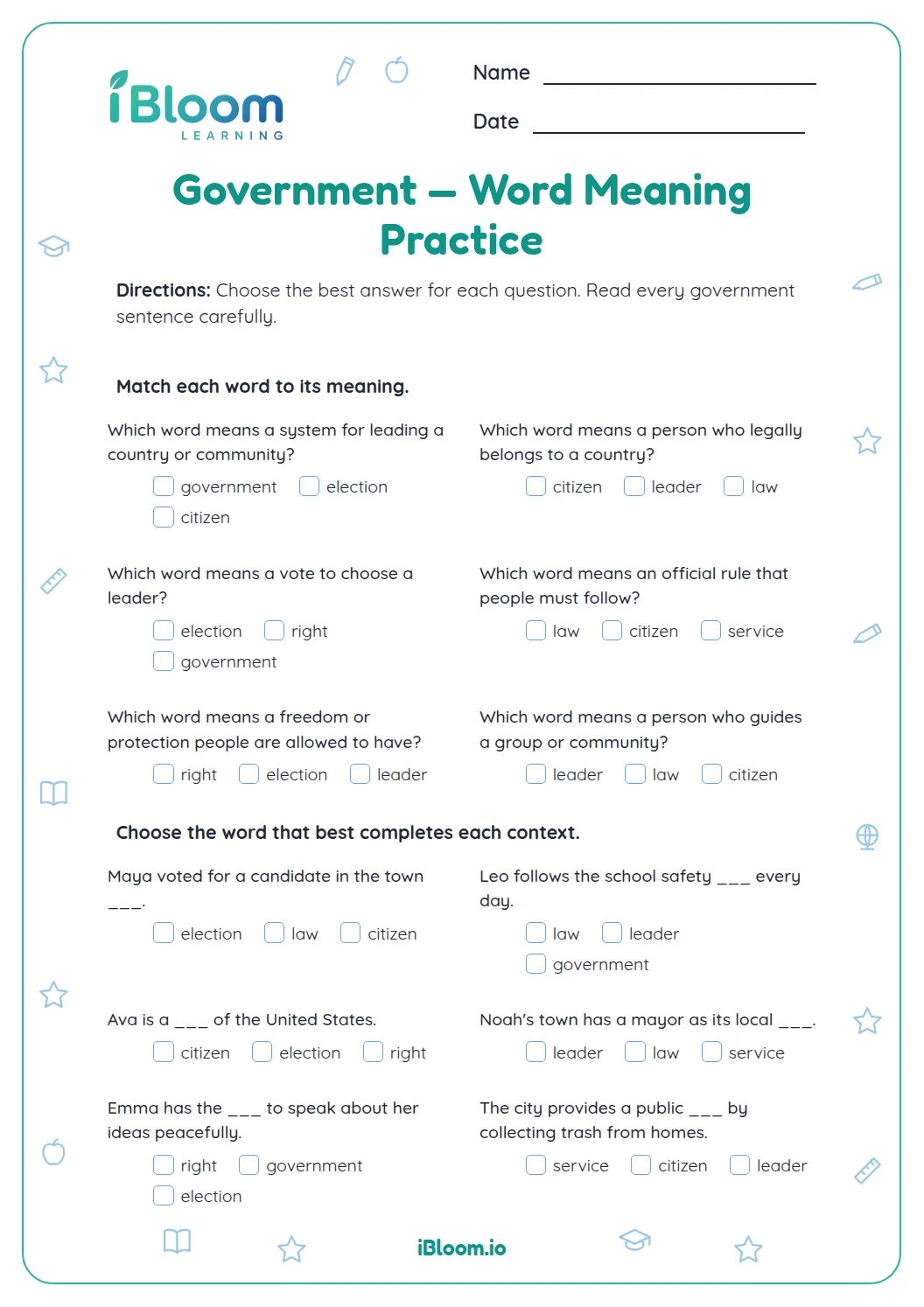
The first part asks students to connect a term to its meaning. For example, question 1 describes a person who leads a nation; the best word is president. Read the whole clue before choosing, then check that the word fits the meaning rather than only the topic.
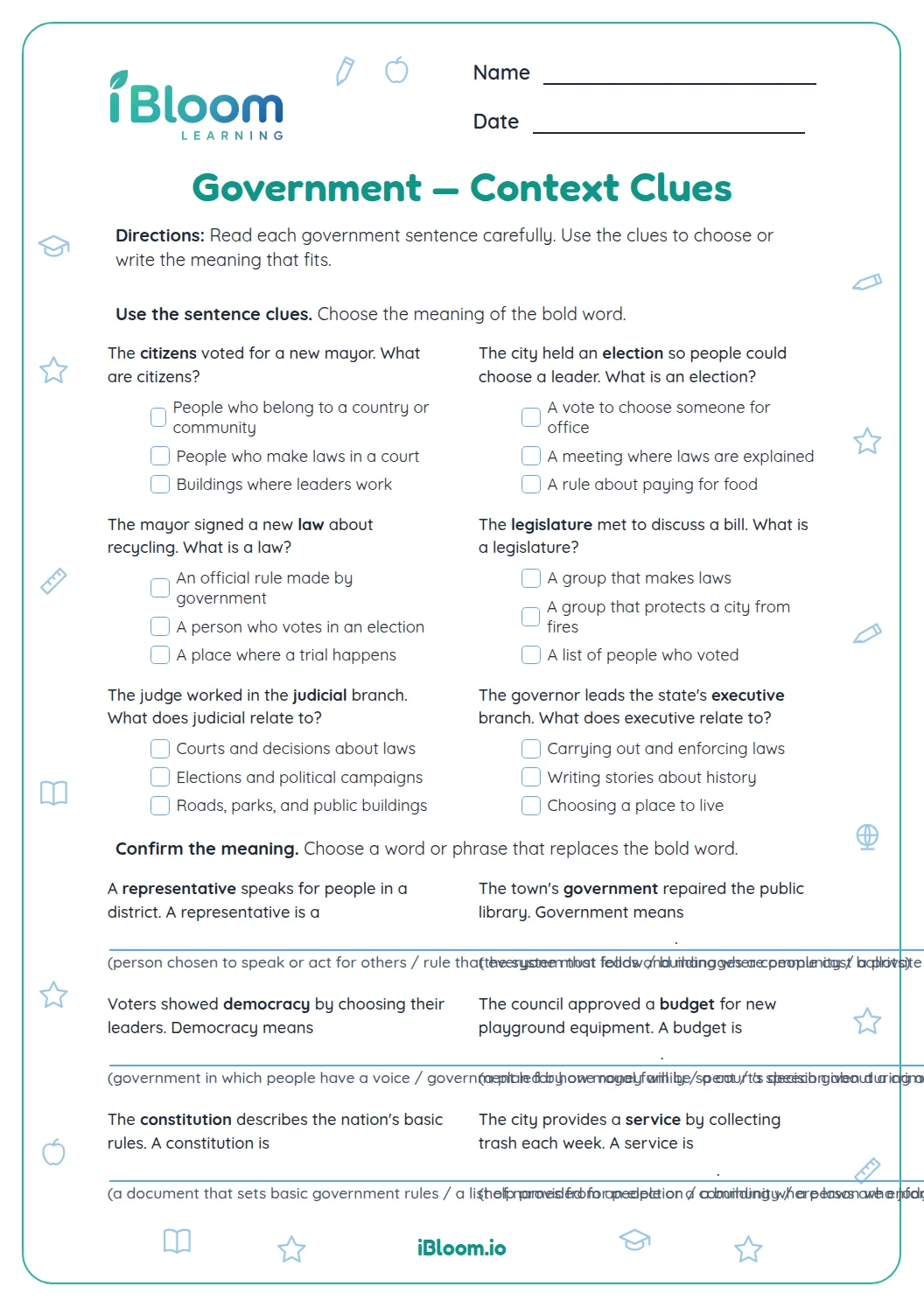
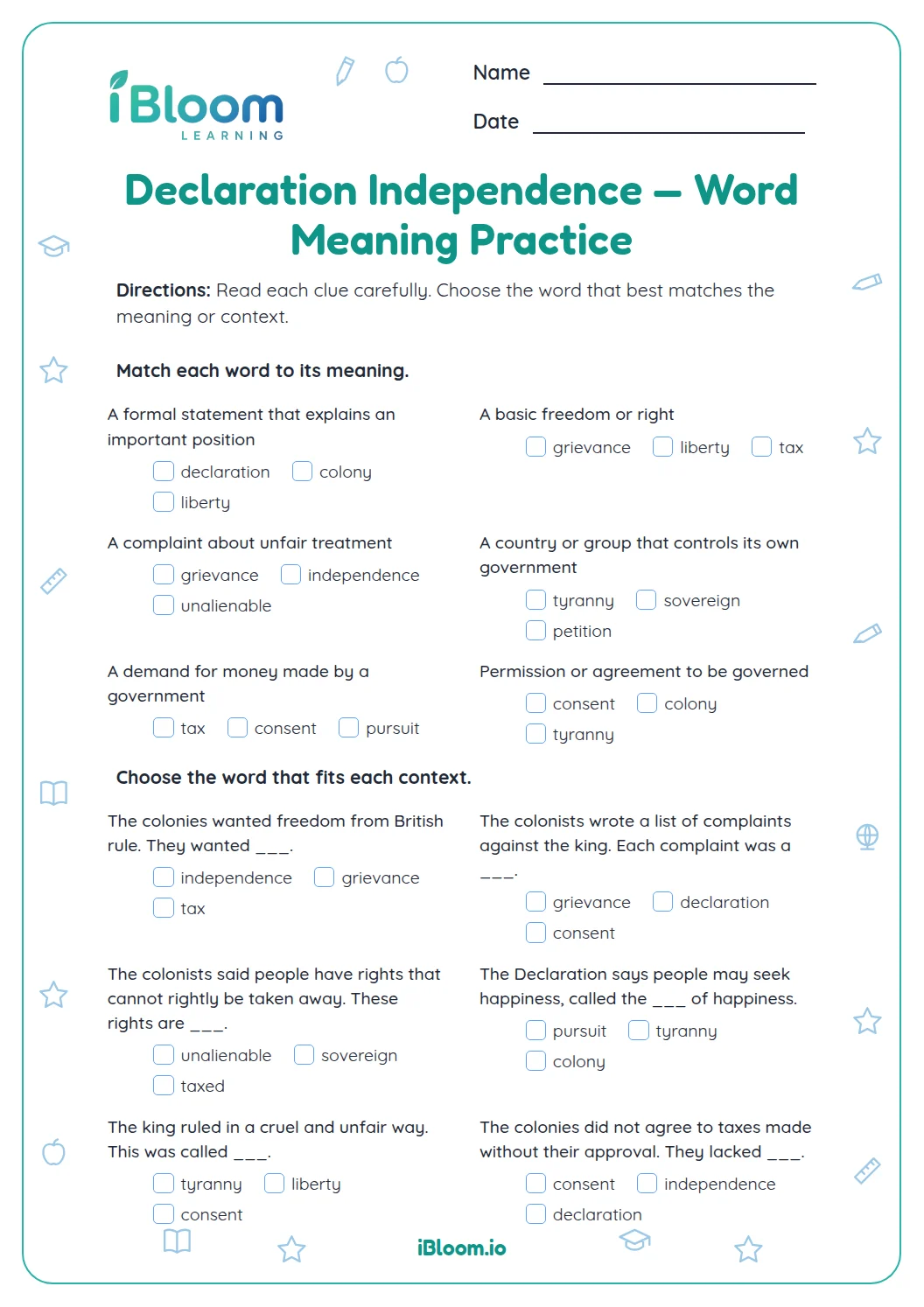
The questions use civic words in clear definitions and short sentence contexts.
- 1Clue: a person who leads a nation
- 2Answer: president
- 3A president leads; a citizen is a person with rights and responsibilities.
How are a candidate, president, election, and inauguration different?
A candidate seeks an elected office, while a president holds that office. An election is how voters choose a leader. An inauguration is the ceremony that marks the beginning of a president’s term. The sheet asks children to notice these distinctions in the clues and in their own explanations.
Part A checks meanings and a familiar presidential fact. Part B uses the words in sentences, so students see how the vocabulary works in context.
What does the word search add to the practice?
Part C asks children to locate ten terms, including president, citizen, election, inauguration, candidate, and amendment. The grid is a review of the words from the earlier questions; finding a word is not a substitute for explaining its meaning.
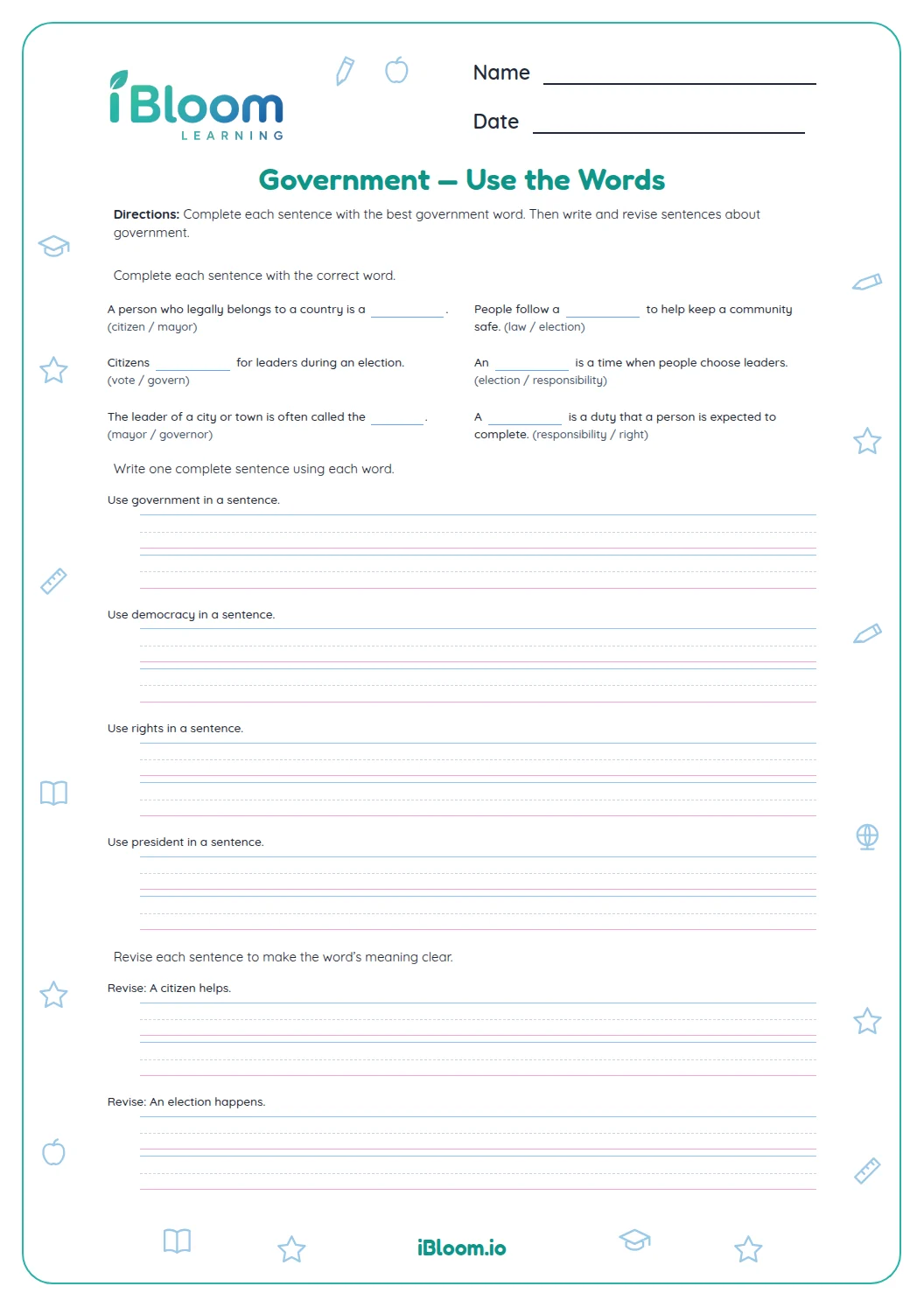
Part D returns to meaning with two comparisons and a sentence using amendment and vote. The separate key gives model responses for these open-ended items.
How can an adult check the answers?
Use the key after the student has finished. For written answers, accept a different response when it accurately explains the distinction or uses both requested words in a sensible sentence. Ask the student to point to the clue that supports a choice.
How to work through the worksheet
- 1Read each clue all the way through before selecting a word.
- 2For a sentence completion, reread the full sentence with the chosen term inserted.
- 3Mark each word found in the grid once, then check it against the word list.
- 4In the written comparisons, name both terms and explain the difference.
- 5Review the key and use the clue to revisit any answer that does not fit.
Common vocabulary mix-ups
The mistake
Calling a candidate the president before the election.
The fix
A candidate is seeking office; a president has been elected and holds the office.
The mistake
Mixing up an election and an inauguration.
The fix
An election chooses a leader; an inauguration is a ceremony that begins the term.
The mistake
Choosing a word because it is about government, even when the clue points elsewhere.
The fix
Match the exact meaning in the clue, then test the word in the sentence.
Common Core alignment
This worksheet gives students focused practice with the standard below.
Use sentence clues to determine the meaning of civic and presidential vocabulary.
On this sheet: Clues and short sentence contexts help students determine the meanings of the target terms.
Show the official wordingHide the official wording
Use context (e.g., cause/effect relationships and comparisons in text) as a clue to the meaning of a word or phrase.
What to practice next
Make more practice
Further reading
Questions parents and teachers ask
Which presidential words appear on the worksheet?
The sheet practices president, citizen, election, inauguration, term, candidate, campaign, amendment, cabinet, and vote. Students meet the words in meaning clues, sentence completions, a word search, and short written responses. The question set emphasizes distinctions among a person, an event, and a period of time.
How many questions and pages are included?
There are 14 questions: six multiple-choice items, four sentence completions, one word-search activity, and three written responses. The printable renders as three worksheet pages with a separate three-page answer key. The key includes sample responses for questions that allow more than one accurate answer.
What is the difference between an election and an inauguration?
An election is the process in which voters choose a leader. An inauguration is a ceremony marking the start of a president’s term. The worksheet asks students to compare those ideas in writing, so they practice explaining the difference instead of memorizing two isolated definitions.
Does the word search replace the vocabulary questions?
No. The word search gives students another look at ten terms, while the earlier questions ask them to connect words with definitions and sentence clues. After finding a term, invite the student to use it in a sentence or explain its meaning to reinforce the vocabulary work.
Is an answer key included?
Yes. A separate answer key accompanies the worksheet and shows the expected choices and completions. For the three written responses, it gives sample answers rather than requiring one exact sentence. Accept another response when it explains the distinction clearly or uses both requested words correctly.