


About this worksheet
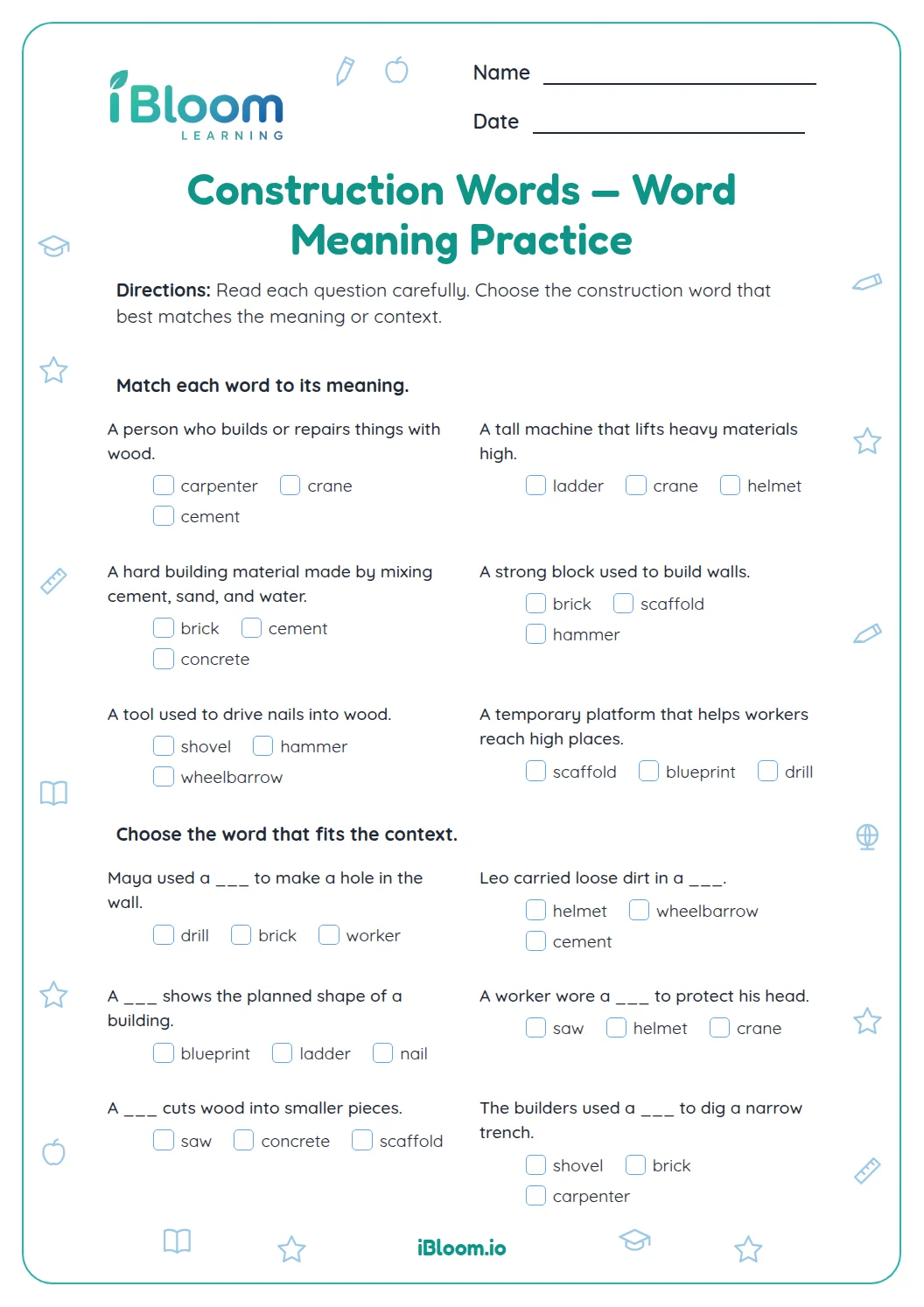
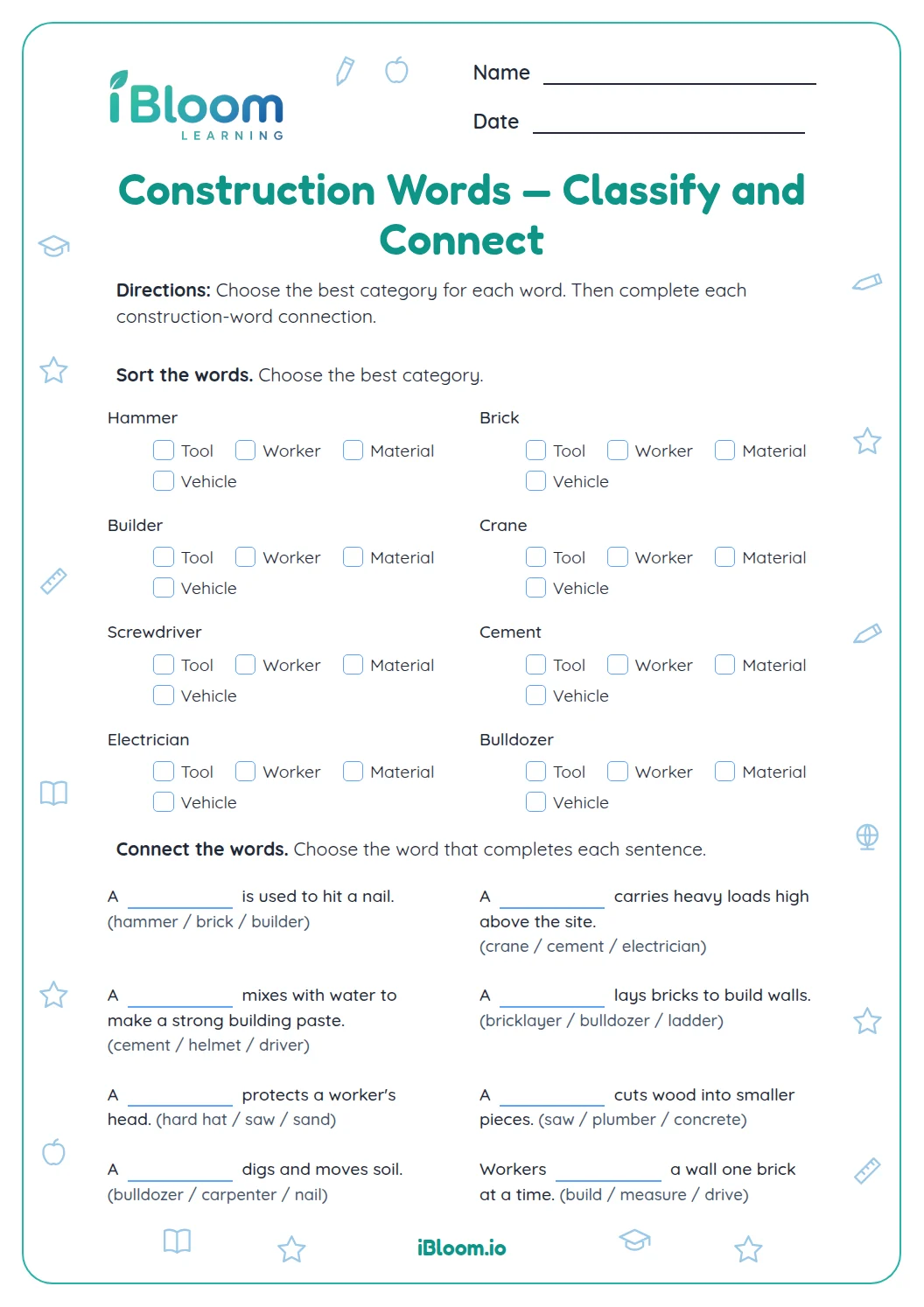
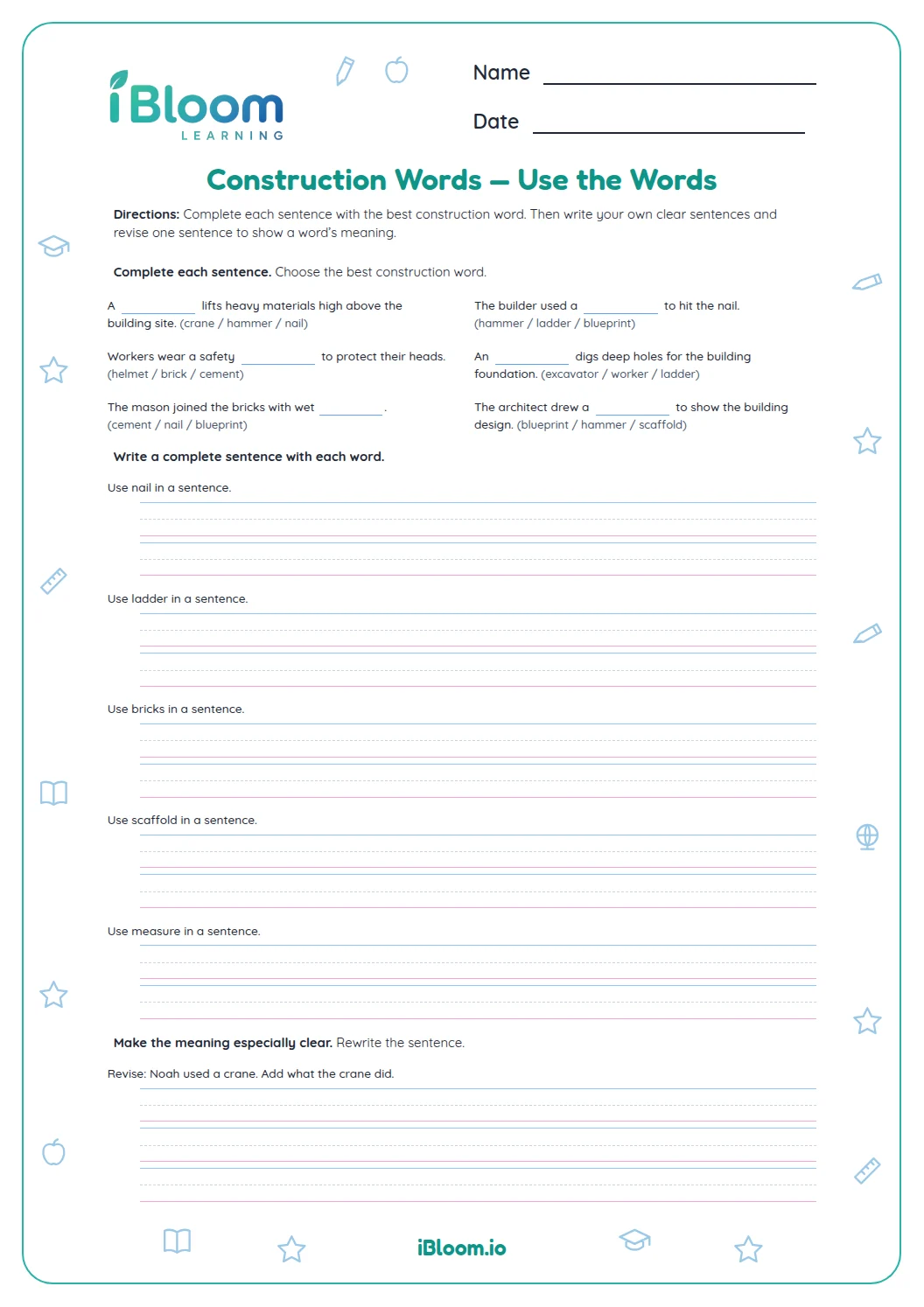
This printable construction vocabulary review helps learners connect words for tools, materials, safety gear, structures, and machines with what they do. Across 15 questions, children match definitions, use sentence clues, and explain simple word relationships. The page is labeled for Grades 1–5, so an adult can read clues aloud when needed and invite learners to explain their choices. The sheet practices using sentence-level context to determine word meaning, a Common Core Language skill. A separate answer key gives fixed choices and sample responses.
Aligned to L.2.4a
What kinds of words belong to construction?
Construction vocabulary includes tools such as a saw and wrench, materials such as concrete and mortar, and machines such as a crane. Safety gear and structures add more words to the topic. Grouping words by their jobs can make them easier to remember.
How do sentence clues help with a new word?
A clue often names an action, object, or place that points to a word’s meaning. In “The crew poured wet concrete into the forms,” poured and forms show that concrete is a building material.
- 1The crew poured wet ____ into the forms for a sidewalk.
- 2“Poured” and “forms” suggest a material used to build.
- 3Choose concrete, not wrench.
- 4Answer: concrete
What does the review ask learners to do?
Part A matches six clues to construction words. Part B includes five sentence clues and four questions about word categories and relationships.
Learners can answer the short written prompts in their own words; the key provides sample answers.
How to use this worksheet
- 1Read the full clue before looking at the choices.
- 2Think about the object’s job, material, or place of use.
- 3Try each choice in the sentence and keep the one that makes sense.
- 4For word connections, name a category or explain what an object does.
- 5Use the key to check meaning, not just spelling.
Common mistakes and quick fixes
The mistake
Choosing a word because it is familiar, even when it does not fit.
The fix
Reread the action in the clue and test each choice in context.
The mistake
Confusing a material with a tool.
The fix
Ask whether the word names something used to build or something used to do the work.
The mistake
Giving a related but vague response.
The fix
Name the specific tool, material, or job and say how it is used.
Curriculum alignment
This practice connects the worksheet tasks with the listed learning standard.
Use sentence and topic clues to determine the meaning of a word.
On this sheet: Sentence clues help learners select and apply construction words precisely.
Show the official wordingHide the official wording
Use sentence-level context as a clue to the meaning of a word or phrase.
What to practice next
Make more practice
Further reading
Questions parents and teachers ask
What construction words does this page practice?
The 15 items review construction words for tools, materials, safety gear, structures, and machines. Learners match six clues, use five sentence contexts, and answer four word-relationship questions. The separate key lists the fixed choices and sample explanations. Learners can use the choices to distinguish a material from a tool or machine.
How many questions are included?
The worksheet has 15 questions in two parts: six clue matches, followed by five sentence-context choices and four questions about word categories and relationships. The two worksheet pages are followed by two answer-key pages with the correct choices.
Is this appropriate for different grade levels?
Read the sentence as a whole and notice the actions, objects, or setting that point to the word. In “The crew poured wet concrete into the forms,” poured and forms suggest a material used in construction. The learner then selects concrete from the choices.
How should learners use context clues?
The clue says that mortar joins bricks in a wall. Mortar is the material between the bricks; it is not the tool that cuts or lifts them. Learners can use this distinction to separate construction materials from tools and machines.
What if a child does not know a word?
The first part uses direct clues, the second puts words in sentences, and the last asks learners to compare categories and jobs. Younger children can have the clues read aloud; older learners can explain which specific clue supports an answer.
Does the answer key accept different answers?
The choice questions have one answer listed in the key. The final four questions are also multiple choice, so the key gives the expected choice rather than open-ended sample responses. Ask the learner to point to the clue or word relationship that supports the selection.