


About this worksheet
This Grade 2 vocabulary worksheet uses familiar toy names to practice classification and word relationships. Children identify toys, connect words by shared uses, complete short statements, and explain how groups fit together. The questions ask children to sort words into categories and describe the ideas those categories represent, practicing Common Core Language standard L.1.5a. The answer key includes exact choices and sample explanations.
Aligned to L.1.5a
What skill does this page practice?
Classifying means grouping words that share a feature or use. Naming the shared feature helps explain why the words belong together.
How can a reader build a strong answer?
Read the whole prompt, find the detail or clue that answers it, and check that your response fits the question.
- 1A kite, balloon, and paper airplane can all fly.
- 2The words connect through a shared way they move.
- 3Answer: fly
What will children do on the worksheet?
The worksheet has 16 questions. The answer key follows the same order and gives sample wording for open responses.
How to use this worksheet
- 1Read each toy name and look at its matching picture when one is printed.
- 2For a category question, check that the feature fits every toy in the group.
- 3Complete each sentence with a word that makes sense for all listed toys.
- 4For written questions, name the connection and explain the shared use.
- 5Use the key to compare your category and explanation.
Common mistakes and quick fixes
The mistake
Grouping toys only because they are both toys.
The fix
Reread the prompt, find the relevant detail, and revise the response so it answers the question clearly.
The mistake
Choosing a feature that fits one word but not the other.
The fix
Reread the prompt, find the relevant detail, and revise the response so it answers the question clearly.
The mistake
Writing a group name without explaining the connection.
The fix
Reread the prompt, find the relevant detail, and revise the response so it answers the question clearly.
Common Core alignment
This activity connects close reading and written responses to a specific English language arts standard.
Sort words into categories and notice what the categories mean.
On this sheet: Children sort toy words into useful groups and explain how the words connect.
Show the official wordingHide the official wording
Sort words into categories (e.g., colors, clothing) to gain a sense of the concepts the categories represent.
What to practice next
Make more practice
Further reading
Questions parents and teachers ask
What does it mean to classify toy words?
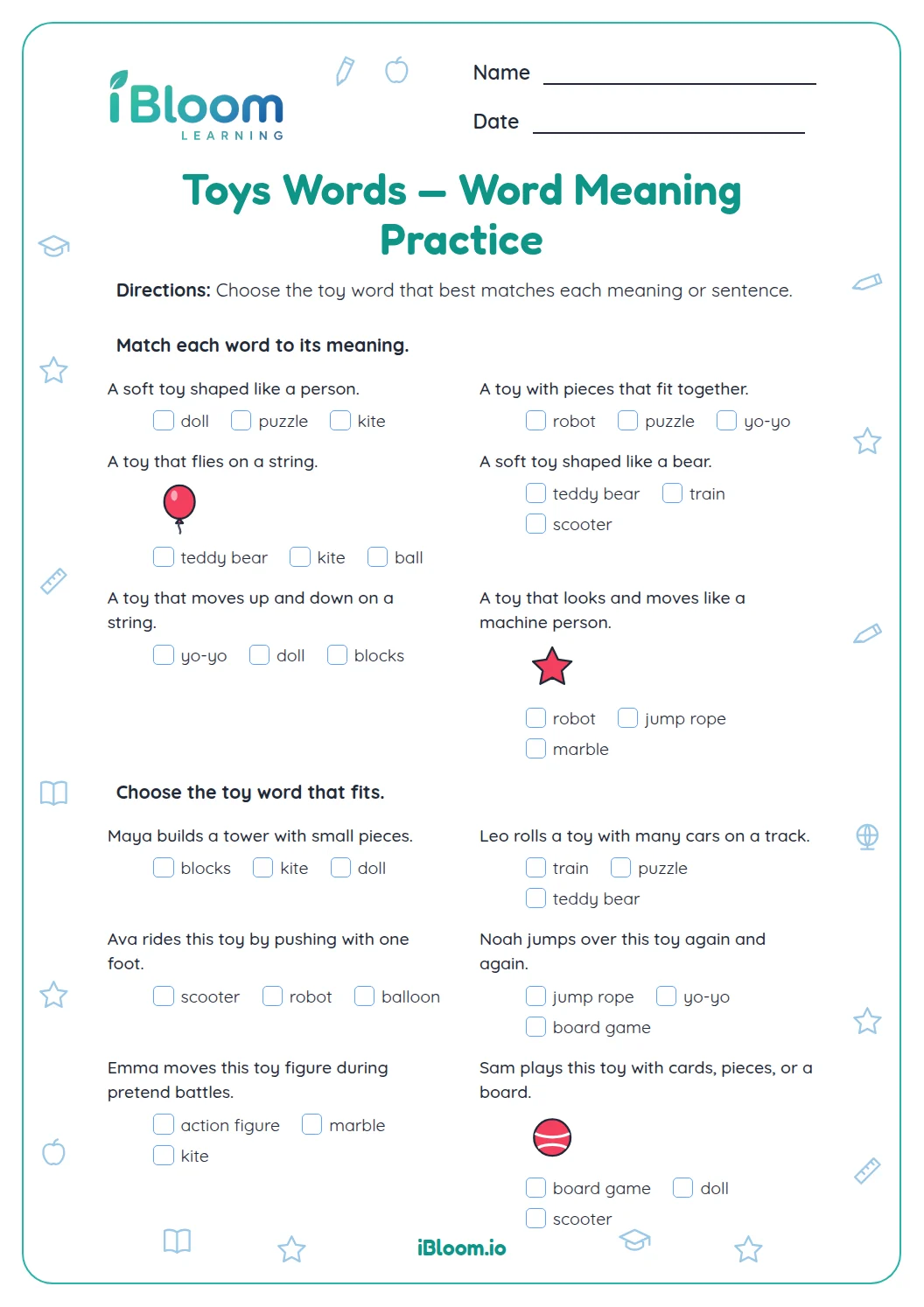
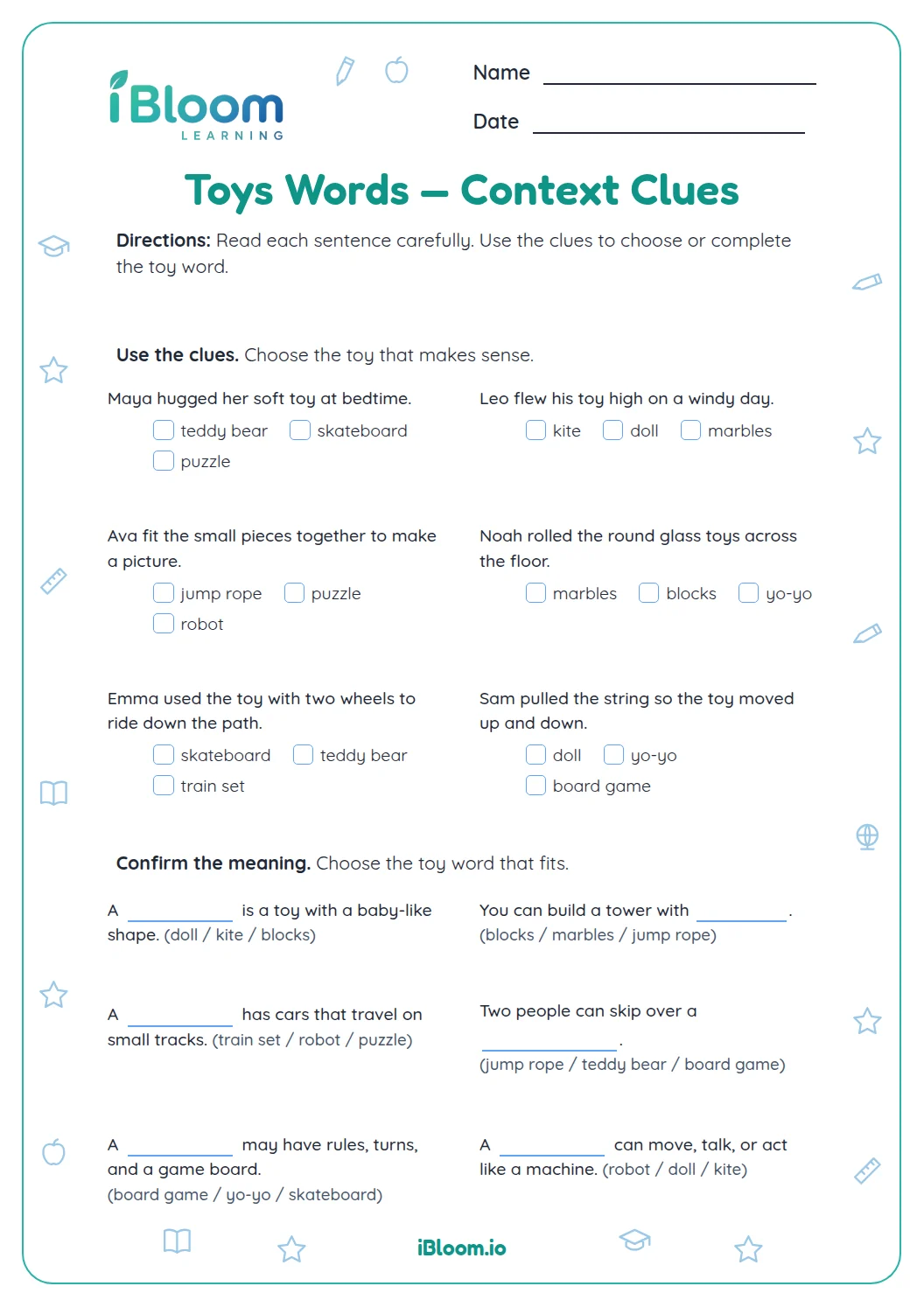
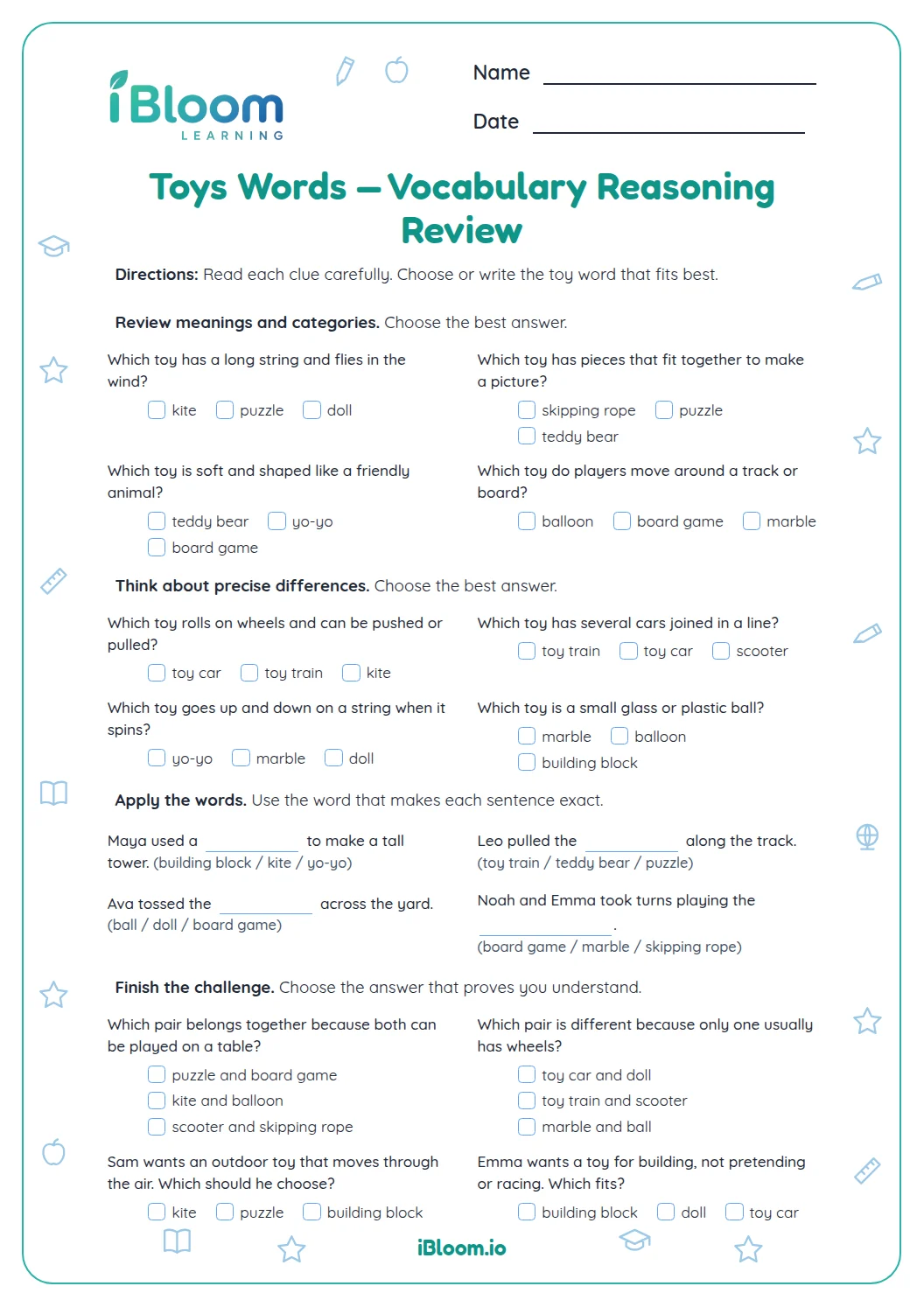
To classify is to place words in groups that share a feature. On this page, a kite and a ball can connect through ways children play with them, while blocks and puzzles connect through building or fitting pieces together. Questions 1–8 practice naming toys before sorting them.
Which toy words appear on the worksheet?
The page includes kite, doll, blocks, puzzle, skateboard, top, yo-yo, ball, beanbag, teddy bear, toy train, balloon, and paper airplane. Children use both the words and their functions to decide how they connect. Question 13 asks children to make two pairs and explain each shared use.
Does every toy fit only one category?
No. A ball can be a toy you toss and a toy that moves. The written items let children explain a sensible shared feature, so a category should be named clearly and fit the words selected. Question 13 accepts sensible groupings when children explain the shared feature.
What should a child write for the open responses?
A complete sentence that names a connection or explains how a toy is used. The answer key offers examples, and other accurate groupings are acceptable when the explanation fits. Question 14 gives one example; question 13 asks children to build two pairs.
How can this worksheet work for mixed ages?
Younger children can read the toy names with an adult and focus on simple groups. Older children can compare more than one feature and write a precise sentence explaining why the words belong together. The key provides examples while allowing other correct sentences.
How long does this worksheet take?
Plan about 20 minutes for 16 questions and a quick review. Talking through how two toys are alike can help children prepare for the final written explanations. The prompts move from recognizing a toy to explaining a category in writing.