



About this worksheet
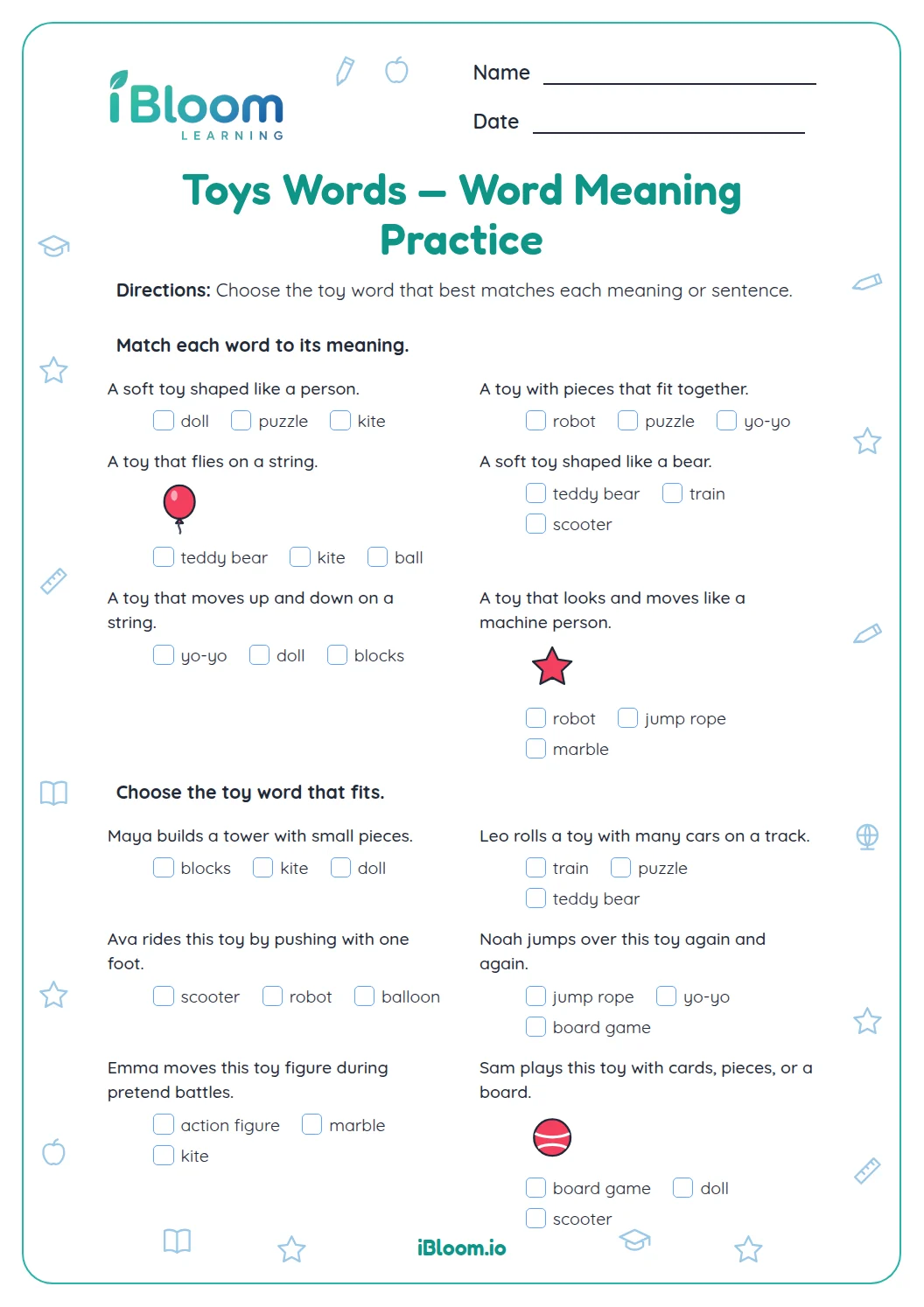
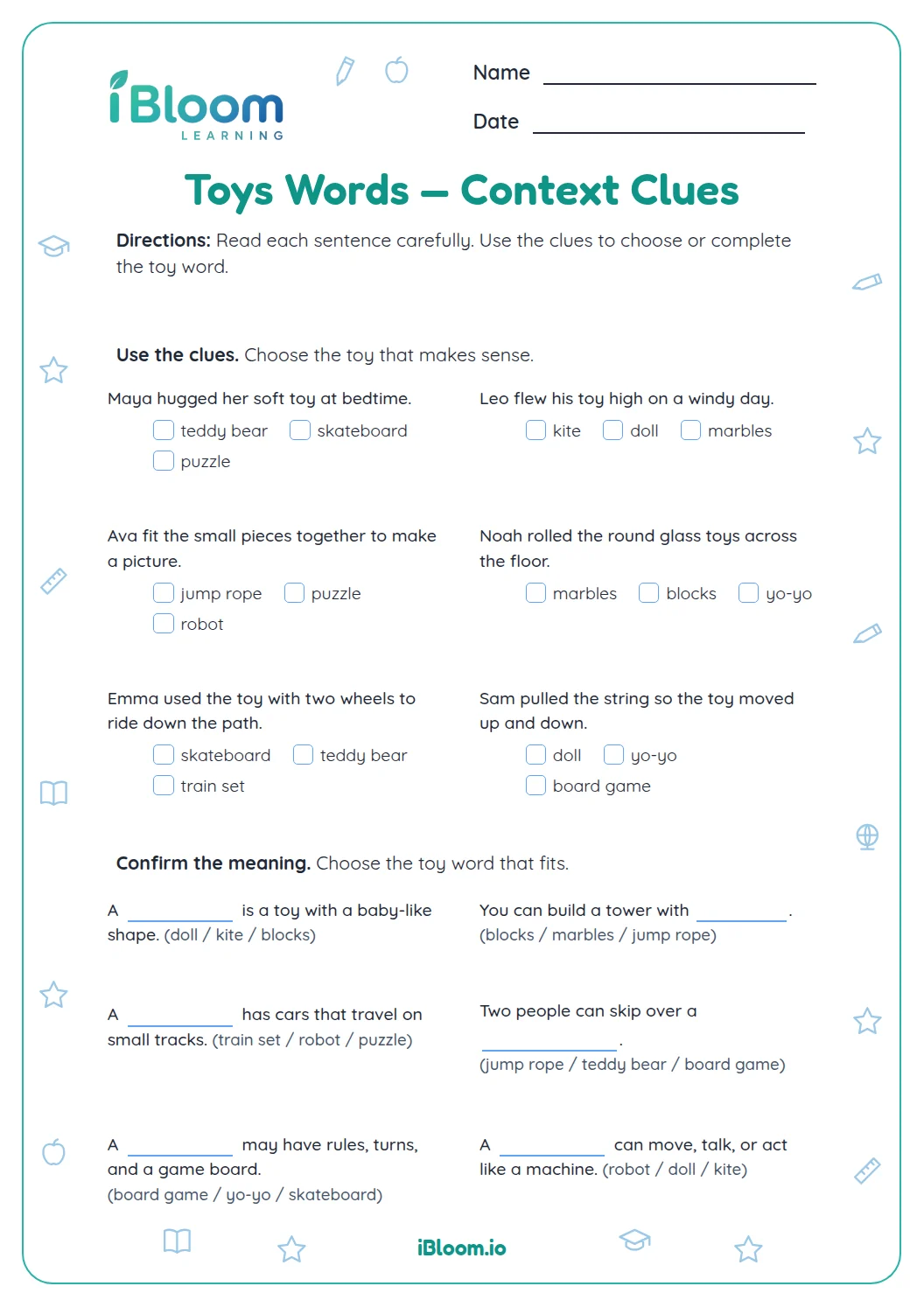
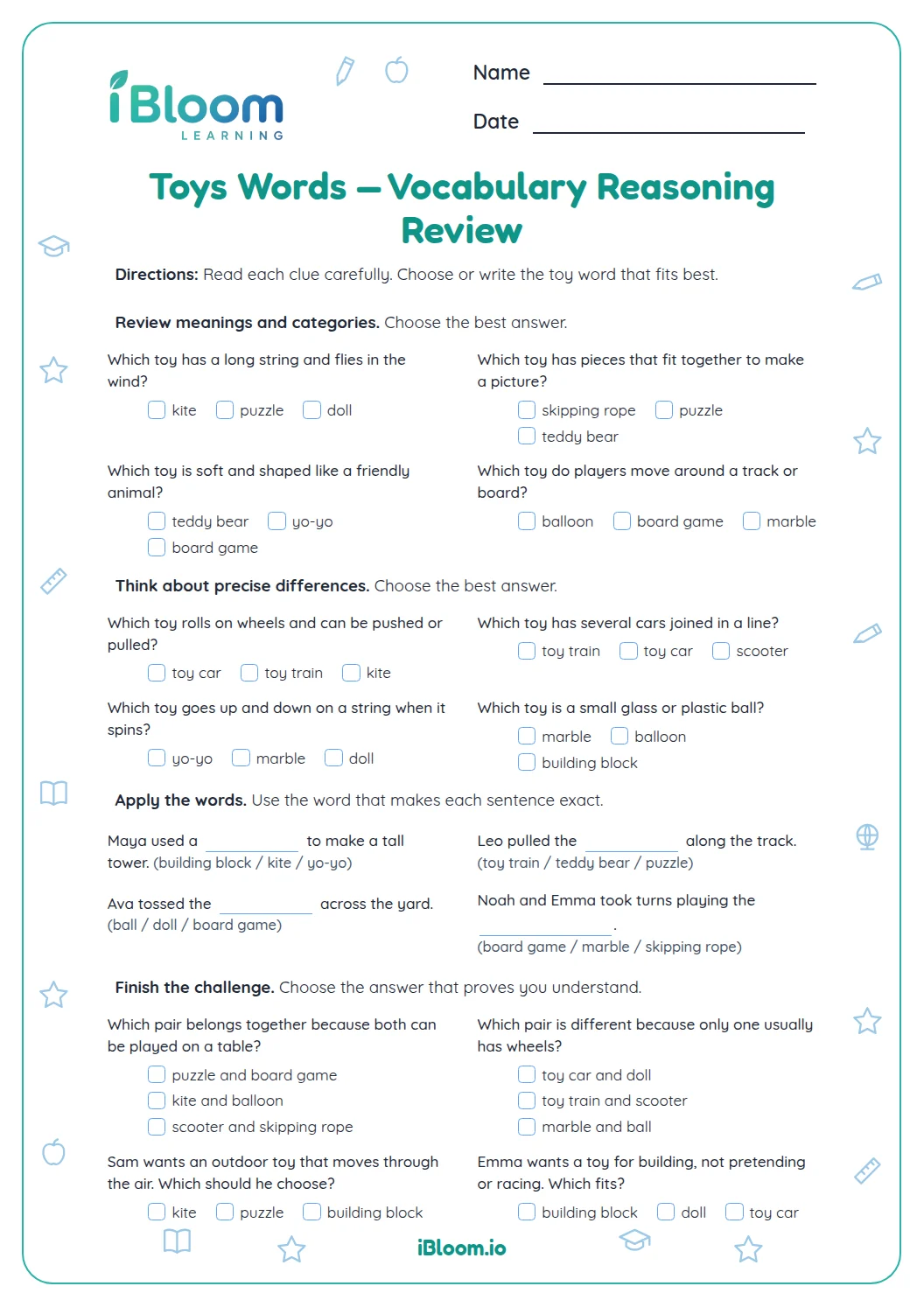
This Grade 2 worksheet follows the old Toys Words — Use the Words page with sentence-level toy vocabulary practice. Students use context clues to write the toy name or action that fits each sentence. The 16 sentences are arranged in two parts, with a separate answer key. The items include familiar toys such as blocks, a train, a kite, a yo-yo, and a wagon. This practices CCSS L.2.4.a.
Aligned to L.2.4.a
What does the worksheet ask students to do?
The 16 prompts are fill-in-the-blank sentences about familiar playthings and actions. Part A focuses on toy names, while Part B mixes toy names and actions. Each sentence gives clues about how a toy is used or what it does.
- Eight toy-name sentences
- Eight more toy words and actions
- One missing word in each sentence
How can a student use a word in context?
Read the whole sentence and notice the action and setting. “Maya flew her ___ high above the park on a breezy day” points to kite because a kite flies outdoors.
- 1Maya flew her ___ high above the park on a breezy day.
- 2A kite flies outdoors in the wind.
- 3Answer: kite.
How can a child check a choice?
Reread the whole sentence with the chosen toy word in place. Check that it matches the action and makes sense from beginning to end.
How to use this worksheet
- 1Read each entire sentence before writing a word.
- 2Use the action and setting as clues to the toy.
- 3Check that the word fits the blank grammatically and by meaning.
- 4Reread the completed sentence to see if it makes sense.
Common mistakes and quick fixes
The mistake
Choosing a toy based on only one nearby word.
The fix
Use all the sentence clues, including the action and setting.
The mistake
Writing a toy name where an action is needed.
The fix
Ask whether the blank names an object or tells what it does.
The mistake
Choosing a word that does not fit the whole sentence.
The fix
Reread the sentence with the word in place and check its meaning.
Common Core alignment
This worksheet practices the following standard.
Use sentence context to identify a word’s meaning.
On this sheet: Students use sentence clues to identify toy words that fit.
Show the official wordingHide the official wording
Use sentence-level context as a clue to the meaning of a word or phrase.
What to practice next
Make more practice
Further reading
Questions parents and teachers ask
What is on the worksheet?
It has 16 fill-in-the-blank sentences in two parts. Students use clues in each sentence to write a toy name or action that fits. The separate answer key lists the intended word for every sentence, and adults can review each written word with the child.
How can students choose the right word?
Each sentence has one blank and enough context to point to a toy or action. Students read the full sentence and write the word that fits the action or setting. For example, a toy that flies high above a park on a breezy day is a kite.
Which toy words appear on the page?
The worksheet includes blocks, a teddy bear, a train, a puzzle, a ball, a yo-yo, a robot, a marble, a wagon, a kite, a jump rope, and the action word bounce. Each sentence supplies context to identify its word. These words appear in both object and action contexts.
How can a student check a choice?
Put the chosen word into the blank and reread the whole sentence. Check whether the word fits the action and the setting. If the sentence says a toy is programmed to move forward, robot makes sense; blocks do not fit that clue.
What does the answer key include?
The key gives one intended word for each of the 16 sentences. Students can check their choices after completing a part, then reread any sentence that was difficult and notice which clue points to the correct toy word. Rereading a sentence helps connect the word to its clue.