
About this worksheet
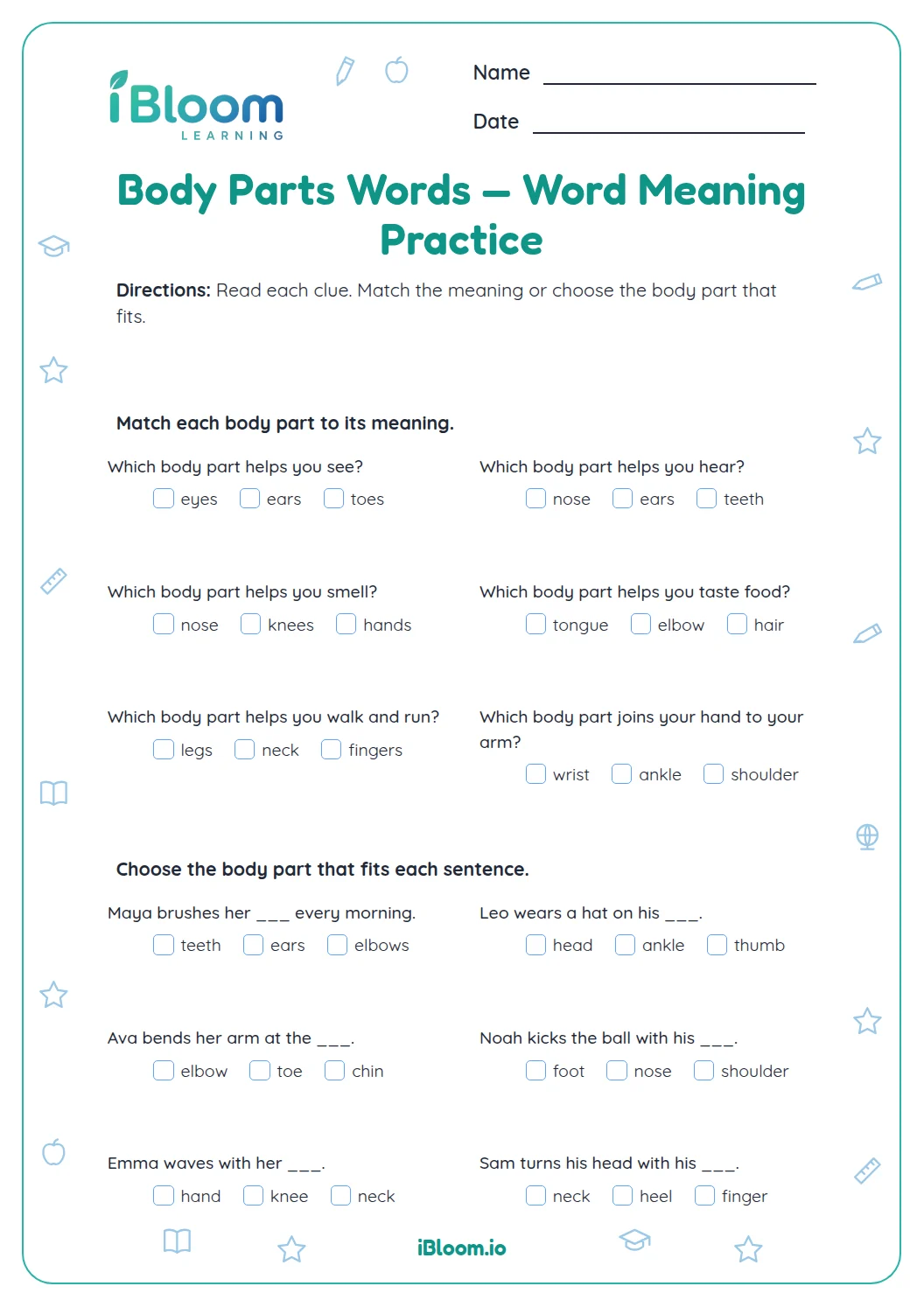
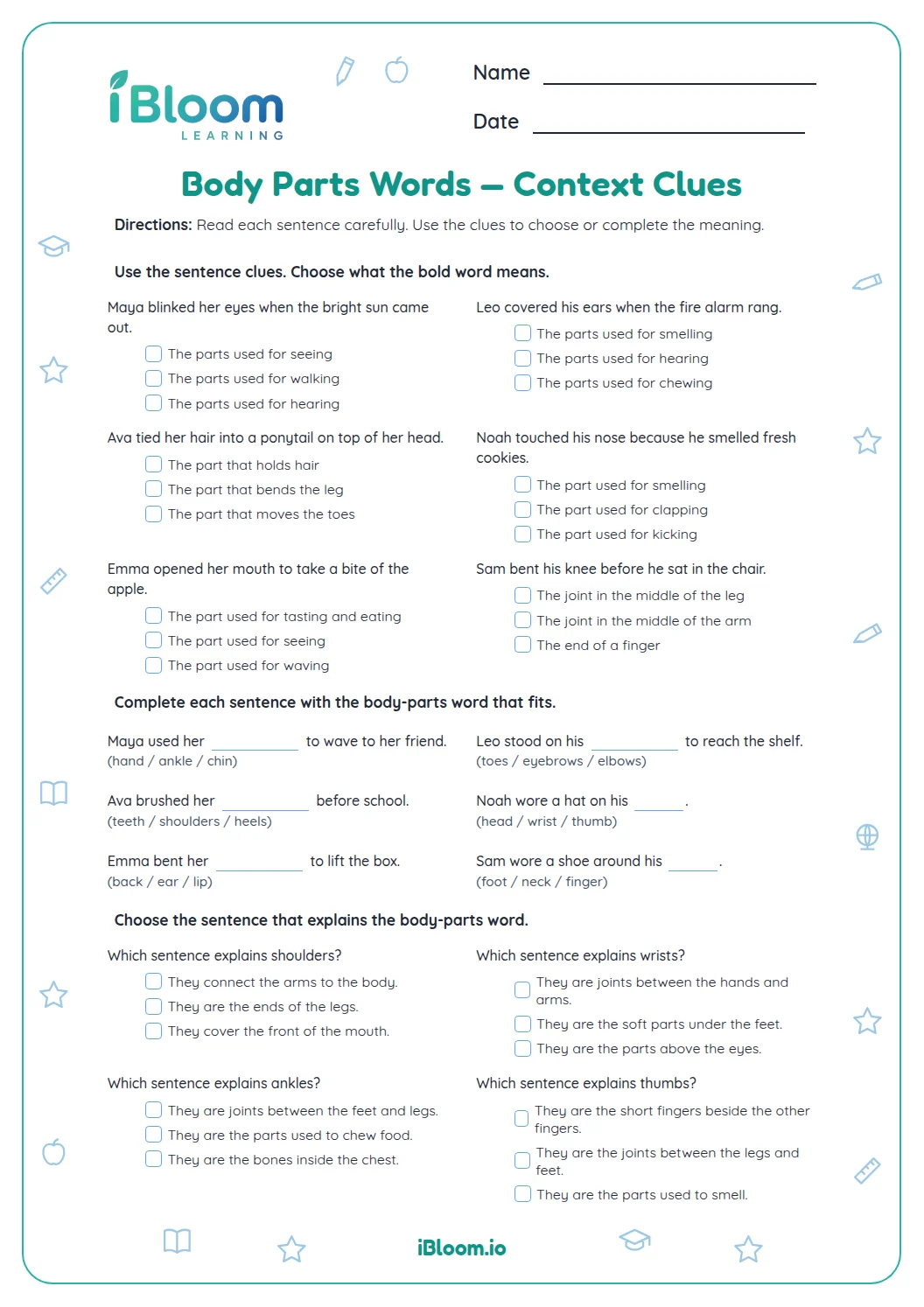
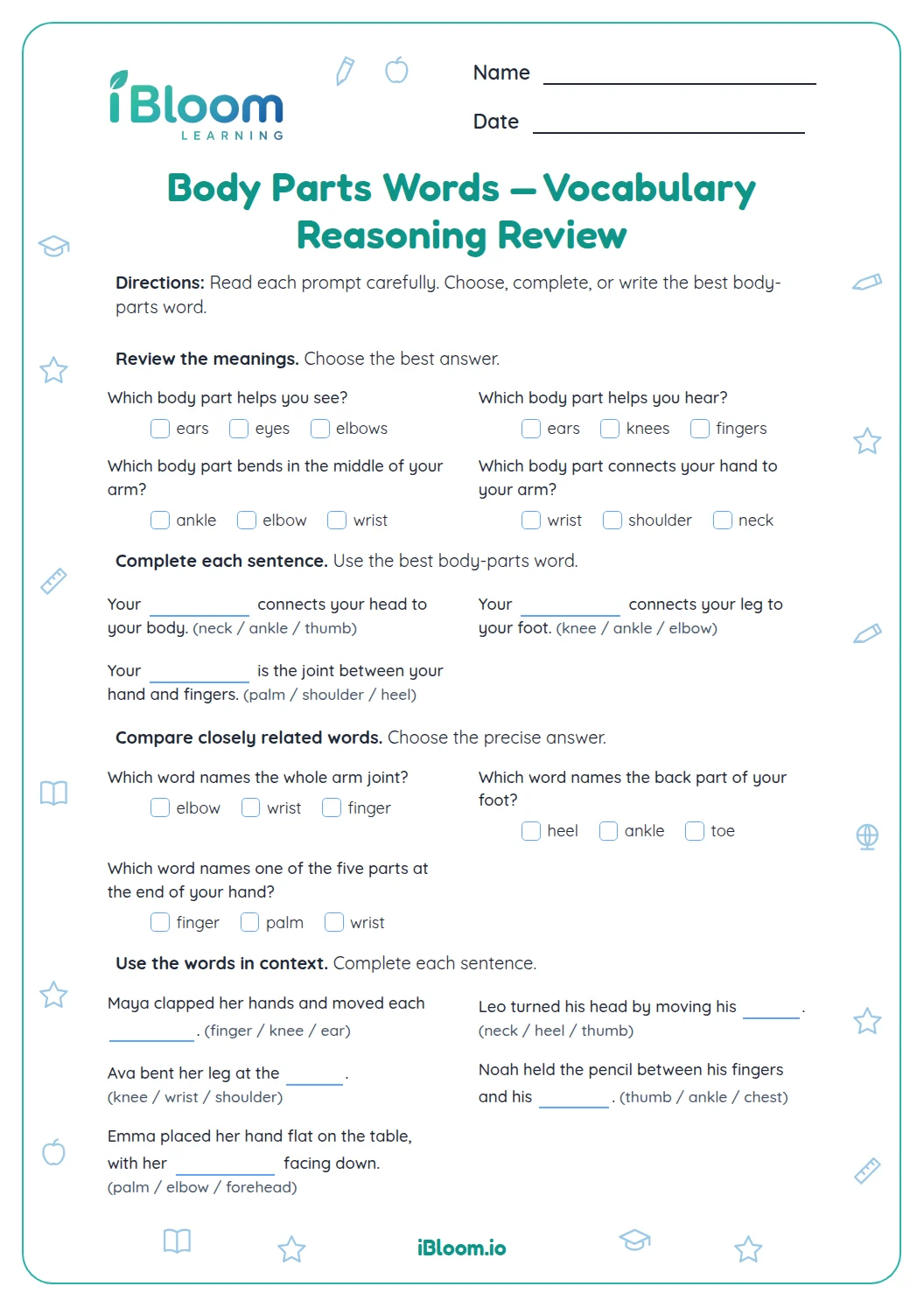
This free printable body-parts vocabulary worksheet is designed for early elementary learners building word knowledge. Children identify body-part words, group related parts such as eye, ear, and nose, and connect body parts to simple jobs such as smelling or bending. Nineteen questions move from recognition to grouping and clues, with a separate answer key for checking. The page practices CCSS L.1.5.a by sorting words into meaningful categories.
Aligned to L.1.5.a
How can a word fit a body-part group?
Look for the shared idea in the words. Eye, ear, and nose are all parts of the face, so face belongs with them. A knee or toe is a body part too, but it belongs with the leg group.
Question 6 uses this idea: eye, ear, and nose all belong on the face. Say the group name aloud before choosing.
- 1eye, ear, nose
- 2All are parts of the face
- 3Choose face
How do you connect a part to its job?
Read the clue and picture the action. Smelling happens with your nose; bending your arm happens at your elbow. Notice how similar body parts can have different jobs.
What will the worksheet ask?
Nineteen questions move from spotting body-part words to grouping related parts and matching each part to a job. Choices include face parts, joints, hands, feet, and limbs.
How to practice body-part words
- 1Read both choices all the way through.
- 2Name the shared group for words such as eye, ear and nose.
- 3Say the clue action, such as smell or bend.
- 4Choose the body part that does that job.
- 5Read your choice back with the question to check that it makes sense.
Common mix-ups
The mistake
Choosing any body part instead of the body part named by the clue.
The fix
Act out the clue safely, then name the part that does the action.
The mistake
Grouping all body parts together without noticing a smaller group.
The fix
Ask what the words share: face parts, joints, hand parts or foot parts.
The mistake
Mixing up ankle and wrist.
The fix
Touch the joint: wrist joins hand and arm; ankle joins foot and leg.
Curriculum alignment
This worksheet builds vocabulary by sorting words into meaningful groups.
Sort words into groups and name the idea that links each group.
On this sheet: Children identify and group words for body parts and match related words by meaning.
Show the official wordingHide the official wording
Sort words into categories (e.g., colors, clothing) to gain a sense of the concepts the categories represent.
What to practice next
Make more practice
Further reading
Questions parents and teachers ask
What does classify mean on this page?
To classify means to put words into groups that share an idea. For example, eye, ear, and nose are all parts of the face. The first questions ask children to spot body-part words, and later questions ask them to recognize related groups and connect parts to their jobs.
What body-part groups appear on the worksheet?
The questions include face parts, arm and hand parts, leg and foot parts, joints, and body parts used for actions. Children work with words such as elbow, ankle, wrist, nose, teeth, eyelids, and shoulder. Each question offers two or three choices.
How can I help if my child is unsure?
Ask your child to say what the clue is asking before looking at the choices. For a job clue, act out the action safely, such as blinking or pretending to smell a flower. For a group clue, name what the example words have in common.
How many questions are on the page?
There are 19 questions in three parts. Children first recognize body-part words, then group related parts, and finally match parts to jobs. The separate answer key lists the correct choice for every question. Review unfamiliar words together by naming or pointing to each body part.
Is there an answer key?
Yes. A separate answer key page gives the correct choice for all 19 questions. Children can complete the sheet first, then use the key with an adult to check each answer and talk through any word that was unfamiliar. Invite them to explain one grouping aloud.