


About this worksheet
This printable clothing vocabulary worksheet gives Grades 1–5 learners 14 questions about familiar clothing terms. Part A uses sentence clues, Part B matches definitions to clothing words, Part C asks for short everyday answers, and Part D gives one model written response. The sentence clues give practice using context to work out a word’s meaning, aligned with CCSS L.1.4a.
Aligned to L.1.4a
How do context clues help with clothing words?
The sentence around a clothing word gives a useful hint about its meaning. A neck, cold walk, and wool point to a scarf; sliding up points to a zipper. Read the whole sentence before choosing.
How can a definition narrow the choices?
A definition names what an item does, where it is worn, or how it is made. Compare every clue with the choices instead of picking the first familiar word.
How can children check a clothing word?
For question 1, the words “around her neck” and “wool” describe a scarf. Try each choice in the sentence: only scarf fits the clues. The same routine works when a definition describes a belt, collar, or button.
- 1Maya wrapped a wool ___ around her neck.
- 2Clues: wool; around her neck
- 3A scarf is worn around the neck.
- 4Answer: scarf
How to use this worksheet
- 1Read each Part A sentence aloud and underline or say the words that give a clothing clue.
- 2In Part B, match the entire definition to a choice; check details such as where the item is worn or how it fastens.
- 3Complete Part C with a clothing word that fits the everyday question.
- 4Check the answer key and ask what clue rules out another choice.
Common clothing-word mix-ups
The mistake
Choosing any warm item when the clue says “around the neck.”
The fix
Look at where the item is worn: a scarf goes around the neck, while a hat goes on the head.
The mistake
Mixing up a zipper and a button because both close clothing.
The fix
A zipper slides; a button passes through a buttonhole. Match the action clue.
The mistake
Calling jeans any kind of pants.
The fix
Jeans are pants made from denim; use the material clue when it is given.
Common Core alignment
Use sentence clues to work out a clothing word.
On this sheet: Part A uses sentence clues to select a clothing word; later parts connect terms to meanings.
Show the official wordingHide the official wording
Use sentence-level context as a clue to the meaning of a word or phrase.
What to practice next
Make more practice
Further reading
Questions parents and teachers ask
What clothing words are on the worksheet?
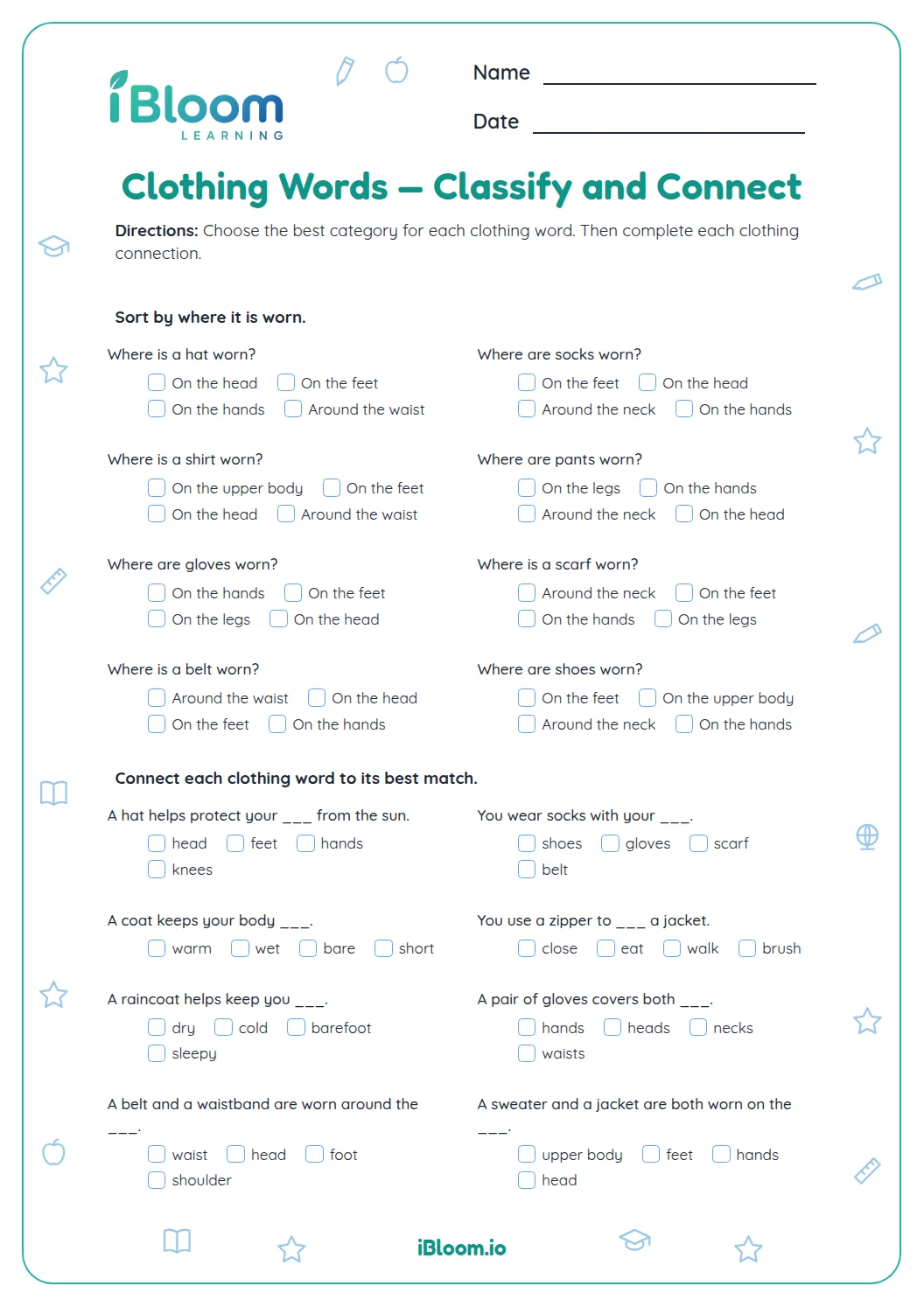
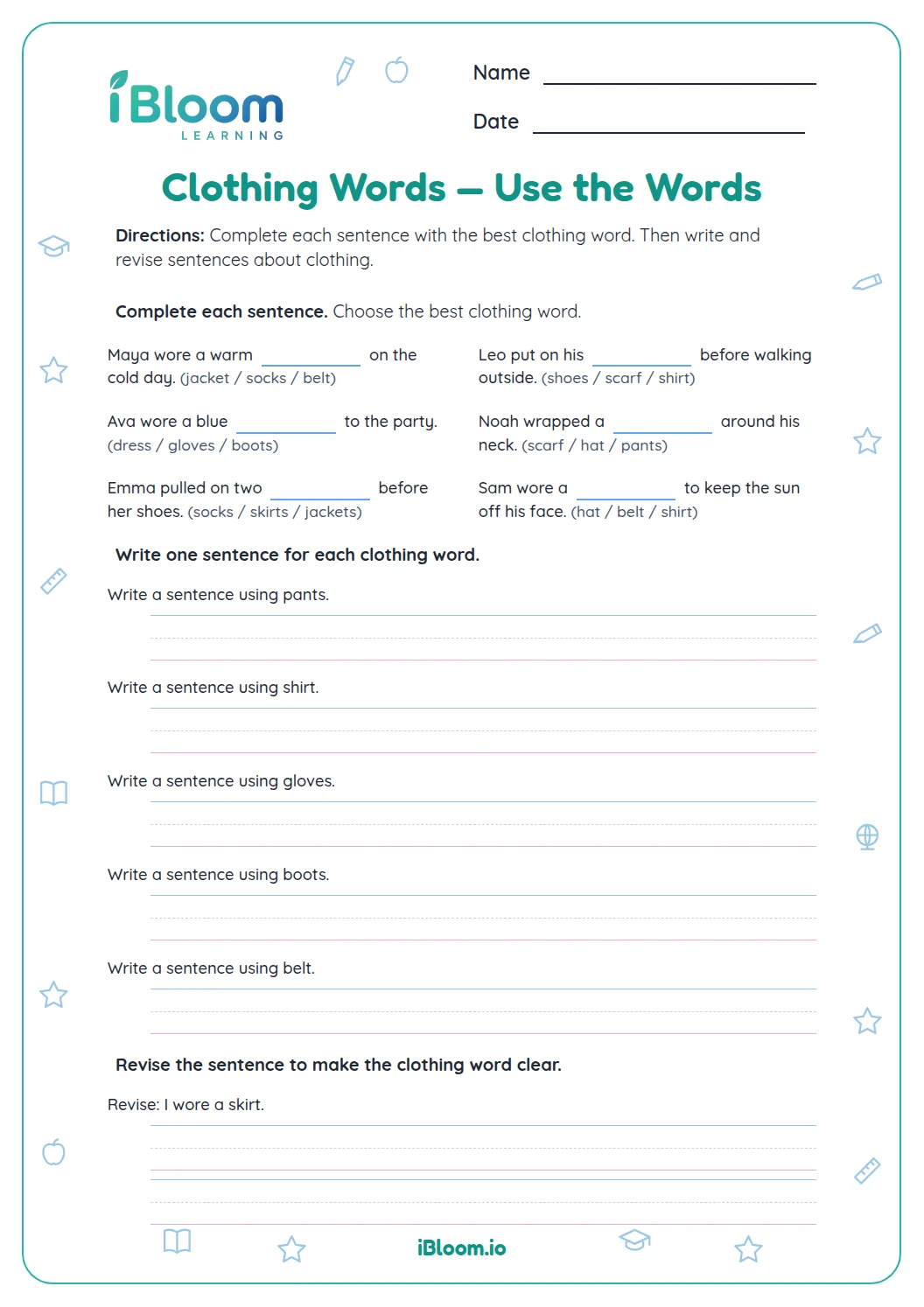
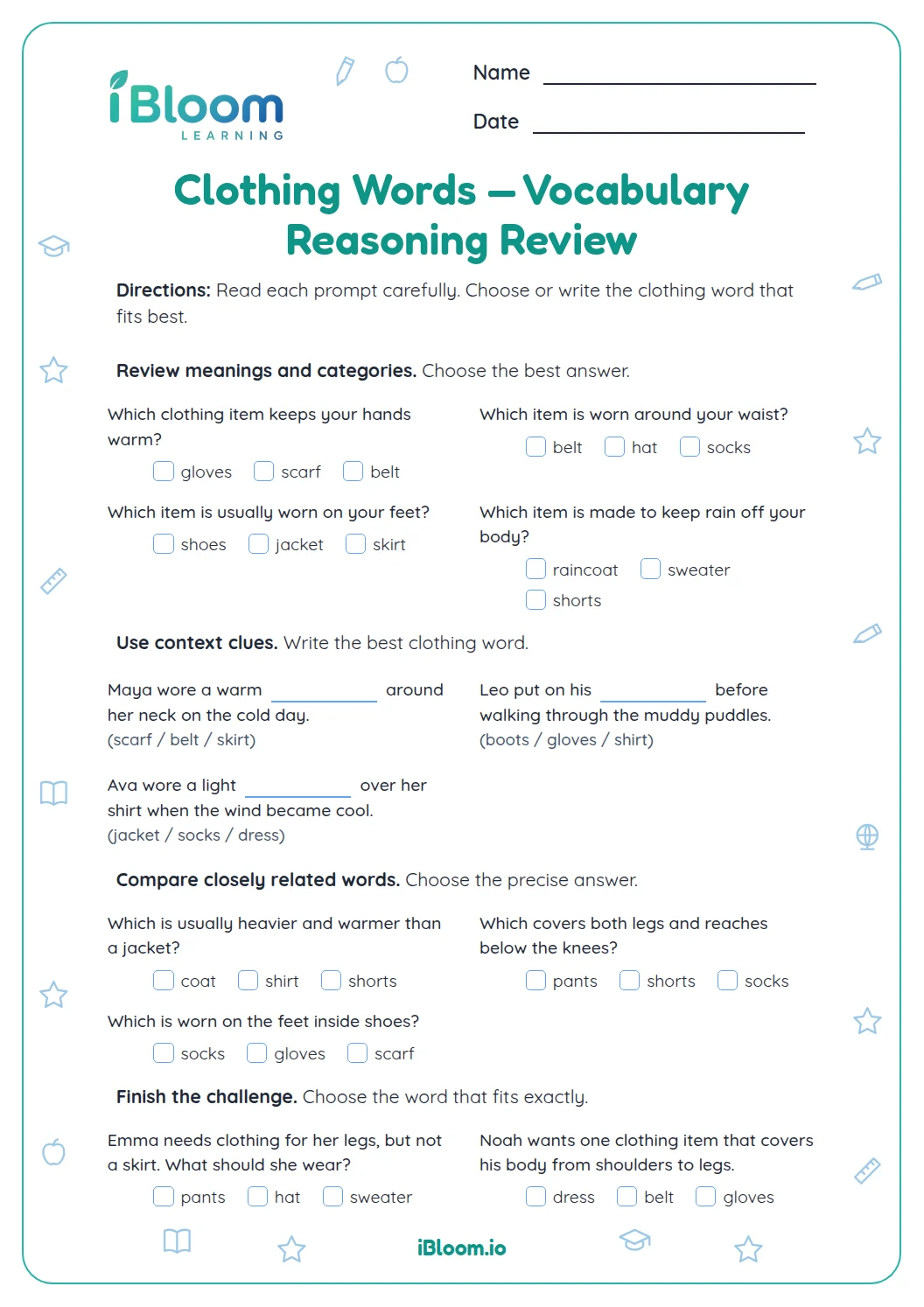
The questions use scarf, coat, socks, zipper, pocket, belt, glove, collar, hat, dress, pants, shirt, and other familiar clothing terms in the choices. Children use sentence clues, definitions, and short familiar-use questions. The separate answer key lists the expected word for each item and a sample for one response.
How many questions are included?
There are 14 questions in four parts. Part A has five sentence clues with multiple-choice answers, Part B has five definitions with choices, Part C has three short answers, and Part D has one written response. The worksheet uses two practice pages and a separate answer key.
How should my child solve the definition questions?
Read the definition all the way through and look for a detail about what the item does, where it goes, or how it is made. For example, a fastener sewn onto clothing and pushed through a hole is a button. Then compare that detail with every choice.
Can I read the worksheet aloud?
Yes. An adult can read each sentence and definition aloud while the child points to the choices and explains a clue. That keeps attention on the word meaning. The final questions draw on familiar clothing, so a child can answer orally before writing the word.
What is the answer to the scarf example?
The answer is scarf because the sentence says the item is made of wool and wrapped around Maya’s neck. Those details match a scarf. The answer key includes all 14 answers, including acceptable sample wording for the final open response.
How long does this worksheet take?
Plan for about 15 minutes, with extra time if you pause to talk about clues or read aloud. Children can complete one part at a time and check the key after finishing. The page moves from sentence clues to definitions, then to short everyday responses.