

About this worksheet
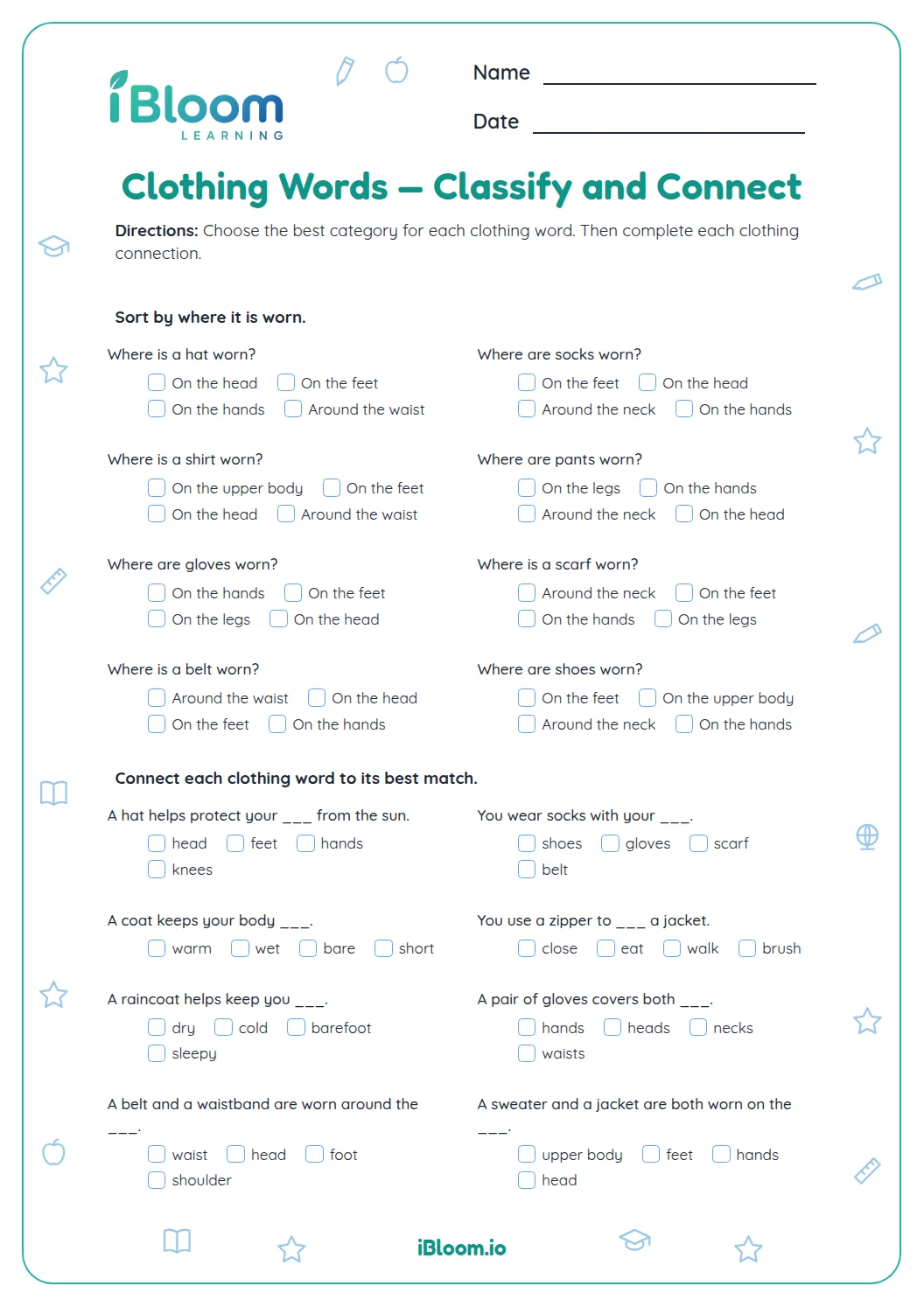
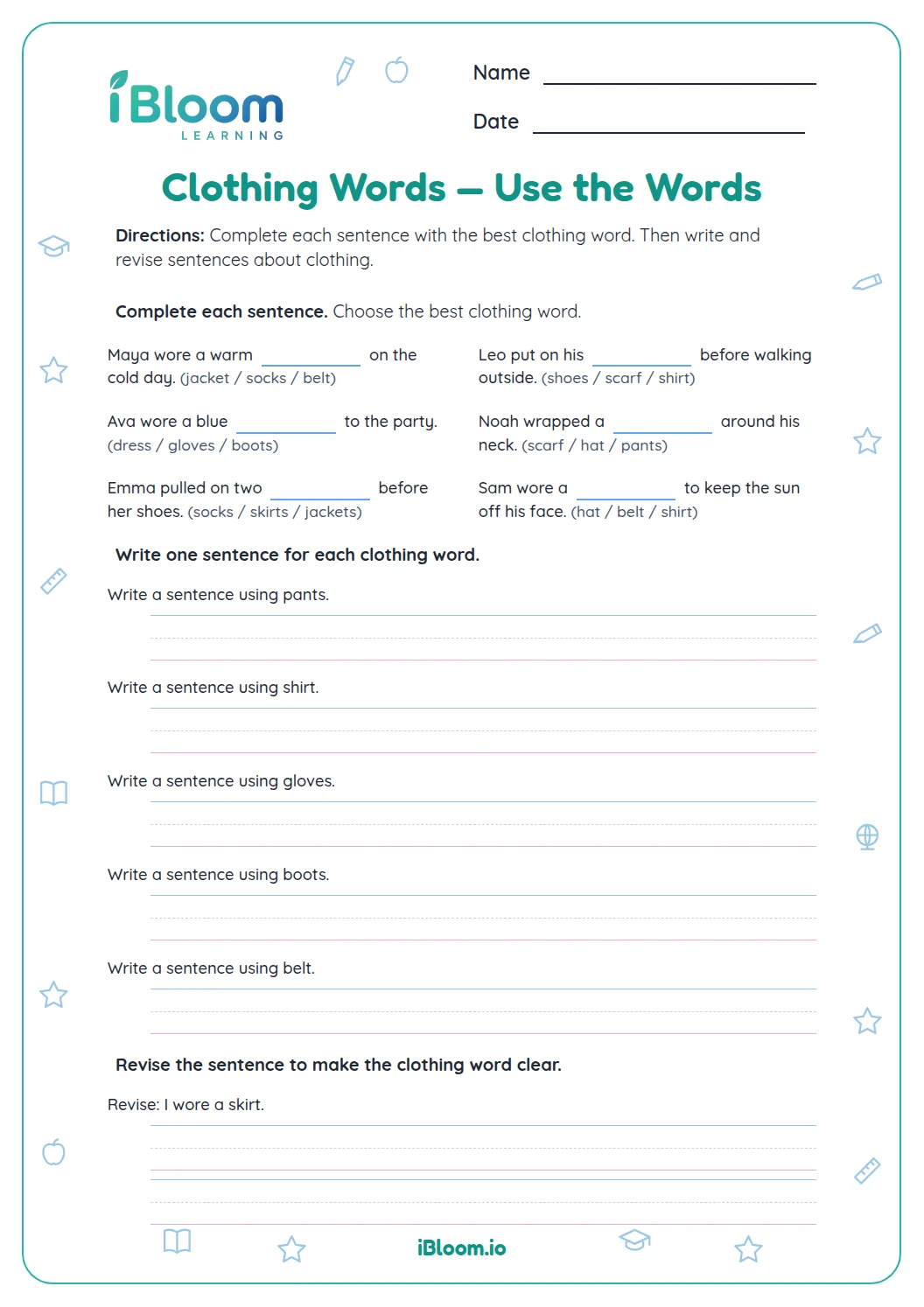
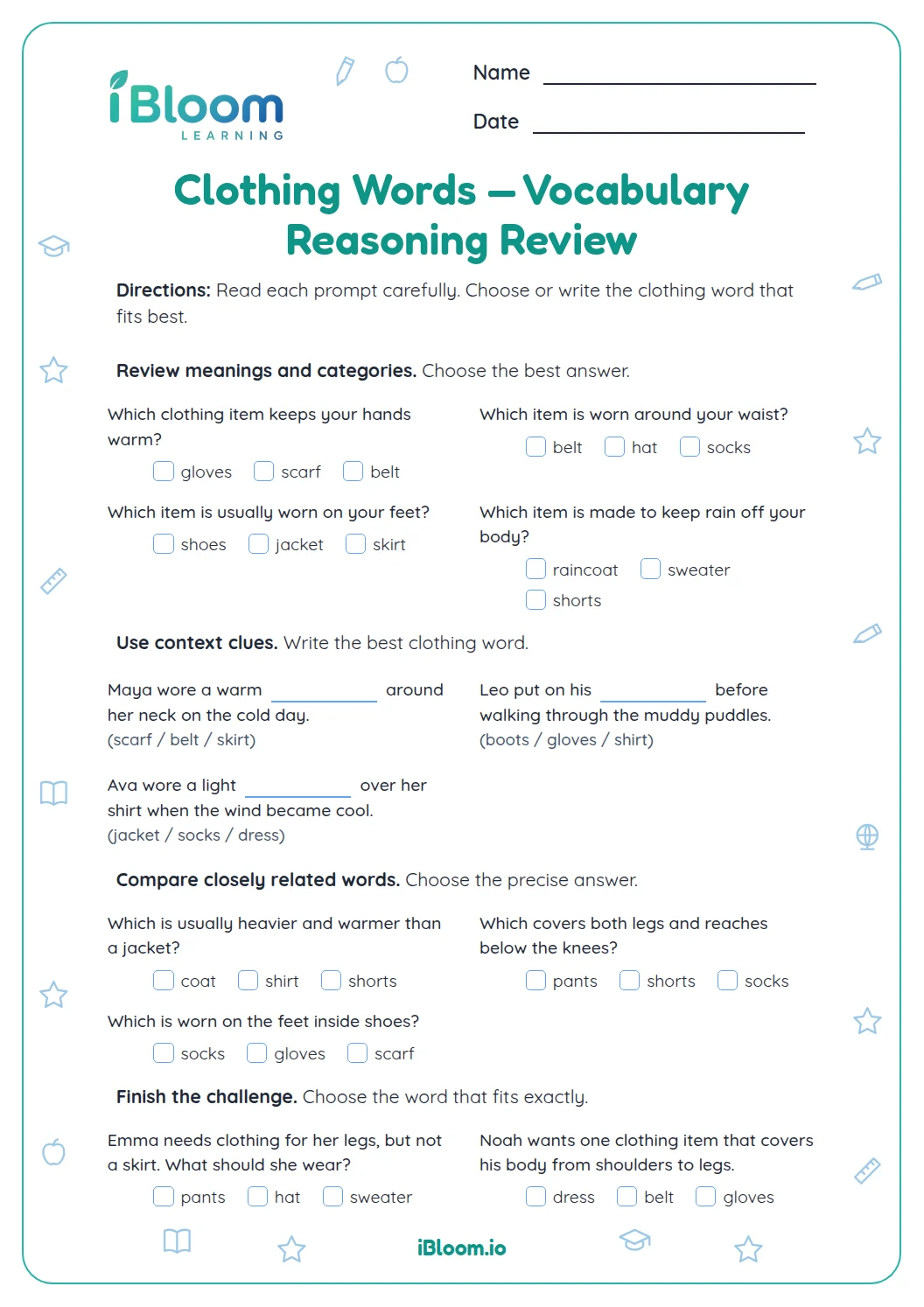
This printable vocabulary worksheet uses clothing words in short everyday situations. Learners read a sentence and use its details to choose the item that fits: boots for puddles, a scarf for a chilly neck, or a belt to keep pants up. Eighteen multiple-choice questions move from direct clues to fuller situations about weather, clothing features, and routines. The separate answer key lists the best-fit word for each sentence. Encourage learners to point to the phrase that helped them decide.
Aligned to L.2.4a
What is a context clue?
A context clue is a detail around a word or blank that helps a reader decide what belongs there. If a sentence says the sidewalk is icy and asks what shoes Noor chose, “boots” fits the clue. Reading the whole sentence matters because the helpful detail may come before or after the blank.
How can readers find the clothing clue?
Read the complete sentence first. Look for information about weather, body parts, clothing features, or what someone is doing. Try each choice in the sentence and check whether it matches the clue. In question 1, “deep snow” points to boots rather than sandals or a shirt.
- 1Maya put on her ___ before stepping into deep snow.
- 2The clue is “deep snow.”
- 3Boots are the clothing choice that fits that situation.
What clothing situations are included?
The questions use clues about snow, sun, rain, cold hands, swimming, muddy trails, and clothing features such as buttons or thick soles. Some ask learners to choose a word directly; others add a little more detail. Each item has one choice that best fits the sentence.
How to use this worksheet
- 1Read the full sentence before looking at the choices.
- 2Find the detail about weather, body part, or clothing use.
- 3Try each clothing word in the blank or question.
- 4Choose the one that matches the detail.
- 5Explain the clue and check the answer key.
Common mistakes and quick fixes
The mistake
Choosing a familiar clothing word without checking the sentence.
The fix
Point to the clue, such as snow, rain, or a cold body part.
The mistake
Using a word that matches only part of the sentence.
The fix
Read the whole sentence again and test the choice against every detail.
The mistake
Confusing clothing worn on nearby body parts.
The fix
Use the sentence clue: a scarf goes around the neck, while a hat covers the head.
Curriculum alignment
Use sentence clues to determine which clothing word fits.
On this sheet: Each item uses a sentence detail to select a clothing word that makes sense.
Show the official wordingHide the official wording
Use sentence-level context as a clue to the meaning of a word or phrase.
What to practice next
Further reading
Questions parents and teachers ask
What is a context clue in a clothing sentence?
It is a nearby detail that helps identify the clothing word. In question 1, “deep snow” is the clue that makes boots a better choice than sandals or a shirt. Readers can point to the clue before choosing.
What kinds of clothing words are included?
The questions use words such as boots, hat, hood, scarf, mittens, socks, pants, belt, coat, dress, gloves, sweater, and sandals. The sentences give clues about weather, activities, body parts, and clothing features. Several answers refer to clothes worn on the head, feet, hands, or body.
How can I help a child who is unsure between two choices?
Read the sentence aloud and ask which detail matters. Then substitute each choice into the sentence. A word that fits the weather or clothing use and makes the full sentence sensible is the best answer. This step helps children connect the selected vocabulary word to its sentence context.
Is there an answer key?
Yes. A separate answer key lists the clothing word that best fits each of the 18 sentences. When checking, have the learner point to the sentence detail that supports the answer, such as “icy,” “buttons,” or “around his waist.”
What ages or grades can use this page?
The source page is listed for Grades 1–5. Younger readers can work with an adult reading the sentence and choices aloud; older learners can complete the choices independently and explain which context clue supports each word. The page can also be used in short sessions by completing one group of questions at a time.