
About this worksheet
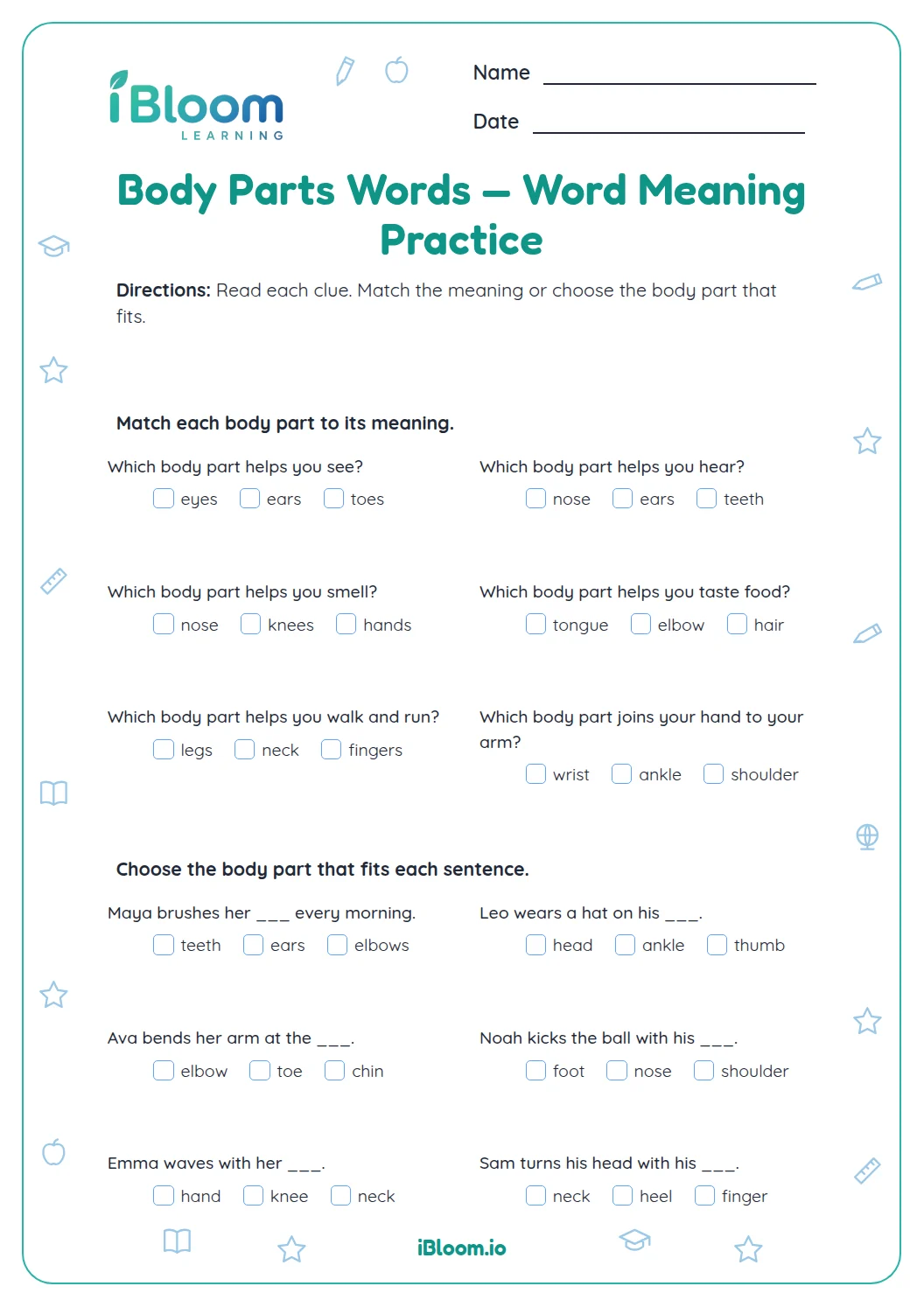
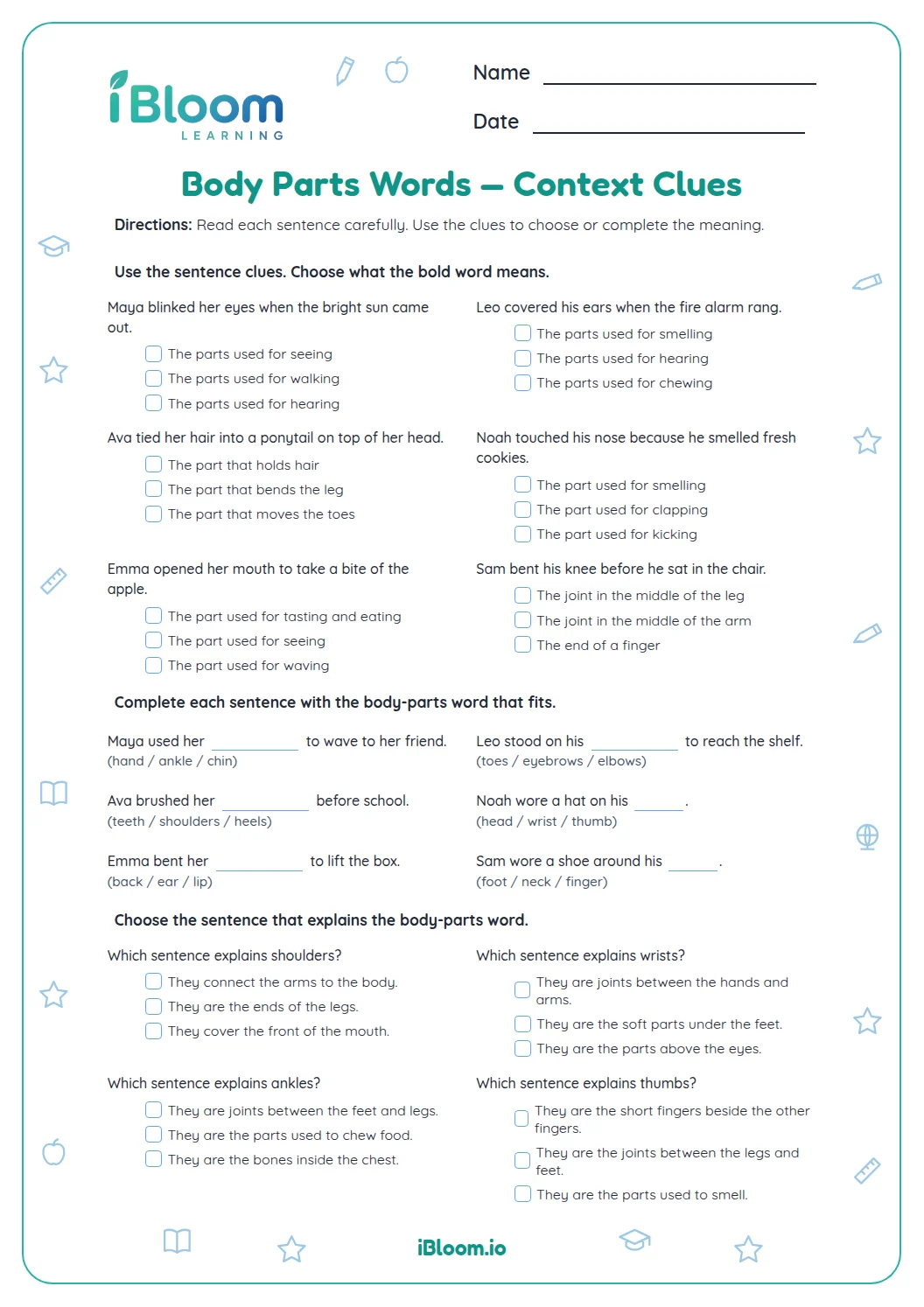
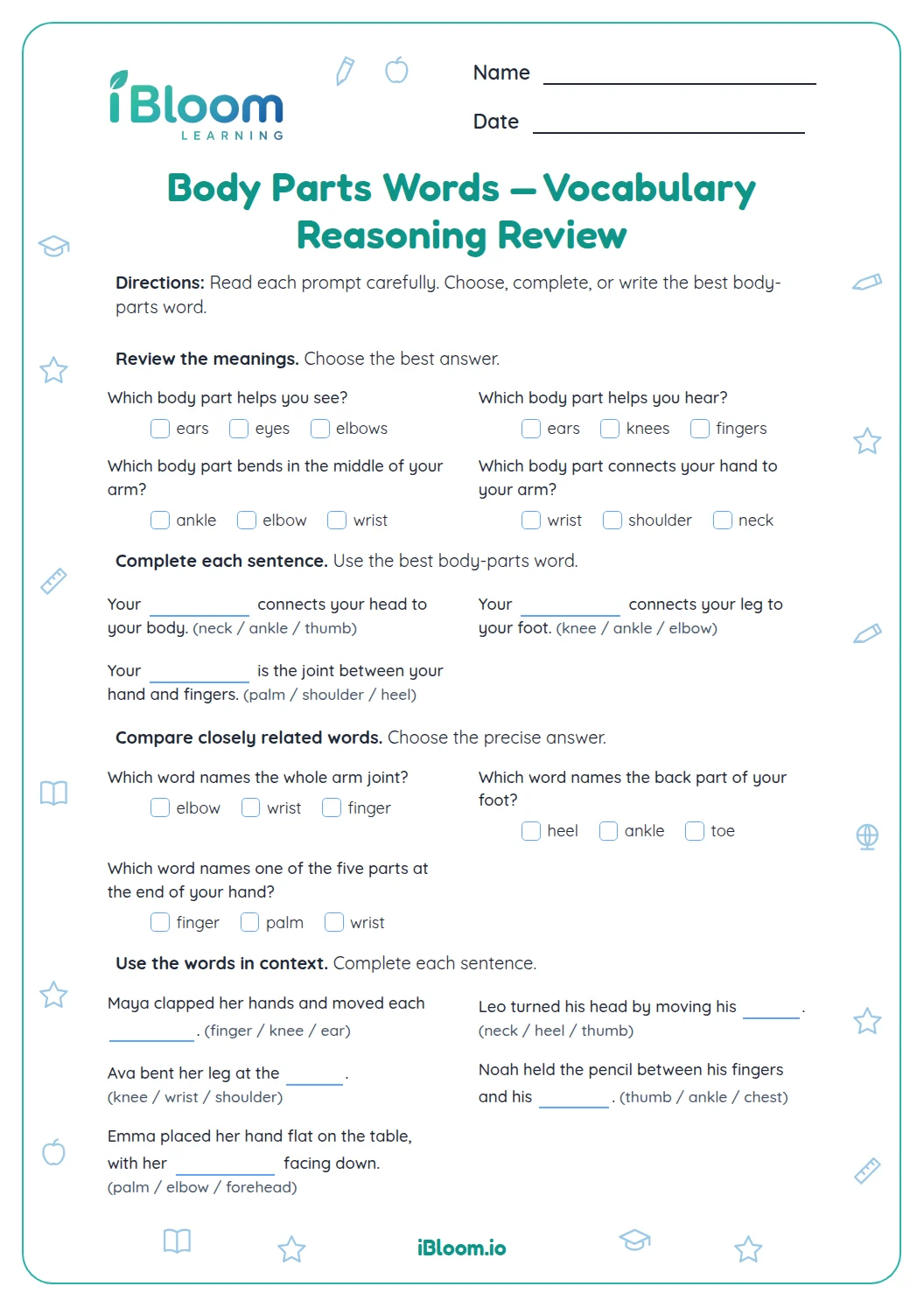
This free printable Grade 2 vocabulary worksheet asks students to choose body-part words that complete everyday sentences. Its 16 multiple-choice items use clues about seeing, hearing, bending, tasting, and other familiar actions. Children read the whole sentence before choosing a word, then check their choices against the answer key. The context practice connects to Common Core L.2.4.a, using sentence-level clues to understand words.
Aligned to L.2.4.a
How do action clues point to a body-part word?
The sentence describes an action such as hearing, bending or clapping. Match the action to the body part that does it.
- 1In “You see with your ___,” eyes completes the sentence because seeing is done with the eyes.
How can students use context?
Read the whole sentence before choosing. Its other words narrow the choices to the body part that fits the action.
How should students check a choice?
Read the completed sentence aloud and ask whether the word makes sense with the action.
How to use this worksheet
- 1Read the sentence from beginning to end.
- 2Notice the action or clue word.
- 3Choose the body part that fits the meaning.
- 4Read the full sentence again to check it.
Common mistakes and quick fixes
The mistake
Choosing a word because it is familiar.
The fix
Use the action clue in the sentence to decide.
The mistake
Mixing up nearby body parts.
The fix
Picture the movement: a knee bends a leg; an elbow bends an arm.
The mistake
Ignoring grammar clues.
The fix
Check whether the sentence needs a singular or plural word.
Common Core alignment
This page practices L.2.4.a through its worksheet questions.
Use sentence clues to choose body-part words that fit the action.
On this sheet: The questions ask learners to practice use the words.
Show the official wordingHide the official wording
Use sentence-level context as a clue to the meaning of a word or phrase.
What to practice next
Further reading
Questions parents and teachers ask
What body-part words does the worksheet practice?
The 16 sentences use words such as eyes, ears, elbow, head, teeth, tongue, shoulder, knee, finger, wrist, foot, and toes. Learners choose the word that makes each action or clue sentence make sense. The answer key lists every completed sentence.
How do sentence clues help with the answer?
The action points to the body part that fits. “You taste lemonade with your ___” cues tongue, while “You bend your leg at the ___” cues knee. Reading the whole sentence helps distinguish the right word from unrelated body-part choices.
Can students use the worksheet to review singular and plural words?
Yes. The choices include forms such as foot and toes, and students must select the form that completes the sentence. They also see body-part words in different contexts, including kicking a ball, wearing a watch, and putting on a sock.
How can a parent support this vocabulary practice?
Read a sentence aloud and ask which action supplies the clue. For “A backpack strap rests on your ___,” the clue is where a strap sits on the body. After the child chooses shoulder, ask them to reread the completed sentence.
What does the answer key show?
The key marks the correct body-part word for all 16 sentences. It is useful for checking after a child finishes a page or for discussing a confusing choice, such as why a wrist fits a watch better than a knee or nose.