

About this worksheet
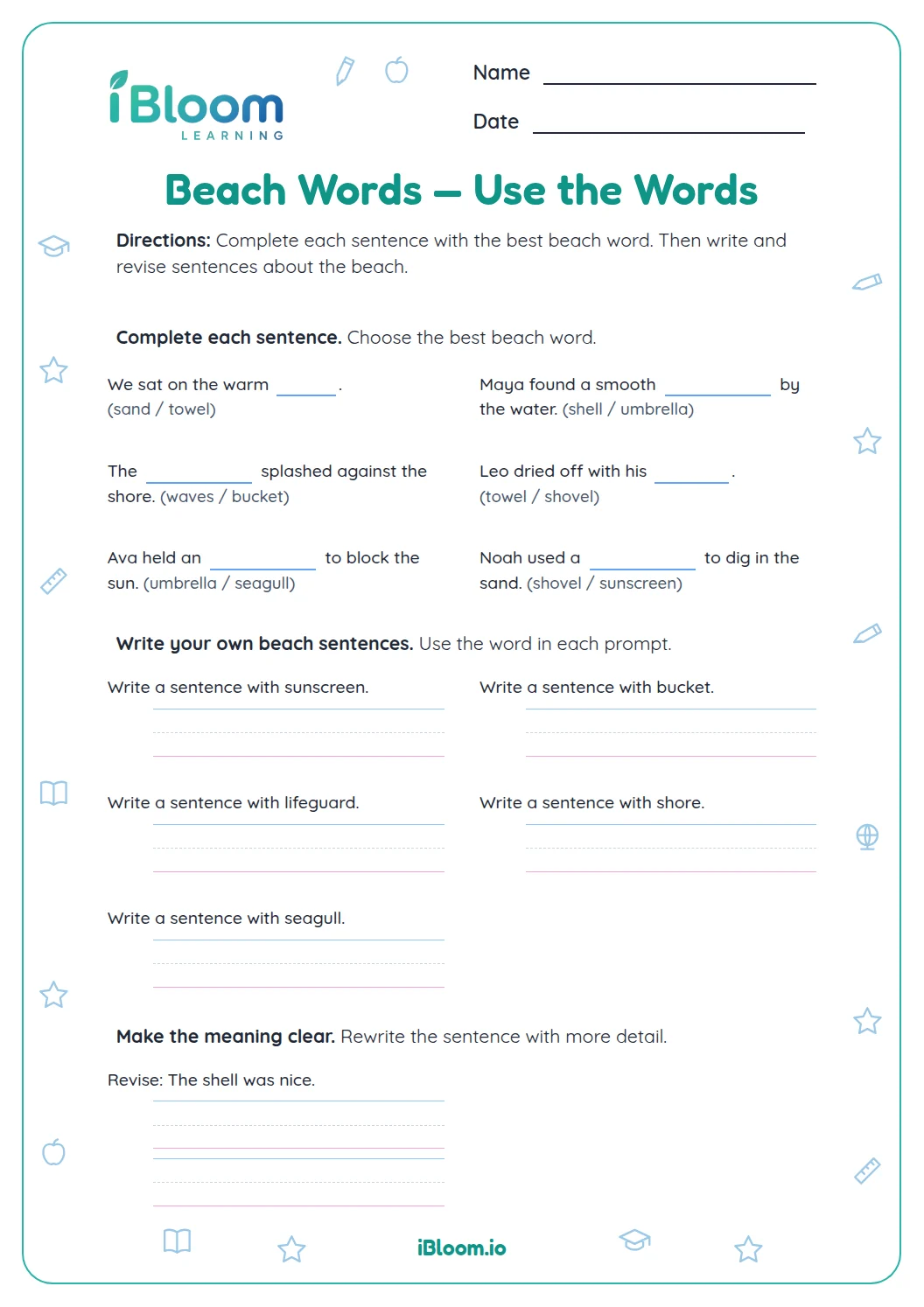
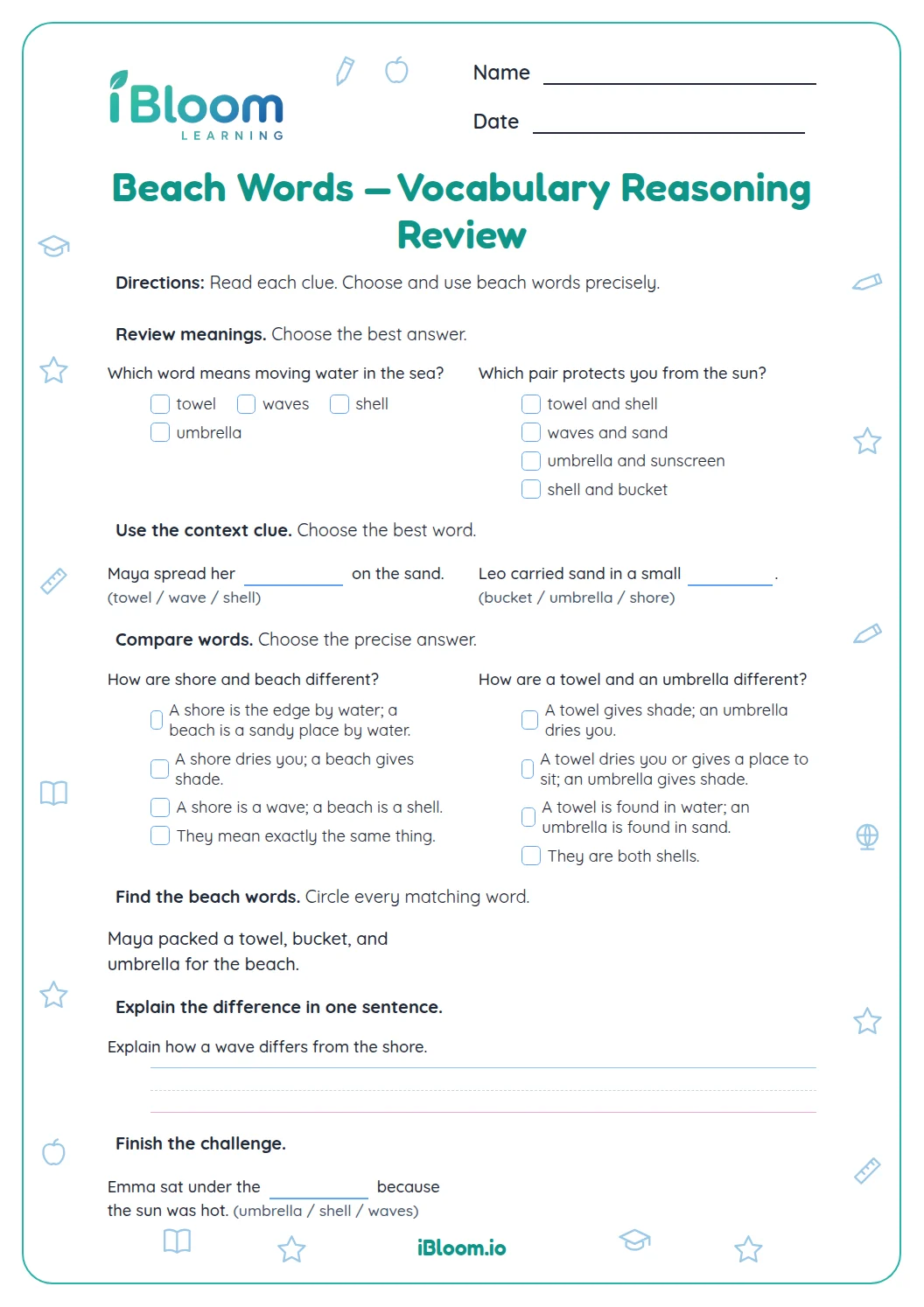
This printable practices six beach-word meanings and eight context clues. Students match sand, shell, waves, towel, umbrella, and shore to definitions, then choose a word that makes sense in a beach sentence or clue. The choices focus on familiar beach objects and settings, with an answer key for each item. The work connects word relationships and shades of meaning with CCSS L.2.5.
Aligned to L.2.5
What words will students practice?
Part A matches six words to their meanings. Part B uses six short beach sentences, and Part C checks two additional meaning clues.
Students choose from clear alternatives, then use the sentence to distinguish related beach words.
- Part A: match six words and meanings
- Part B: complete six beach contexts
- Part C: identify two words from meaning clues
How can a sentence clue help?
Look at what the sentence says about the missing word. “Maya built a castle with wet ___” points to sand because sand can be shaped into a castle.
- 1Maya built a castle with wet ___.
- 2Answer: sand
How are shore and wave different?
The shore is the land beside the water. A wave is moving water. A sentence about walking beside the ocean points to shore; one about water rolling toward the beach points to wave.
How to use this worksheet
- 1Read all of the meaning clue before choosing a word.
- 2In Part A, compare the choices and select the word that matches the definition.
- 3In Part B, use the specific clue in the sentence to complete the blank.
- 4In Part C, use enough context for a reader to understand the word.
- 5Check open responses against the sample meanings in the answer key.
Vocabulary mix-ups to watch for
The mistake
Choosing a word because it is beach-related even when the definition points elsewhere.
The fix
Find the key clue in the meaning, such as “container,” “shade,” or “meets land.”
The mistake
Treating shore and wave as the same thing.
The fix
A shore is the place where land meets water; a wave is moving water.
The mistake
Writing a sentence that uses the word without showing what it means.
The fix
Add a clue about what the object does or where it is, such as “The wave rolled toward shore.”
Common Core alignment
The questions ask students to connect words with meanings and show those meanings in context.
Show understanding of word relationships and shades of meaning.
On this sheet: Students connect beach words with meanings, compare related terms, and use words in context.
Show the official wordingHide the official wording
Demonstrate understanding of word relationships and nuances in word meanings.
What to practice next
Make more practice
Further reading
Questions parents and teachers ask
Which beach words are in the matching part?
Part A includes sand, shell, waves, towel, umbrella, and shore. Students choose a meaning for each word, such as “cloth used for drying” for towel and “the land beside the sea” for shore. The key shows each match. These familiar terms connect the definitions to beach settings.
How do students use context clues?
In Part B, students read the whole sentence before choosing a word. Details such as “dried his face,” “roll toward the beach,” or “sat under” point to towel, waves, or umbrella. Those clues narrow the choices and clarify each word.
What is the difference between shore and wave?
The shore is land beside the sea. A wave is moving water. The worksheet uses “walked along” as a clue for shore and “roll toward the beach” as a clue for waves, showing that the terms have different meanings.
Is there a word bank?
Each question shows three choices, so students can compare possible meanings without a separate word bank. The answer key lists one intended choice for every question and helps families check the completed page together after the practice is finished.
Can younger students use the page?
An adult can read the directions and sentences aloud for students who are still developing reading fluency. Students can then use sentence clues and answer choices to identify the beach word that fits the context of each item.