





About this worksheet
This cursive worksheet practices lowercase b and capital B, then connects lowercase b to vowels and words. The final line, “Be brave,” lets writers carry the joins into a short sentence. It has 16 practice prompts and a separate key for checking the target letters and words.
How should a writer form lowercase b?
Begin with a smooth entry stroke and form the tall loop and rounded body of lowercase b as shown in the school cursive model. Keep the letter resting on the baseline. Trace the repeated b row before moving to the blank row.
- 1Trace: b
- 2Copy: b b b
How does b connect to a vowel?
A join carries the exit stroke of b into the next letter. Practice the combinations slowly and keep the letters at a consistent size. The worksheet includes be, ba, bi, bo, and bu to compare several following strokes.
- 1Trace: be
- 2Notice the connection from b to e.
Which words make useful b-join practice?
Short words let the writer repeat the b entry and continue through several joins. The worksheet practices bee, bat, bed, big, box, and bun after the vowel joins.
- 1Trace: box
- 2Copy: box
How can joins stay clear in a sentence?
Keep letters within each word connected, leave a clear space before the next word, and return to the baseline after tall strokes. The final prompt, “Be brave,” gives practice joining letters inside two words while keeping a word space.
- 1Be brave.
- 2Join letters within each word.
How to use this worksheet
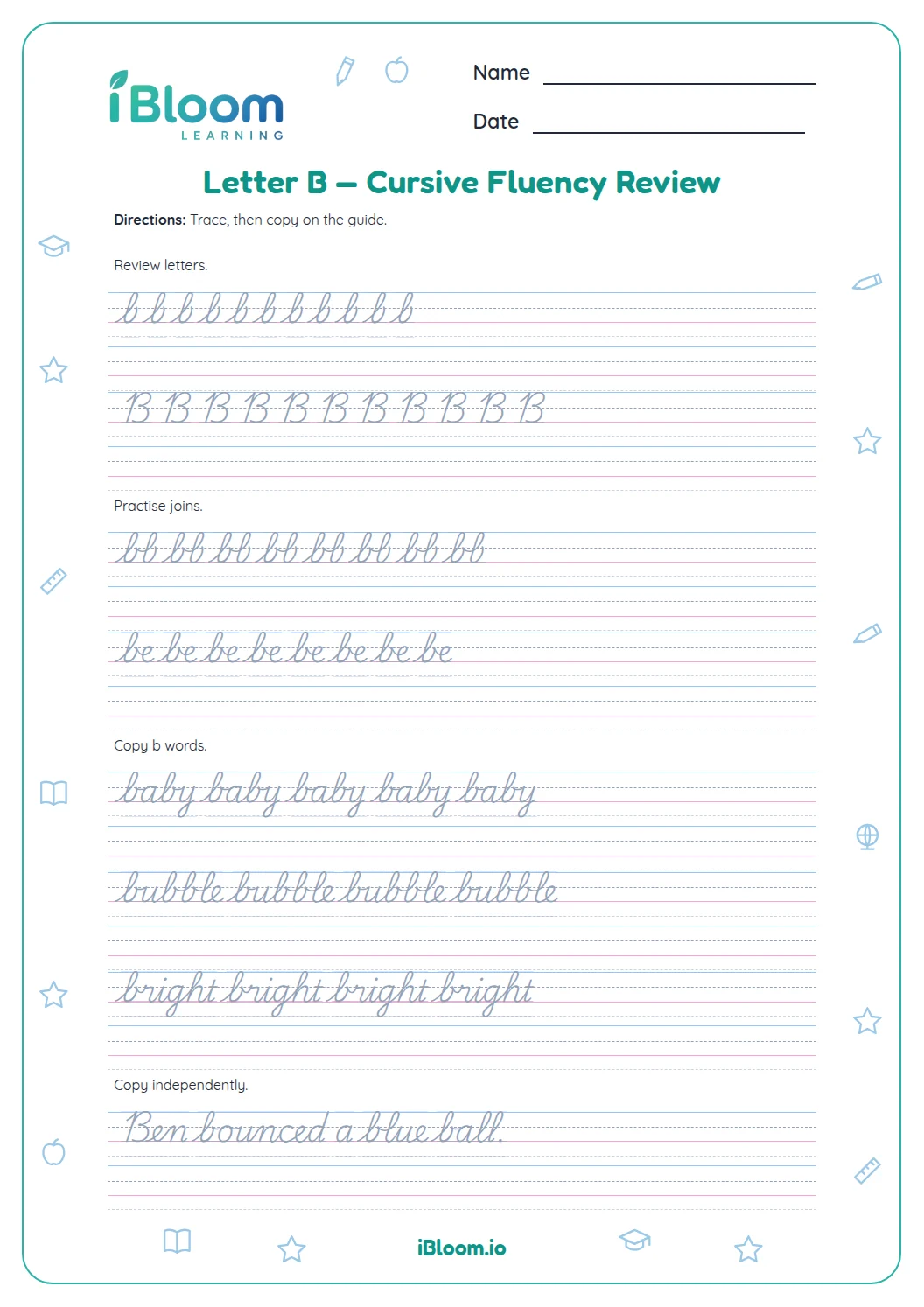
- 1Trace lowercase b slowly on its model line.
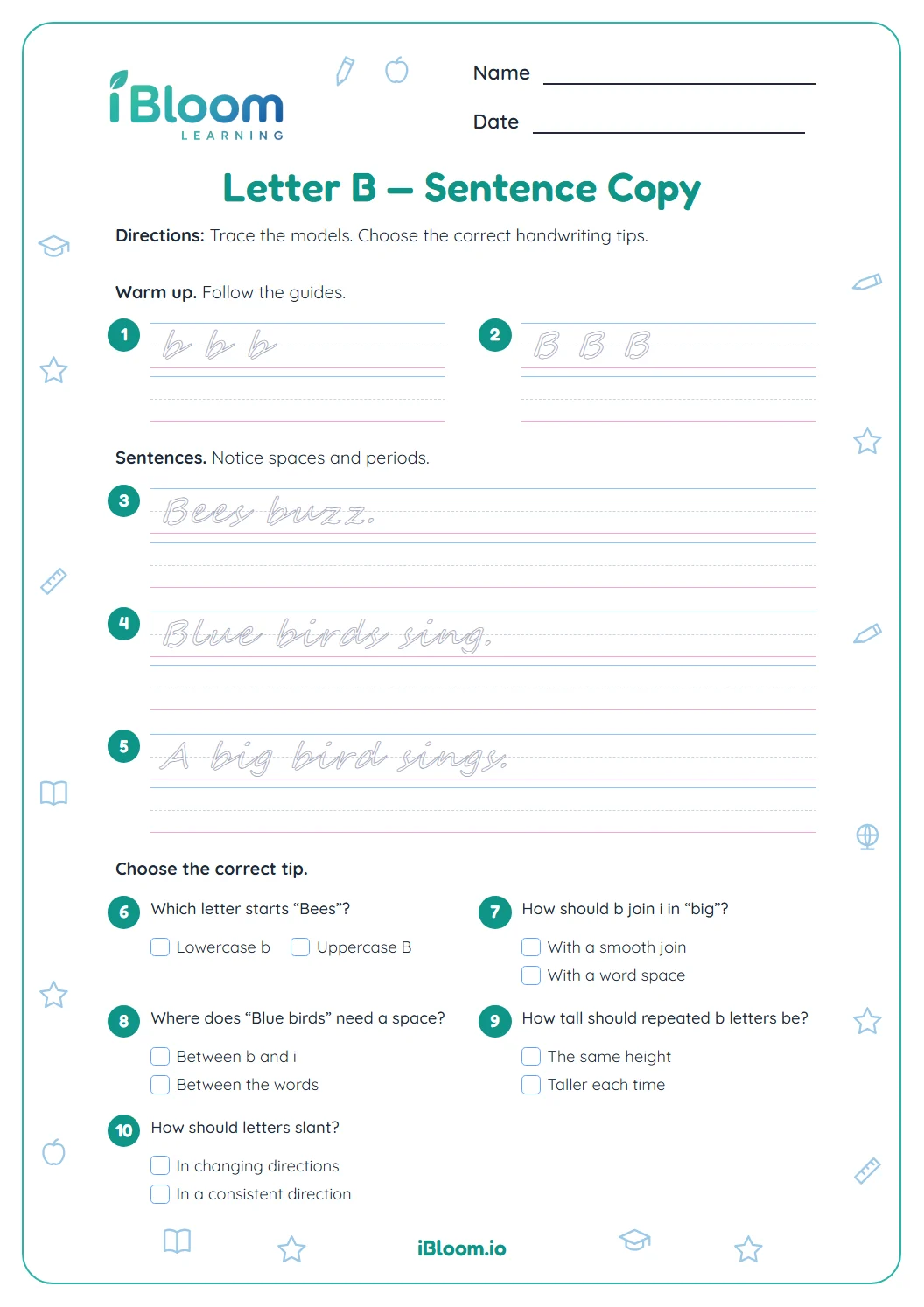
- 2Copy the lowercase and capital forms with steady size.
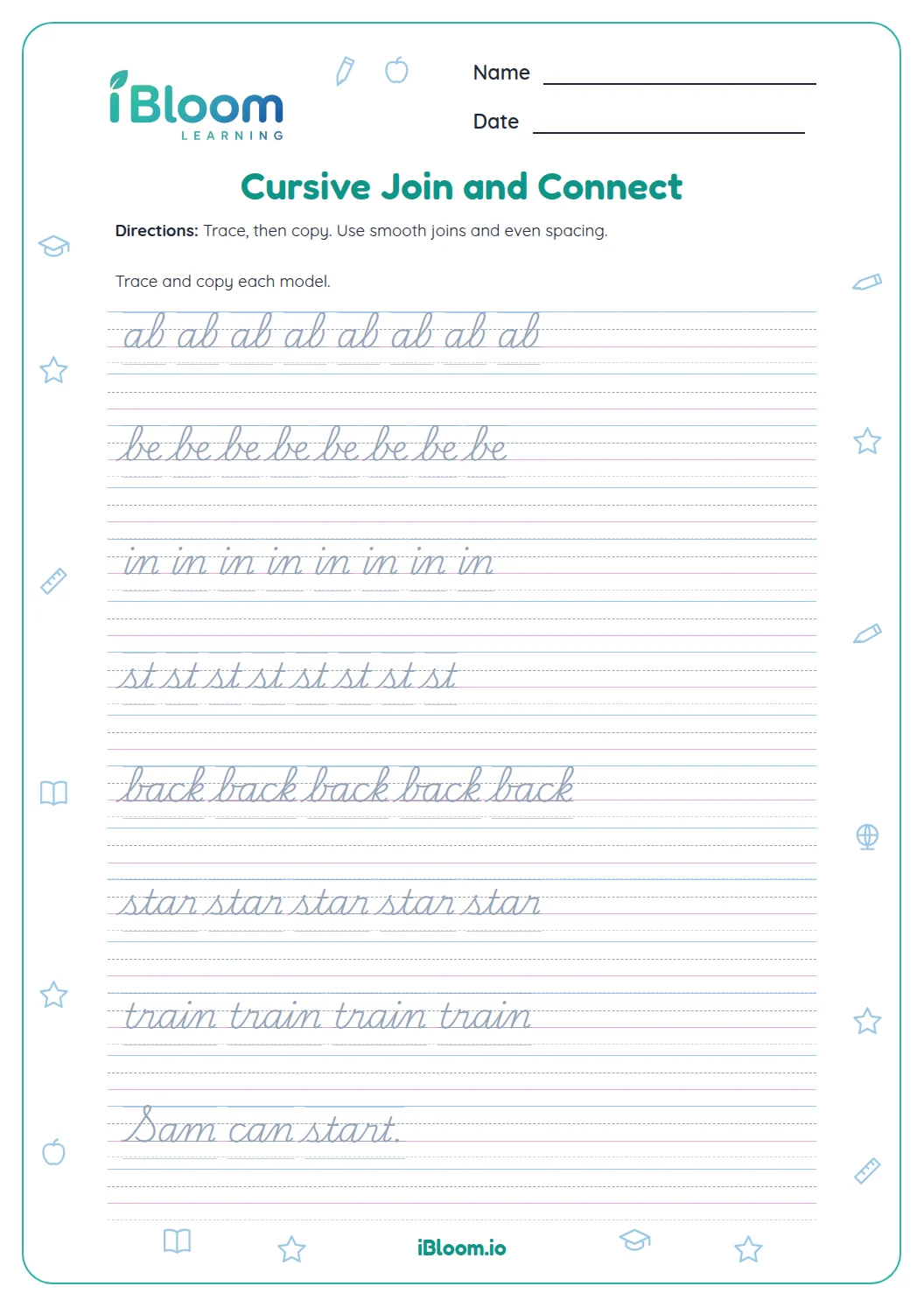
- 3Practice each b-vowel join without lifting between letters.
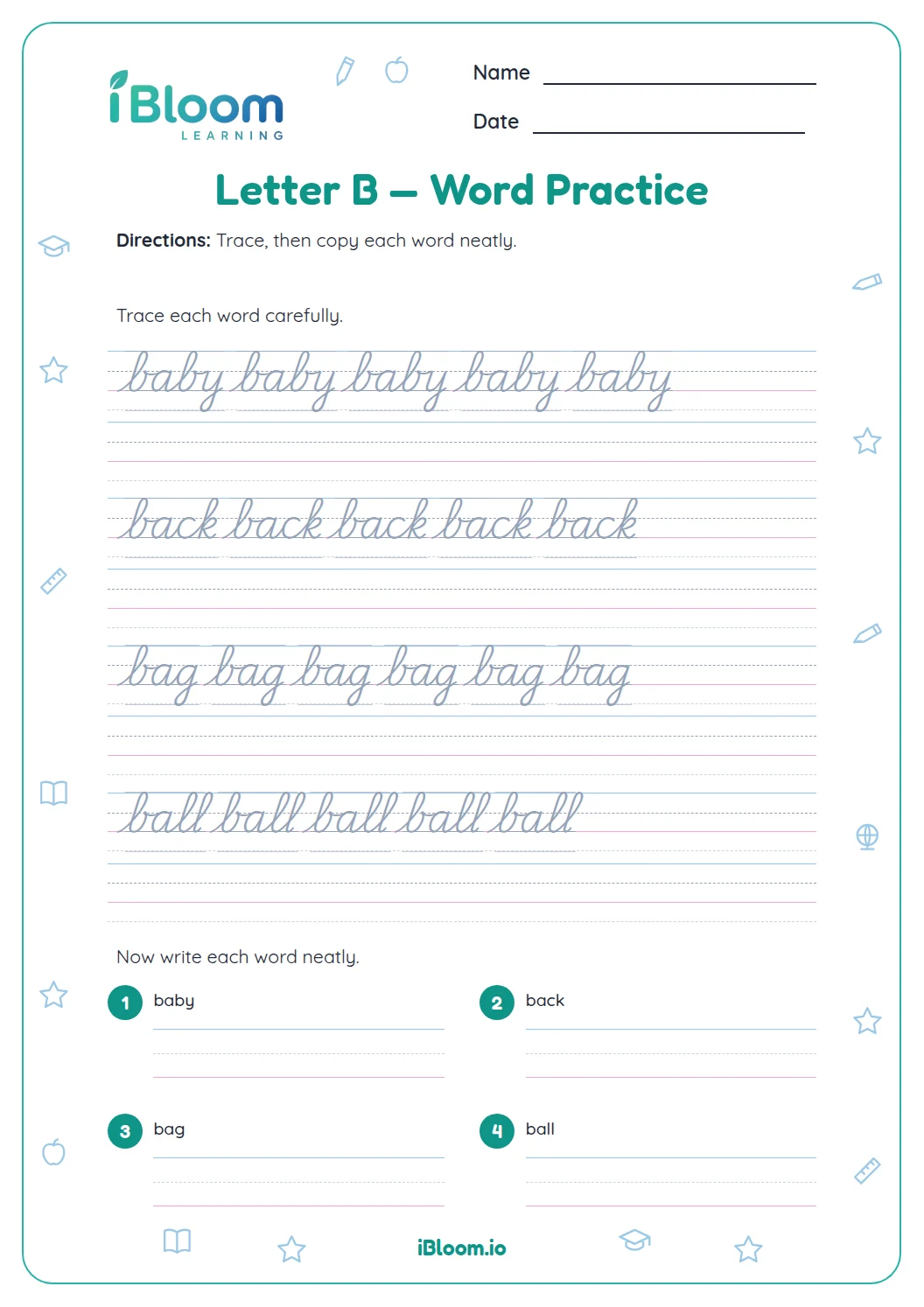
- 4Trace each short word and then copy it.
- 5Leave a word space when copying the sentence.
- 6Read the final copy and check that each b is clear.
Common slips and ways to check
The mistake
Making the tall loop too short to distinguish b.
The fix
Compare the tall stroke with the model and keep it above the rounded body.
The mistake
Lifting the pencil between letters that should join.
The fix
Follow the exit stroke of b into the next letter in one connected movement.
The mistake
Joining separate words together.
The fix
Keep letters connected inside a word, then leave a visible space before the next word.
What to practice next
Make more practice
Questions parents and teachers ask
Which forms of B are practiced?
The worksheet begins with lowercase b and capital B, including repeated forms of each. It then focuses on lowercase b joins into vowels and short words. The last prompt, “Be brave,” brings connected letters into a short sentence. The printed forms are the models to copy.
Should the pencil lift between joined letters?
Usually the pencil stays on the paper while letters inside a word connect. Follow the cursive model’s exit stroke from b into the next letter. Lift between words, where a clear space is needed, as in the final prompt “Be brave.”
Which b joins are on the sheet?
Children practice be, ba, bi, bo, and bu. These short combinations let them focus on how the lowercase b exit stroke meets several different vowels before copying complete words such as bed, big, and bun. The letter order stays the same as the printed model.
Which words are included?
The word lines include bee, bat, bed, big, box, bun, and baby. Each starts with b, so children can keep practicing the target letter while moving from a simple vowel join to longer connected forms. The answer key shows the same word list for checking.
What does the answer key show for handwriting?
The key repeats the target letters, joins, words, and the sentence “Be brave.” Handwriting can vary, so use the key to check that letters are recognizable and in the right order, and that letters within a word connect. Compare the letter order and word space.
How long should a child practice?
About 20 minutes is a reasonable starting session for 16 cursive prompts, though handwriting speed varies. A child can pause after the letter forms or vowel joins, then return to the word lines and sentence while keeping the strokes controlled.