



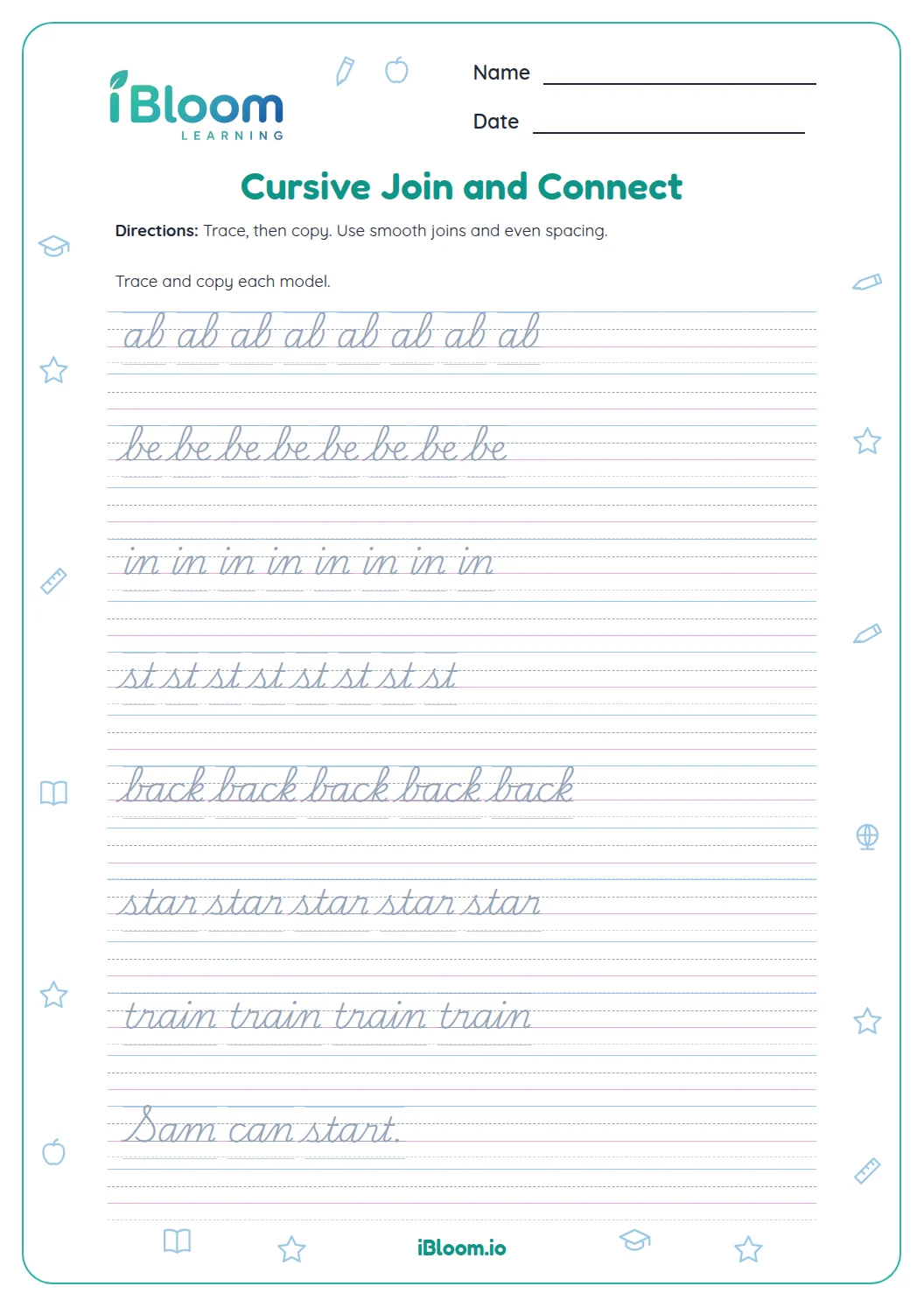

About this worksheet
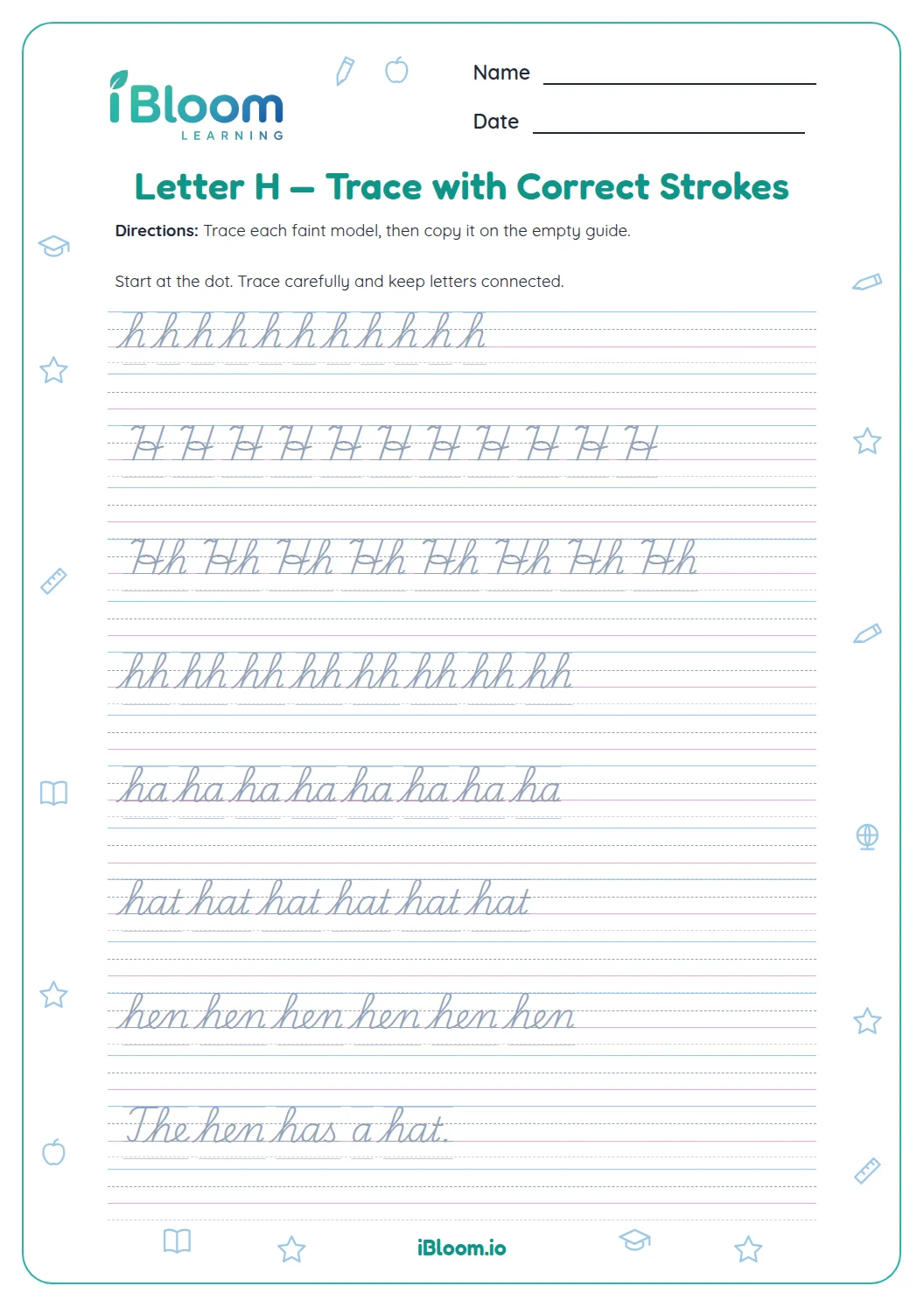
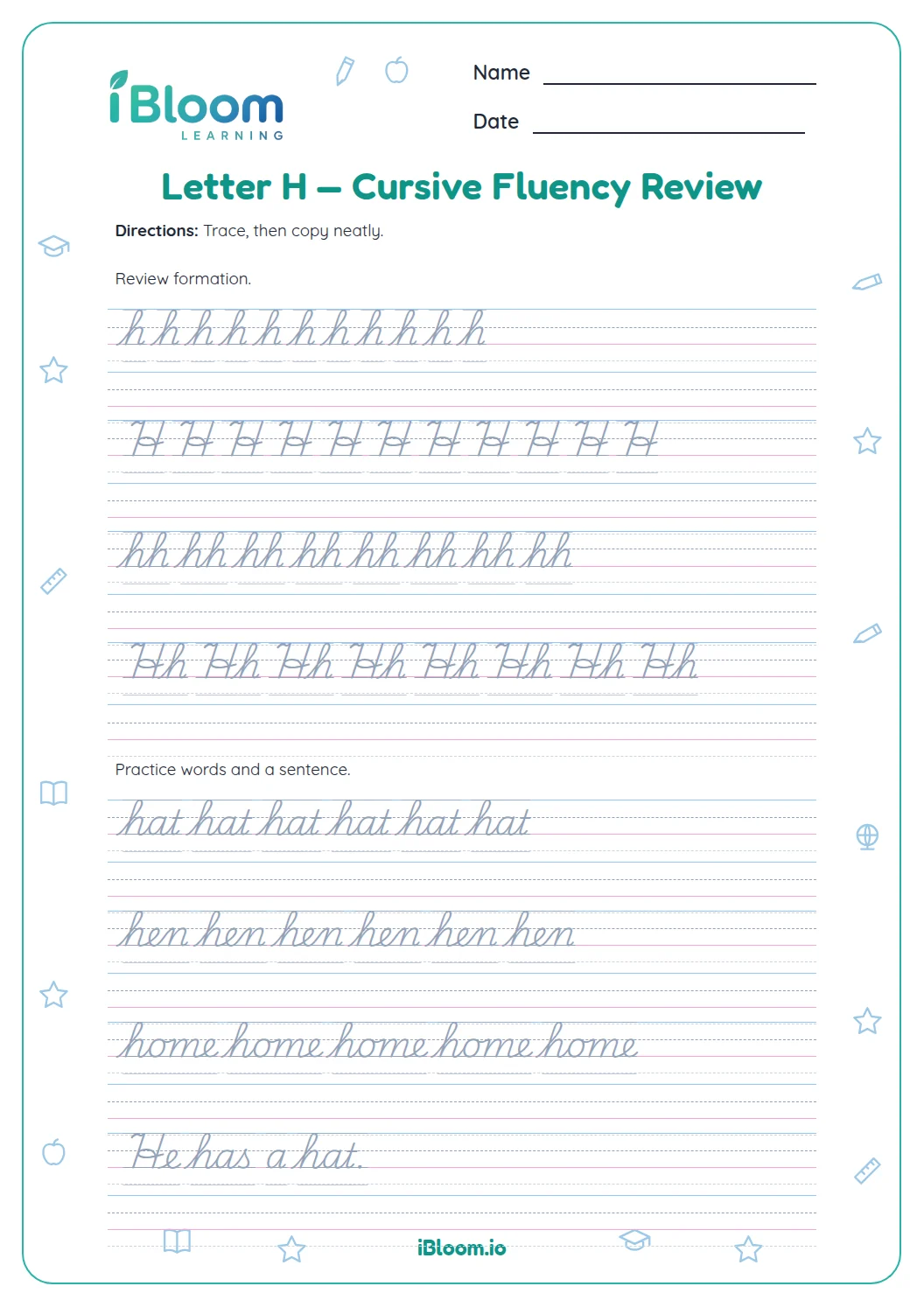
This printable builds from a single lowercase cursive h to joins such as ha and he, then to familiar words like hat, home, and happy. Each prompt uses the cursive tracing row and a blank row for copying. The sequence keeps the focus on the h entry and exit strokes while giving learners practice connecting letters.
What should a learner notice about cursive h?
The lowercase cursive h begins with an entry stroke, rises into a tall loop, and returns to the writing line. In a joined word, its exit stroke leads into the next letter. Children can slow down at first and aim for a smooth, readable shape rather than speed.
The first rows isolate the letter and its vowel joins. The word rows then let learners keep the same motion while spelling familiar words.
How does the practice build?
Fifteen rows move from simple strokes to connected writing. Short items make the join visible; longer words give learners a chance to keep letters evenly sized and connected.
- Part A: Warm-up joins — trace h and connect it to vowels.
- Part B: Short h words — copy short words such as hug, ham, and hen.
- Part C: Longer h words — write home, happy, honey, and a brief greeting.
- The answer key repeats the target text for each row.
What to check while copying
Look for a clear tall loop, letters resting on the baseline, and comfortable spacing between words. If a connection becomes hard to read, pause and repeat that join on scrap paper before continuing.
Use the tracing rows
- 1Sit with the page straight and keep the writing hand relaxed.
- 2Trace the gray model slowly, noticing where h rises and returns to the line.
- 3Copy the same letters on the empty row without racing.
- 4For words, say the word softly and keep the pencil moving through each join.
- 5Use the key to confirm the letters and spelling, then choose one word to rewrite neatly.
Common handwriting slips
The mistake
Making the h loop too short to distinguish it from a small hump.
The fix
Pause at the top of the tall loop and compare the shape with the model.
The mistake
Lifting the pencil between every letter in a word.
The fix
Practice the h-to-vowel join by itself, then try the whole short word.
The mistake
Writing quickly before the joins are steady.
The fix
Copy one word slowly with even height; add speed only after it stays readable.
What to practice next
Make more practice
Questions parents and teachers ask
What does this cursive page practice?
The page starts with lowercase cursive h, then practices joins from h into vowels before moving to familiar words that contain h. Learners trace a model and copy it on the next handwriting row. The sequence focuses attention on the tall loop, baseline return, and smooth exit stroke.
Why are some prompts only two letters long?
Short joins let learners focus on how the exit stroke of h connects to the next letter. Once that movement feels comfortable, the word rows give practice keeping the same connection while spelling a complete word. Children can pause and repeat a join if the letters become difficult to read.
Should children trace and copy every item?
Yes. Each cursive prompt is intended to be traced on the gray model row and copied on the empty handwriting row. Encourage a slow, relaxed pencil movement at first. The purpose is to form a recognizable h and connect it neatly; speed can come later after the writing stays readable.
Does this page follow a required national cursive sequence?
The page provides a practical sequence for practicing lowercase h, vowel joins, and familiar h words. Cursive instruction timing and letter forms can vary across states and schools, so teachers may align the page with their local handwriting program. The answer key repeats the target text for each row.