



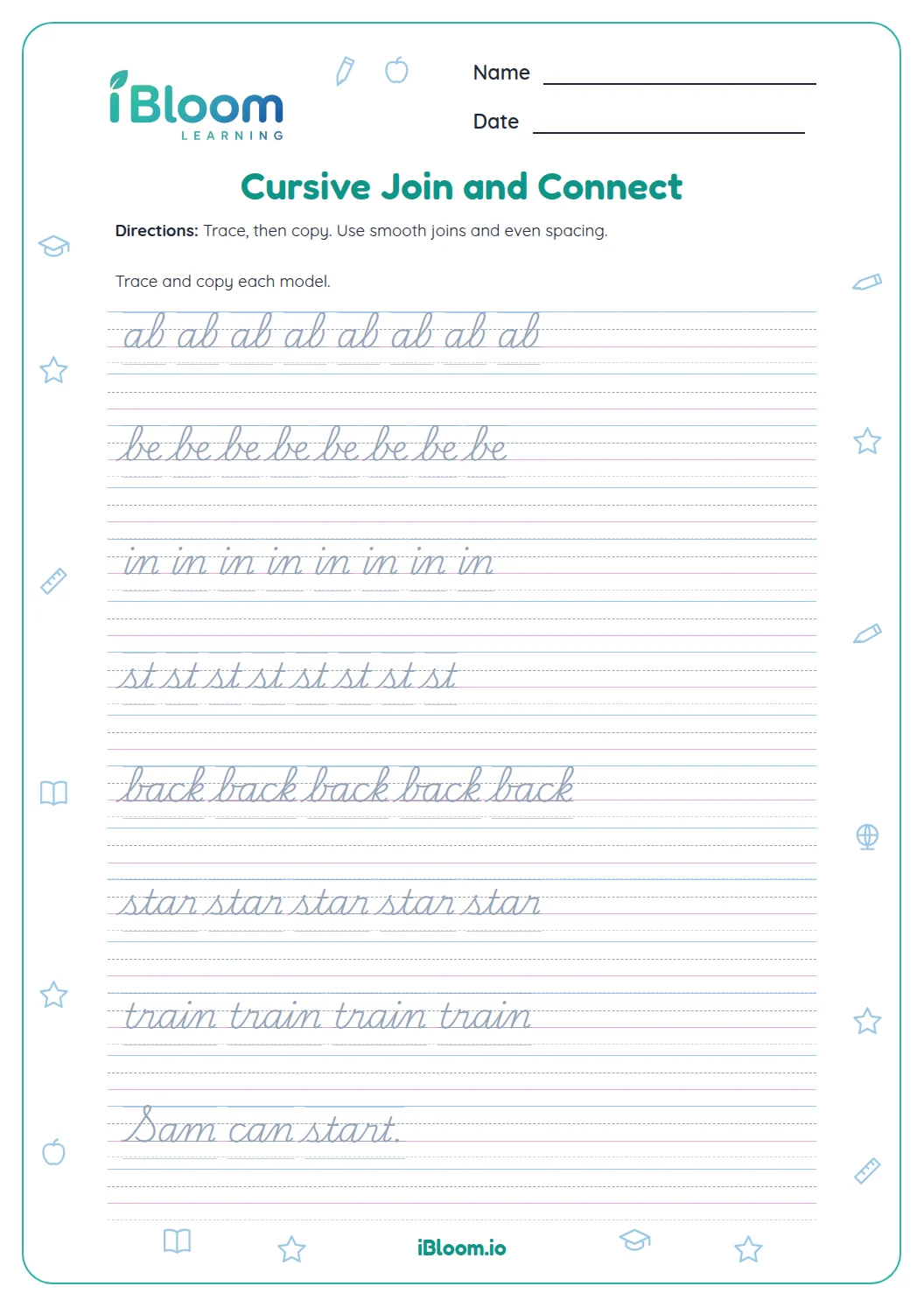

About this worksheet
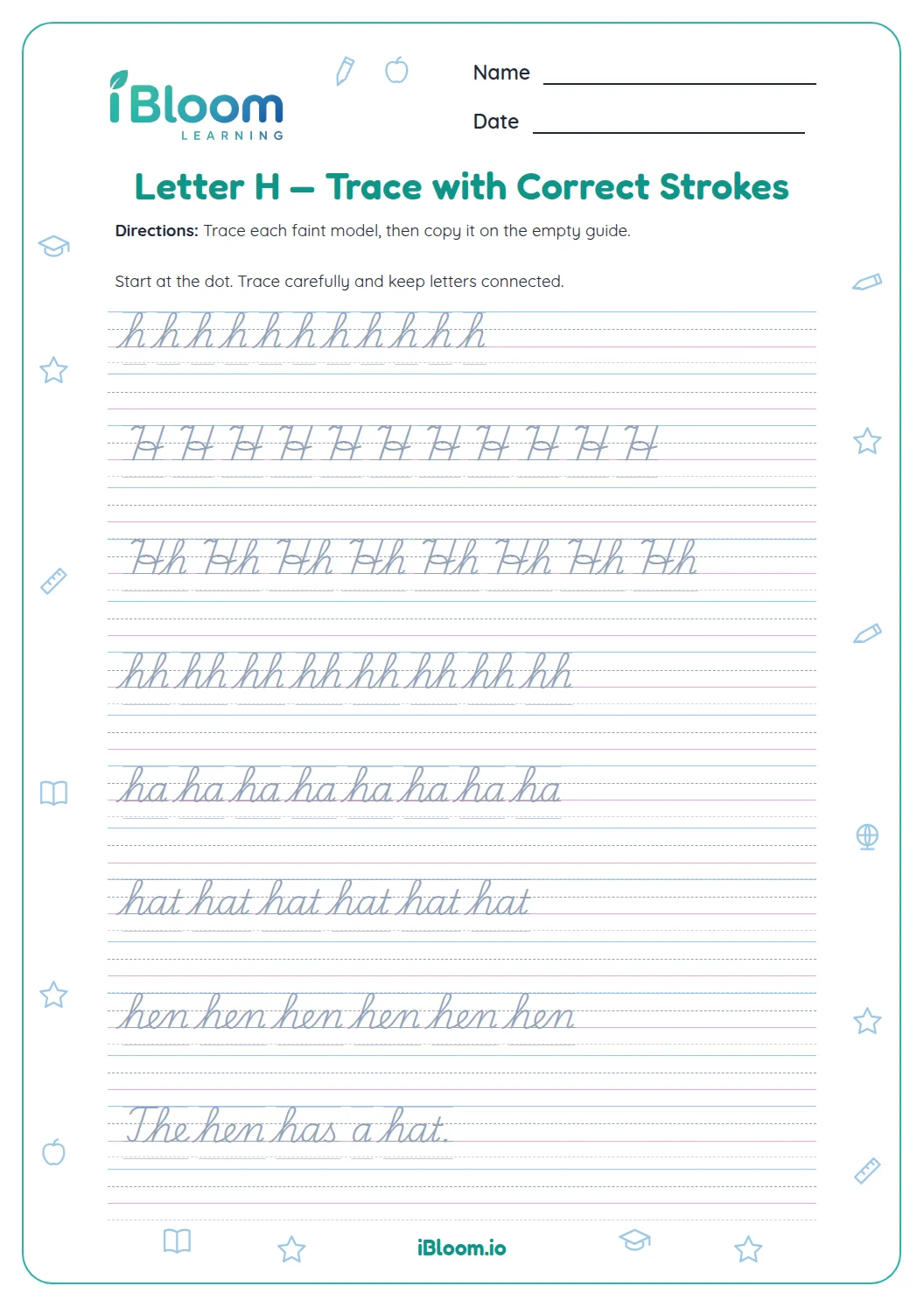
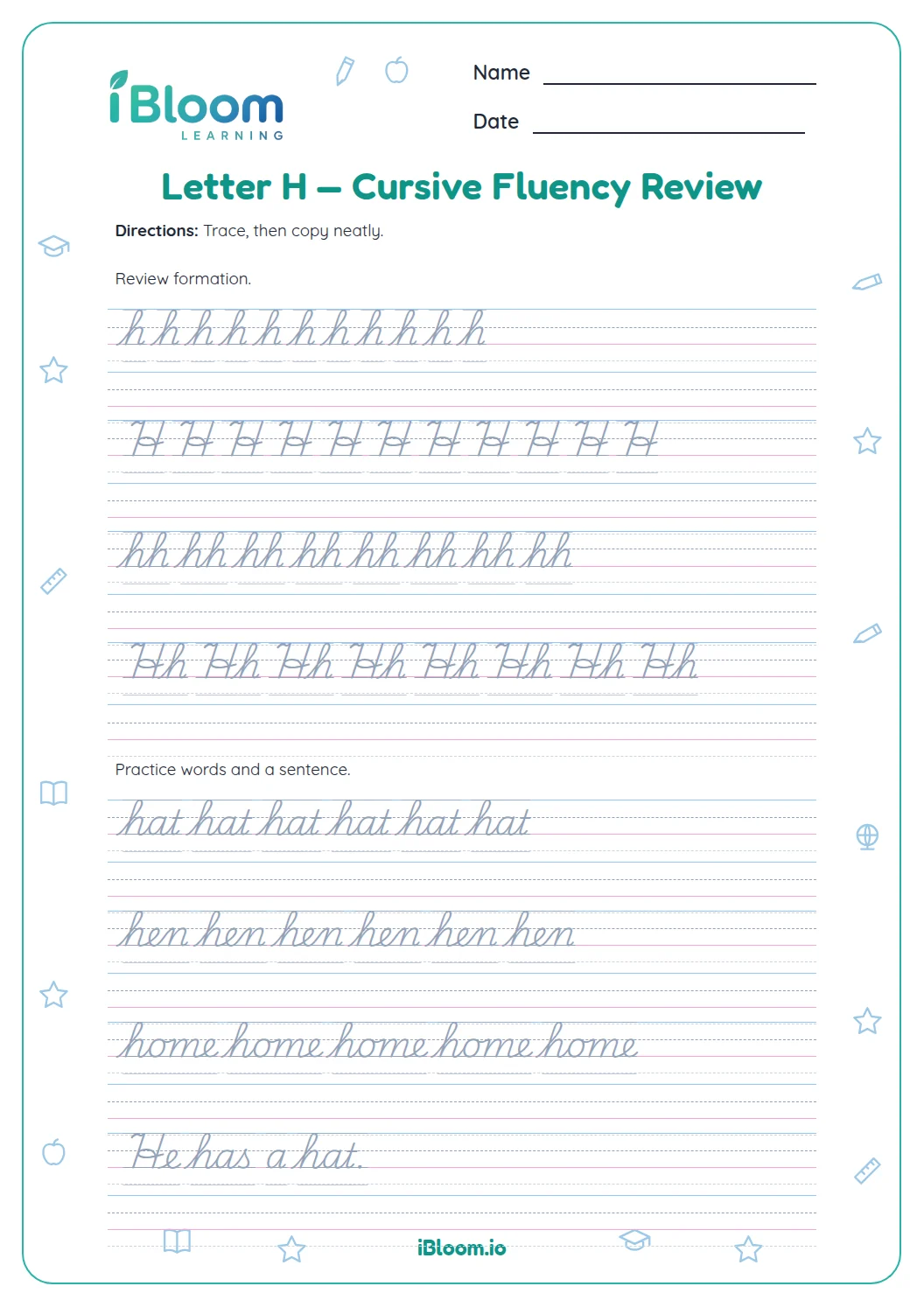
This printable cursive worksheet focuses on uppercase H, lowercase h, and the connections that appear in words beginning with h. Learners trace and copy letter forms, practice short joins, write useful words, and finish with complete sentences. The sequence gives repeated handwriting practice without switching to unrelated letter drills. A separate key shows the intended text for each line.
How does the practice build?
The first lines isolate H and h so learners can focus on the starting strokes and letter height. Short groups such as ha, he, hi, ho, and hu then help the hand move directly from h into the next lowercase letter.
Which words give h meaningful practice?
Words such as hill, happy, hand, honey, and home place h at the start of familiar spellings. Names begin with a capital H, so learners also practice an uppercase form in real writing.
Why copy full sentences at the end?
A sentence asks children to keep letter shapes and spacing legible across connected words. The final lines give practice carrying a smooth cursive rhythm through a complete thought.
How to use this worksheet
- 1Sit with the paper angled comfortably and hold the pencil gently.
- 2Trace the gray model slowly, following its letter shape.
- 3Copy the same text on the empty handwriting row.
- 4Keep lowercase letters even in height and leave readable spaces.
- 5Pause between lines and check joins before continuing.
Common mistakes and quick fixes
The mistake
Making lowercase h too tall or too short.
The fix
Compare its height with the model and keep it consistent across the line.
The mistake
Lifting the pencil between letters that should connect.
The fix
Move smoothly from h into the next lowercase letter where the script joins.
The mistake
Writing a name with a lowercase first letter.
The fix
Use a capital H for names such as Helen, Harper, and Holly.
What to practice next
Make more practice
Questions parents and teachers ask
Which forms of H does this sheet practice?
The lines include uppercase H and lowercase h, then connect h to following letters in joins such as ha, he, hi, ho, and hu. Words and sentences give learners a chance to use H and h within connected cursive writing.
Why start with single letters and joins?
Practicing H and h first lets learners focus on the letter shapes. The next lines connect h to another letter, followed by words and sentences. This order moves from a short form to longer connected writing while keeping the target letter in view.
Should learners trace or copy each model?
The worksheet asks learners to trace each cursive model and then write the same text again. Tracing supports attention to the shape and connection; copying gives a chance to form it independently. The answer key shows the text for every practice line.
Why are names capitalized?
Names begin with capital letters, so names such as Holly and Hannah provide meaningful practice with uppercase H. The sentences also let children connect the target letter to other cursive forms and ordinary writing conventions. The answer key repeats the exact model text.
How can an adult give useful feedback?
Invite the learner to compare one letter at a time with the model. Look for a clear H or h, connected strokes, and spaces between words. Then let the learner try the next line independently and decide what to adjust.
Does the worksheet include an answer key?
Yes. The separate key displays each model line in cursive. Use it to confirm the letters, joins, words, and sentences before practice or when checking that the copied text matches the prompt. It is especially useful for confirming the less familiar h joins.