







About this worksheet
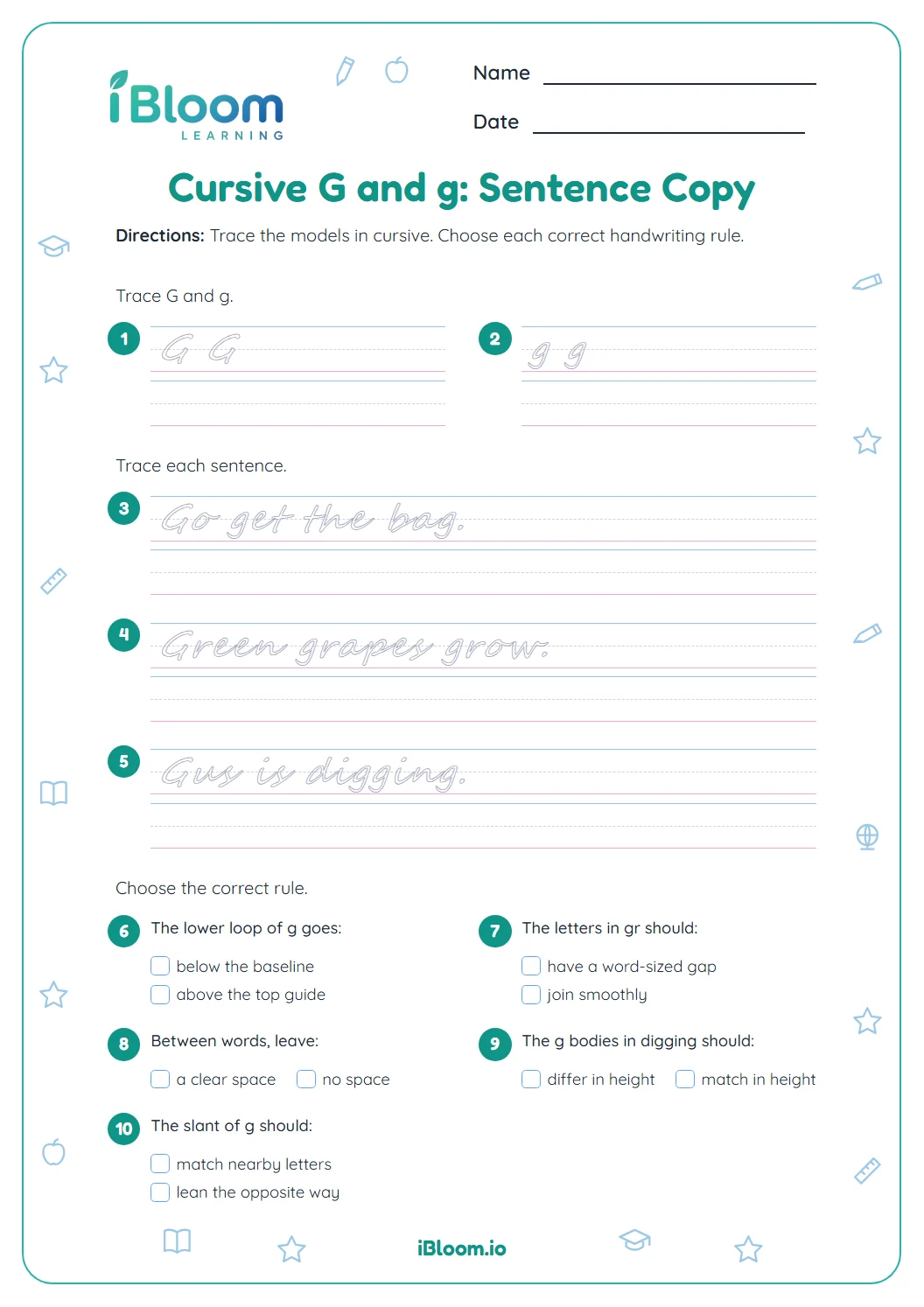
This free printable gives learners in Grades 2–5 focused practice writing cursive G. The 15 items move from lowercase and uppercase forms to short words, names, phrases and sentences. Each cursive model gives children a sample to follow and a line for copying, so they can carry the letter shape into connected writing. A companion answer guide shows the text to practice.
How does the practice begin?
The first two items give lowercase g and uppercase G on their own. Follow the printed cursive model and compare the height, slant and shape as you copy.
- 1Model: g
- 2Copy the lowercase cursive g on the line.
How does g connect in words?
Short words give the letter a neighbor while keeping the focus on its form. Trace the complete word instead of treating the letters as separate printed shapes.
- Part A traces lowercase and uppercase G.
- Part B practices g in short words.
What comes after the short words?
Names and phrases give more room to practice the joins. The last three items are complete sentences, so children can carry the same letter shape into longer writing.
- Part C traces names and phrases.
- Part D copies short sentences.
How to use this worksheet
- 1Trace lowercase g with the model, then copy it.
- 2Trace uppercase G and copy the same form.
- 3Trace go, then copy the joined word.
- 4Trace gap, then copy the joined word.
- 5Trace gum, then copy the joined word.
- 6Trace get, then copy the joined word.
- 7Trace glad, keeping the g connected.
- 8Trace grow, keeping the g connected.
- 9Trace Gus, then copy the name.
- 10Trace George, then copy the name.
- 11Trace the phrase green leaf.
- 12Trace the phrase garden gate.
- 13Trace Greg grows green beans.
- 14Trace Gus gets a blue bag.
- 15Trace Go, Gail, go!
Common mistakes and quick fixes
The mistake
Making lowercase g too tall or too small beside its neighbors.
The fix
Compare the rounded body and descender with the printed model before copying.
The mistake
Letting the join make g hard to recognize.
The fix
Keep the g shape clear as you move into the next letter.
The mistake
Rushing the whole word after tracing one letter.
The fix
Trace and copy one complete word at a time, checking the slant and spacing.
What to practice next
Make more practice
Questions parents and teachers ask
Which forms are on this cursive G worksheet?
The worksheet begins with lowercase g and uppercase G. It then practices g in short words, names, two phrases and three complete sentences. Each item has a cursive model to follow and a writing line for copying. The printed models and answer guide use the same forms.
Does the worksheet include actual cursive writing?
Yes. All 15 items use cursive models for children to trace and copy. The sequence starts with individual letter forms and then moves into connected words and sentences. A slower trace makes it easier to compare each part before moving to the next item.
How can a child check a lowercase g?
Compare the copied letter with the printed model. Look at the round body, the part that drops below the line and how the next letter connects. The answer guide shows the same text as the worksheet. The line shows the copied form for comparison.
How long does the practice take?
Plan for about 15 minutes, with a short break if the writing hand gets tired. Children can work carefully through the forms and words rather than trying to finish quickly. The four-page layout lets learners pause between sections and continue later.
What is in the answer guide?
The guide lists the text for all 15 items and shows the expected cursive forms in red. Handwriting can vary slightly, so use the model to compare letter shape, slant and connections. Compare the guide with the model, not with how quickly a learner writes.
Can an older learner use this page?
Yes. The page is labeled for Grades 2–5 and focuses on one cursive letter. Older learners can use it to revisit lowercase and uppercase G, practice joins, or work on steady spacing in words. Short sessions can keep the focus on consistent, legible letter forms.