






About this worksheet
This printable gives students in Grades 2–5 fourteen focused cursive responses centered on uppercase P and lowercase p. Learners write letter forms, joins, and P words on short answer lines, then copy two complete sentences. A separate key shows expected forms and sample responses for open word prompts.
Which P forms and joins can students trace?
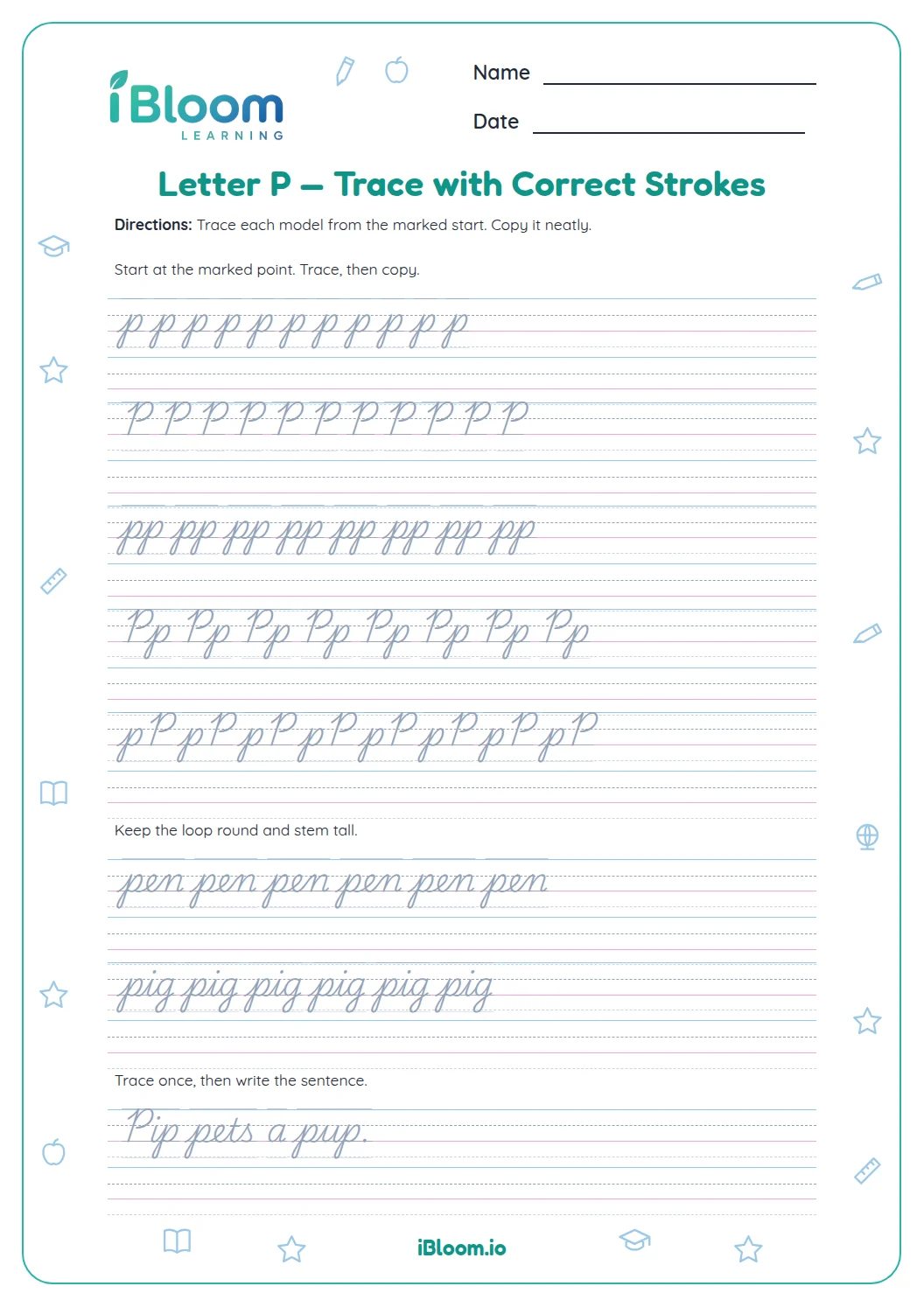
The first six prompts ask students to write uppercase P, lowercase p, and short joins such as Pa, Pe, and Pi. Form each letter clearly and keep joined letters connected.
- 1Model: Pa
- 2Trace the connected letters.
What should students notice about lowercase p?
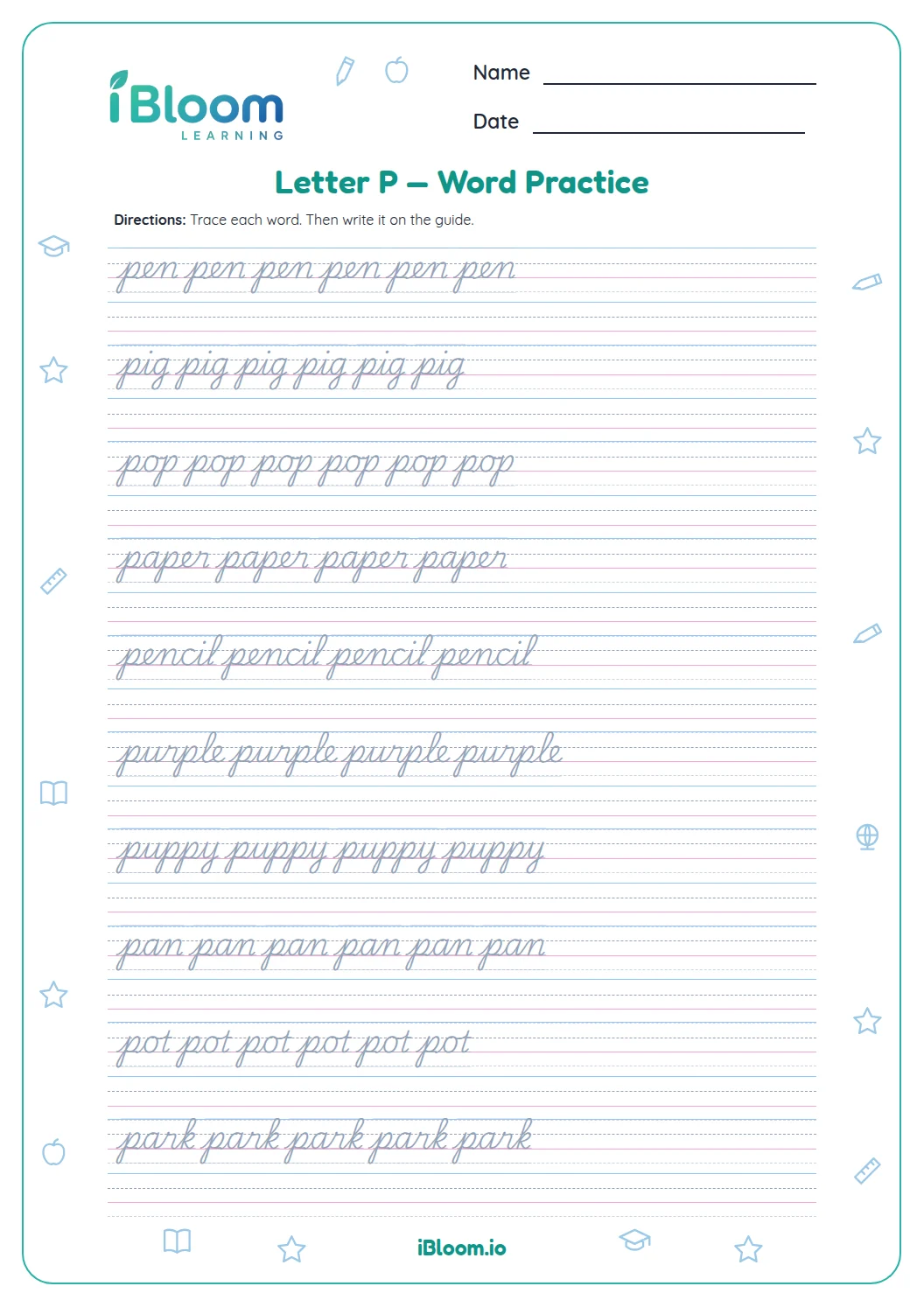
The next six prompts practice paper, puppy, purple, pencil, and two student-selected words. Keep letters within each word connected and leave a clear space before the next word.
How can students check a full cursive word flow?
The final two prompts are complete sentences with P words. Copy each full sentence, then check that capital letters begin the sentence and spaces separate words.
- 1Pat has a puppy.
- 2Copy the sentence in cursive.
How to use this worksheet
- 1Write uppercase P and lowercase p carefully.
- 2Connect letters in each short join.
- 3Write the P words with clear spacing.
- 4Copy both full sentences, keeping their capitals and punctuation.
- 5Compare your work with the model strings in the key.
Common mistakes and quick fixes
The mistake
Making lowercase p the same height as P.
The fix
Compare the lowercase loop with the middle zone; let its downstroke extend below the baseline.
The mistake
Leaving a gap between joined letters in one word.
The fix
Follow the connecting stroke into the next letter; leave spaces between words only.
The mistake
Rushing the phrase and losing letter shape.
The fix
Copy one word at a time and check the P before moving on.
What to practice next
Make more practice
Questions parents and teachers ask
What does the answer key show?
The key lists the model letters, joins, words, and sentences for all 14 prompts. Compare letter shapes and word spacing, while allowing for natural differences in handwriting. Use it after the student has completed each short response or sentence-copy task.
Which cursive forms are practiced?
The sheet practices uppercase P, lowercase p, a Pp pairing, short joins such as Pa and Pe, and familiar P words. It finishes with a full sentence to copy. Each activity keeps attention on the letter forms named in the title.
How should a student copy the models?
Start at a comfortable pace and follow the model from left to right. Keep letters within a word connected, let lowercase p descend below the baseline, and leave visible spaces between words. Neat and readable writing matters more than speed.
How many items are included?
There are 14 cursive prompts across two worksheet pages: 12 short responses and two sentence-copy tasks. A separate answer key follows on two pages. The practice moves from letter forms and joins to words and complete sentences, so students can work in brief steps.
Should students lift the pencil between letters?
Keep the connecting strokes flowing within a word when practical. Lift or pause between words so spaces stay clear. The P joins give focused connection practice, and the two sentence models show how connected writing remains readable in a complete thought.