






About this worksheet
This printable cursive worksheet gives learners in Grades 2–5 focused practice with bottom-e joins. Students trace and copy two complete sentence models, then complete 12 cursive words and write each answer in cursive. The models and word prompts focus attention on smooth letter connections, a steady baseline, and clear word spacing. The answer key lists all 14 responses.
How do the sentence models show bottom-e joins?
Part A has two complete sentences to trace and copy. In question 1, “A turtle made a home near a tree,” notice the connected letters inside words such as “beside” and “hedge.”
- 1Trace the complete sentence.
- 2Keep connected letters smooth inside each word.
- 3Copy it with clear word spaces.
Which bottom-e words do students complete?
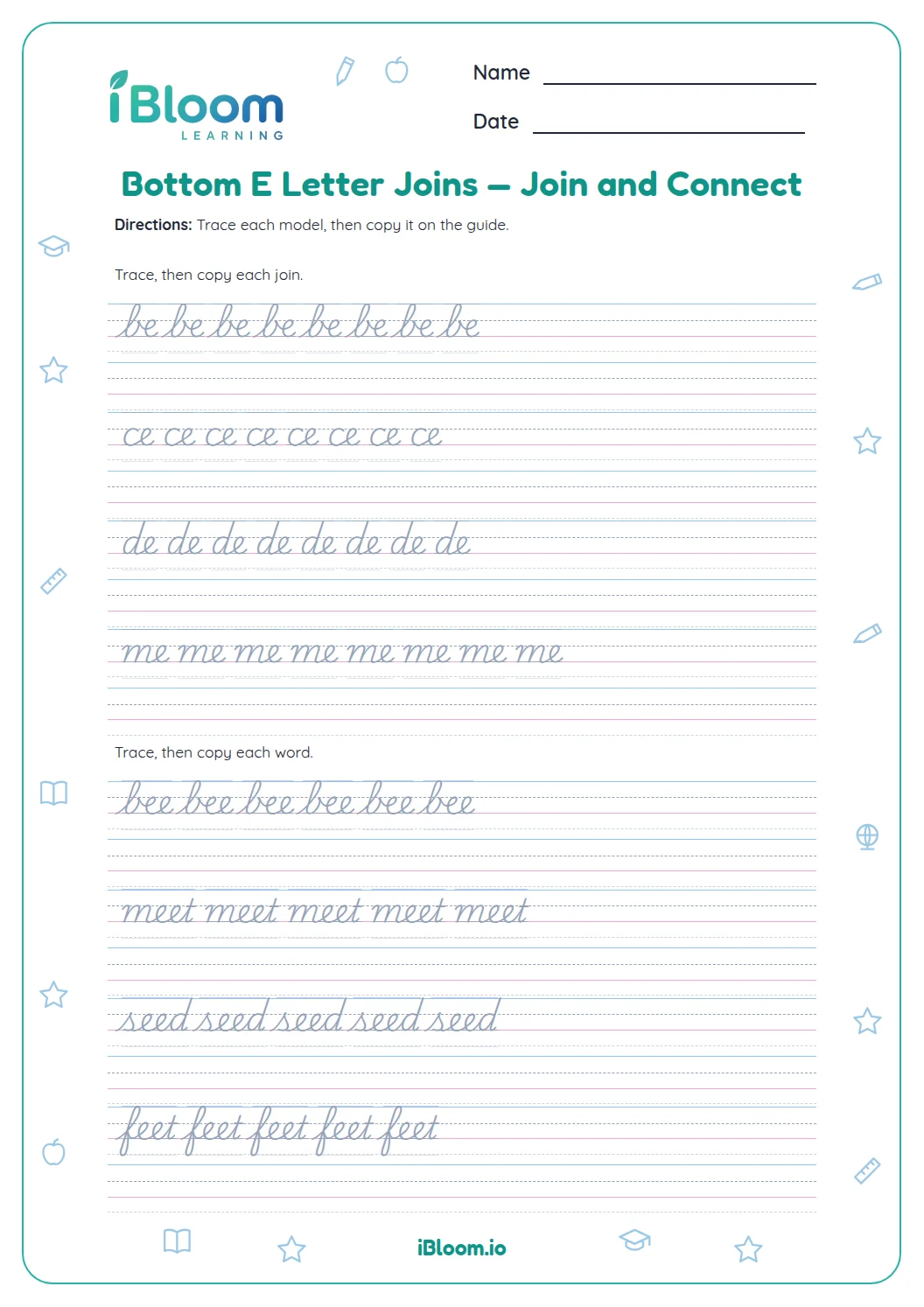
Part B has 12 cursive word models for words such as theme, scene, green, and cheese. Complete each word, then write the answer in cursive so the join is practiced as part of the word.
What should a learner check after copying?
Look for readable e forms, smooth connections, and visible spaces between words. Use the answer key to check spelling and the exact sentence wording.
How to use this worksheet
- 1Warm up by tracing a small cursive e in the air.
- 2Trace each model slowly and follow the join into e.
- 3Copy the same text on the open row.
- 4Leave a clear space between words in each sentence.
- 5Compare the copy with the answer key for text and spacing.
Common mistakes and quick fixes
The mistake
Lifting the pencil after e
The fix
Follow the exit stroke straight into the next letter.
The mistake
Making the e too large
The fix
Keep e close in height to the other lowercase letters.
The mistake
Rushing longer words
The fix
Slow the hand and keep the joins relaxed.
What to practice next
Make more practice
Further reading
Questions parents and teachers ask
What does bottom-e practice mean?
Bottom-e practice focuses on the connecting stroke into a lowercase e in a cursive word. This sheet uses two sentence models and 12 short word prompts. Students complete each word, write it in cursive, and check spelling with the included answer key.
How many questions are on the worksheet?
There are 14 questions: two sentence models for extended tracing and copying, followed by 12 cursive word models. The short responses ask learners to complete bottom-e words such as theme, green, and cheese, then write each answer in cursive on the printed line.
Why does the sheet use both sentences and single words?
The two sentences let students practice joins while keeping spaces and punctuation clear. The 12 cursive word models let them focus on individual words and their e connections. The answer key gives the target wording so an adult can check each response.
What should I check in my child’s cursive?
Check that the letters are recognizable, e connects into the next letter, and the writing rests on the baseline. For the short prompts, check each completed word’s spelling. The answer key shows the expected text, including both sentence models and all word responses.
How can a learner use the answer key?
Have the learner try each sentence and word before looking at the key. Then compare the copied sentence wording and completed spellings. The key supplies the model text; handwriting can vary while remaining legible and connected. The printed models make this practice easy to review together at home. The printed models make this practice easy to review together at home.