







About this worksheet
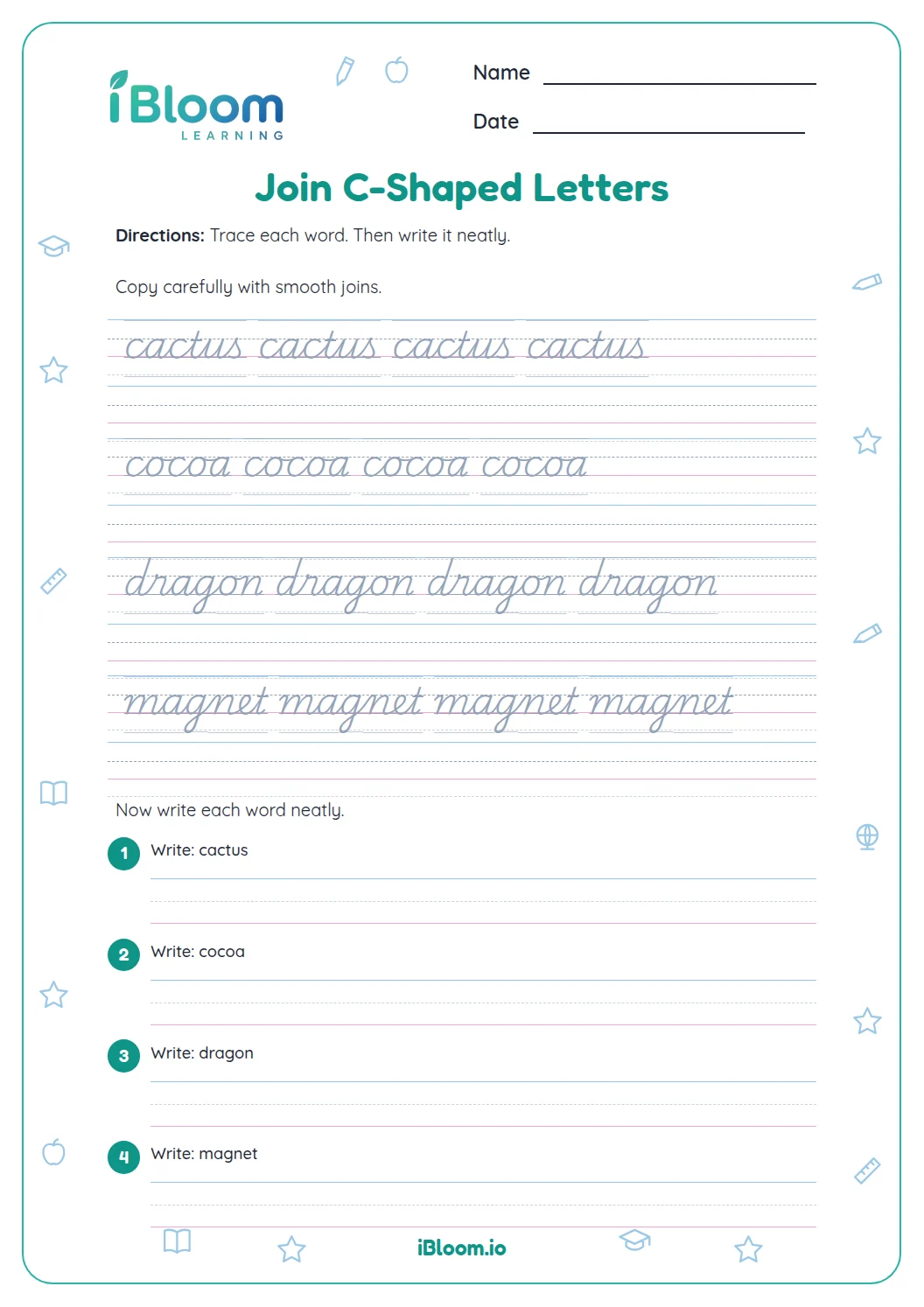
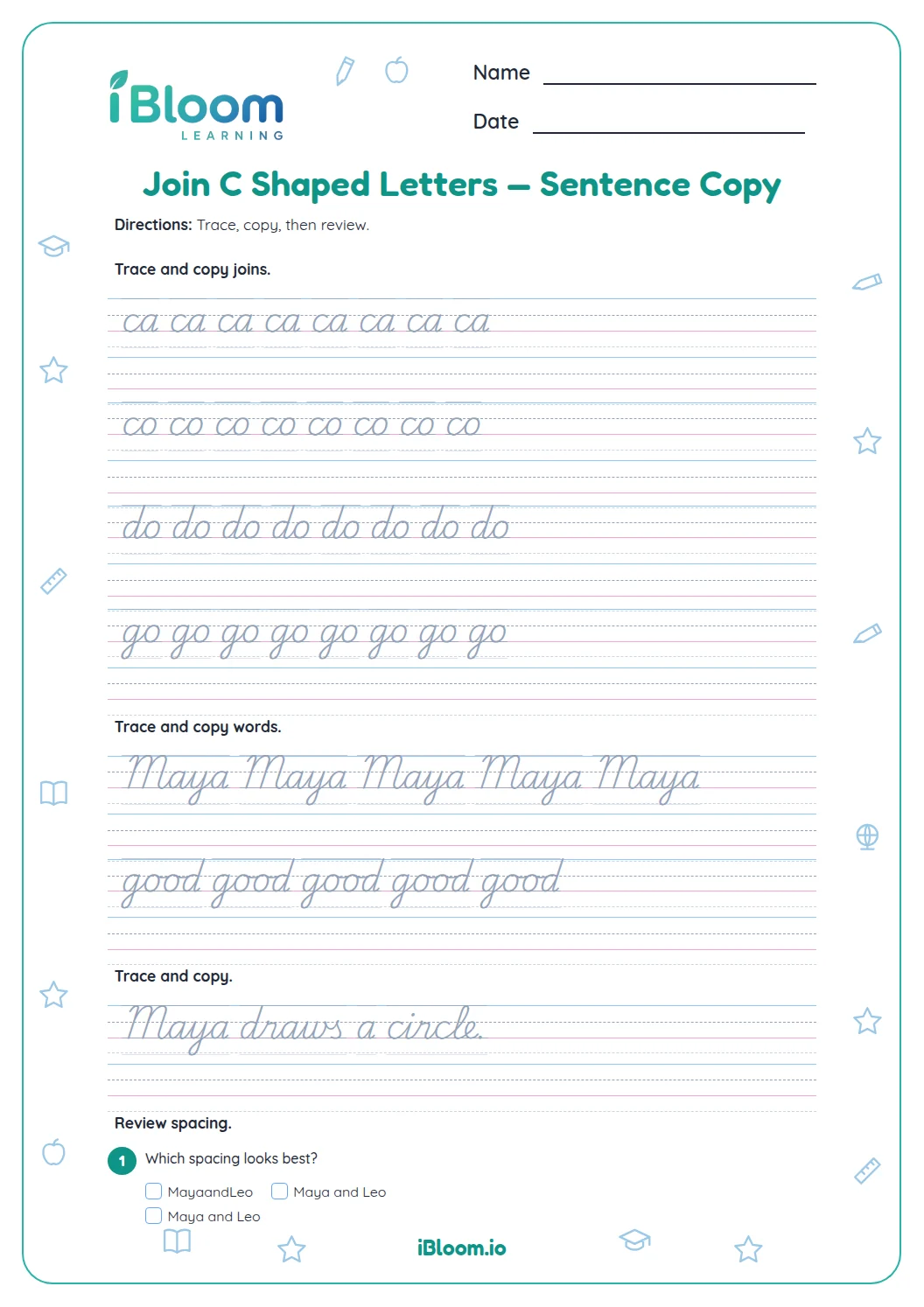
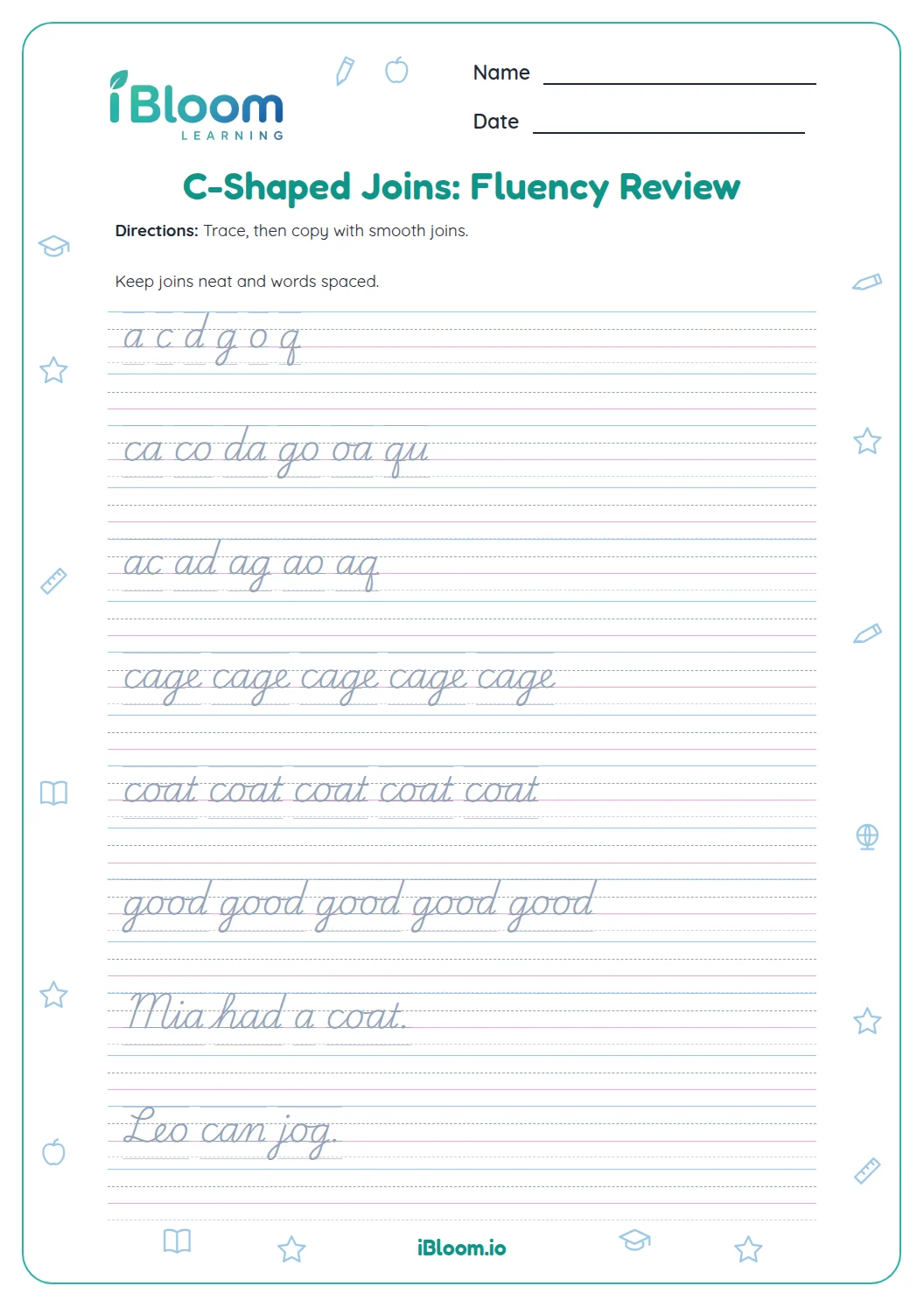
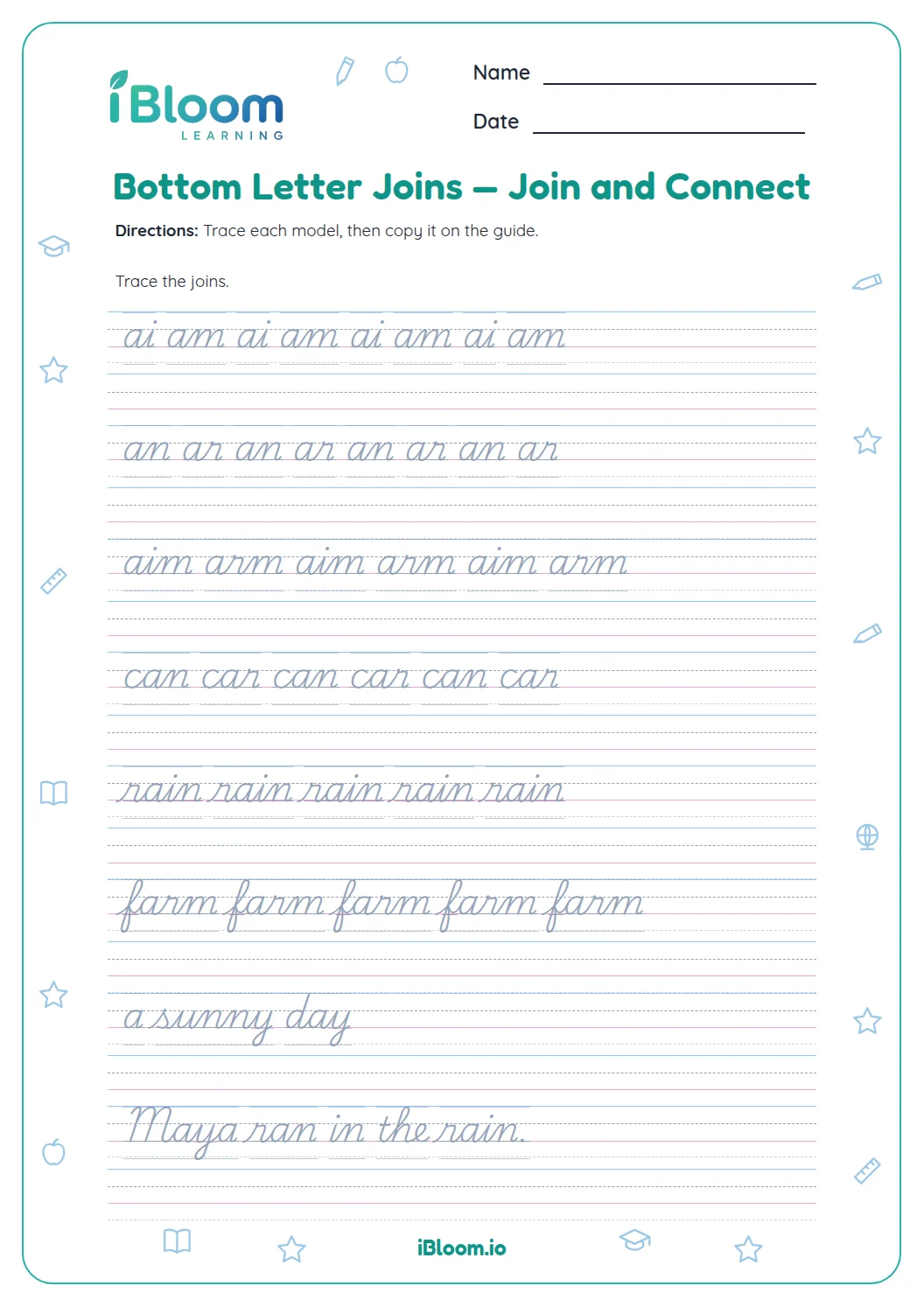
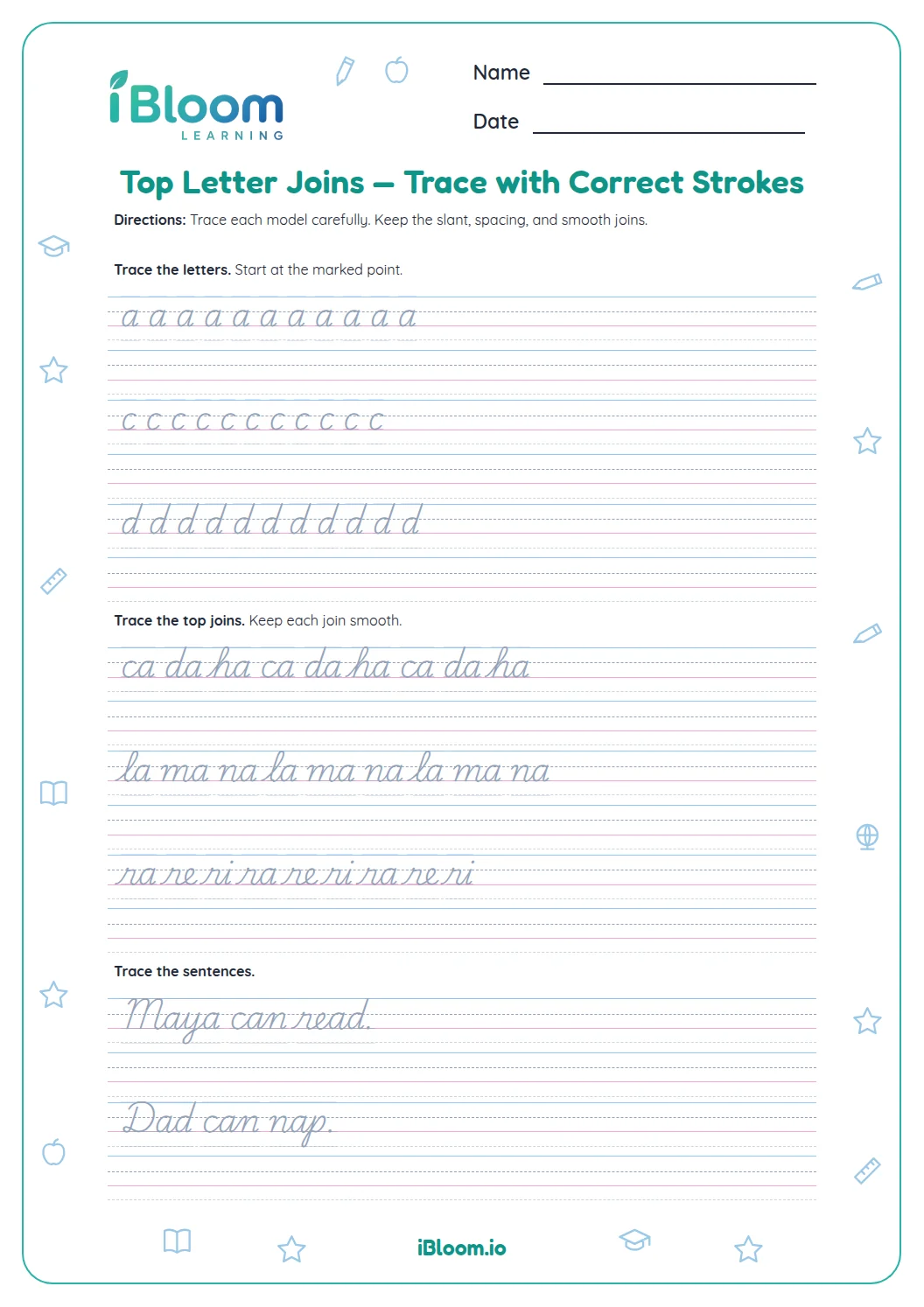
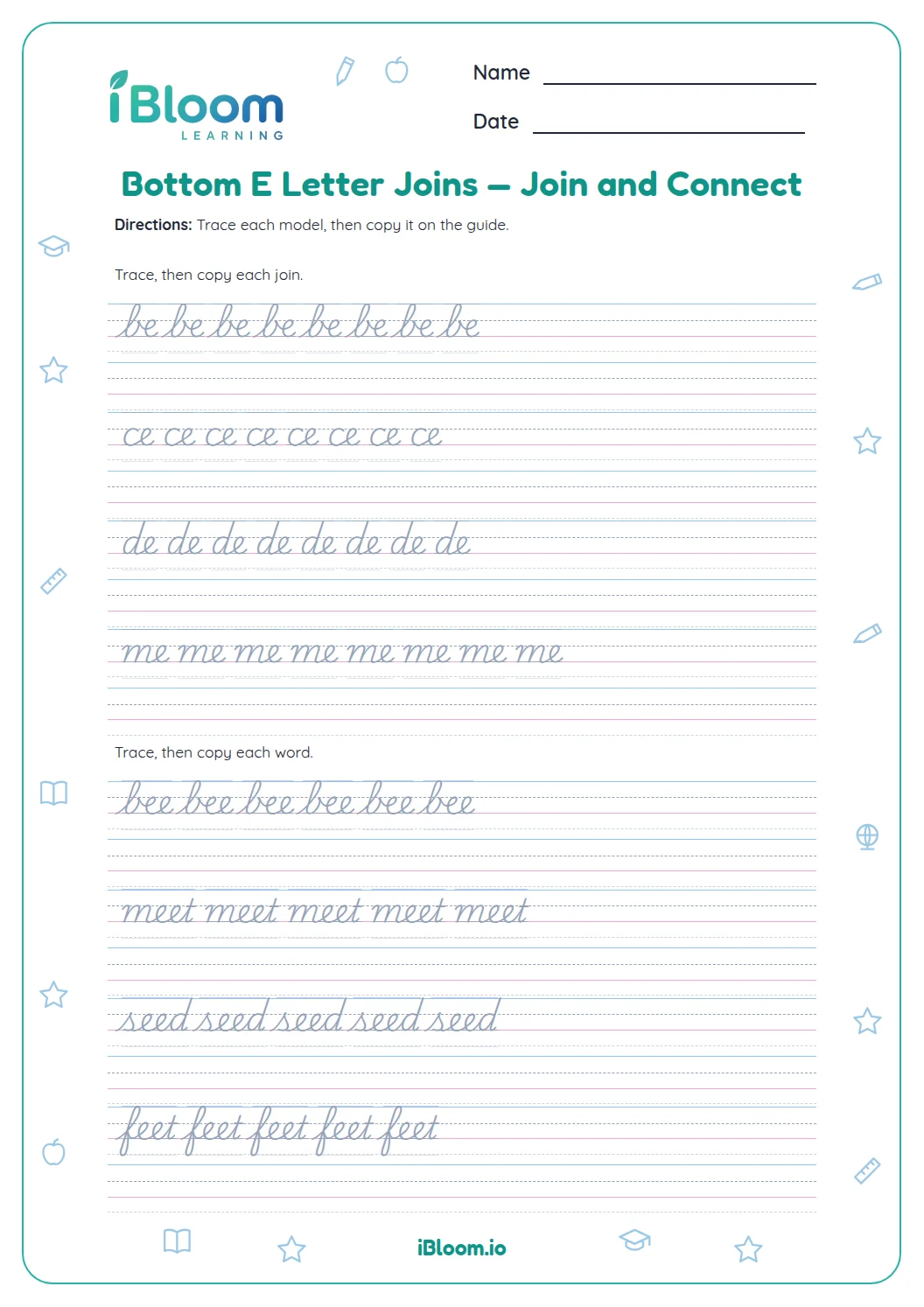
This free printable cursive worksheet is for Grade 2 to Grade 5 children who are learning to join letters. It focuses on the c-shaped letters, the ones that begin with a small backward c: a, c, d, g, o and q. Each row prints in a school cursive with a gray model to trace and an empty line to copy. The answer key shows every row in green.
What are c-shaped letters in cursive?
The c-shaped letters are a, c, d, g, o and q. Each one starts with the same small backward c, then does something different: a closes the circle and drops a line, d closes it and adds a tall stem, g adds a tail below the line. Teaching them as one family helps children see why joins into them look alike.
This sheet uses a, c, d, g and o. The letter q belongs to the family too, but it is rare in everyday words, so it is not practiced here.
How does a join into a c-shaped letter work?
Most letters in cursive finish with a small exit stroke that leads into the next letter. For the c-shaped letters, the exit stroke has to curl up and over so the pencil arrives at the start of the backward c, moving in the right direction. In the joins ac, ad and ag, the a ends at the baseline and the stroke swings up to start c, d or g.
The second row of Part A changes the starting letter. The o ends at the top, not the baseline, so the join to the next letter is a short bridge across, as in oa, oc, od and og. The bridge takes extra care, because the pencil has to travel across before the next letter begins.
- 1Model: oa oc od og
- 2Trace the gray row, one pair at a time.
- 3Write the o, close it at the top, and let the pencil carry across.
- 4Start the c-shape right where the bridge ends: do not lift.
- 5Check: no gap between the two letters in any pair.
How do the joins turn into real words?
Part B puts the joins to work in words. In ago, the join a to g is a baseline join into a c-shaped letter, and g to o goes from the tail back up. In good, the o to o and o to d joins are the bridge from Part A. In cocoa, c, o and a all repeat the family.
The last row is a whole sentence, "Dad made good cocoa.", so children keep the joins going through four words and leave a space between each.
- Part A: 2 rows of two-letter joins, from a and from o
- Part B: 2 rows with ago, good, dog, cocoa, code and cod
- Part C: 1 sentence with 4 words
What does a good join look like?
Check three things. The round part of a, d, g and o is closed, so a does not look like u. There is no gap or pencil lift between joined letters. And the letters in a word are the same size and sit on the same line.
How to use this worksheet at home or in class
- 1Warm up by writing the backward c in the air, then a, d and g, which all start with it.
- 2Trace the gray joins in Part A from left to right, keeping the pencil down inside each pair.
- 3Copy each row on the empty line underneath and compare it with the model.
- 4Do Part B the same way, saying each word quietly as you write it.
- 5Copy the sentence and leave a gap about the width of a lowercase o between words.
- 6Check with the answer key and circle the one join that looks best.
Common mistakes and quick fixes
The mistake
Leaving the a, d or g open at the top, so a looks like u and d looks like cl.
The fix
Close the round part before writing the straight line down, and trace the gray model until the circle meets itself.
The mistake
Lifting the pencil between letters, so ad becomes a and d written next to each other.
The fix
Keep the pencil on the paper from the end of the first letter to the start of the second. Lift only at the end of a word.
The mistake
Dropping to the baseline after o in oc and od, which adds a loop or a gap.
The fix
Leave o at the top and move straight across. Try the join in the air, then trace the gray bridge slowly.
What to practice next
Make more practice
Further reading
Questions parents and teachers ask
Which letters are the c-shaped letters?
They are a, c, d, g, o and q, the letters that start with a small backward c. This sheet practices a, c, d, g and o, in joins, words and a sentence. The q is part of the family but appears in few everyday words, so it is not on this page.
Why do the joins from a and o look different?
The a ends at the baseline, so its join swings up into the next letter. The o ends at the top, so its join is a short bridge across. The first row of Part A uses a and the second uses o, so children practice both exits one row at a time.
What do the answers look like?
The key shows every row written in green cursive on the copy line, so you can compare a child's joins with a model. There is one correct form for each row: ago, good, dog, cocoa, code and cod, and the sentence "Dad made good cocoa."
Should my child learn these joins before whole words?
Yes, joins first helps, which is why Part A comes before the words. A child who has practiced ac, ad and og finds ago, good and dog much easier. If words are still hard, repeat the joins row before moving on.
How long does the sheet take?
Most children take about 15 minutes, because careful cursive is slow. It is fine to split it: do Part A on one day and Parts B and C on another. A few minutes on several days is easier on a young hand than one long sitting.