
About this worksheet
Students trace lowercase and uppercase cursive g, h, i, j, k, and l, then practice the forms in short words. Each letter in the G–L range appears before the word practice. The key repeats the target text so a caregiver can check letter choice and order.
Which letters does the worksheet cover?
The worksheet practices g, h, i, j, k, and l in lowercase and uppercase. Students trace the lowercase forms first, then the capital forms, before practicing two short words.
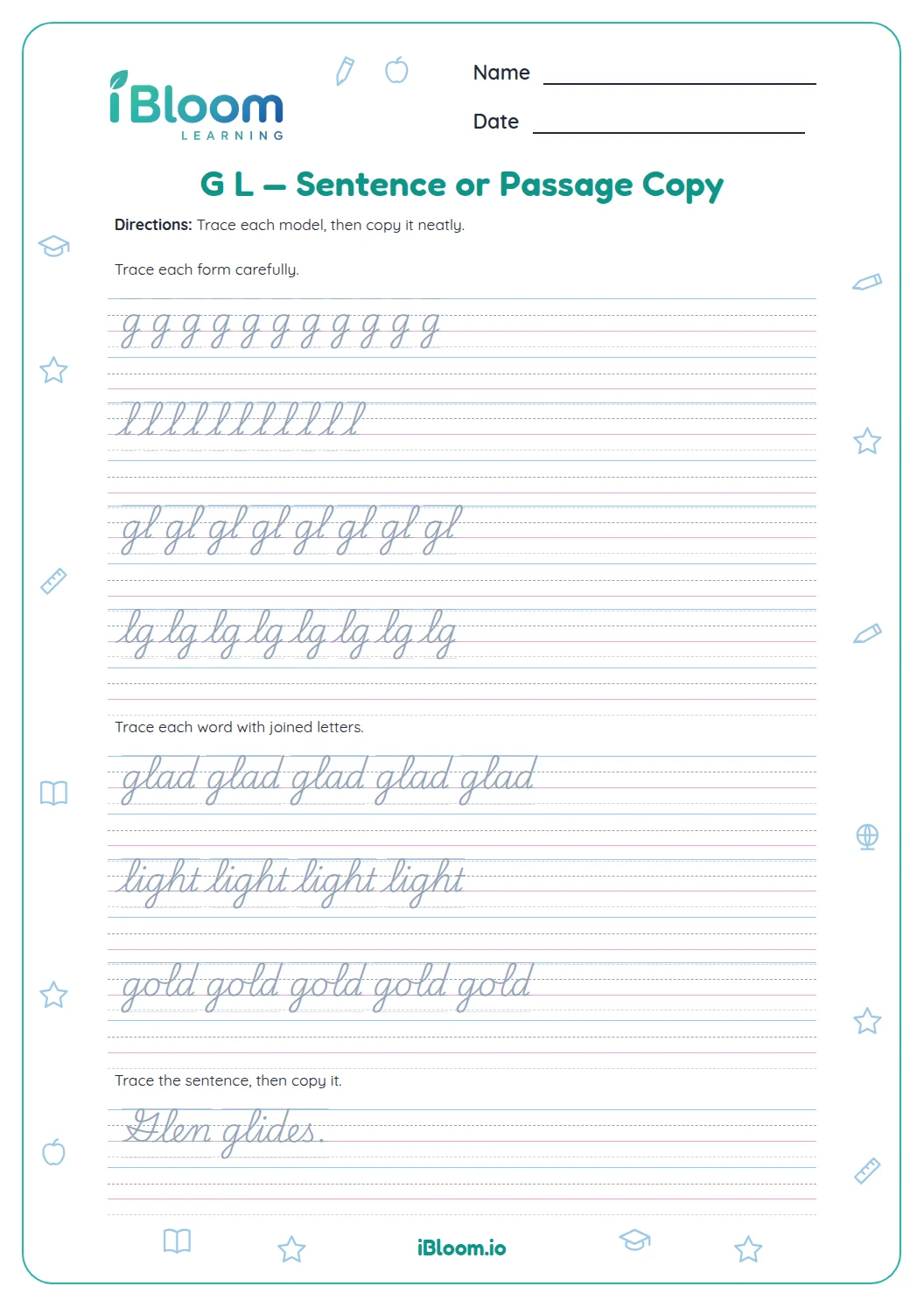
- 1Trace g g g g g, following the model on the handwriting line.
- 2Then trace G G G G G, keeping the capital form distinct.
How does tracing help with cursive joins?
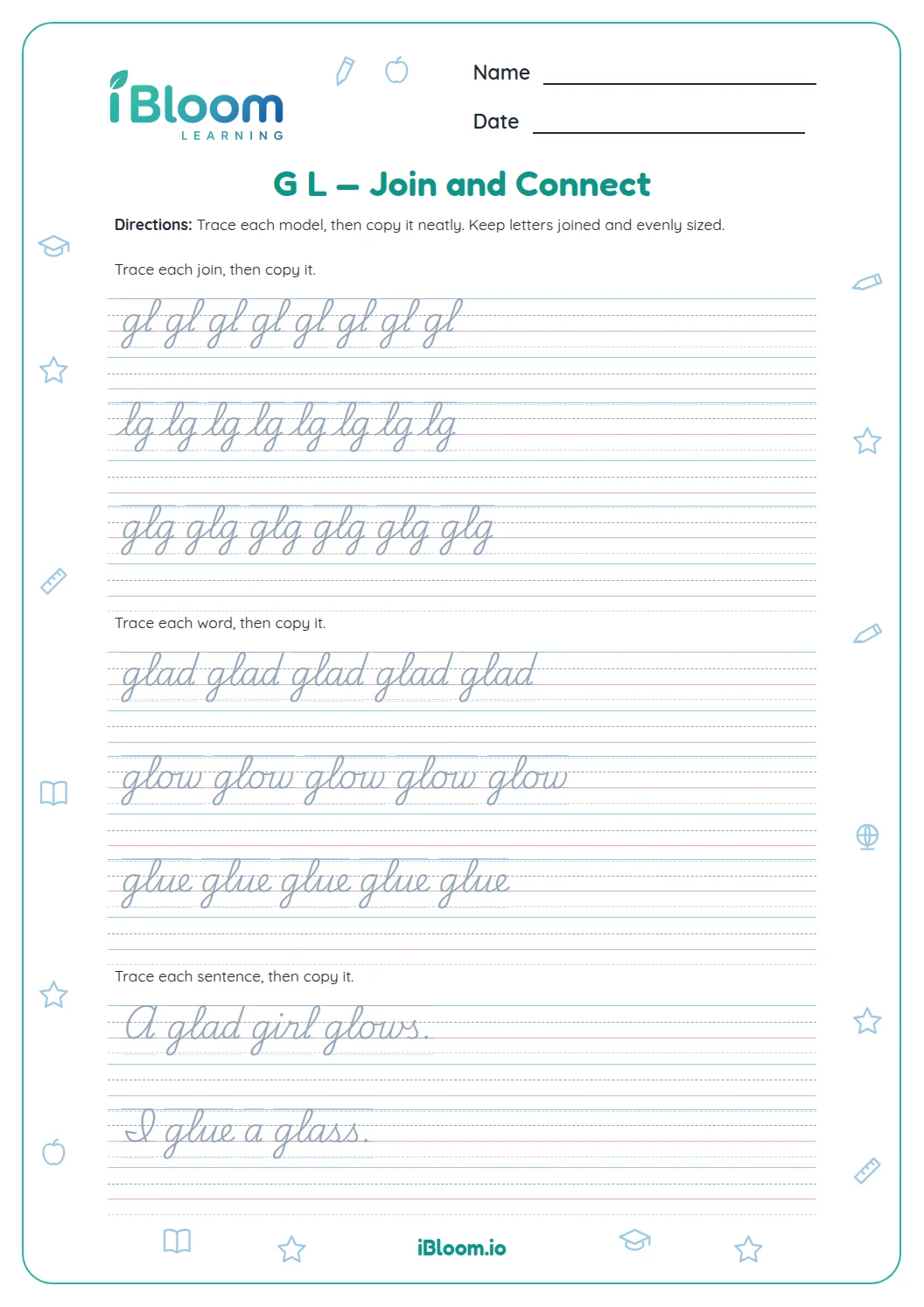
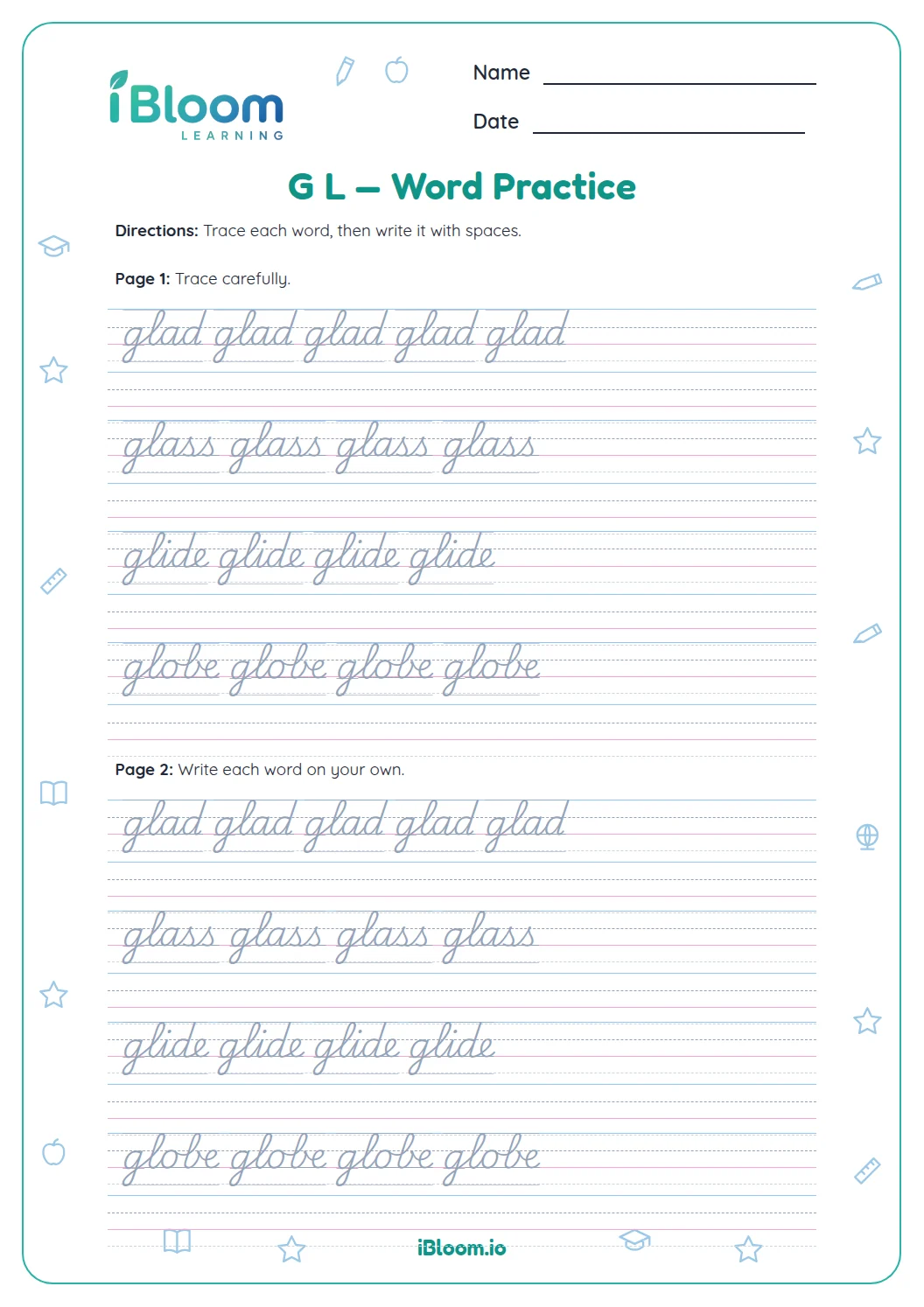
The words “glad” and “jog” bring target letters together. Tracing them gives students a chance to follow cursive joins while keeping each letter readable.
What should a child check while copying?
Look for a steady slant, clear letter shape, and an even baseline. Capitals begin words or names; lowercase letters continue the word. A correct copy keeps the same letters and order as the printed model.
How to use this worksheet
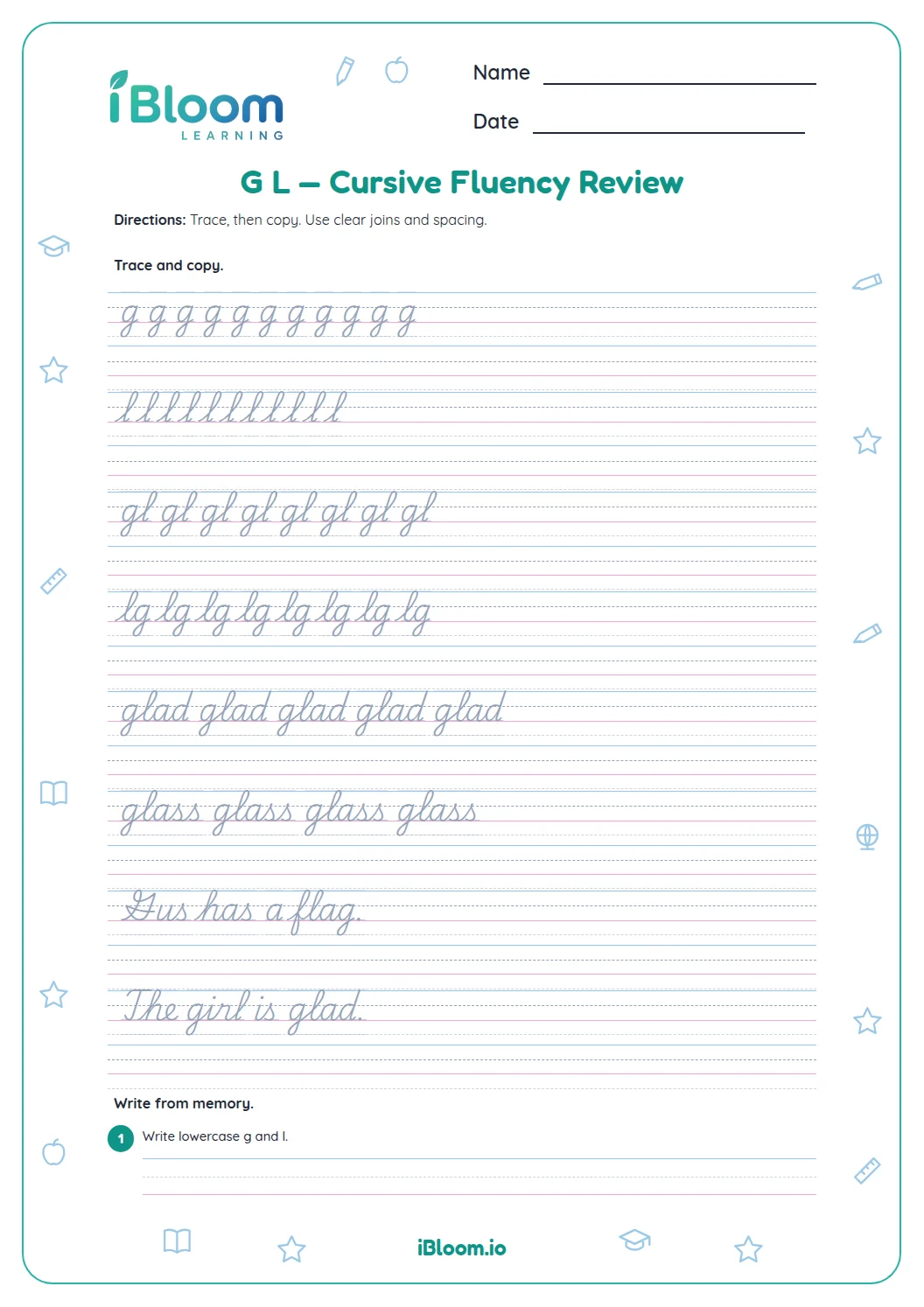
- 1Start with the lowercase letter and notice where the stroke begins.
- 2Trace the gray model slowly while staying on the handwriting line.
- 3Repeat with the uppercase form, keeping its shape distinct.
- 4Trace each word from left to right and follow the joins.
- 5Copy the target once more with even spacing and a clear baseline.
Common mistakes and quick fixes
The mistake
Making a capital and lowercase letter the same size and shape.
The fix
Compare the model and keep capitals taller and distinct.
The mistake
Lifting the pencil between letters in a connected word.
The fix
Follow the joining path shown by the cursive model.
The mistake
Letting letters drift above or below the baseline.
The fix
Use the handwriting lines to keep letter bodies aligned.
What to practice next
Make more practice
Further reading
Questions parents and teachers ask
Which letters are included in this practice page?
The worksheet covers g, h, i, j, k, and l in lowercase and uppercase. Students trace those twelve forms first, then practice two short words, “glad” and “jog.” The complete G–L range appears, with both forms of each letter before the word practice.
Should my child trace lowercase or uppercase letters first?
The prompts begin with lowercase forms, then move to capitals. Students can follow that order to notice how each capital differs from its lowercase partner. Both forms appear for every letter from G through L before the word practice begins.
What should I look for in a cursive letter?
Look for a recognizable shape, steady size, and alignment with the handwriting line. Slant can vary between writers. A clear letter that follows the model’s general stroke and position is more useful than expecting every student’s handwriting to look identical.
Why are words included after individual letters?
The words “glad” and “jog” let students connect the cursive forms they just traced. Each word uses letters from the G–L group, giving children practice following joined strokes while keeping the letters readable and in the correct order.
How should the answer key be used for handwriting?
Use the key to check which letters and words appear and in what order. Handwriting varies, so compare for readable forms, joins, and general alignment rather than expecting a child’s tracing or copied line to match the printed model exactly.
What comes after the G–L letters?
Move to the M–Q worksheet to practice the next letter group, then continue with R–V and W–Z. The A–F page covers the earlier group. These pages organize cursive practice into smaller sets, so children can work on a few new letter forms at a time.