

About this worksheet
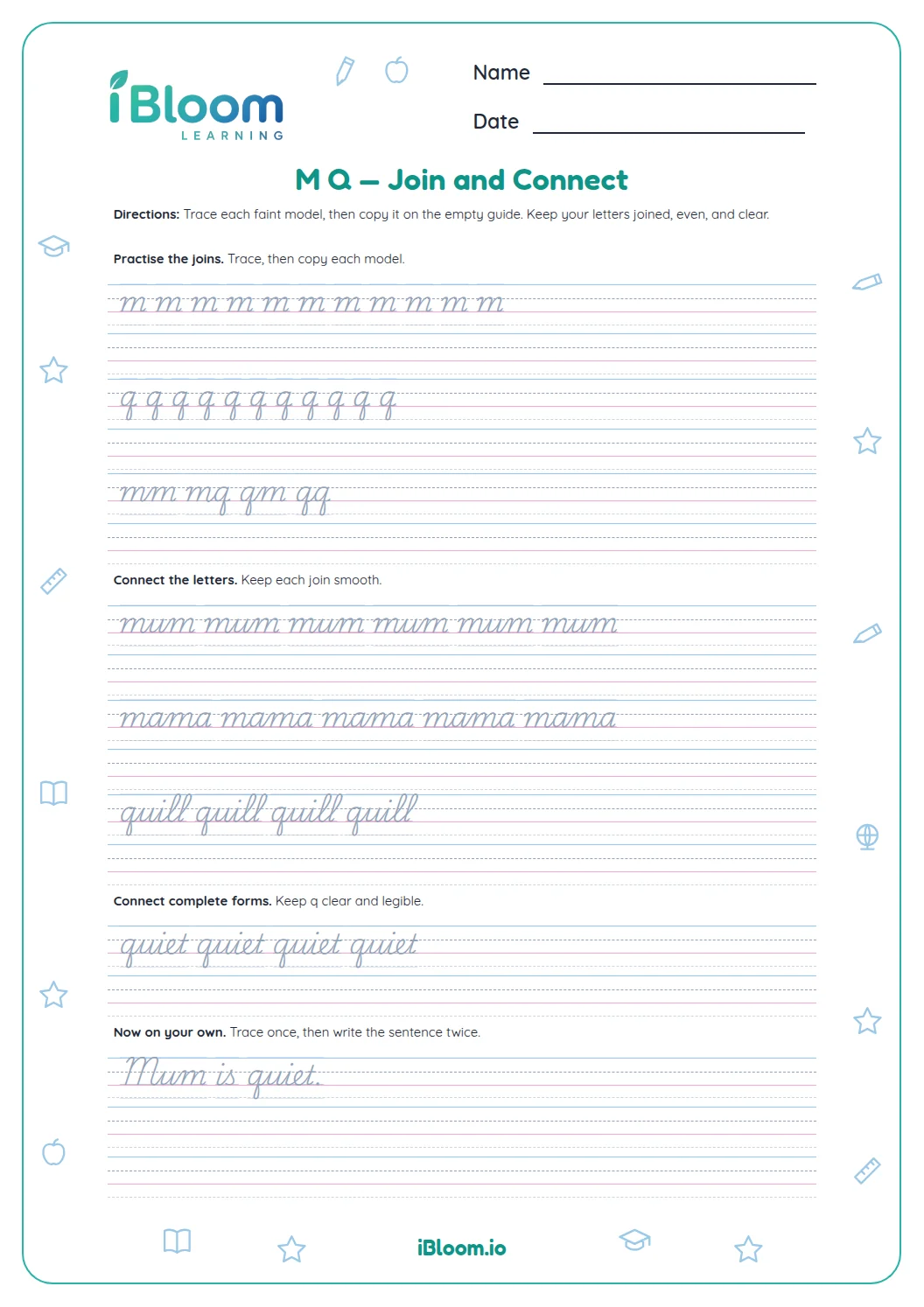
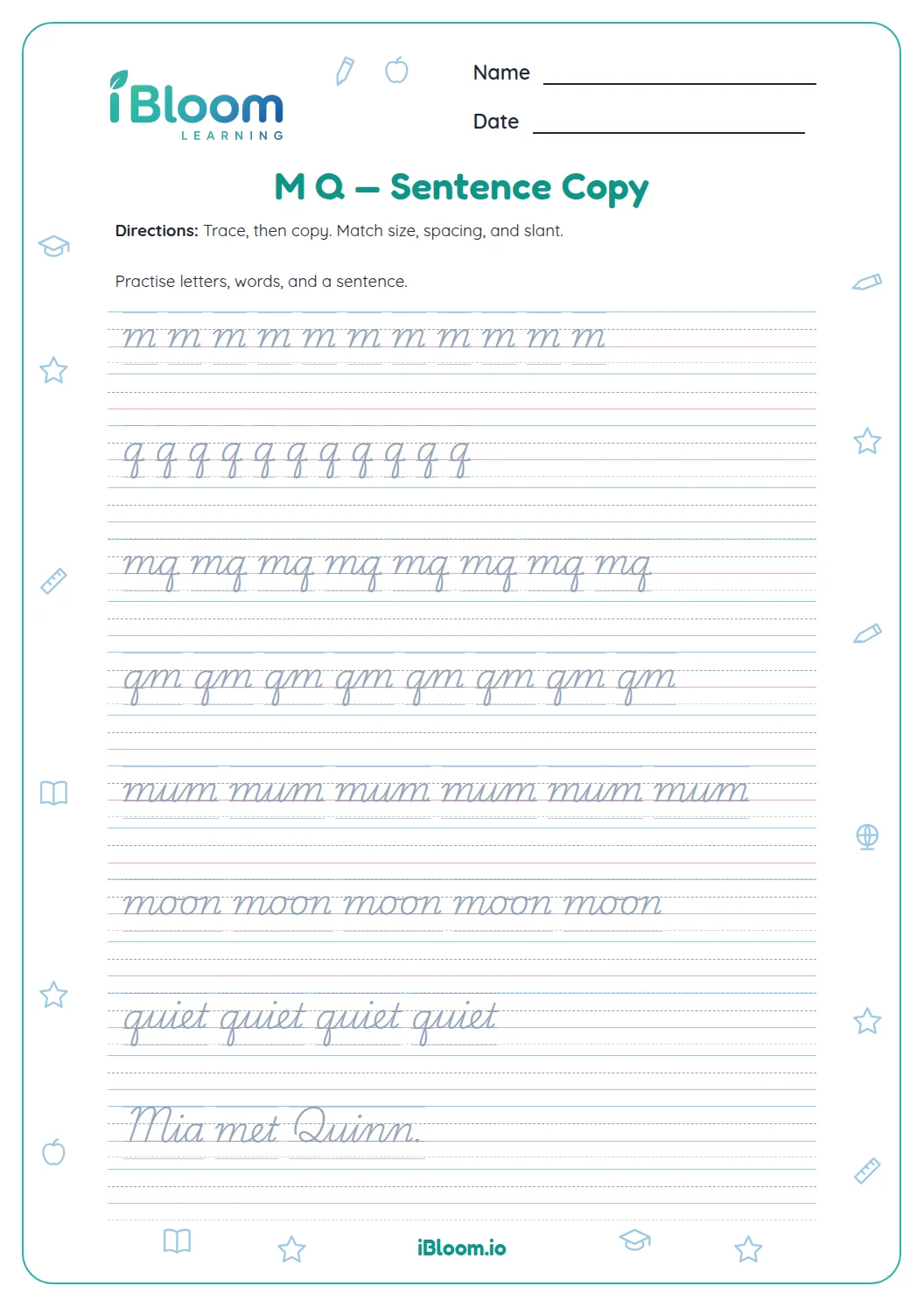
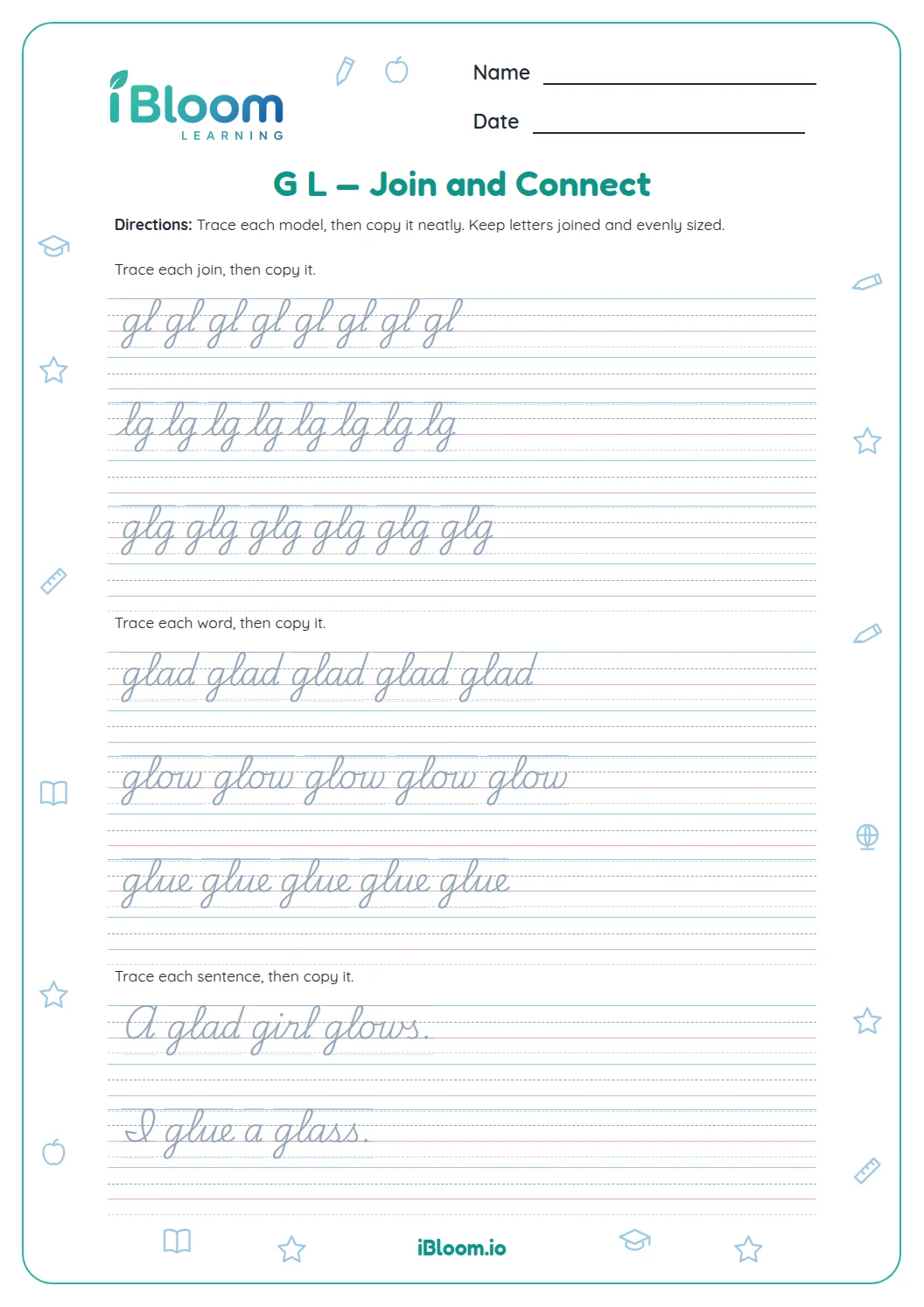
This printable cursive worksheet is for students in Grades 2–5 practicing letters M through Q. Students trace and copy one uppercase and one lowercase letter group, then complete 12 cursive words that use the target letters and write each answer in cursive. The answer key lists all 14 responses for checking letter forms, sequence, and spelling.
How do students practice uppercase M–Q?
Question 1 models the uppercase group M N O P Q. Trace the sequence, then copy it while keeping each capital clear and evenly spaced.
- 1Trace M N O P Q.
- 2Copy the uppercase sequence on the line.
How does lowercase practice change the forms?
Question 2 repeats the target sequence in lowercase: m n o p q. Compare letter height and entry strokes while keeping the forms readable.
Which M–Q words appear in the compact prompts?
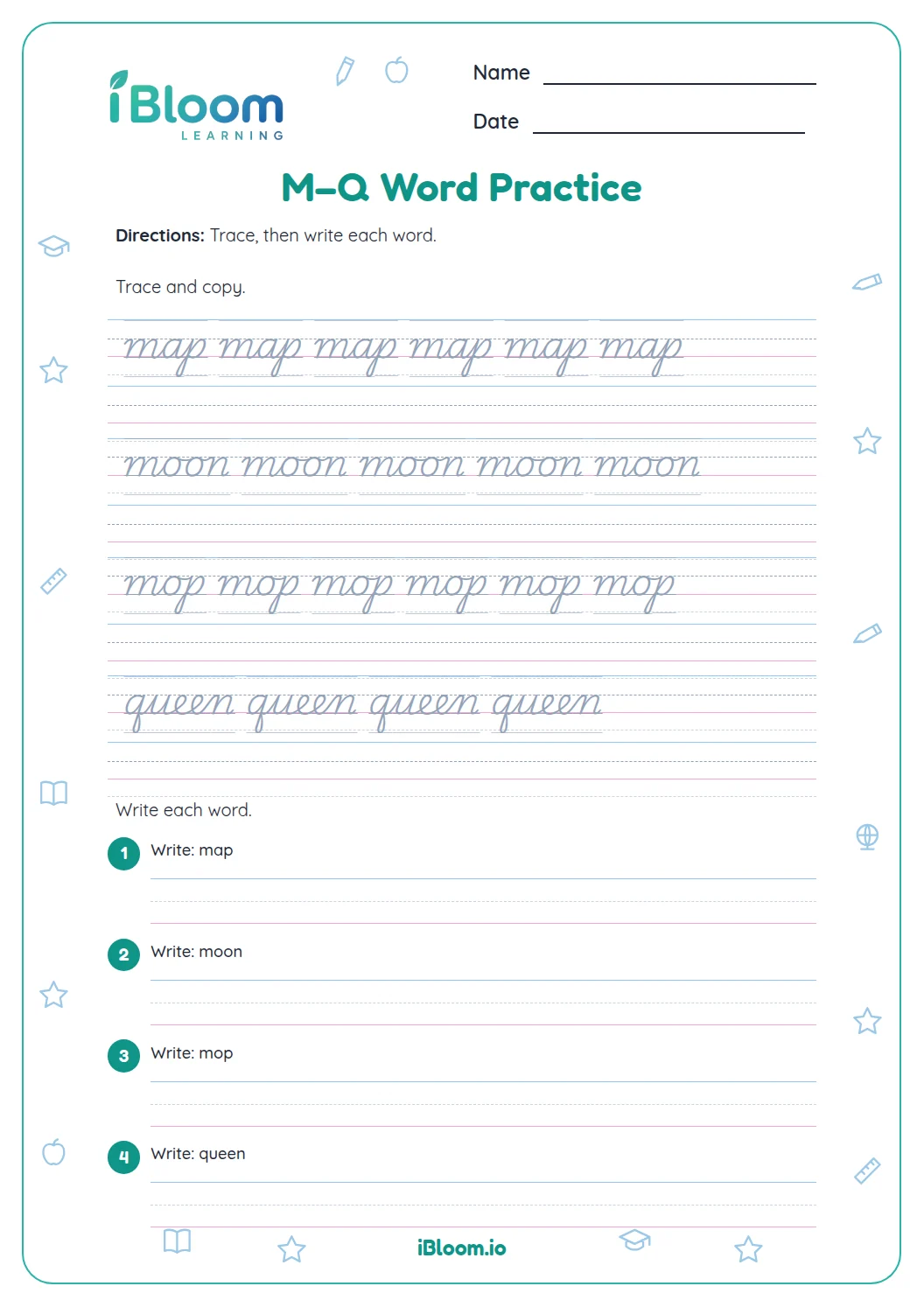
Part B asks learners to trace and copy 12 words, including moon, queen, and pencil. Each answer uses one or more M–Q letters and is written in cursive.
How to use this worksheet
- 1Trace each uppercase model, then copy it.
- 2Repeat with lowercase M–Q forms.
- 3Notice which letters rise above or drop below the line.
- 4Trace and copy each whole word in Part C.
- 5Use the answer key to check letter order and spelling.
Common mistakes and quick fixes
The mistake
Rush through the gray model.
The fix
Slow down and follow the stroke from start to finish.
The mistake
Make capitals the same size as lowercase letters.
The fix
Use the model to compare letter height and shape.
The mistake
Join letters so their forms become hard to read.
The fix
Keep the word readable, even when a join needs a small lift.
What to practice next
Make more practice
Questions parents and teachers ask
Which letters does this worksheet cover?
The worksheet practices uppercase M, N, O, P, and Q, plus lowercase m, n, o, p, and q. Two cursive models show the groups, and 12 cursive word models use the same letters in words such as moon, queen, and pencil.
How many questions are included?
There are 14 questions: two cursive letter-group models and 12 compact cursive word models. Students write each answer in cursive. The answer key gives the expected groups and words so families can check letter order and spelling. Students can write word models directly on the printed lines. Students can write word models directly on the printed lines.
What is the purpose of the word prompts?
The word prompts place M–Q forms in familiar spelling patterns. Students complete words such as mop, pond, and quiet, then write each answer in cursive. This connects the letter shapes with their use inside whole words and gives practice with spelling.
How should a student use the answer key?
First compare the copied uppercase and lowercase groups with their models. Then check the completed words for spelling and letter order. The key provides the target responses, while each student’s cursive can differ slightly and remain readable on the writing lines.
How long might the worksheet take?
Plan for about 20 minutes. Allow time to trace and copy both letter groups and write the 12 short word answers. Learners can pause between parts, then use the answer key to check the completed practice at home, including spelling.