
About this worksheet
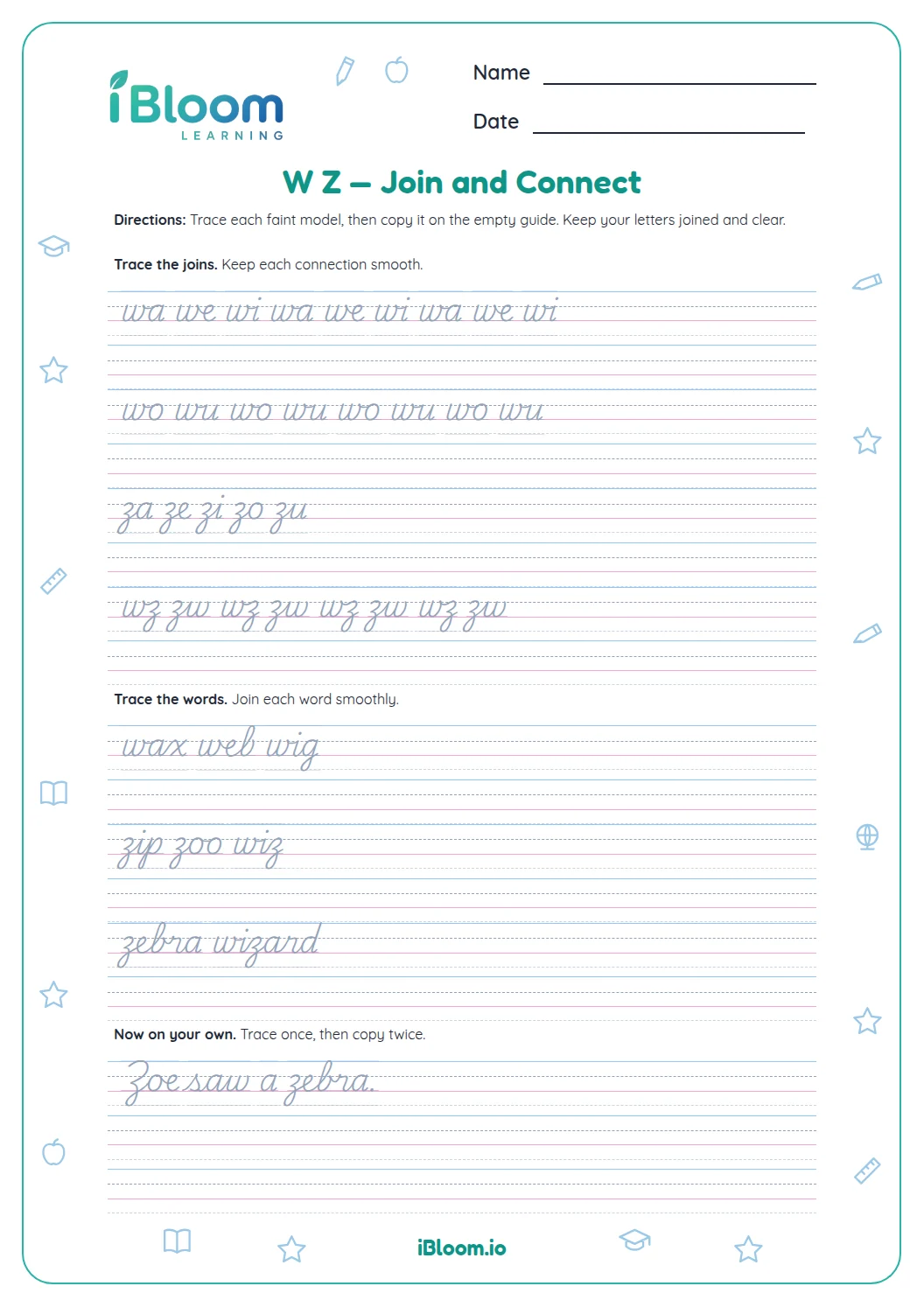
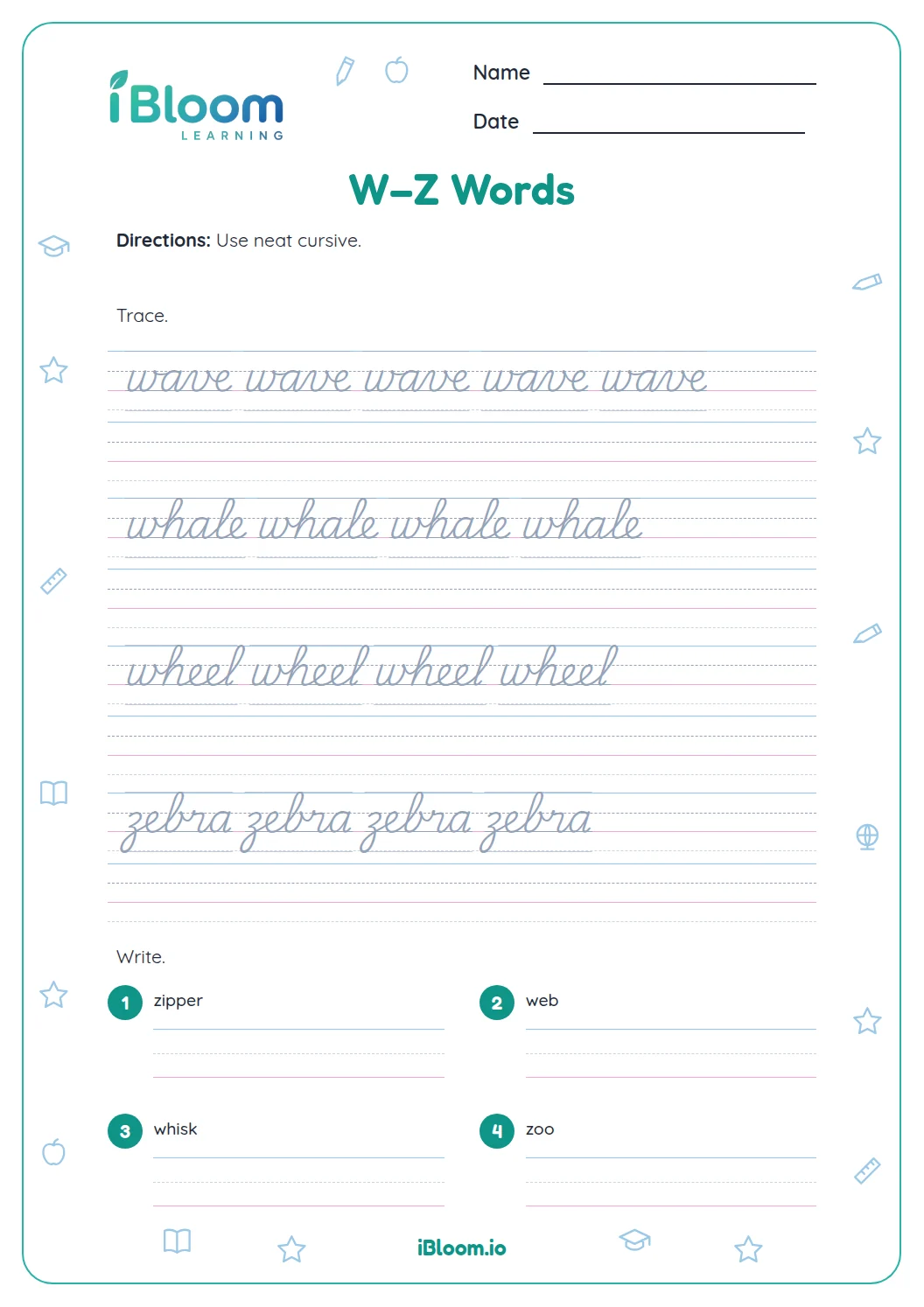
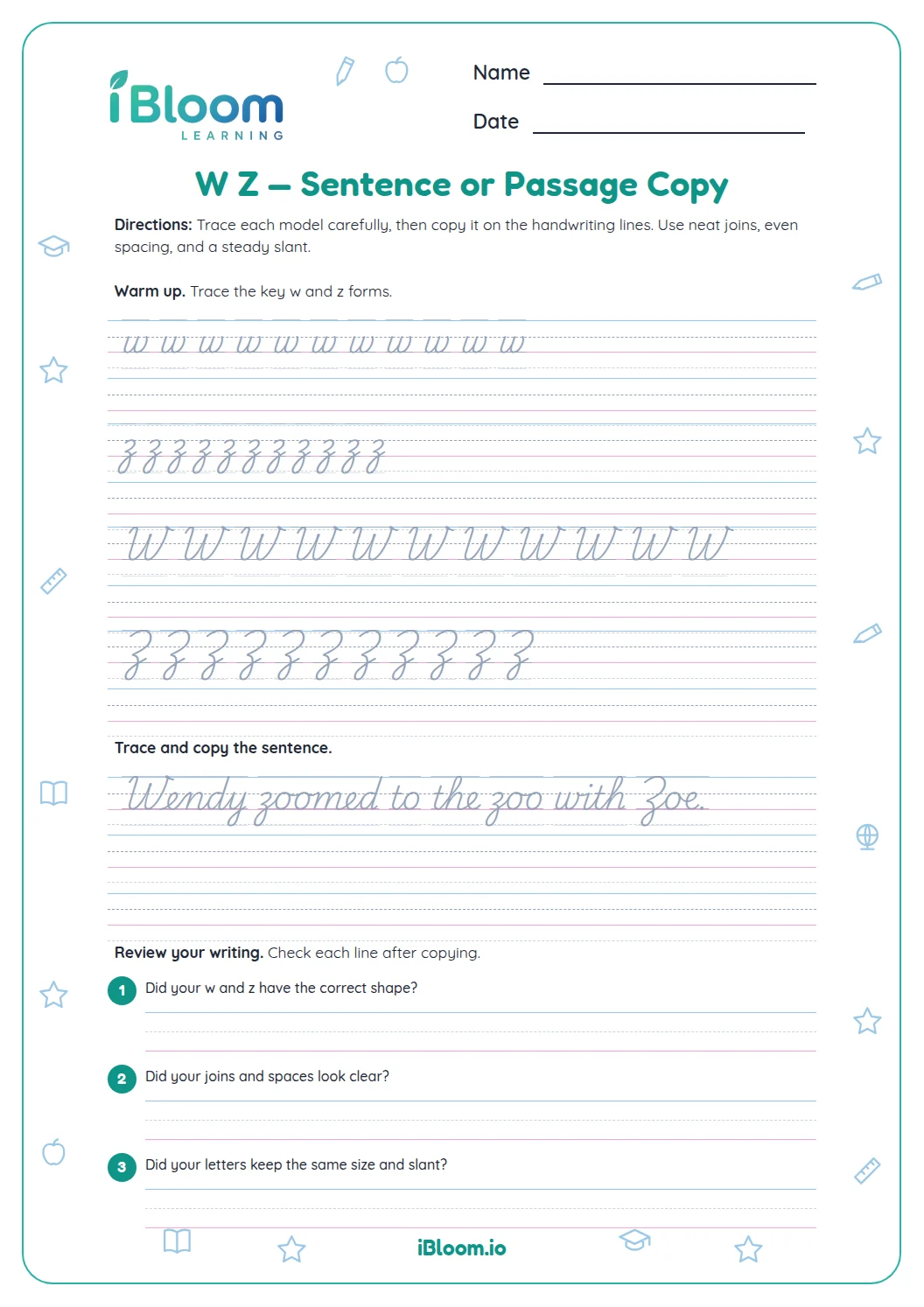
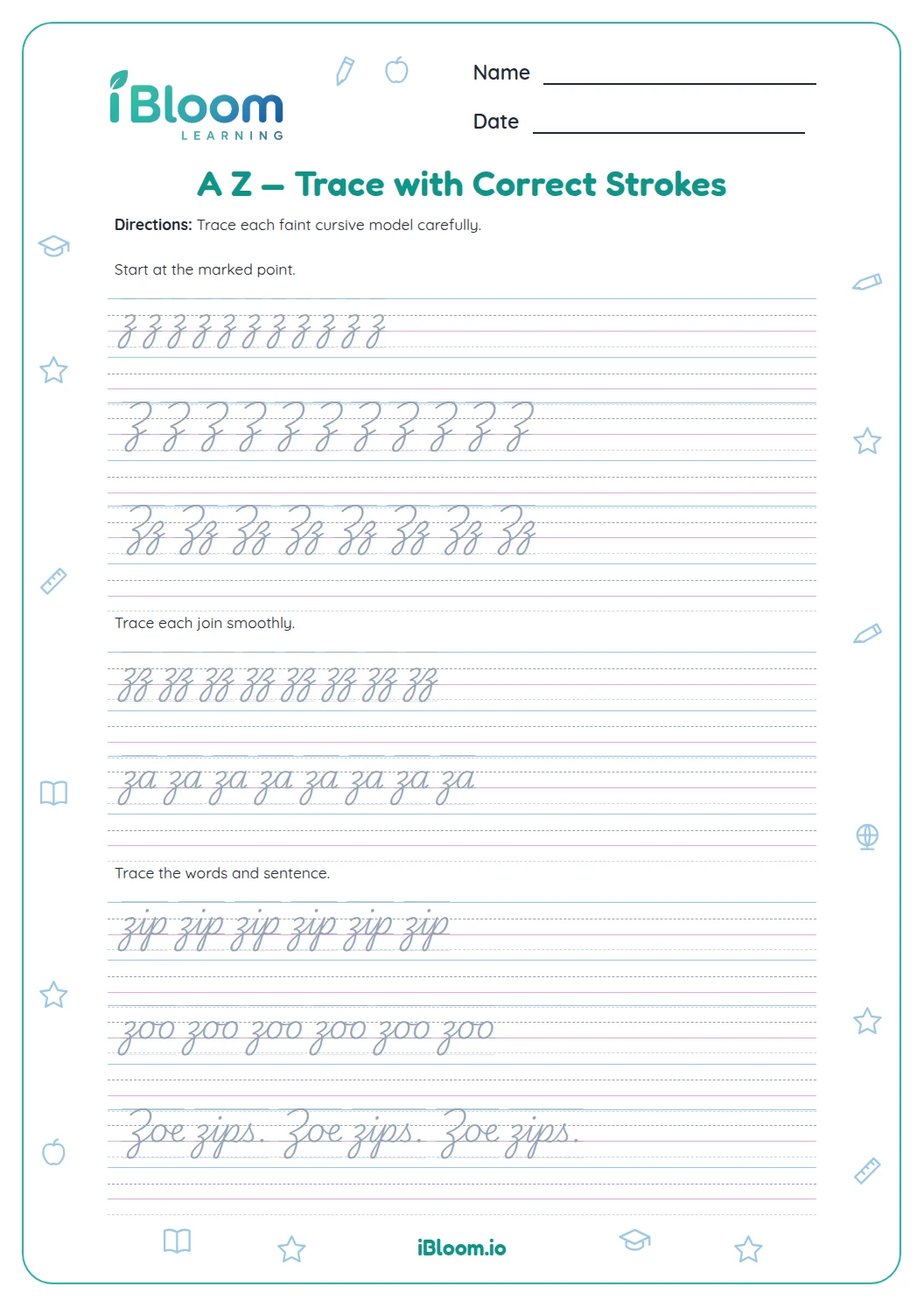
This free printable cursive review covers the last four letters of the alphabet: w, x, y and z, in lowercase and capitals. It is for Grade 2 to Grade 5 children who have already learned these letters and now need to write them smoothly. Every row prints in a school cursive with a gray model to trace and an empty line to copy: the eight letters, the joins wa, wo, ax, ox, ya, ye, za and zo, the words wax, box, yes, zoo, yawn, zebra and extra, and the sentence "Six yellow zebras swim." Children finish by writing a sentence of their own with a w, x, y and z word. The answer key shows every row in green.
What is on this cursive W to Z review?
The sheet climbs from single letters to a sentence in four parts. Part A is the letters themselves: w, W, x and X in one row, y, Y, z and Z in the next. Part B practices the joins children meet most with these letters: wa, wo, ax and ox, then ya, ye, za and zo.
Part C puts the letters into words (wax, box, yes, zoo, then yawn, zebra, extra) and into the sentence "Six yellow zebras swim.", which has all four letters. Part D is a pair of writing lines for a sentence of the child's own with a w, x, y and z word. Every cursive row prints on handwriting lines with a gray model and an empty line under it.
- Part A: 2 rows, the 8 letters (lowercase and capital)
- Part B: 2 rows, 8 joins
- Part C: 3 rows, 7 words and 1 sentence
- Part D: 1 sentence written from scratch
How do w, x, y and z join to the next letter?
In most school cursive styles, w finishes with a stroke at the midline, so the next letter starts from up there instead of from the baseline. That is why wa and wo look different from ya and za, where the letter swings back up from its loop below the line before joining.
Lowercase x is the odd one out: children write its first half as part of the word and add the crossing stroke after the word is finished, the same way they cross a t. y and z both have tails that drop below the line and loop back up into the next letter.
- 1Model: ya ye za zo
- 2Trace each pair slowly, left to right.
- 3y and z drop below the line, then loop back up.
- 4Carry the loop straight into a, e or o without lifting.
Why copy a sentence and then write one?
A sentence adds what single words cannot: a capital letter, spacing between words and a period. "Six yellow zebras swim." uses all four letters and has four words to space evenly, all in one row.
Part D is the fluency check. Nothing is traced, so the child has to remember the letter shapes and joins. Any true sentence with a w, x, y and z word works, such as "Wes saw six yaks at the zoo."
How can you tell if cursive is neat enough?
Neat does not mean identical to the model. Check a few things you can see: letters sit on the line, they lean the same way, tails drop below the line only where they should, and the gaps between words are about the same size.
- Letters rest on the bottom line, except tails, such as y and z, which drop below it
- Every x is crossed
- All letters lean the same way
- Letters inside a word are joined, not separate
How to use this worksheet at home or in class
- 1Warm up by tracing w, x, y and z in the air with two fingers, then the capitals.
- 2Sit with feet flat, paper tilted, and the pencil held lightly. Cursive goes more smoothly with a relaxed grip.
- 3Trace the gray model in each row from left to right, slowly, without lifting inside a word.
- 4Copy it on the empty line directly underneath. Cross every x after its word, then compare with the model.
- 5Write your own sentence in Part D, then read it aloud to check it has a w, x, y and z word, a capital and a period.
- 6Check with the answer key, and circle one letter or join to improve next time.
Common cursive mistakes and quick fixes
The mistake
Writing a print-style capital X or Z instead of the cursive shape.
The fix
Trace the capital models in Part A three times before copying. Say the strokes aloud as you go.
The mistake
Crossing the x in the middle of a word, so the pencil lifts and the next letter does not join.
The fix
Write the whole word first, then go back and cross the x, the same way you cross a t.
The mistake
Starting the letter after w from the baseline, so wa or wo looks broken.
The fix
Notice that w ends at the midline. Begin the next letter right there, with no dip down to the line.
What to practice next
Make more practice
Further reading
Questions parents and teachers ask
Should my child trace the gray model before copying?
Yes. Tracing first lets a child feel each stroke and join before writing it alone. Do one gray row, then copy it on the empty line directly underneath. If the copy looks very different from the model, trace the same row again before moving on.
Why is x crossed after the word?
In most school cursive, the first half of x joins to the letters around it, and the crossing stroke is added once the word is finished, just like crossing a t. That keeps the pencil moving through the word. Rows 3, 5 and 6 on this sheet all practice it.
What does the answer key show?
The key shows every row written in green cursive on the copy line, so you can compare a child's letters and joins with a model. For the last question, which has many correct answers, it shows one sample sentence: "Wes saw six yaks at the zoo."
What grade is this review for?
It is labeled Grades 2 to 5 because schools teach cursive at different times. It suits a child who has already been taught w, x, y and z and wants a mixed review, not a first lesson. Pair it with the A to Z review for practice across the whole alphabet.
How long does the sheet take?
Most children take about 20 minutes, including the sentence of their own. Cursive done carefully is slow, so plan for a slower pace on the capital letters. It is fine to do Parts A and B on one day and Parts C and D on another.