

About this worksheet
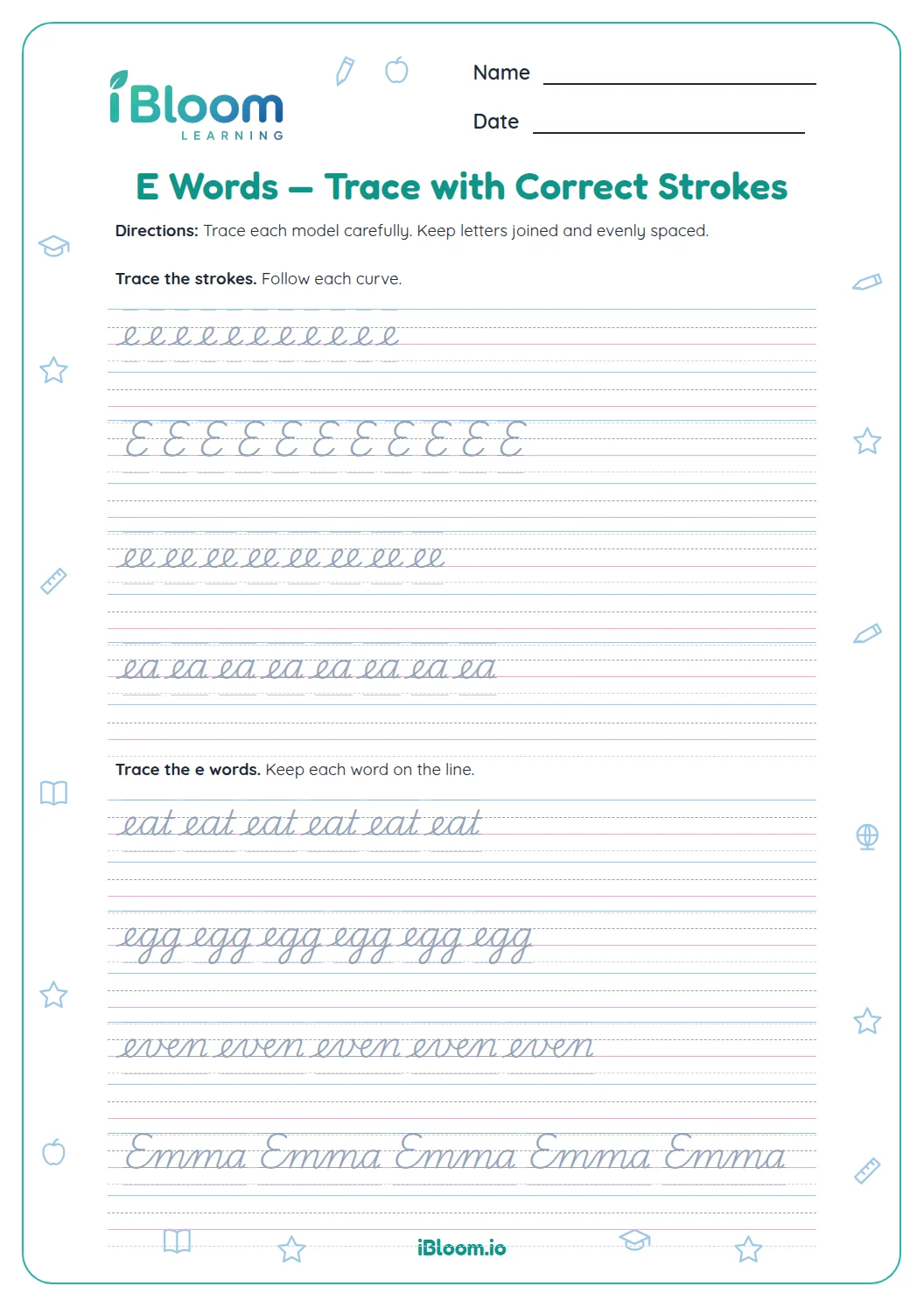
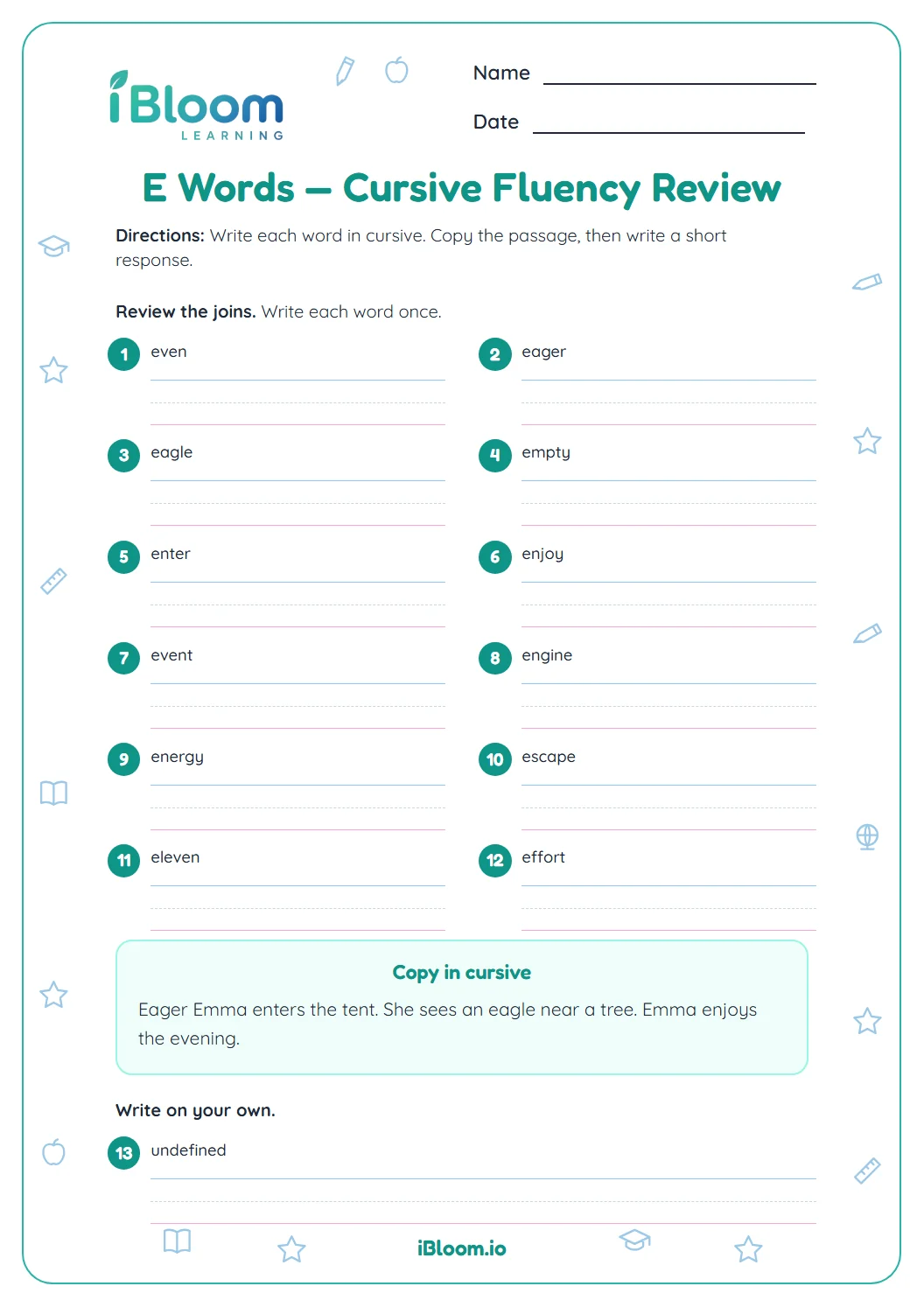
This free printable cursive worksheet is for Grade 2 to Grade 5 children who are learning to join letters and write whole words. All the words begin with e. Each row prints in a school cursive with a gray model to trace and an empty line to copy. The answer key shows every row in green.
What is on this cursive e words worksheet?
Part A has two rows of joins: ee, ea, el and en, then er, es, ev and eq. Part B has two rows of words, egg, elf and elbow, then eagle, equal and even. Part C is the sentence "Eve eats eggs every day." Every row has a gray model to trace and an empty line to copy.
Several joins from Part A come back inside the words: el in elf and elbow, ea in eagle, eq in equal, ev and en in even, and ev and er in every. Practicing a join first makes it easier to write inside a word.
- Part A: 2 rows, 8 e joins
- Part B: 2 rows, 6 words beginning with e
- Part C: 1 sentence with 5 words
- Words: egg, elf, elbow, eagle, equal, even, Eve, eats, eggs, every, day
How does cursive e connect to other letters?
The cursive e is made with a small loop, and it ends with an exit stroke at the baseline. That makes it a baseline-join letter, like a, c and d, so the next letter starts from the line. The loop stays open, so the e does not turn into a blob.
After the e, letters with tall loops, like l in el, take a long upward stroke. Letters that drop below the line, like g in egg and q in equal, need the pencil to travel down and back.
- 1Model: egg elf elbow
- 2Trace egg: an e, then g, which drops below the line, then g again.
- 3Trace elf: e, then l with a tall loop, then f with a loop above and below.
- 4Trace elbow: e, l, b, o and w, joining all five without lifting.
- 5Copy the row on the empty line and compare.
Why finish with a sentence?
A sentence checks that the skill carries over to writing. "Eve eats eggs every day." has a capital E to form, five words to space and a period to finish. Four of the five words start with e, so children use the e joins again and again.
Because the words are all easy to read, a child can focus on the shape of the letters, not on spelling.
How to use this worksheet at home or in class
- 1Warm up by writing a row of loops in the air or on a whiteboard, with the e's loop open at the top.
- 2Trace the gray joins in Part A from left to right. Copy each row on the empty line below.
- 3Say each word in Part B aloud before you trace it, then copy it without lifting the pencil inside the word.
- 4Copy the sentence in Part C, with a gap about the width of a lowercase o between words.
- 5Read the sentence aloud to check the capital E and the final period.
- 6Compare with the answer key and choose one word to write again more neatly.
Common mistakes and quick fixes
The mistake
Pinching the loop of e shut, so it looks like a smudge or an i.
The fix
Make the loop open and slightly slanted. Trace the gray ee row slowly, keeping a small gap inside each loop.
The mistake
Lifting the pencil after letters that drop below the line, such as the g in egg and the q in equal.
The fix
Keep going: the pencil swings back up into the next letter. Practice the pair eg and eq in the air before writing the word.
The mistake
Making the l in elf and elbow as short as the e, so it looks like another e.
The fix
Let the l reach the top line, taller than the e. Trace el slowly three times, then try elf and elbow.
What to practice next
Make more practice
Further reading
Questions parents and teachers ask
Why do all the words start with e?
One letter of focus lets children repeat the same join across many words. Starting every word with e lets them practice the e loop and its exit stroke eight times in Part A, then again in egg, elf, elbow, eagle, equal and even.
Which joins does Part A practice?
Part A practices ee, ea, el and en in the first row, and er, es, ev and eq in the second. The eight joins include two vowels, a tall-loop letter (l) and a letter that drops below the line (q), so they prepare children for many words that start with e.
What do the answers look like?
The key shows every row written in green cursive on the copy line, so you can compare a child's loops and joins with a model. Each row has one correct text, exactly what the gray model shows, including the period at the end of the sentence.
Should children trace first or copy first?
Trace first. The gray model lets a child feel the strokes and joins before writing the same text alone on the empty line. If the copy looks very different from the model, trace the row once more before moving to the next one.
How long does the sheet take?
Most children take about 15 minutes, because careful cursive is slow. You can split it: do the joins on one day and the words and sentence on another. A few minutes on several days is easier on a young hand than one long sitting.