







About this worksheet
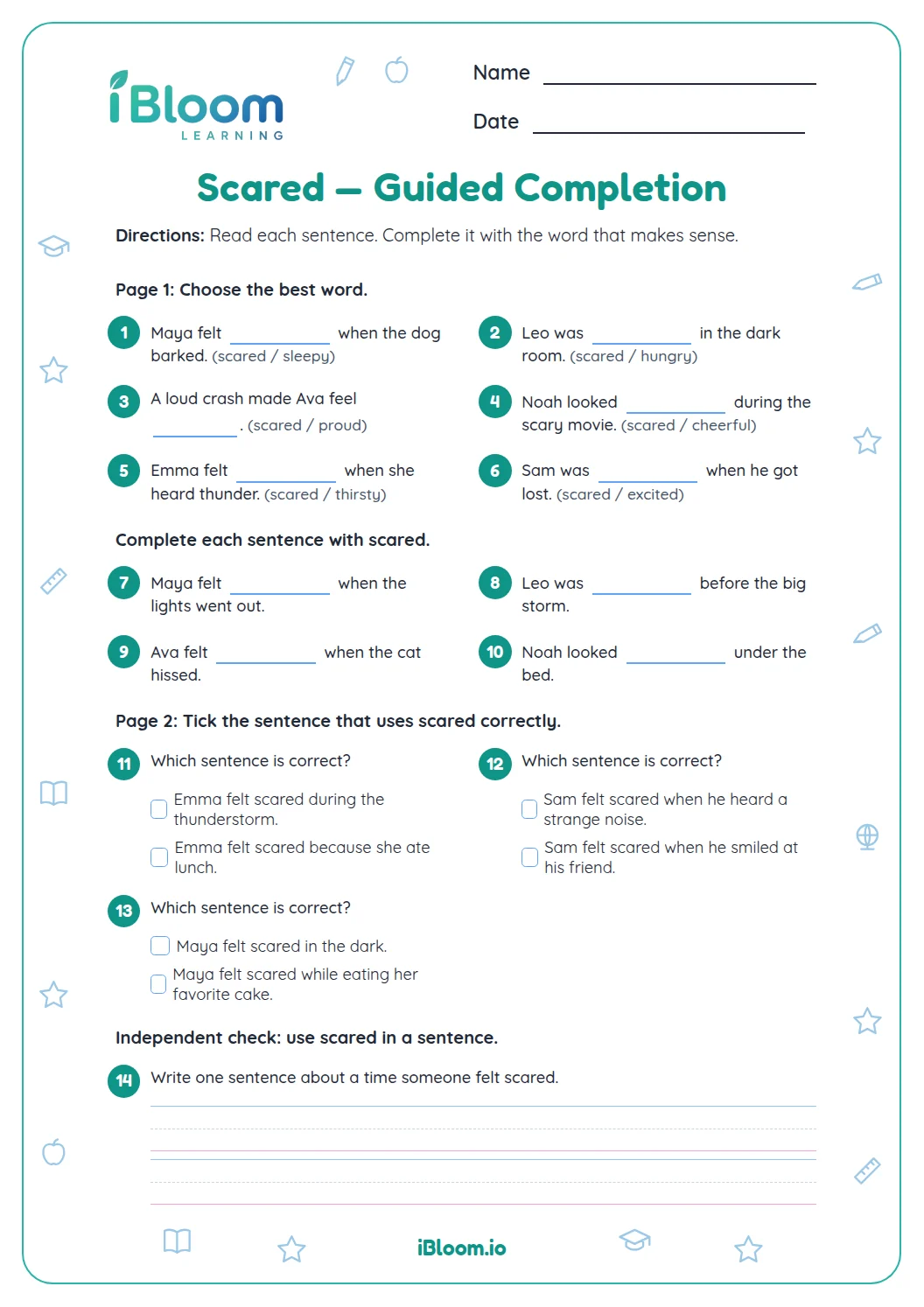
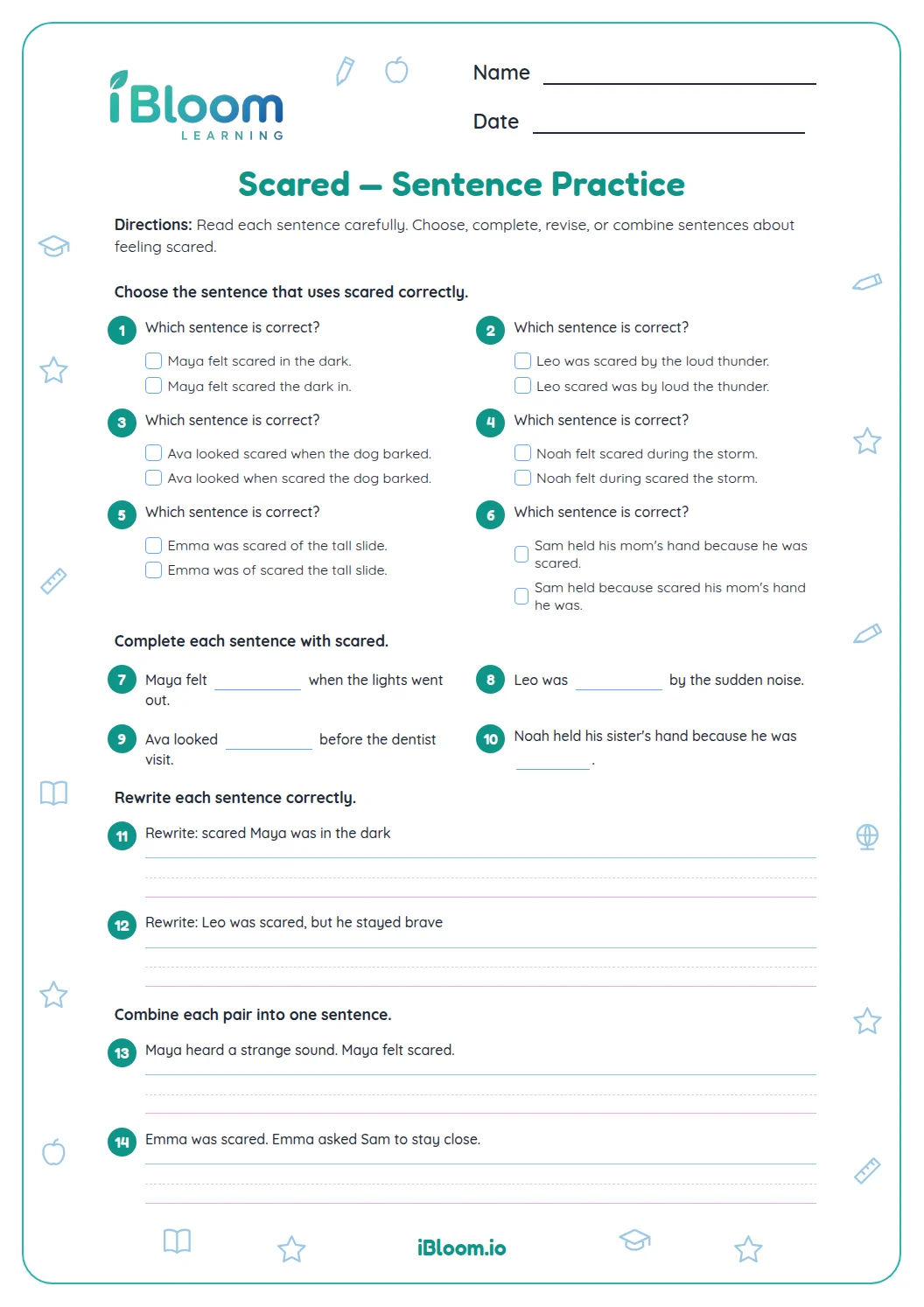
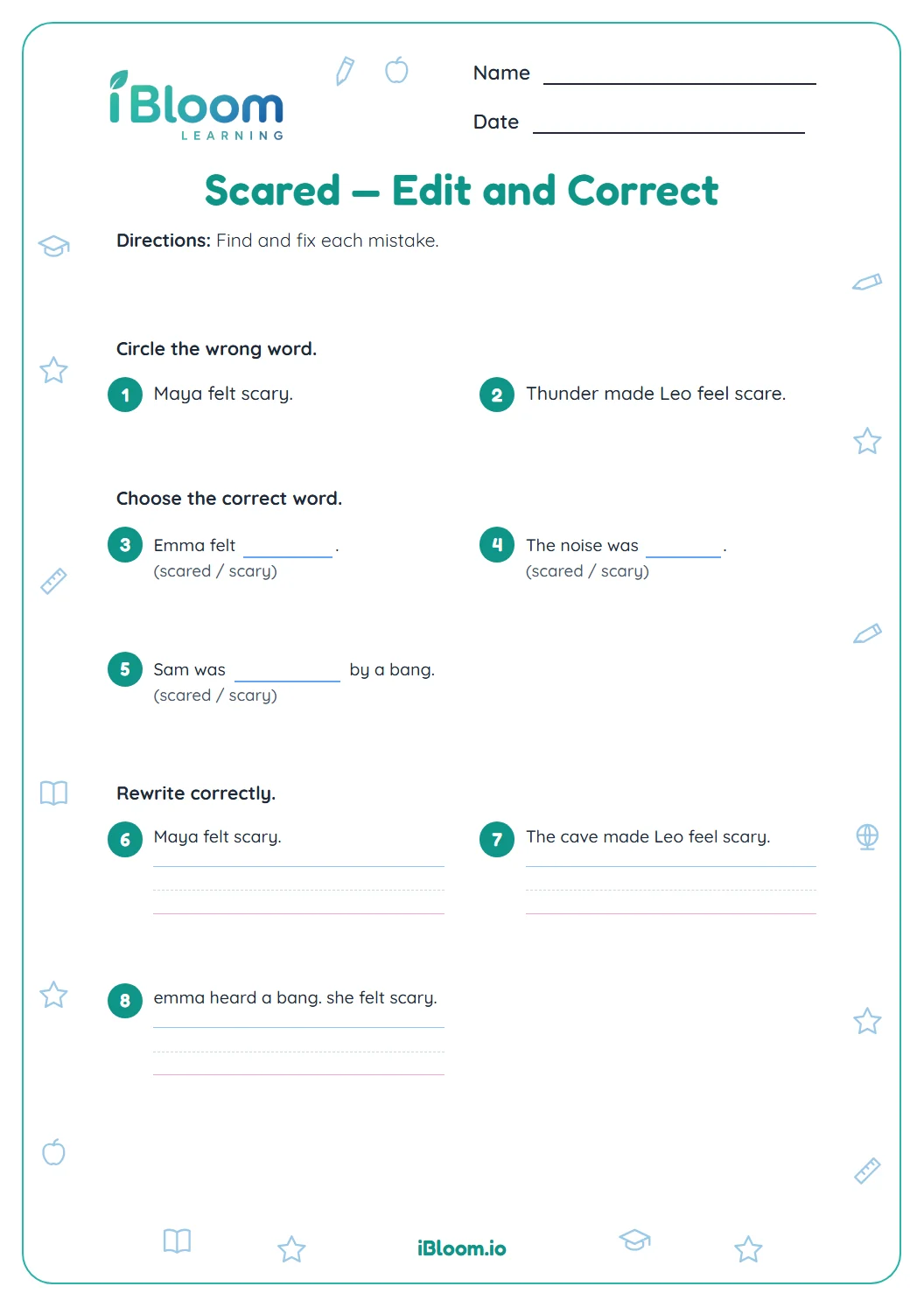
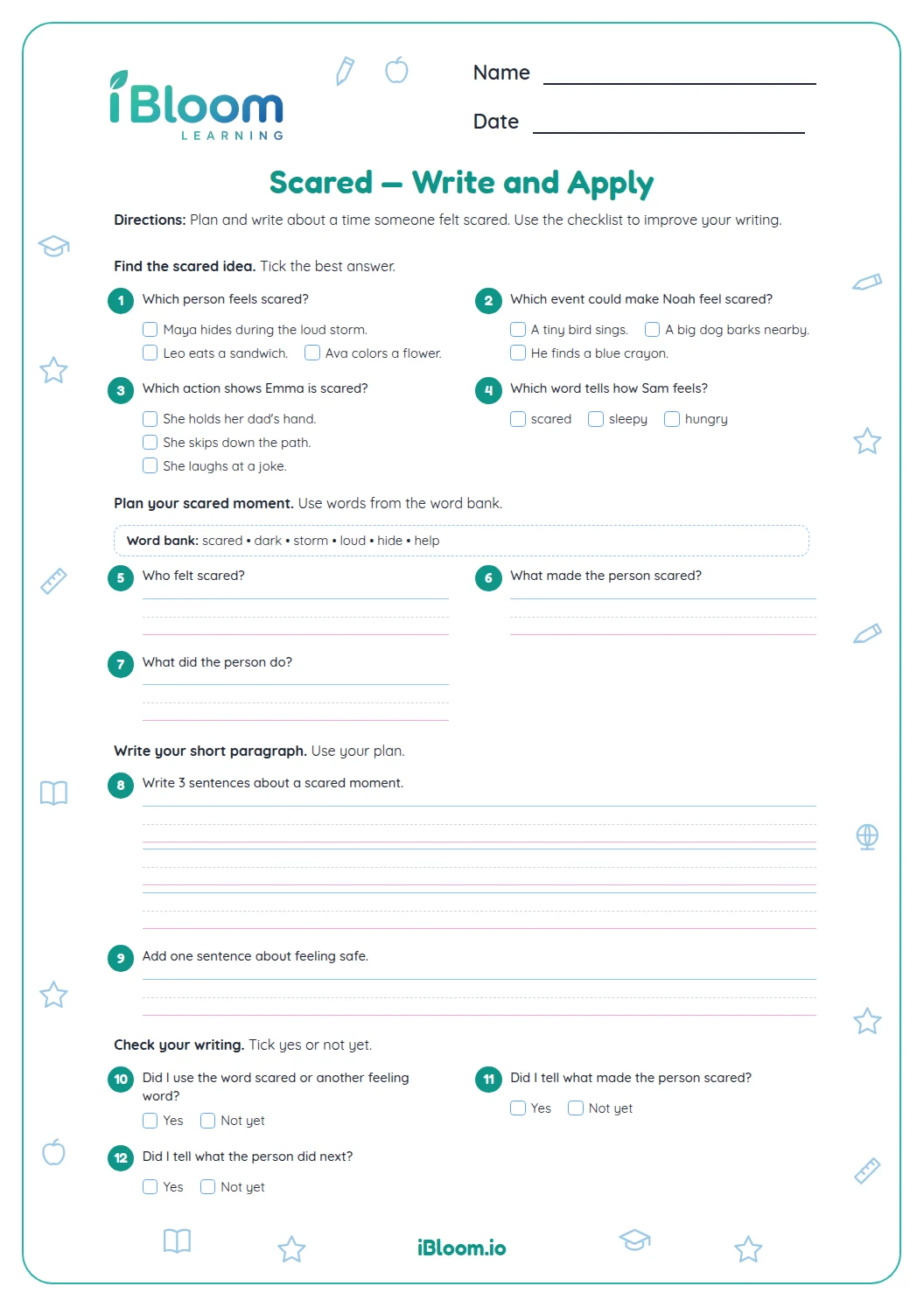
This free printable Grade 1 worksheet is a mixed review on writing a short narrative about being scared. Ten questions take children from choosing a fear word, to picking sentences that show fear, to using an order word, choosing an ending, fixing one sentence and writing two sentences of their own. It practices Common Core W.1.3 and suits first graders who are ready to put the parts of a short story together. The scenes are everyday ones, such as the lights going out or a bump in the night, and a separate answer key gives sample answers for the two writing questions.
Aligned to W.1.3 and L.1.1.e
What does a first-grade narrative need?
In first grade, a narrative is a short story about one event, told in the order it happened. Common Core W.1.3 asks for two or more events in order, some details about what happened, a word such as first, then or next that shows the order, and some sense of an ending.
A scared story is a friendly place to practice, because children know how the feeling looks: hands shake, a person hides, a voice gets small. The sheet turns those ideas into choices first, then into sentences children write themselves.
- 1Mia heard a bump. ___ she called for Mom.
- 2Two events: the bump, then the call.
- 3The word that links them is Then.
- 4Mia heard a bump. Then she called for Mom.
How do children show fear instead of only naming it?
Telling uses the feeling word: Emma felt scared. Showing uses what Emma does or what her body does: She hid behind Dad. Questions 3 and 4 ask children to pick the sentence that shows fear, and questions 5 and 6 ask which sentence gives the stronger detail.
In question 5, Maya saw a dark hall. Her legs would not move tells the reader more than She looked at it. A good test to share with your child: could you picture it, or could you act it out?
- 1Telling: Sam felt scared.
- 2Showing: His hands shook.
- 3Showing: He ran to Mom.
What is on this worksheet?
Ten questions in four parts, from choosing a word to writing two sentences. Every question uses a scene from a young child's day, so first graders can picture it.
- Part A, Fear words: choose the word that fits a sentence and the word that means scared
- Part B, Show the fear: four questions, choosing the sentence that shows or tells more about fear
- Part C, Order and ending: add an order word, then pick the best ending for a story
- Part D, Edit and write: fix one sentence, then write two short sentences
- Answer key with sample sentences for the writing lines
How do you mark the two writing questions?
Questions 9 and 10 do not have a single correct answer, so the key shows samples. In question 9, the verb is the main fix: I was scared but I ask for help should say asked, because the sentence tells about something that already happened. The comma before but is a bonus.
For question 10, look for two complete sentences that answer both questions: why Sam was scared and what he did. Credit any sensible pair, such as a loud noise followed by running to his dad.
How to use this worksheet at home or in class
- 1Start with a minute of talking: ask your child to tell about a time they felt scared in two short sentences, out loud.
- 2Do question 1 together and read each choice aloud before your child picks one.
- 3For questions 3 to 6, ask what you could see or hear if someone felt scared, and let your child act out both choices before filling in a bubble.
- 4Have your child do questions 7 and 8 alone, then read the whole sentence with the order word out loud to check it.
- 5Before the writing lines, remind your child to start with a capital letter and end each sentence with a period.
- 6Check with the answer key, then ask your child to read their two sentences from question 10 and point to the detail that shows fear.
Common mistakes and quick fixes
The mistake
Writing only the feeling word, as in Sam was scared. Sam was scared.
The fix
Ask what Sam did or what his body did. Add that detail as the second sentence: His hands shook.
The mistake
Leaving the verb in the wrong time, as in I was scared but I ask for help.
The fix
Read the sentence aloud and ask if it already happened. If it did, the action word needs the ending -ed: ask becomes asked.
The mistake
Writing events out of order, such as He ran to his dad. He heard a loud noise.
The fix
Ask which happened first. Rewrite with order words: First he heard a loud noise. Then he ran to his dad.
Common Core alignment
This sheet practices first-grade narrative writing, plus one past-tense verb fix in question 9.
Write a short story with events in order, details, order words and an ending.
On this sheet: Children choose detail sentences, add an order word, pick an ending and write two sentences about Sam.
Show the official wordingHide the official wording
Write narratives in which they recount two or more appropriately sequenced events, include some details regarding what happened, use temporal words to signal event order, and provide some sense of closure.
Change a verb to show that something already happened, like ask to asked.
On this sheet: Question 9 asks children to change ask to asked so the sentence tells about the past.
Show the official wordingHide the official wording
Use verbs to convey a sense of past, present, and future (e.g., Yesterday I walked home; Today I walk home; Tomorrow I will walk home).
What to practice next
Make more practice
Further reading
Questions parents and teachers ask
Can my child do this sheet if they have not done the other Scared worksheets?
Yes. Every question is a short, self-contained scene, so no earlier sheet is needed. The other Scared sheets give more gentle practice, but a first grader who can read short sentences with a grown-up nearby can start here. If the writing lines feel hard, do Parts A to C first.
Why does the sheet ask children to pick sentences before they write?
Choosing first lets children see the difference between telling and showing before they have to produce it. In questions 3 to 6, they compare two sentences and decide which one makes a clearer picture. That experience gives them a model for the two sentences they write in question 10.
What is a good answer to question 10?
A good answer has two complete sentences: one about why Sam was scared and one about what he did. For example, Sam heard a loud noise. He ran to his dad. Spelling does not need to be perfect. Check for a capital letter, an ending period, and a detail that fits the question.
Why does question 9 change ask to asked?
Because the sentence tells about something that already happened. I was scared is in the past, so the second action must be in the past too: I asked for help. Reading the whole sentence aloud is the easiest check, since I was scared but I ask sounds mixed up. A comma before but is a small extra fix.
Why is Mia felt safe at last the best ending in question 8?
An ending should close the problem in the story. Mia heard a bump and called for Mom, so feeling safe at last tells the reader the scary part is over. Mia has a red hat is only a detail about her clothes, and it does not finish anything. Ask your child what made Mia feel safe.
Is there an answer key for this worksheet?
Yes. The separate two-page answer key marks the correct choice for questions 1 to 8 and gives a sample sentence for questions 9 and 10. Print the worksheet by itself and keep the key for checking. For the two writing questions, accept any sensible answer that is a complete sentence with a capital letter and a period.