






About this worksheet
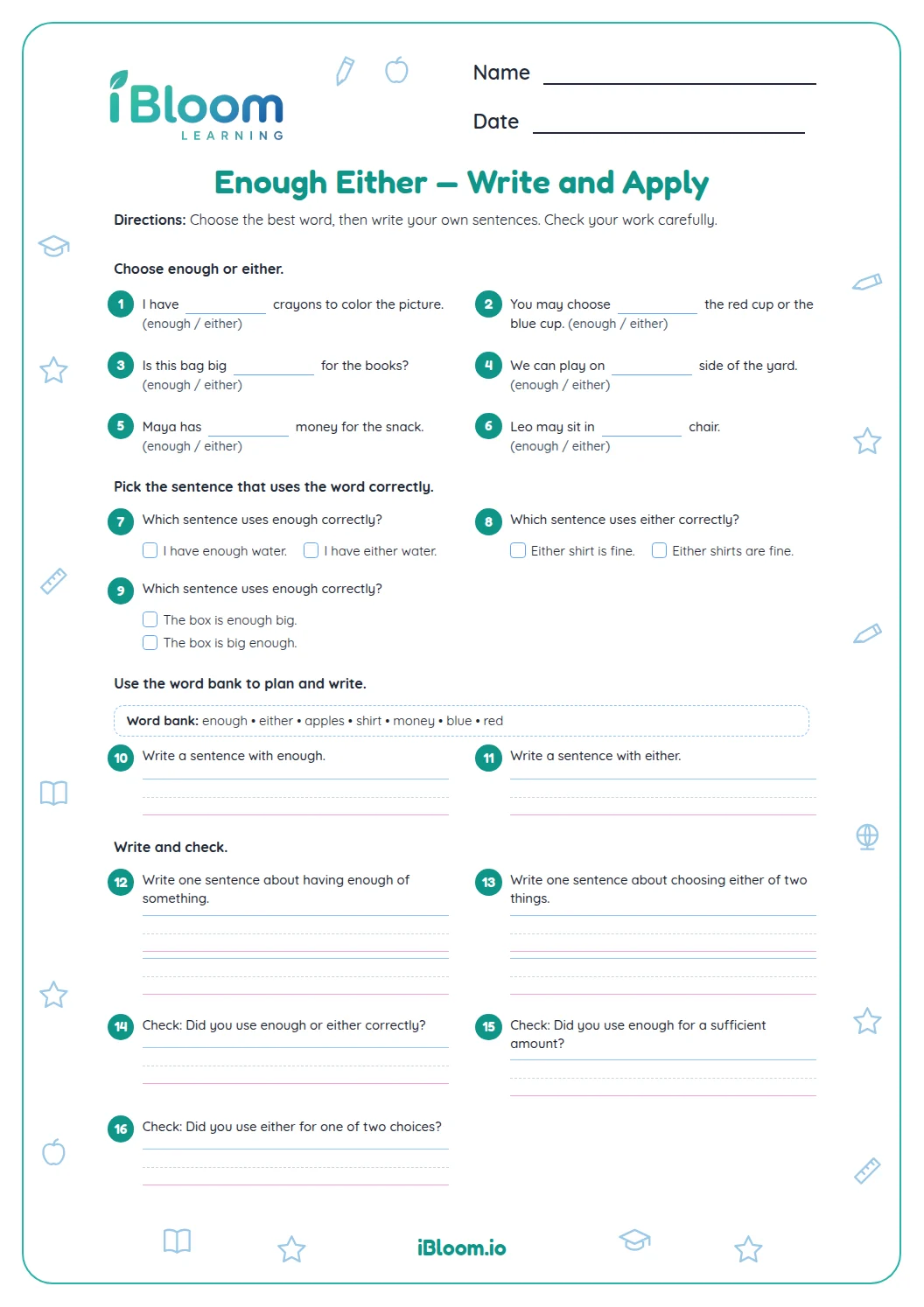
This Grade 1 printable helps children decide when enough means a need is met and when either refers to one of two choices. Part A offers both words as choices; Part B asks learners to supply the word from context. The sentences use familiar situations such as sharing crayons, choosing a shirt, and having time to read. An answer key is included.
What does each part practice?
Part A gives a choice between enough and either in complete sentences. Part B removes the choices, so the learner must use meaning to select the word.
- Part A: 8 sentence choices
- Part B: 8 independent completions
When does enough fit?
Enough tells that there is as much as needed. In “The team has enough water for practice,” the water meets the need.
- 1The team has ___ water for practice.
- 2Practice needs water, and the sentence says the amount meets that need.
- 3Answer: enough
When does either fit?
Either points to one of two things or choices. In “Milo did not pick either shirt,” the sentence is about two shirts and neither was picked.
How can a learner check a choice?
Read the sentence again with the selected word. Ask whether it describes a sufficient amount or one of two choices.
How can a learner work through this page?
- 1Read the whole sentence before choosing.
- 2In Part A, try each word in the blank.
- 3For Part B, ask whether the sentence means a sufficient amount or one of two.
- 4Read the completed sentence aloud.
- 5Check each response with the key.
Common mistakes and quick fixes
The mistake
Using either for an amount that meets a need.
The fix
Ask if the sentence tells that there is as much as needed; if so, use enough.
The mistake
Using enough when a sentence refers to two choices.
The fix
Look for the two things or options; either can refer to one of them.
The mistake
Choosing from just one phrase.
The fix
Use the entire sentence as the clue.
What to practice next
Questions parents and teachers ask
What is the difference between enough and either?
Enough means there is as much as needed. Either refers to one of two choices or things. For example, enough cups means every guest can have one, while either cup points to one of two cups. Read the sentence around the blank to decide which meaning fits.
What does Part A ask children to do?
Part A has eight sentences with enough and either as choices. Children read each sentence and choose the word that makes sense. Some sentences describe a sufficient amount; others name two choices. The key gives one response for each sentence.
What changes in Part B?
Part B has eight more sentences, but the word choices are removed. Children recall the two words and use sentence meaning to complete each blank. The sentences include clear clues about whether a need is met or one of two items is meant.
Is either only used in negative sentences?
No. Either can refer to one of two choices in a question or a positive sentence too. On this page, some examples use negatives because they make the two-choice meaning clear. The key idea is the reference to two options, not the negative word.
How can I help if both words seem possible?
Ask the learner to say what the sentence means in their own words. If it means an amount meets a need, enough is the fit. If it refers to one of two things, either is the fit. Then reread the sentence with that word to check the meaning.