







About this worksheet
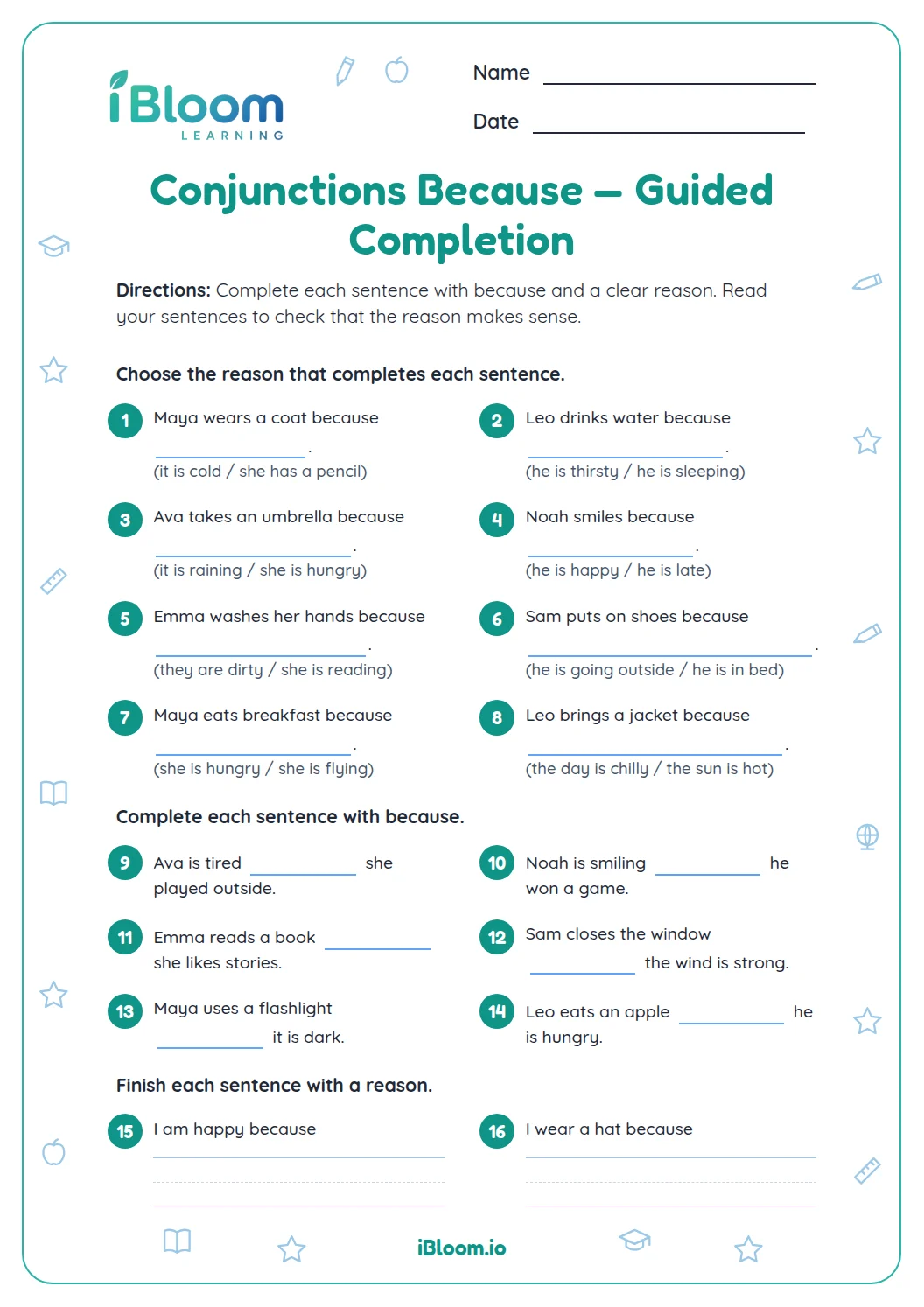
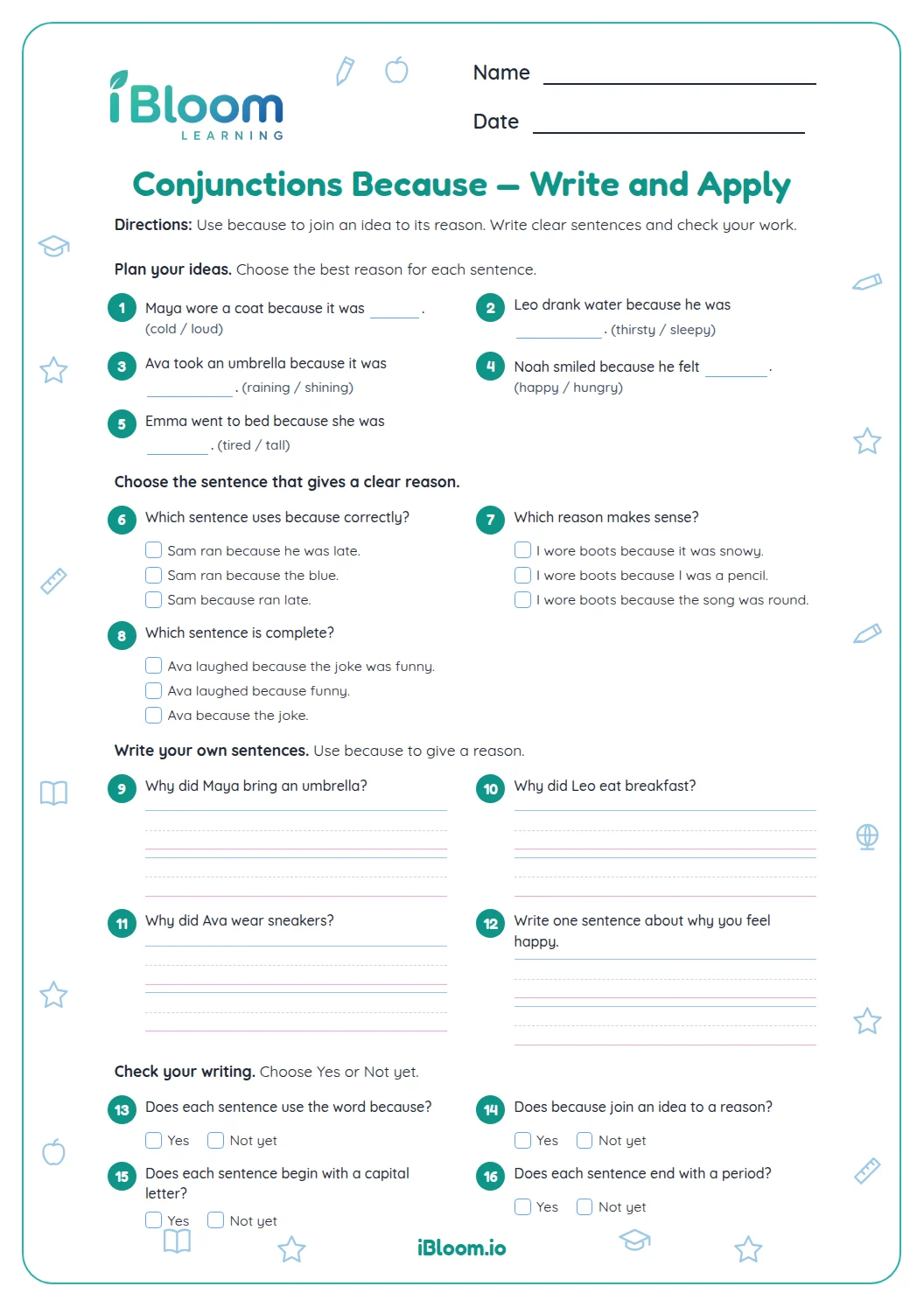
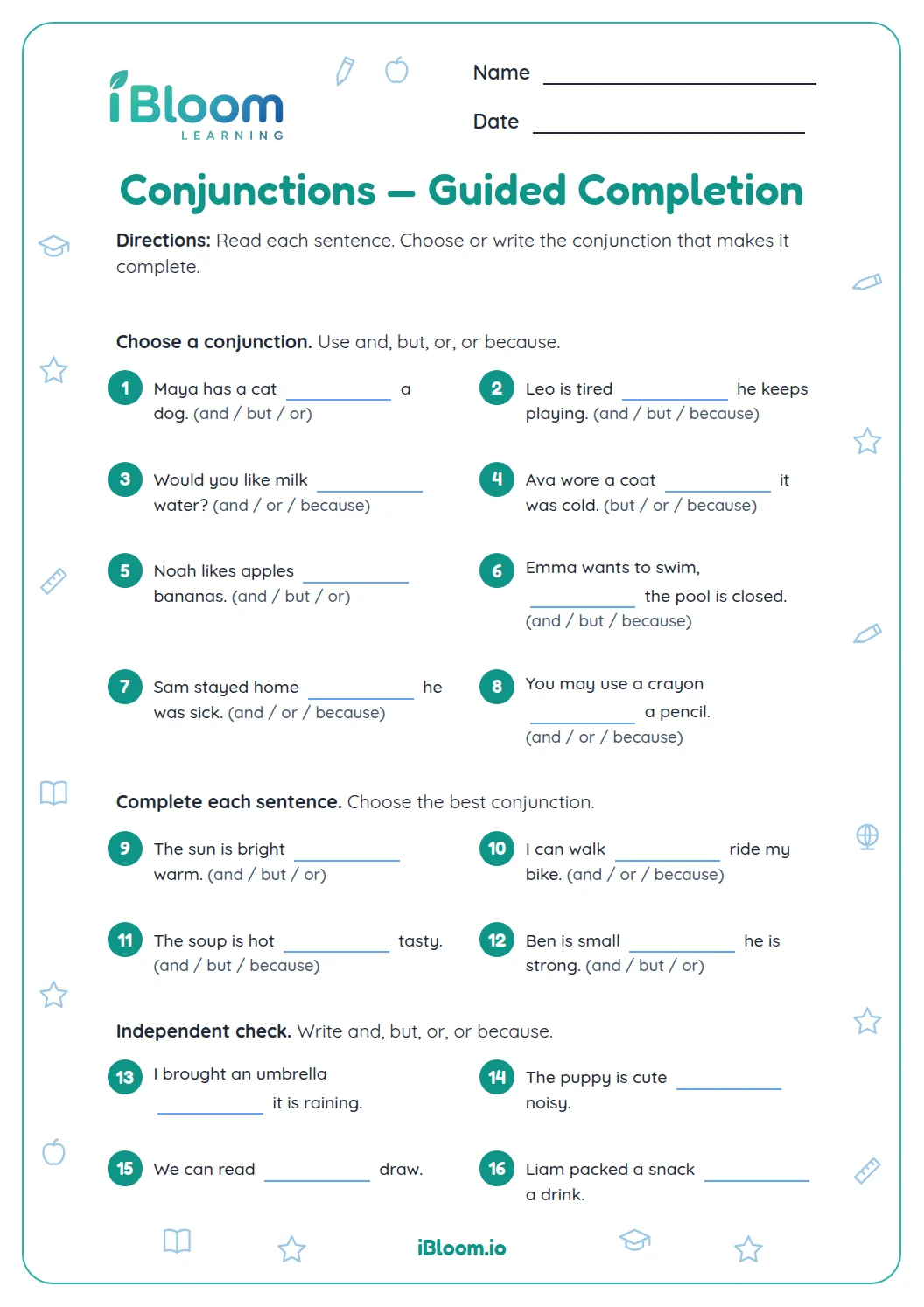
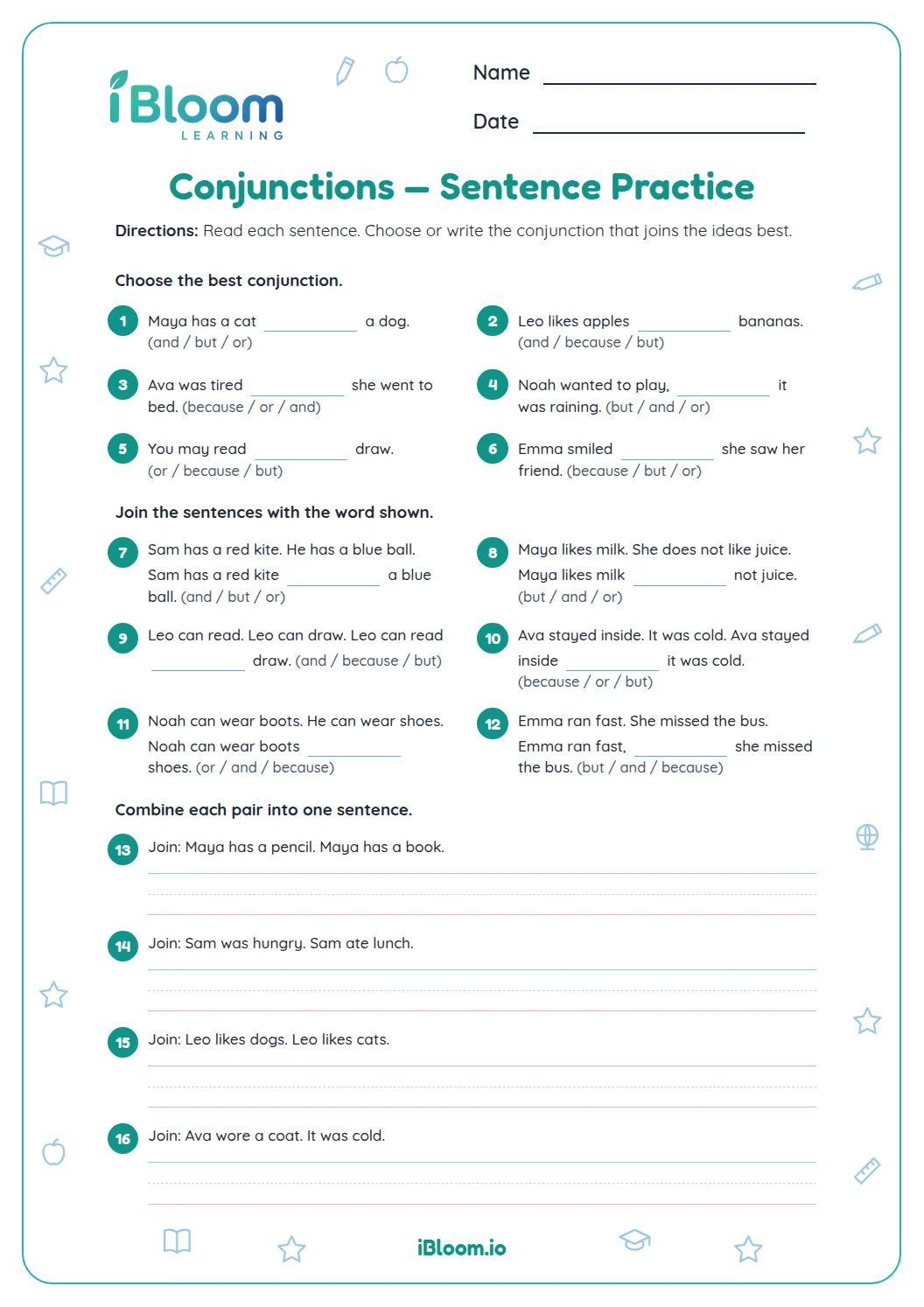
This Grade 1 grammar worksheet practices because as a conjunction that joins an idea to its reason. Children complete six sentences, choose corrections for five sentence items, then combine or write four sentences. The three worksheet pages include both sentence fragments and complete thoughts; the separate key shows suggested wording for open responses. This work practices the use of frequently occurring conjunctions in L.1.1.g.
Aligned to L.1.1.g
How does because connect two ideas?
Because signals that the next idea gives a reason. In “I wore boots because it was raining,” the first clause tells what happened and the second explains why. Children complete six sentences by choosing a reason that makes sense and fits the sentence.
- 1I wore boots because ___ was raining.
- 2Answer: it
- 3“It was raining” gives the reason for wearing boots.
How can a learner check a sentence?
A complete sentence communicates a whole thought and uses punctuation that fits. In question 8, the prompt begins with “Because the puppy was wet”; the child chooses a complete sentence that uses that reason. A fragment that starts with Because needs another idea to finish it.
What do the writing questions ask?
Questions 12–15 ask children to join related thoughts, fix a because fragment, or write their own because sentence. The key shows one possible response. Other complete sentences are acceptable when because clearly links a reason to the idea.
How to use this worksheet
- 1Read both ideas in a sentence before choosing a completion.
- 2Check that the words after because give a reason for the first idea.
- 3For editing choices, read the whole option aloud and check its ending punctuation.
- 4Join the two related thoughts in questions 12 and 15 with because.
- 5For questions 13 and 14, make sure the sentence is complete and the reason makes sense.
Common mistakes and quick fixes
The mistake
Choosing words after because that do not explain the first idea.
The fix
Ask “Why did it happen?” and choose an answer that responds to that question.
The mistake
Leaving a sentence that begins with Because unfinished.
The fix
Add the main idea, such as “We spoke softly because the baby was asleep.”
The mistake
Adding a comma between because and its reason.
The fix
Keep because next to the reason it introduces and finish the sentence with correct punctuation.
Curriculum alignment
This sheet practices the standard listed below.
Learners choose and edit complete sentences using because.
On this sheet: Learners choose and edit complete sentences using because.
Show the official wordingHide the official wording
Use frequently occurring conjunctions (e.g., and, but, or, so, because).
What to practice next
Make more practice
Further reading
Questions parents and teachers ask
What does because do in a sentence?
Because connects an idea to its reason. In “I wore boots because it was raining,” the phrase “it was raining” explains why the boots were worn. The worksheet asks children to complete, edit, and write sentences that make this connection clear.
How many questions are included?
There are 15 questions in three parts. Children complete six sentences, choose corrections for five sentence items, and write four sentences of their own. A separate answer key follows the worksheet and gives sample answers for the writing prompts.
Why is “Because the puppy was wet” a fragment?
That phrase gives a reason but does not say what happened because the puppy was wet. It needs a main idea, such as “We dried the puppy because it was wet.” Question 8 asks children to choose a complete sentence that uses the reason.
Are the written answers flexible?
Yes. Questions 12–15 invite children to combine thoughts or create a sentence. The key shows one possible answer, but another response works when it is a complete sentence and because clearly connects the reason to the idea. This is the same conjunction skill used throughout the page.
Is an answer key included?
Yes. A separate key gives the correct choices and sample responses for the writing questions. For open-ended items, use the sample to check the sentence structure and meaning; the child’s exact wording can differ while remaining correct. The samples are guides for checking complete, meaningful sentences.