





About this worksheet
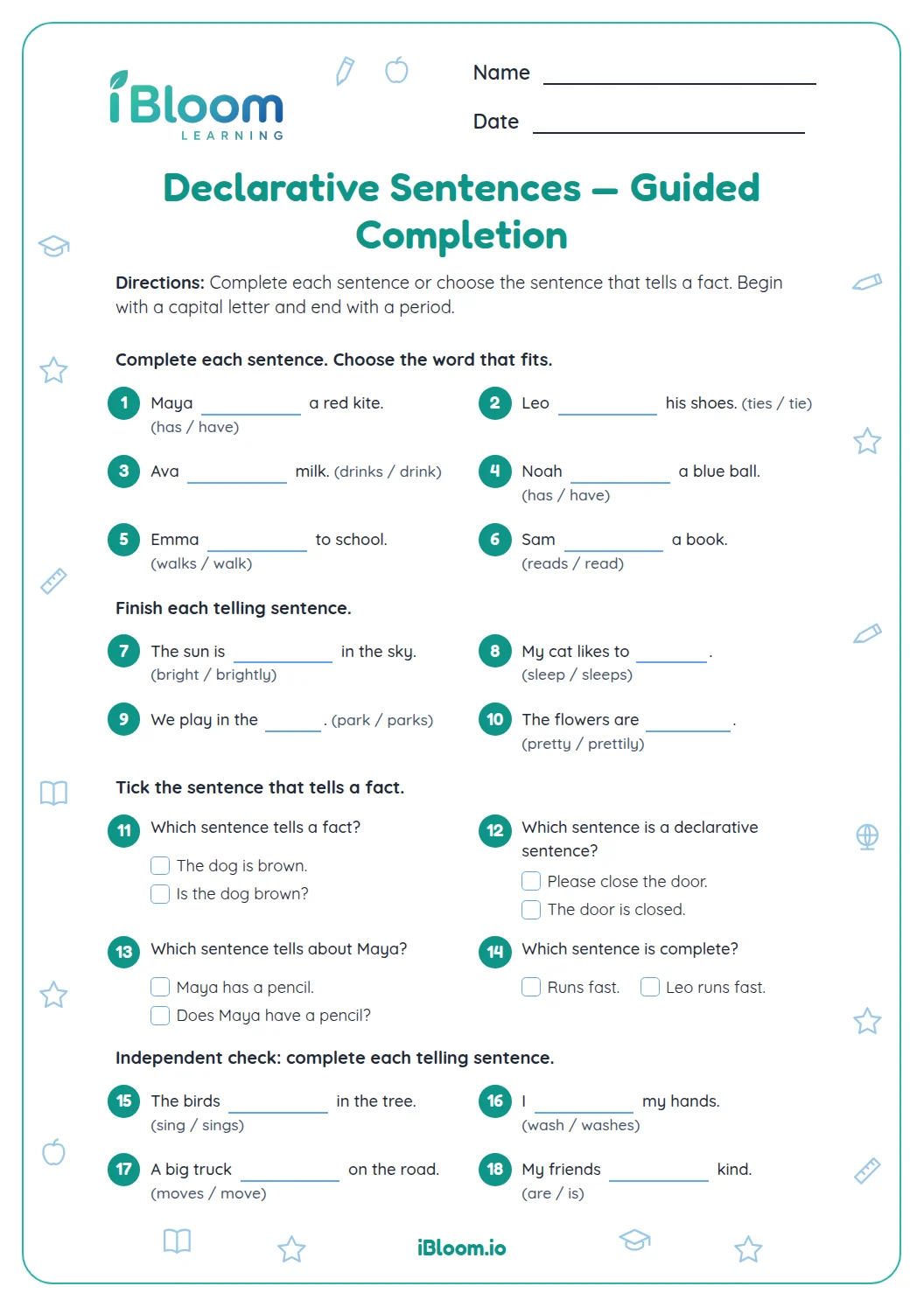
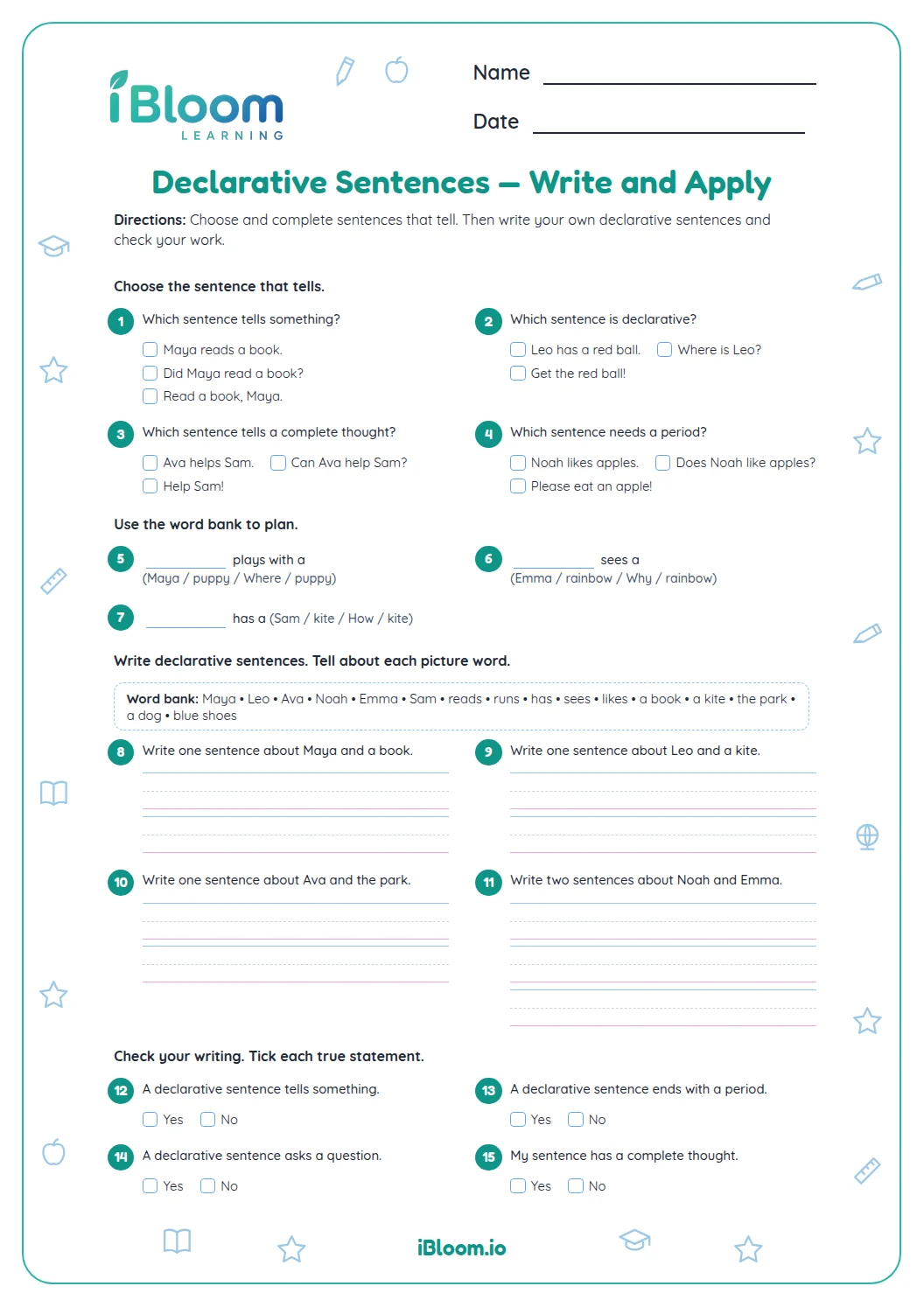
This Grade 1 printable teaches children to recognize a declarative sentence: a sentence that tells something and usually ends with a period. Children first distinguish statements from questions, commands, and exclamations; then they choose the ending mark for six statements and write two of their own. The answer key includes the intended choices and sample statements.
What makes a sentence declarative?
A declarative sentence tells the reader something. Part A compares statements with questions, commands, and exclamations, so children look at the sentence’s purpose instead of only its first word.
- 1“The clouds cover the sun.” tells something, so it is declarative.
Which ending mark fits each sentence?
Part B asks children to choose an ending mark. Statements take periods; questions take question marks; an exclamation shows a strong feeling. Comparing these marks helps children distinguish declarative sentences from other sentence types.
How can children write a telling sentence?
Part C asks for a statement about a pet and one about a classroom. Each response should tell something clearly and end with a period. The answer key gives examples; children may write different true or sensible statements.
How to use this worksheet
- 1Read the whole sentence aloud before choosing.
- 2Ask whether it tells something, asks, gives a direction, or exclaims.
- 3For a telling sentence, choose the period in Part B.
- 4Write a complete statement for each Part C topic.
- 5Check that each statement ends with a period and compare with the key.
Common mistakes and quick fixes
The mistake
Calling a sentence declarative because it starts with a capital letter.
The fix
Check what the sentence does: a capital letter starts many sentence types.
The mistake
Confusing a question with a statement.
The fix
Listen for whether the speaker asks for information or tells something.
The mistake
Ending a statement with a question mark.
The fix
Reread the sentence as a telling sentence and place a period at the end.
What to practice next
Make more practice
Questions parents and teachers ask
What is a declarative sentence?
A declarative sentence tells or states something. “The train is blue” gives information, so it is declarative and ends with a period. This worksheet contrasts statements with questions, commands, and exclamations to help children notice each sentence’s purpose.
Is “Please open your book” declarative?
No. It gives a direction, so it is a command rather than a telling sentence. In Part A, children decide whether examples tell something; the command is one of the items that helps them distinguish a statement from another sentence type.
Why does a declarative sentence end with a period?
A period is the usual ending mark for a statement. Part B also contrasts statements with a question, “Where did we put the map?”, and an exclamation, “What a bright rainbow!” so children choose a mark that fits each sentence’s purpose.
What should a child write for the final questions?
Question 13 asks for a telling sentence about a pet; question 14 asks for one about a classroom. “My cat sleeps” and “Our class reads” are sample statements. Each should express a complete idea and end with a period.
Can a sentence begin with “What” and still be declarative?
Yes, sentence purpose matters more than a single word. In “What a tall tree that is!” the speaker exclaims, so it is not declarative. Compare that with a statement such as “The tree is tall,” which tells something and ends with a period.
How can we check the worksheet together?
Read each sentence aloud and say what it does: tell, ask, command, or exclaim. Then check the ending mark for a statement. The answer key gives the intended answers, and the last two prompts can have many correct sentences.