



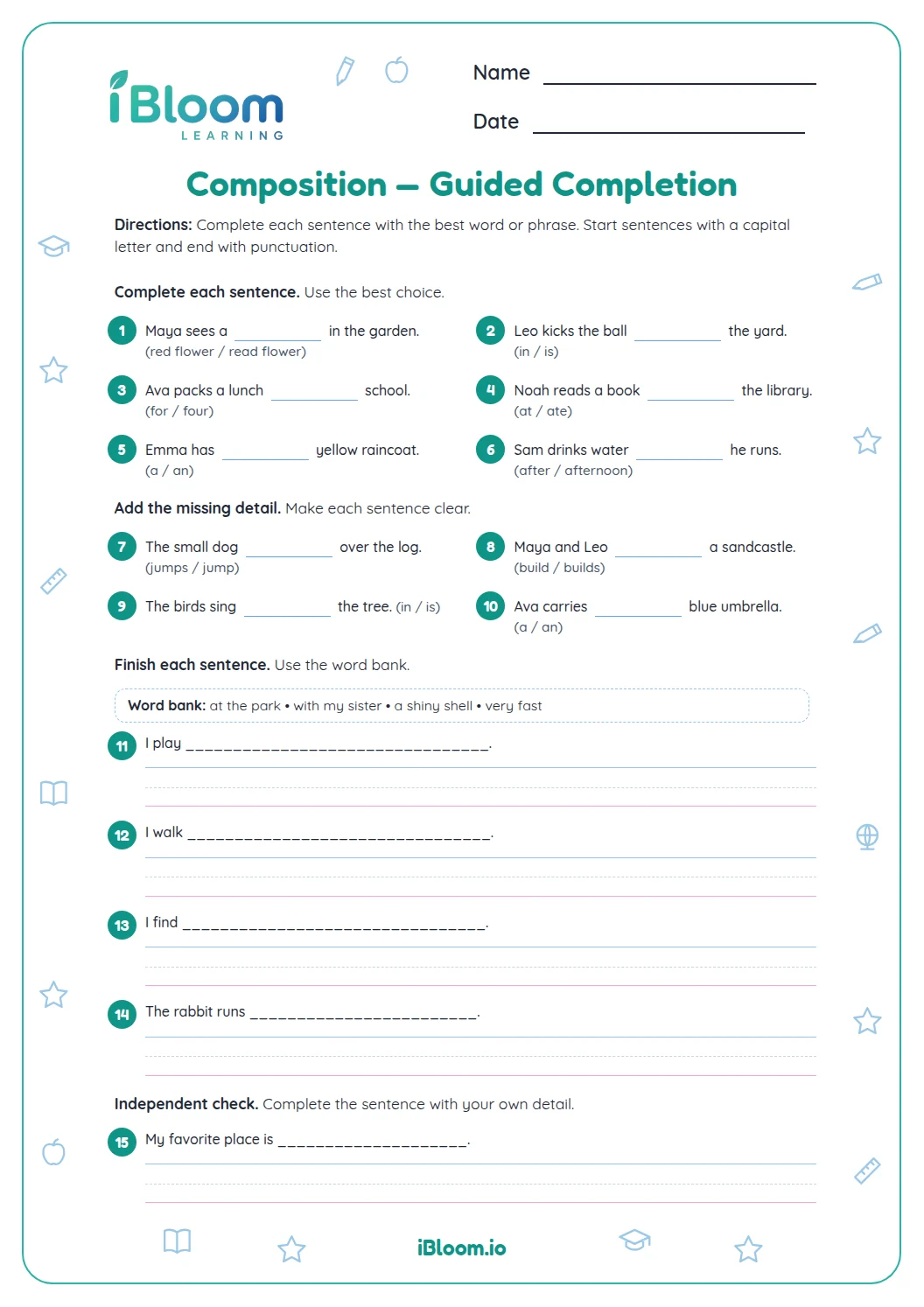

About this worksheet
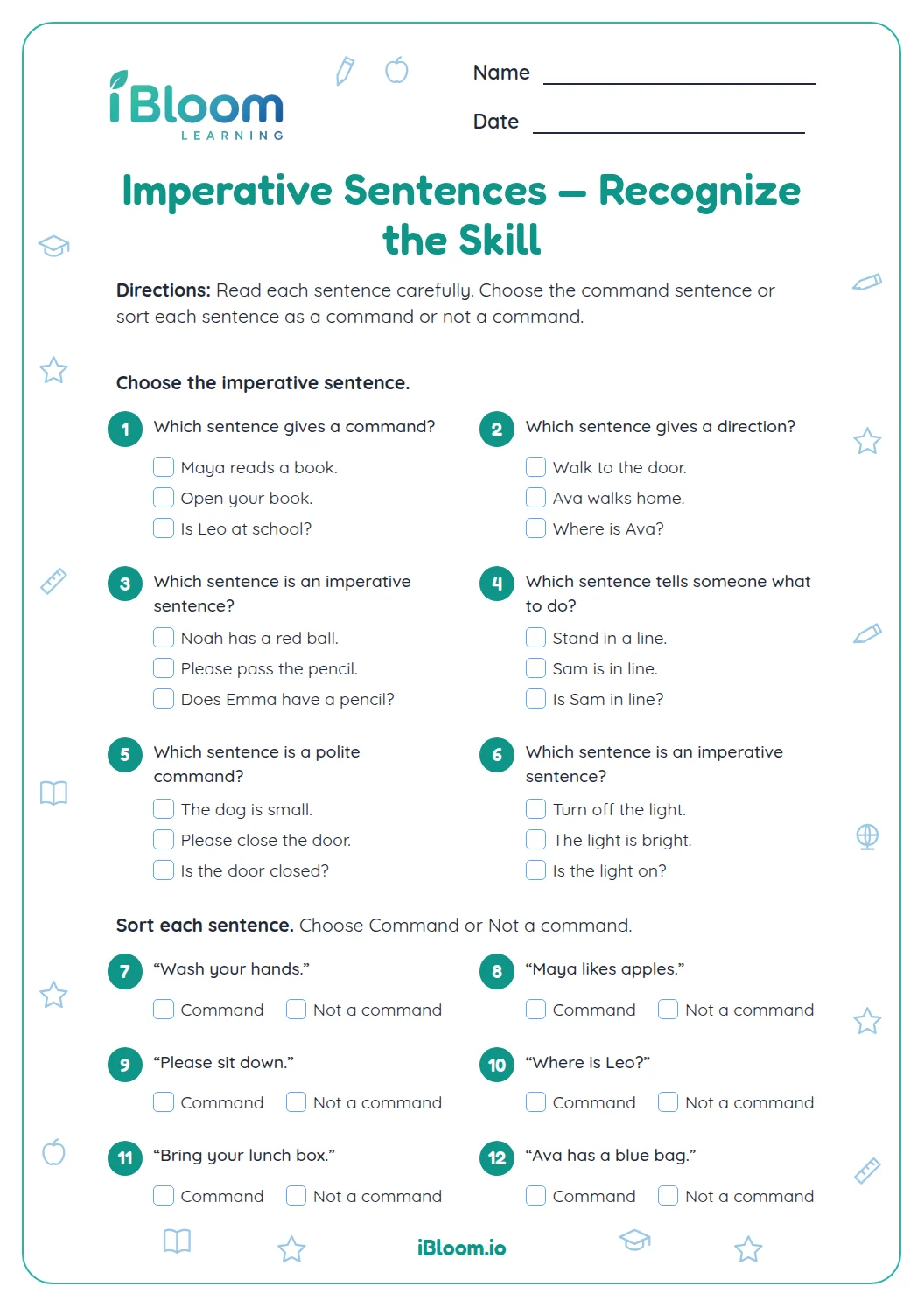
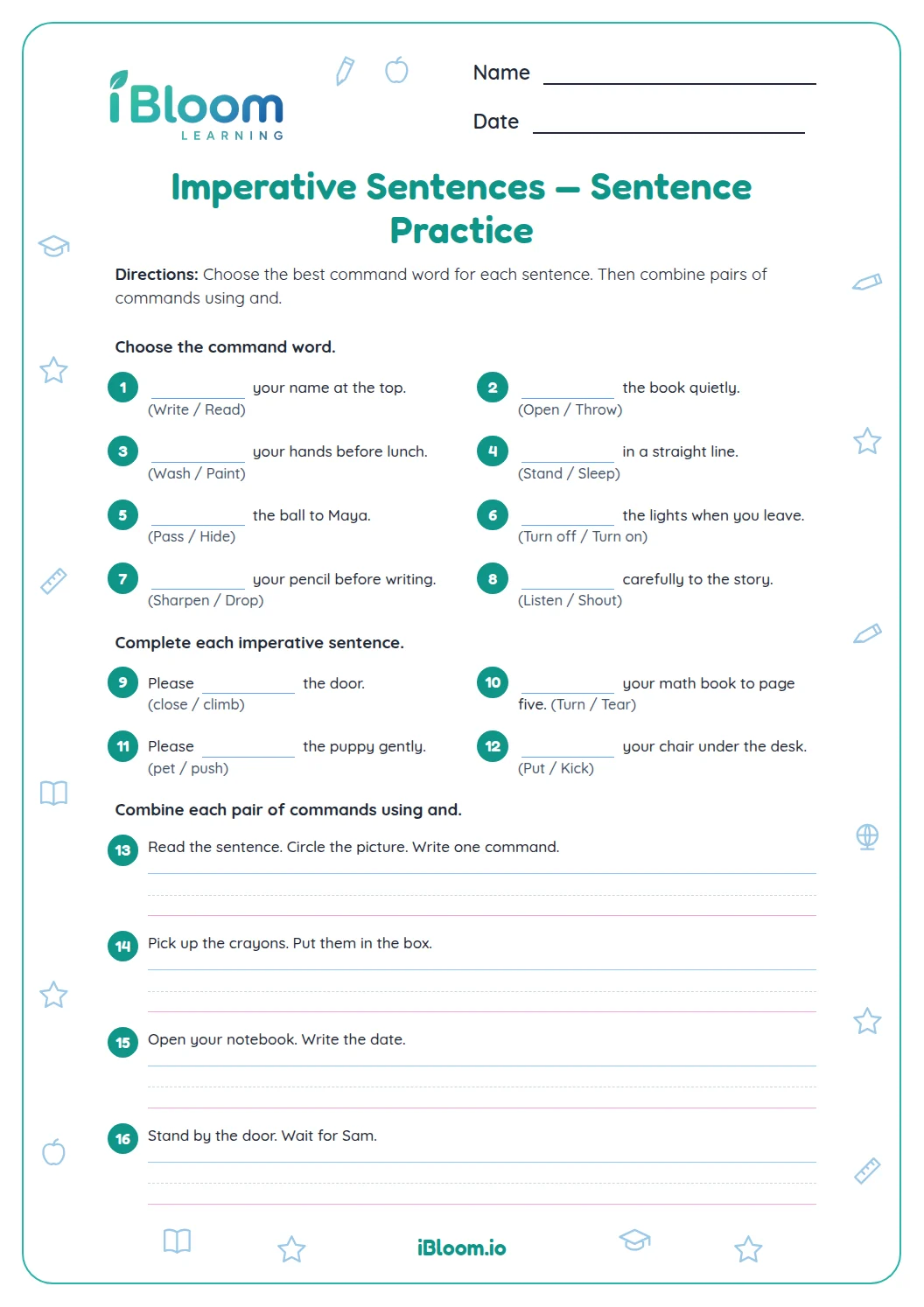
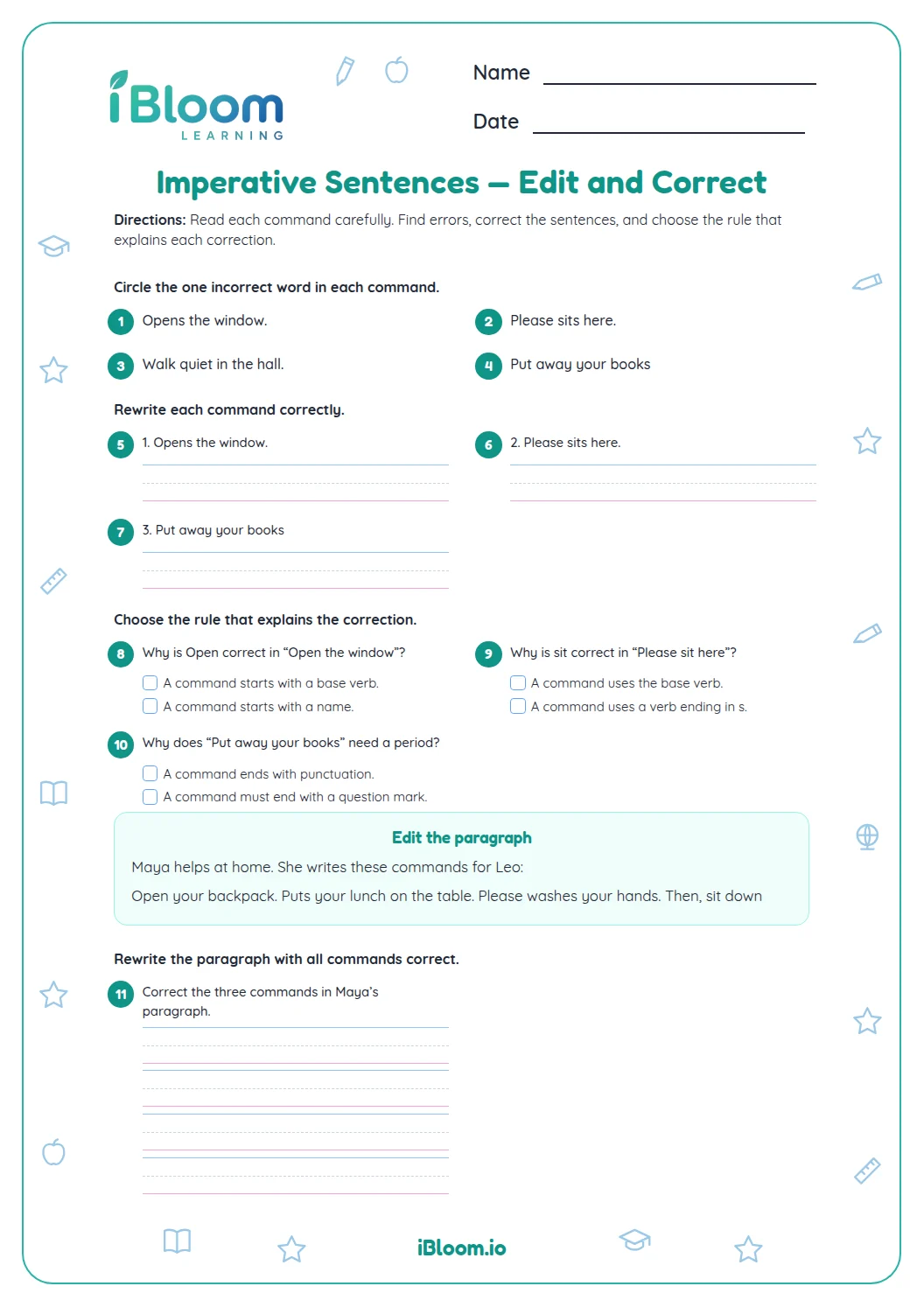
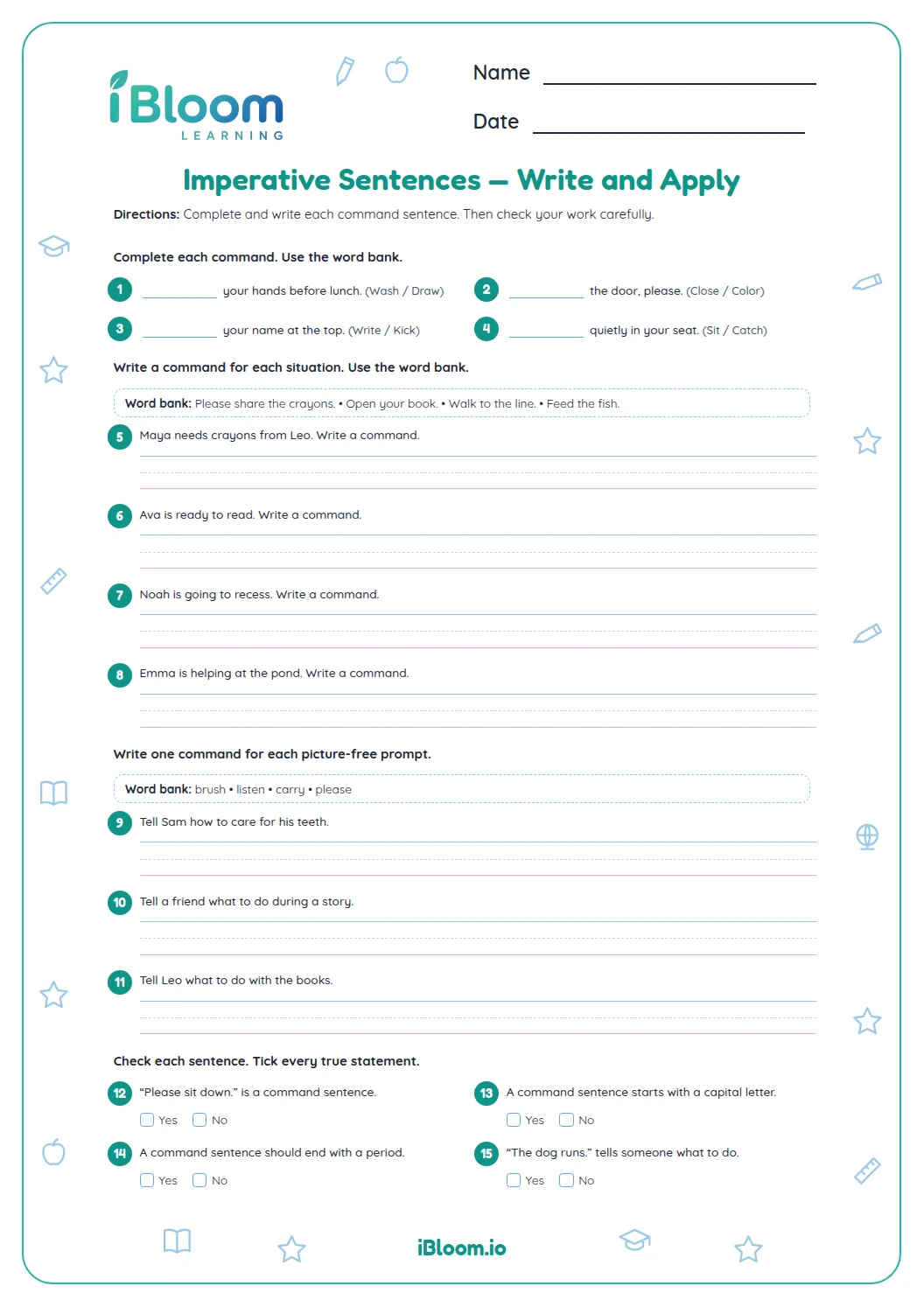
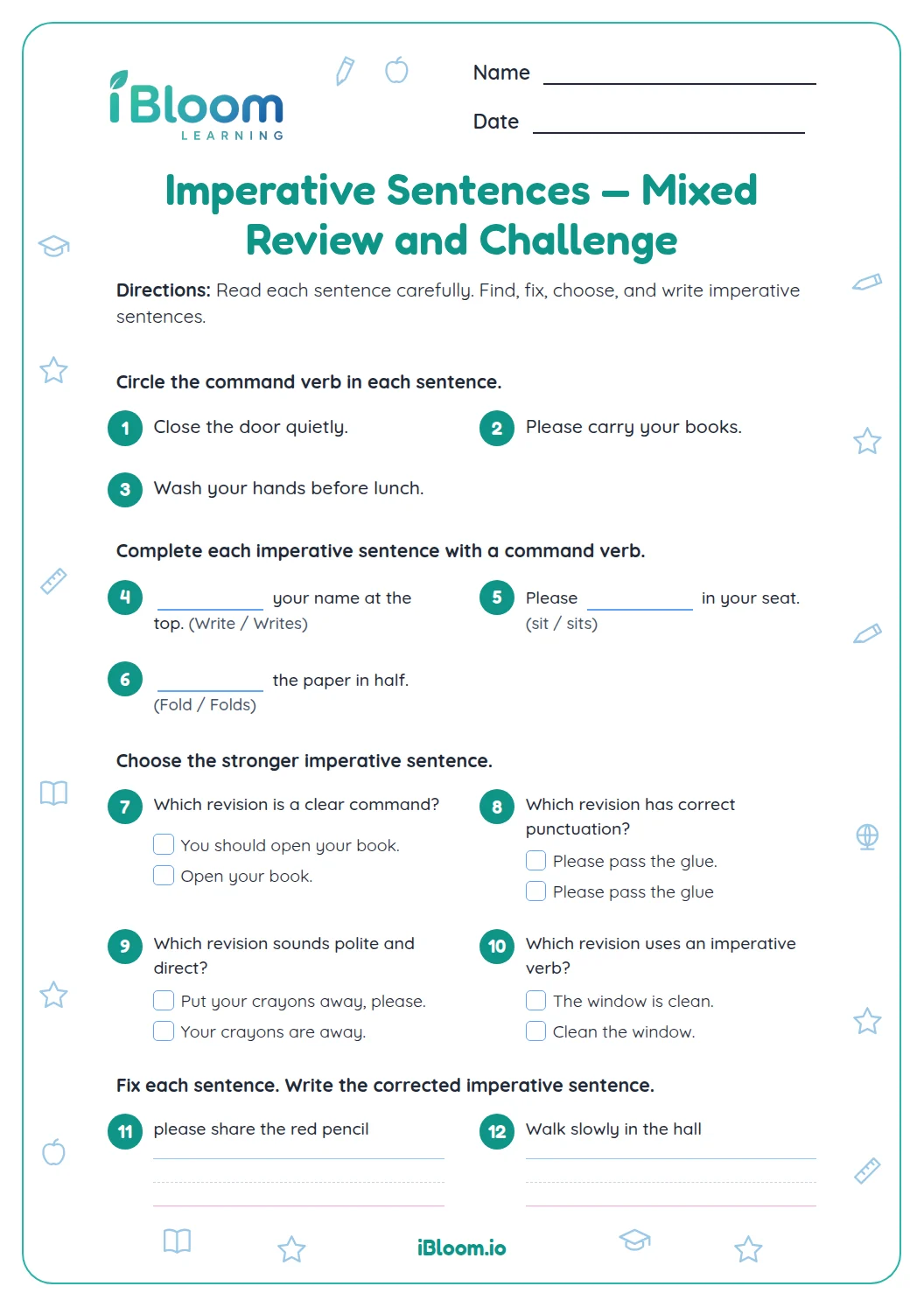
This two-page Grade 1 grammar worksheet introduces imperative sentences as directions and requests. Children identify commands, choose verbs that complete them, and write a few guided directions of their own. The 16 questions progress from sentence recognition to completion, with a separate answer key that includes sample responses. It practices CCSS L.1.1.j, producing and expanding sentence types in response to prompts.
Aligned to L.1.1.j
What does an imperative sentence do?
An imperative sentence tells someone to do something or makes a request. It often begins with an action word, as in “Wash your hands.” A polite direction may begin with “please.” The subject you is understood, even though it is not written.
In question 1, “Please close the gate” gives a direction. “The gate is green” tells a fact, and “Where is the gate?” asks a question.
- 1Please close the gate.
- 2This sentence asks the reader to close the gate.
- 3It is an imperative sentence.
How can a verb complete a direction?
Look for an action that makes sense in the situation. “___ the door gently” needs a verb such as close. Read the whole sentence after filling in the blank to check that the direction is clear.
What will children write?
The 16 questions move from recognizing a direction to choosing a useful verb and finishing a command. Two final prompts invite a complete direction in the child’s own words. The separate key gives exact choices and sample completions.
How to use this worksheet at home or in class
- 1Read each sentence and decide whether it tells, asks, or directs.
- 2For a blank, think of an action that fits the words around it.
- 3Read the completed direction aloud to check it sounds complete.
- 4For the last two prompts, write a clear action that fits the setting.
- 5Use the key to compare the idea, not just the exact wording, on open responses. The sample commands give families a model for discussing what makes a direction complete.
Common mistakes and quick fixes
The mistake
Choosing a sentence that tells a fact instead of giving a direction.
The fix
Ask whether the sentence tells someone what to do.
The mistake
Using a verb that does not fit the words around the blank.
The fix
Read the whole sentence with the verb inserted and check its meaning.
The mistake
Writing a command without a clear action.
The fix
Begin with an action word such as fold, wash, or carry.
Common Core alignment
This page connects the printed practice to the grade-level skills named below.
Complete and expand imperative sentences in response to prompts.
On this sheet: Complete and expand imperative sentences in response to prompts.
Show the official wordingHide the official wording
Produce and expand complete simple and compound declarative, interrogative, imperative, and exclamatory sentences in response to prompts.
What to practice next
Make more practice
Further reading
Questions parents and teachers ask
What is an imperative sentence?
An imperative sentence gives a direction or makes a request. “Please feed the fish” tells the reader what to do, so it is imperative. This worksheet begins with sentence choices and then lets children complete directions with action words. The examples use familiar classroom and home situations.
Does every command need the word “please”?
No. “Put the book away” is a command without please. Adding please can make a request sound polite, but the sentence still needs to tell the reader what action to take. The worksheet includes both direct and polite directions. Children can compare the verb at the start of each command.
How many questions are on this worksheet?
There are 16 questions across two worksheet pages: six sentence choices, six verb blanks, and four guided completions. The separate answer key includes the correct choices and sample ideas for open responses. The sample commands give families a model for discussing what makes a direction complete.
Why is the subject missing from a command?
In a command, the subject you is usually understood. “Close the gate” means “You close the gate.” Children do not need to add the word you to every direction; they should make sure the action itself is clear. The opening verb usually tells the reader what to do.
Can a child use a different word than the answer key?
For the verb blanks, another verb may work if it makes a clear and grammatical direction. The final two questions invite original sentences, so the key gives sample answers. Check that the response tells someone what to do and fits the prompt.