



About this worksheet
This free Grade 1 worksheet practices printing and recognizing uppercase K and lowercase k. Children trace K, identify lowercase k, and find the letter in familiar words. The printable includes a separate answer key. Tracing provides a model for practicing uppercase and lowercase forms named in CCSS L.1.1.a.
Aligned to L.1.1.a
How do children trace K and k?
Uppercase K begins with a tall stem and two angled strokes. Lowercase k uses the same basic strokes at a smaller size. Trace slowly from the top, then compare the result with the model.
- 1K (uppercase)
- 2Start at the top; make a tall stem and two angled strokes.
Why trace short K words?
Moving from an individual letter to a familiar short word lets children keep the same letter shape while practicing spacing. Say each word before tracing it, then find its first letter.
What is on the page?
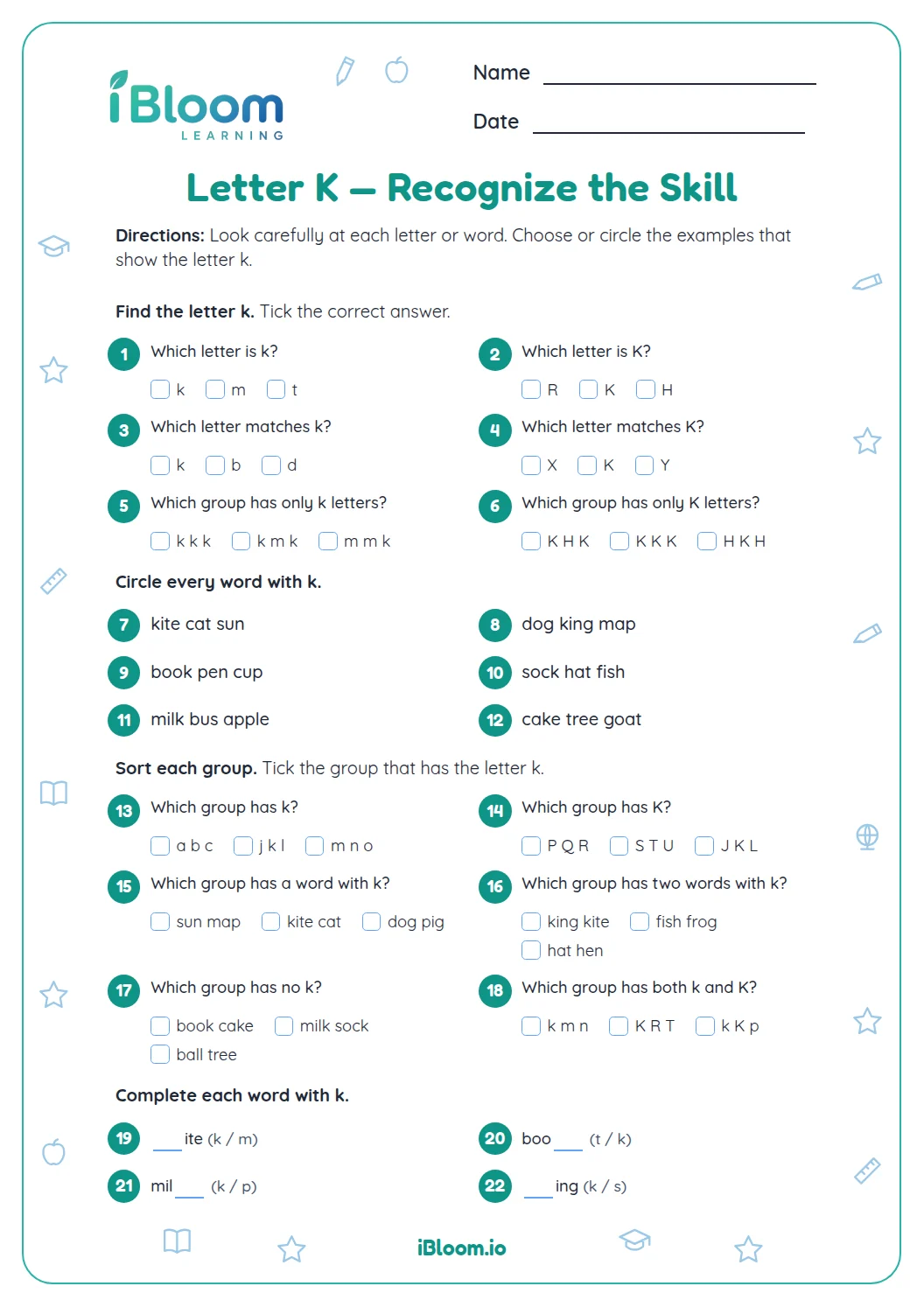
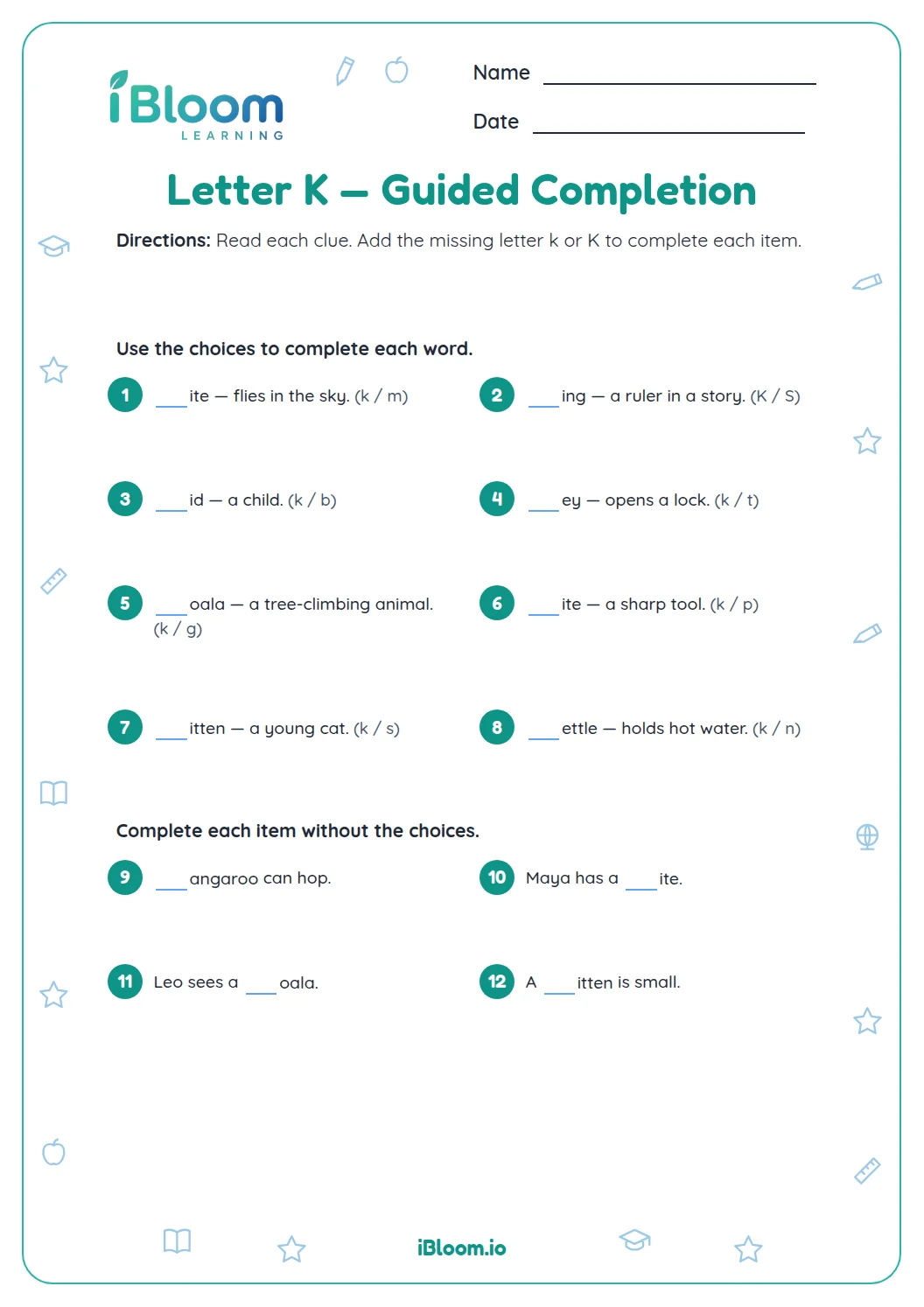
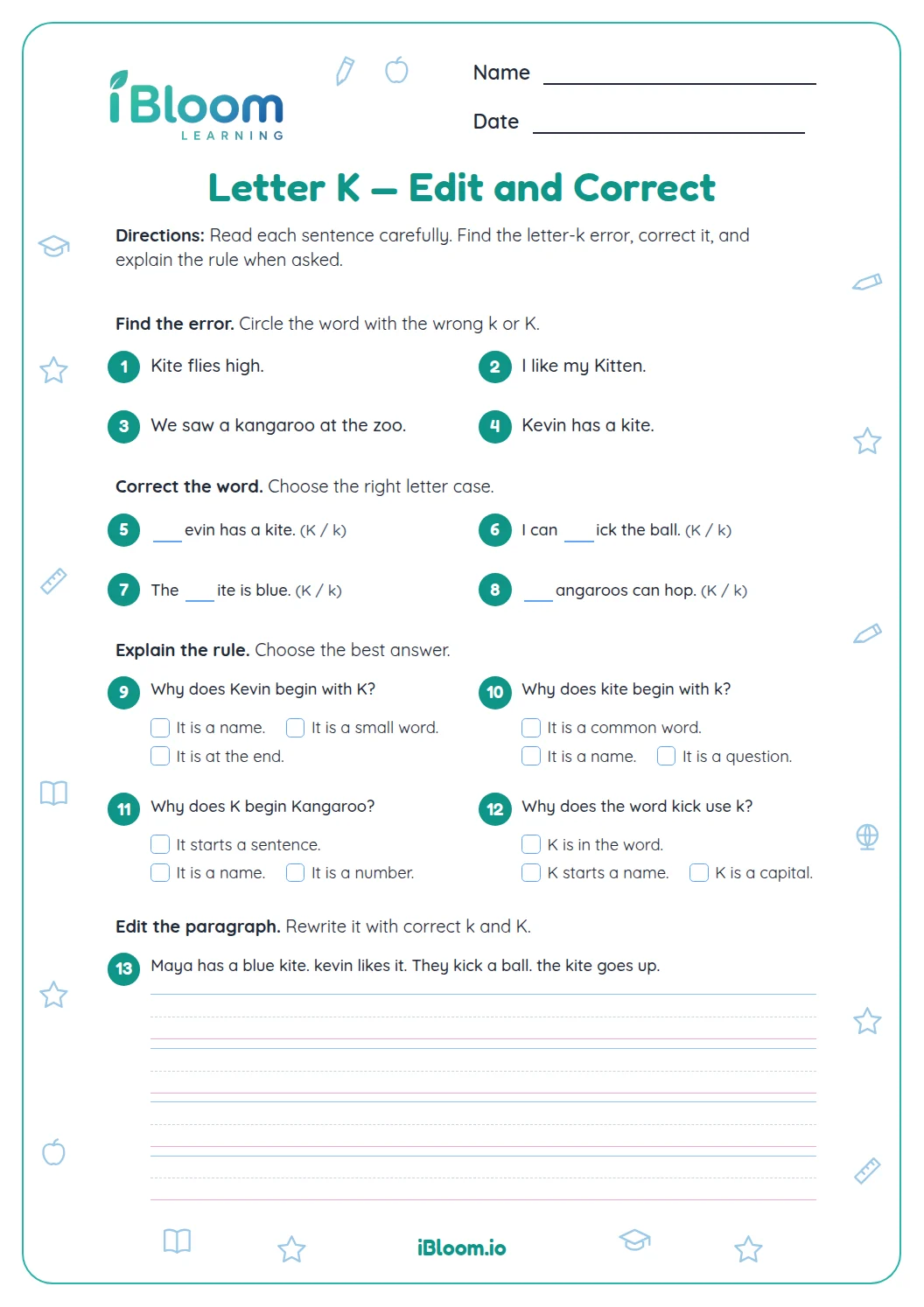
The sheet begins with an uppercase tracing prompt, then moves to letter-form and word recognition. Its 14 questions include uppercase and lowercase forms and short words with K at the beginning or end.
- Part A: uppercase and lowercase K
- Part B: Kk and short K words
- Part C: recognize a lowercase k and a word that begins with k
- Answer key gives the expected letters and choices
How to use this worksheet at home or in class
- 1Read the instruction and section heading before starting each part.
- 2Work through the first example together and name the steps aloud.
- 3Let the learner complete the next questions independently.
- 4Pause after each part to check that the answers make sense.
- 5Use the separate answer key to review; revisit any missed item with the worked steps.
Common mistakes and quick fixes
The mistake
Starting lowercase k at the baseline.
The fix
Start at the top line, move down, then add the angled strokes.
The mistake
Reversing the diagonal strokes.
The fix
After the tall line, make the short arm and leg meet at the middle.
The mistake
Confusing K and k in a word.
The fix
Check the tall straight stem and the two angled strokes.
Common Core alignment
This worksheet practices the following Common Core skills through its printed questions.
Print uppercase and lowercase forms of K.
On this sheet: Tracing and selecting K forms practices printing and recognizing an uppercase and lowercase letter.
Show the official wordingHide the official wording
Print all upper- and lowercase letters.
What to practice next
Make more practice
Further reading
Questions parents and teachers ask
Which forms of K does the sheet practice?
Children trace uppercase K, then identify lowercase k and the pair Kk. Later items ask them to recognize the letter in words and choices, including kite, kangaroo, and book. The answer key lists the letter or choice for each item.
How do children form uppercase K?
Begin at the top line and draw a tall straight stem. From around the middle, add one diagonal stroke toward the upper right and another toward the lower right. The tracing prompt gives a large model to follow. Say the letter name as you trace.
How is lowercase k different from uppercase K?
Lowercase k is shorter, but it still has a tall stem and two angled strokes that meet around the middle. Children compare the lowercase choice with uppercase K and the pair Kk in the recognition items. Look for the stem and both diagonals.
Why trace words as well as single letters?
Tracing builds familiarity with letter shapes, while finding K in words helps children notice it in print. This worksheet uses familiar examples such as kite, key, king, and book after the tracing prompt. These words give several places to spot K.
Is the answer key useful for handwriting questions?
The key shows the expected letter for the tracing prompt and the correct choice for recognition items. For handwriting, check whether K is recognizable and whether the child followed the model’s basic strokes. The key makes checking the expected form straightforward.