
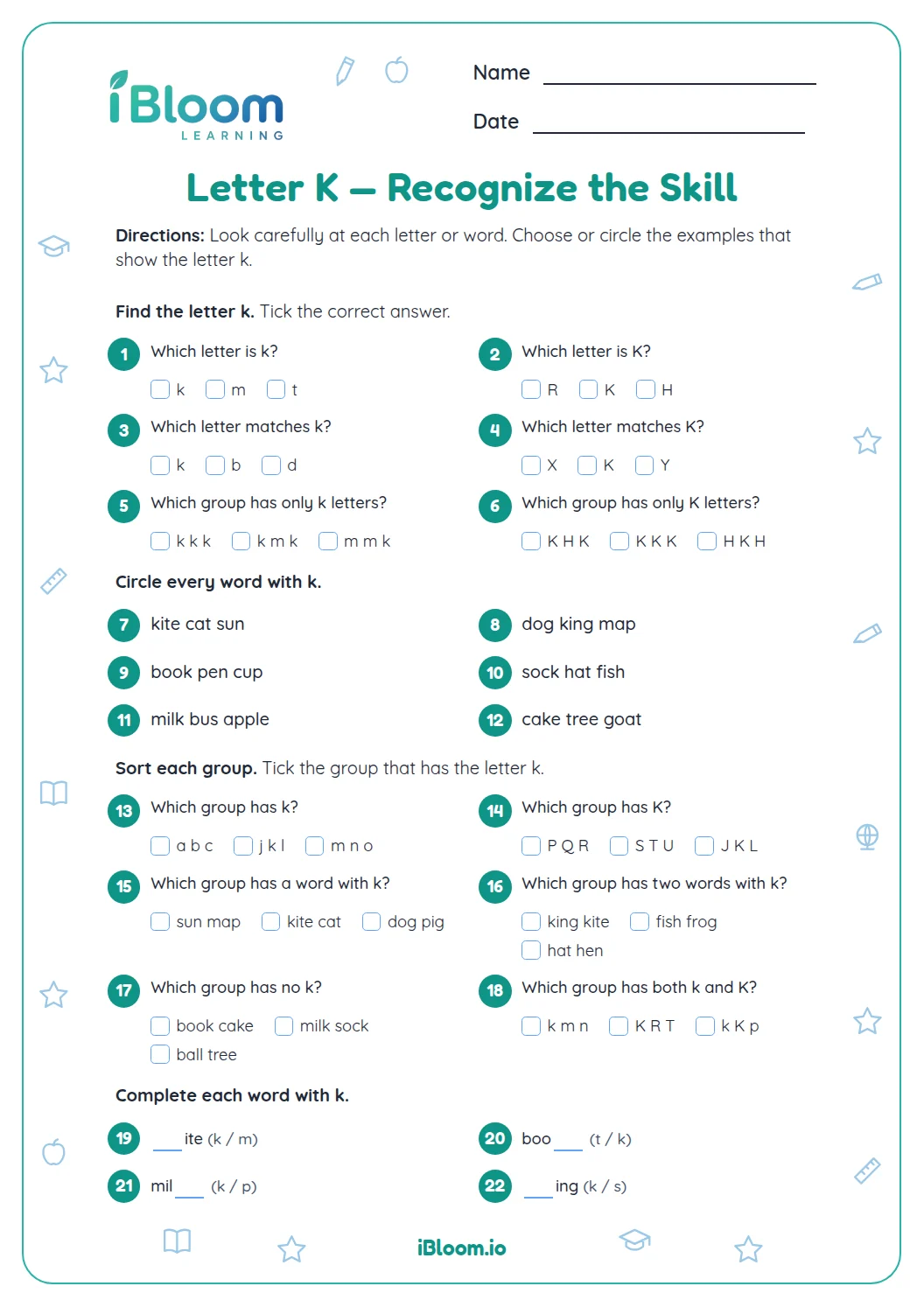
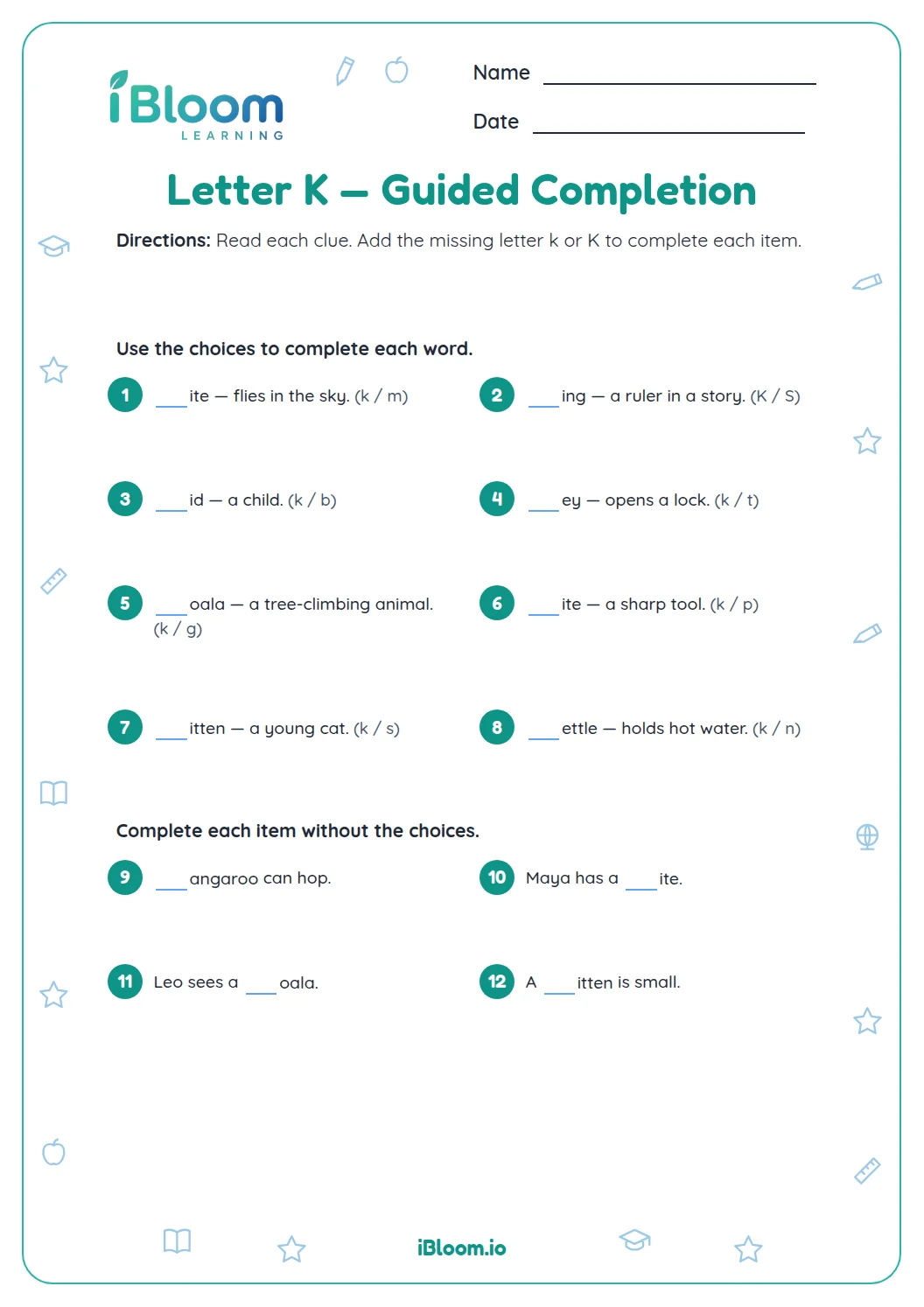
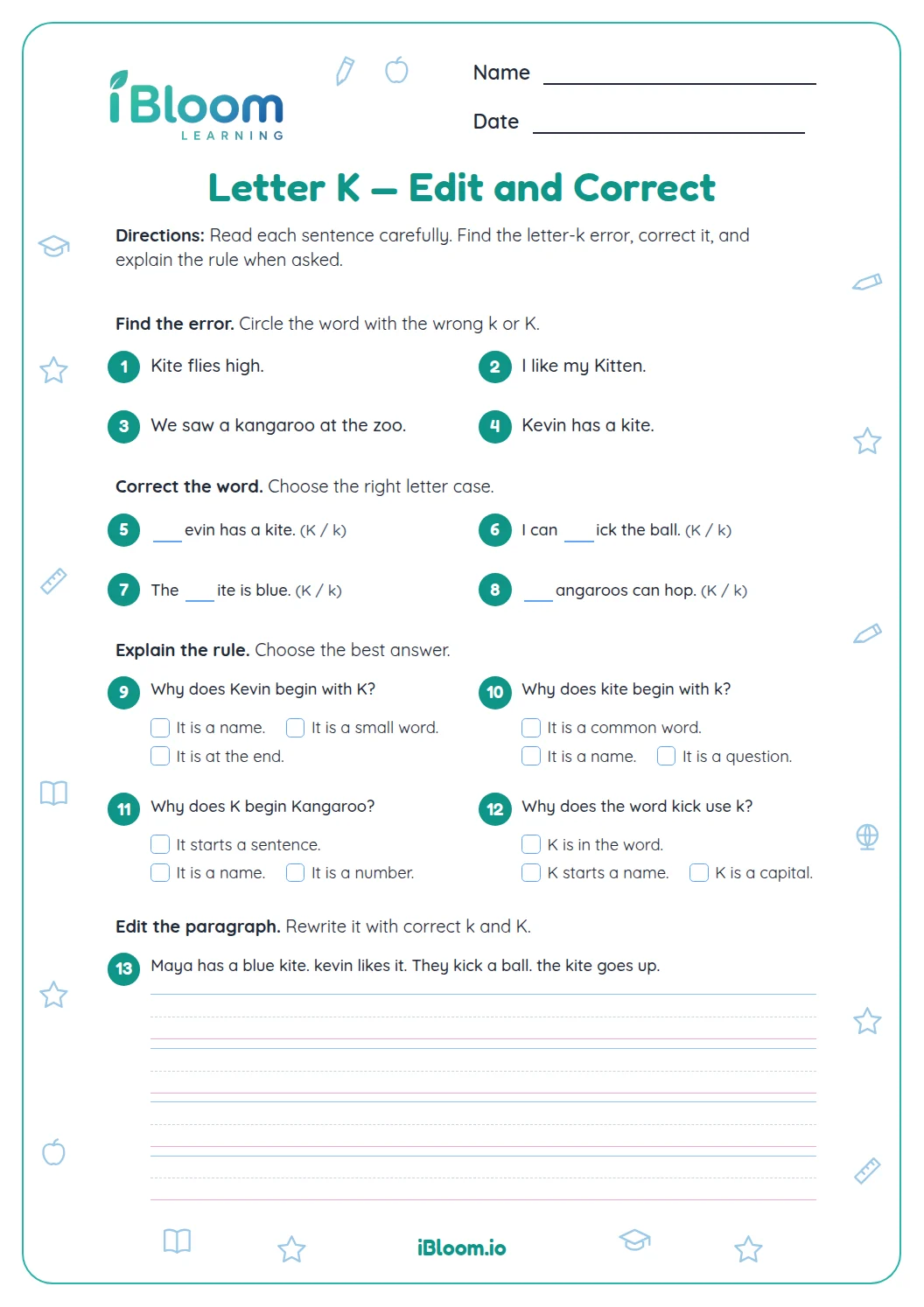




About this worksheet
This free Grade 1 printable gives children one trace activity for uppercase and lowercase K, followed by 13 choices about K words, complete thoughts, capitals, and end punctuation. It connects letter practice to short sentences such as “The kite is red.” The answer key includes the tracing model and the correct choices.
Aligned to CCSS.ELA-Literacy.L.1.1.a
What does this K worksheet include?
Part A is one tracing activity for K and k. Part B has 13 choices: some complete a K-word sentence, while others ask children to spot a complete sentence, a capital, or a period.
- Part A: Trace uppercase K and lowercase k.
- Part B: Choose K words and correct sentence examples.
- A separate answer key repeats the tracing model and lists the choices.
How can a child turn a K word into a sentence?
A complete sentence tells a whole thought. In “Kevin has a kite,” Kevin is the subject and “has a kite” completes the idea. A capital begins the sentence, and a period closes it.
- 1“The king by a gate” is not a complete thought. “The king sings” tells what the king does and ends with a period.
How can you check a sentence?
Read the choices aloud and ask whether each one tells a whole thought. “The small kittens” names something but leaves the reader waiting; “Kittens nap.” tells what they do. Check the first capital and ending mark too.
How to use this worksheet
- 1Trace the uppercase K once slowly, following each slanted line.
- 2Trace lowercase k and notice its tall line and two short strokes.
- 3Say each K word before tracing it.
- 4For a sentence prompt, say the whole sentence aloud before writing.
- 5Reread each sentence and check the capital and end punctuation.
Common mistakes and quick fixes
The mistake
Stopping at a word group such as “The small kittens.”
The fix
Ask who or what the sentence is about and what it does; add the missing idea.
The mistake
Writing lowercase k when a name begins the sentence.
The fix
Capitalize the first letter of a sentence and the first letter in a person’s name.
The mistake
Leaving off the final punctuation.
The fix
Read the sentence aloud, then add the mark that shows the thought is complete.
Common Core alignment
This worksheet gives focused practice printing uppercase and lowercase K.
Practice printing upper- and lowercase K.
On this sheet: Practice printing upper- and lowercase K.
Show the official wordingHide the official wording
Print all upper- and lowercase letters.
What to practice next
Make more practice
Further reading
Questions parents and teachers ask
What letters should my child trace?
The trace activity practices uppercase K and lowercase k. Children follow the printed model, then move into sentence choices that use familiar K words such as kitten, key, and kite. The answer key repeats the model so an adult can check the letter forms.
How many activities are on the worksheet?
There are 14 items across two parts: one tracing activity and 13 word or sentence choices. Part A traces K and k once. Part B asks children to choose K words and recognize complete sentences, capitals, and periods. on this page.
Does the answer key require the same sentence every time?
The answer key repeats the K k trace model. For the sentence choices, check whether the selected option tells a complete thought, begins with a capital where needed, and ends with punctuation when the prompt asks about a period. This keeps the key focused on the actual tasks.
How can I help with handwriting without doing it for my child?
Point to the first mark in the model and ask your child to trace slowly from left to right. For the sentence choices, let the child read both options aloud and explain which one tells a whole thought. Check capitals and end punctuation too.
What is the difference between uppercase K and lowercase k?
Uppercase K begins a sentence or a name such as Kevin or Kara. Lowercase k appears in ordinary words such as “kite” and “kind.” The trace model shows both forms, and several choices use K words in short sentences. The trace itself includes the uppercase and lowercase form.
Which skill can we practice next?
After tracing K and k, children can practice another letter or copy a simple sentence. The related Grade 1 handwriting pages continue letter practice, while sentence worksheets give more opportunities to write complete thoughts. The sibling links point to related letter worksheets.