




About this worksheet
This Grade 1 printable gives children repeated practice forming uppercase K and lowercase k, tracing familiar K words, and using those words in writing. The first part offers trace lines; the second moves from a word to complete sentences. Children work with kite, king, kitten, key and kind, then add their own examples. The practice supports legible letter formation in CCSS L.1.1.a, with sample responses in the answer key.
Aligned to L.1.1.a
What does this forming and using the letter K worksheet practice?
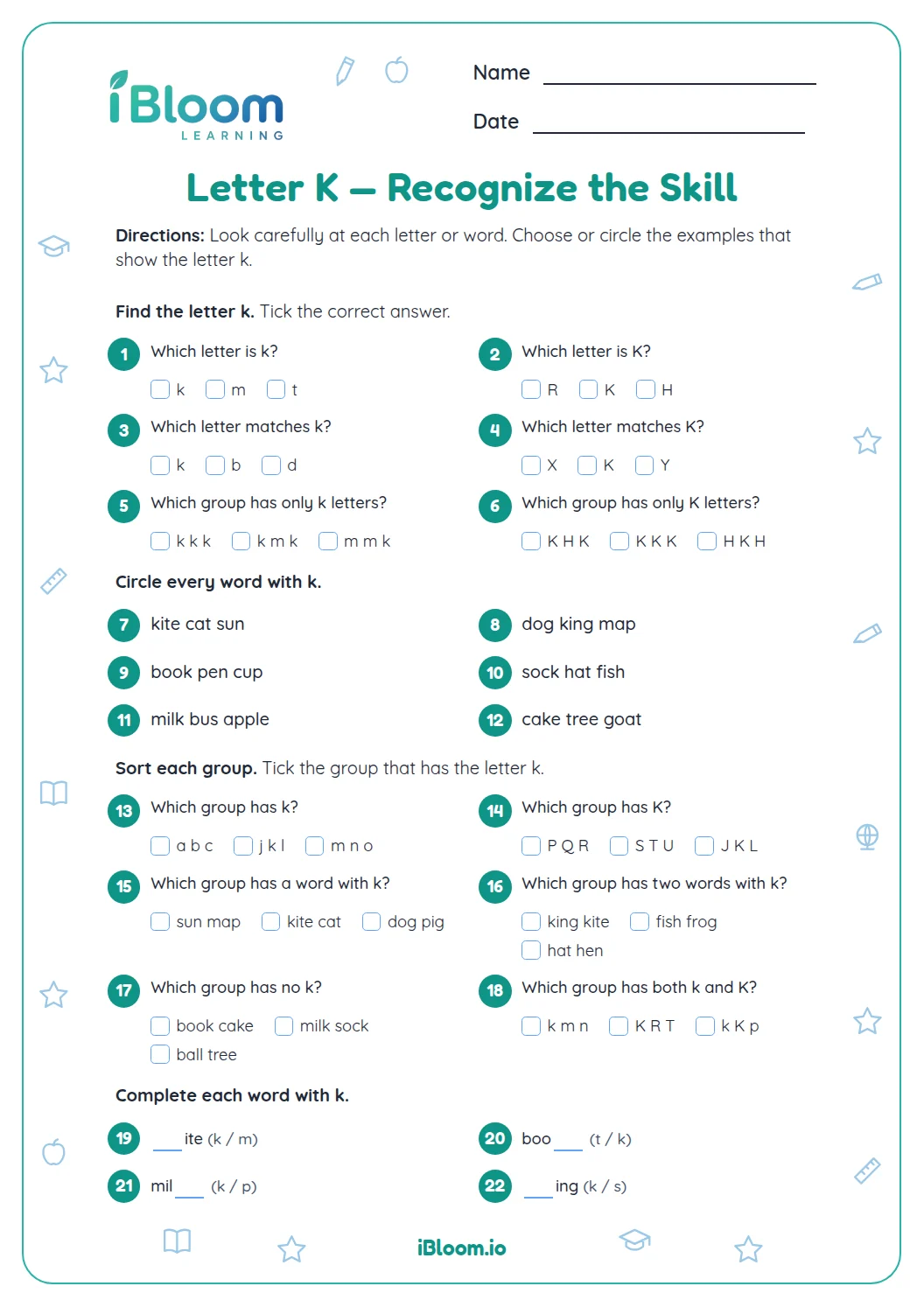
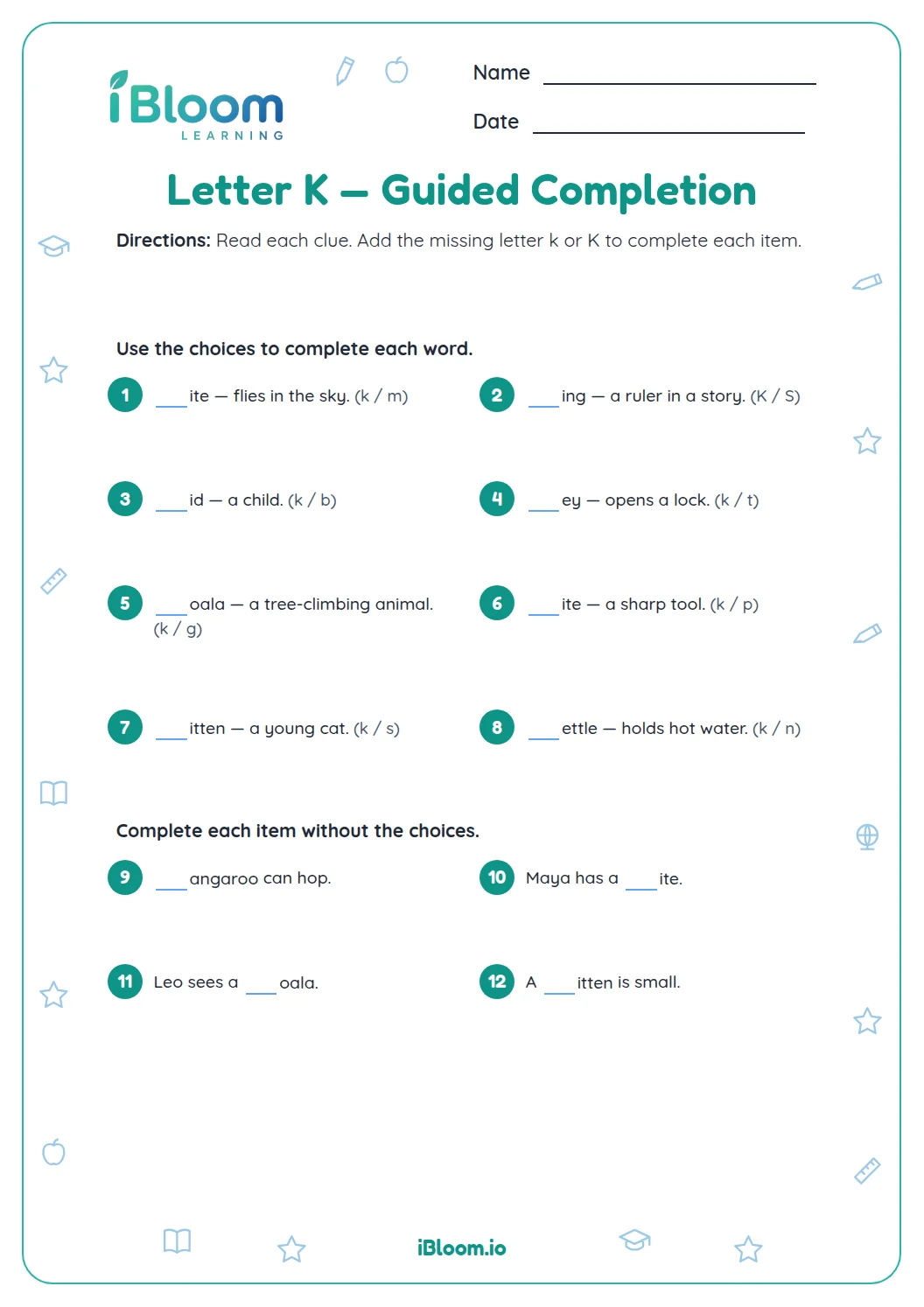
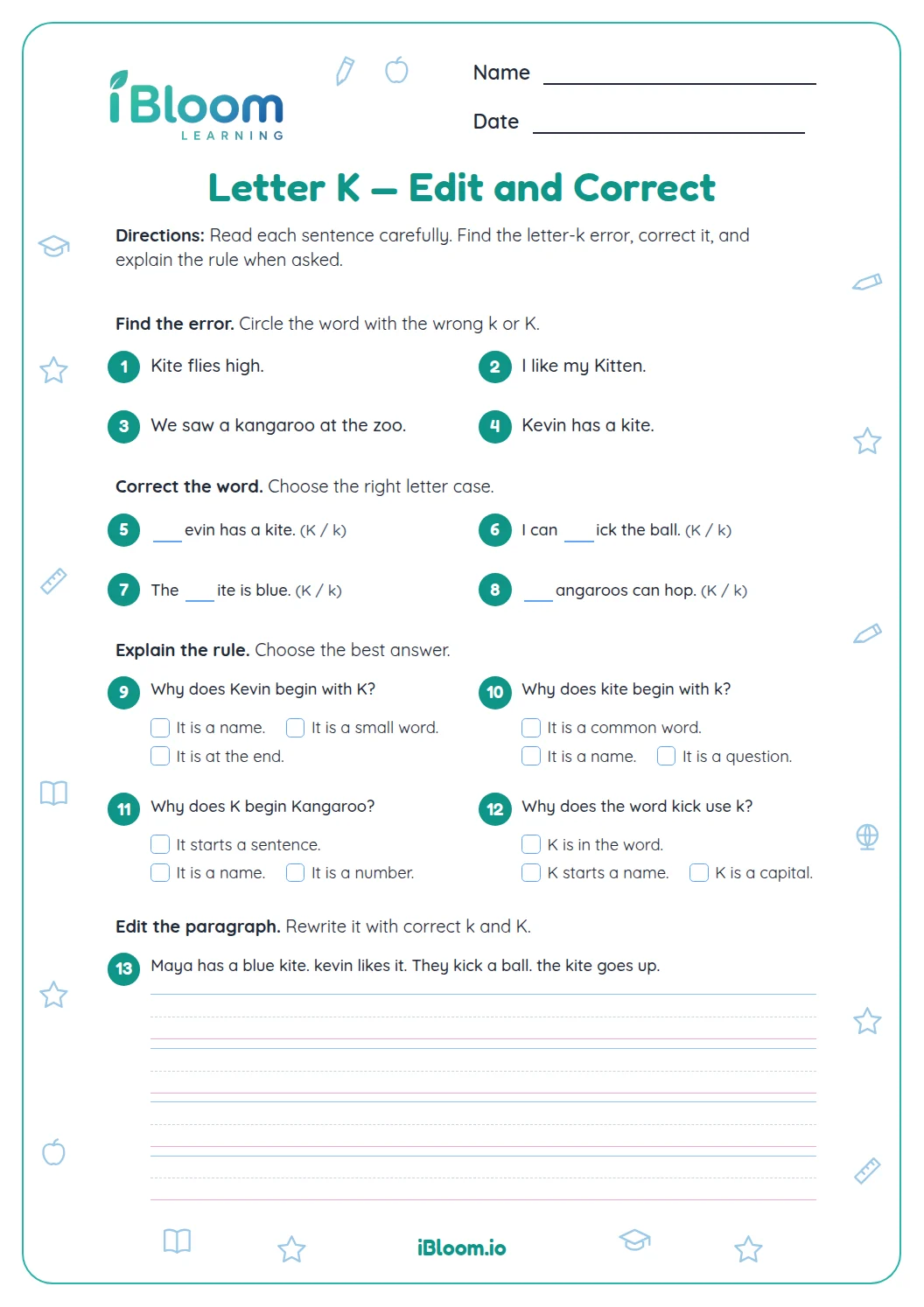
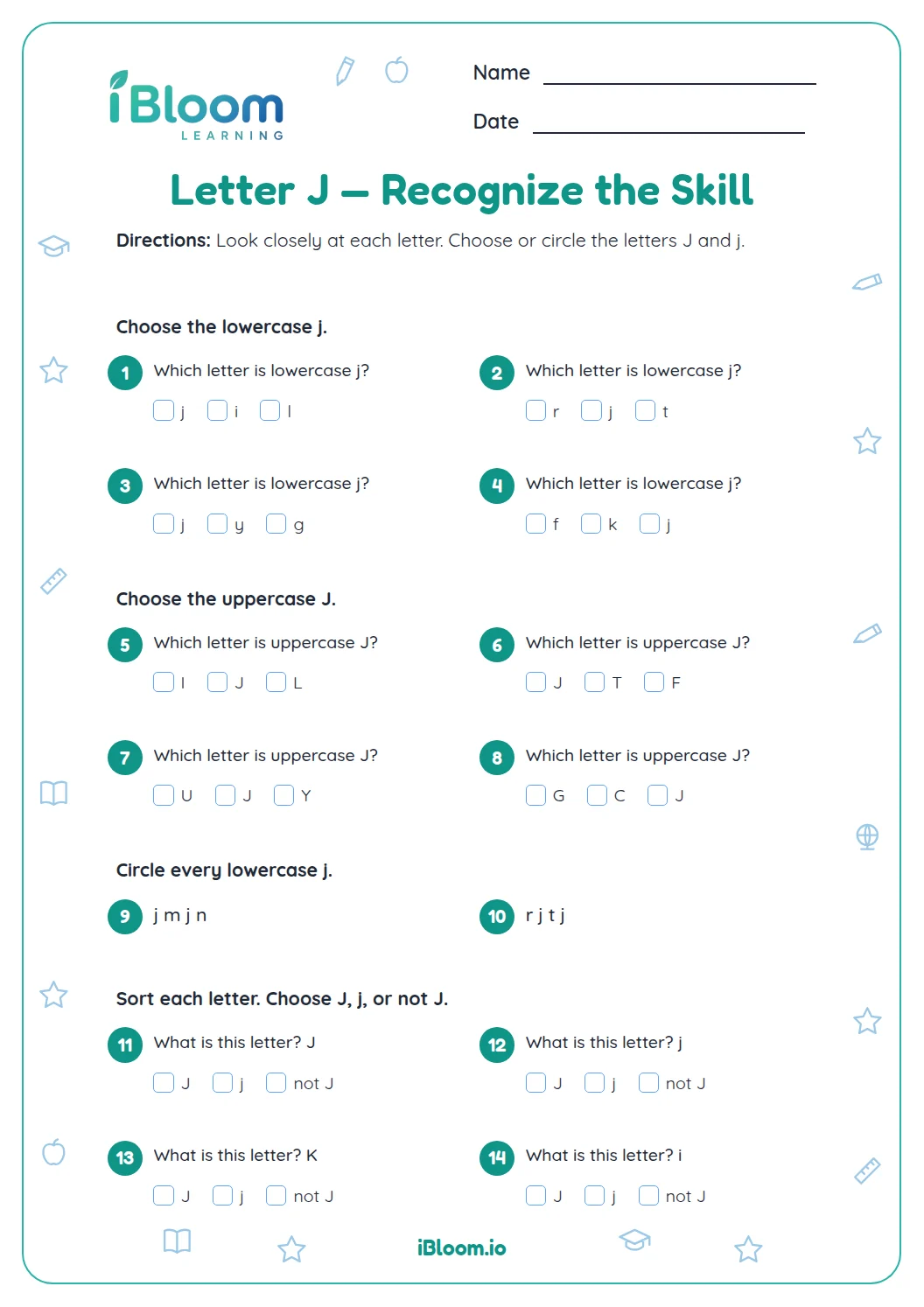
This four-page printable gives children guided practice tracing uppercase K, lowercase k and five K words. A later part asks them to recall K words and use supplied words in complete sentences.
The key shows tracing models and sample written responses.
How can a child work through forming and using the letter K?
Trace the straight stem, then make the two slanting strokes meet it at the middle. After tracing the word models, use a target word in a sentence with an uppercase first letter and a period.
- 1Trace K k, then write: “I see a kite in the sky.”
- 2Start the uppercase K with a straight line; add two slanting strokes from the middle.
How can an adult help without giving the answer?
Invite the child to trace slowly from left to right, keeping the stem straight. For sentence writing, check that the target word appears and the sentence begins with a capital letter.
How to use this worksheet
- 1Name the letter and say its sound before tracing.
- 2Trace uppercase K and lowercase k slowly on the line.
- 3Trace each model word, watching for the K at the beginning.
- 4Write a K word from memory in Part B.
- 5Use a complete thought when a prompt asks for a sentence.
- 6Check that K is formed clearly and the sentence begins with a capital.
Letter K writing mistakes and quick fixes
The mistake
Making the slanting strokes meet at the very top or bottom.
The fix
Keep the stem straight, then join both slanting strokes around the middle of K.
The mistake
Writing lowercase k like a capital K.
The fix
Use a shorter lowercase stem and add the small arm and leg from its middle.
The mistake
Leaving the K word out of the sentence.
The fix
Reread the prompt and point to the target word in the finished sentence.
Common Core alignment
The writing tasks support clear, legible letter formation in first-grade written work.
Form uppercase and lowercase letters legibly.
On this sheet: Part A traces both letter forms and K words; Part B applies the letter in written words and sentences.
Show the official wordingHide the official wording
Print all upper- and lowercase letters.
What to practice next
Make more practice
Further reading
Questions parents and teachers ask
Does this page teach uppercase K or lowercase k?
It practices both. The first trace item focuses on uppercase K, the second on lowercase k, and another line places both forms together. The words that follow begin with uppercase K because they start sentences or name the printed word.
Which K words do children trace?
Children trace kite, king, kitten, key and kind. These familiar words let them practice the letter at the start of a word before writing original responses in Part B. They can also name the picture or object each word describes as they trace.
What should a child do if the slanting lines look uneven?
Use the middle of the straight stem as a meeting point for the two slanting strokes. Move slowly and keep the letter tall enough to match the handwriting line. The trace models give repeated chances to practice the movement.
Are the sentence answers fixed?
No. The key gives sample sentences to show a complete response, but any sensible sentence using the target word can be accepted. The word prompts have short sample answers, and children may choose other words that begin with K.
Why write sentences after tracing?
Tracing supports the movement, while original writing asks children to recall the letter and use its word in context. The transition from tracing a word to writing a sentence connects handwriting practice with everyday written work and gives an adult a chance to check letter formation.
What can we practice next?
Move to Letter L or revisit Letter J, then try the general print-letters page for more forms. The linked Grade 1 letter tracing worksheets provide another focused practice page, while the letter practice generator can create a page for a letter that needs more work.